
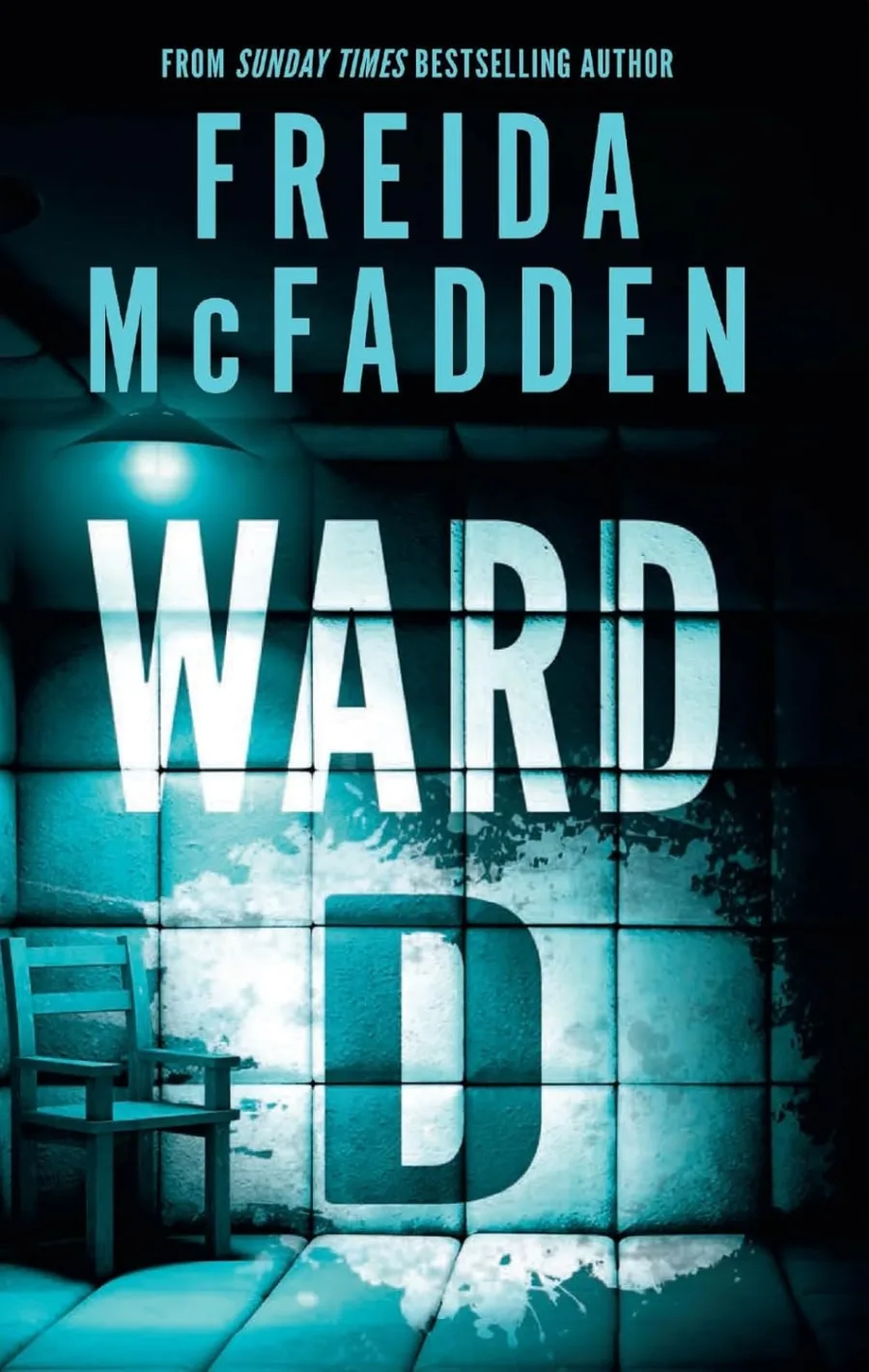
Ward D: A Taut Psychological Thriller from the Author of the sensational Housemaid series
Paperback
• 320 Pages
• ₹ 550.00
• English
• 9781464265488
No ratings yet
| Publisher | Poisoned Pen Press |
|---|---|
| ISBN13 | 9781464265488 |
| ASIN/SKU | 1464265488 |
| Book Format | Paperback |
| Language | English |
| Pages | 320 |
| List Price | ₹ 550.00 |
| Publishing Date | 14/05/2025 |
| Dimensions | 12.9 x 1 x 19.8 cm |
| Weight | 200 g |
| Book Code | BD00055089 |
Buy this Book
Amazon Stores
Ebook Stores
Other Stores
Discover Ward D: A Taut Psychological Thriller from the Author of the sensational Housemaid series by Freida McFadden. This book is published by Poisoned Pen Press in Paperback format, ISBN 9781464265488, ASIN 1464265488, under Literature and Fiction, Crime, Thriller and Mystery.
Book Description
TIKTOK SENSATION!
#1 Sunday Times and n bestselling author Freida McFadden returns with Ward D: a gripping locked room thriller set in an eerie hospital ward.
Medical student Amy Brenner is spending the night on a locked psychiatric ward. All she has to do is make it through the night shift...
Ward D is the hospital’s mental health unit and as a medical student, Amy is required to gain experience on the floor. But little do her colleagues know it may force her to confront a past she’s fought hard to forget.
The night starts. The countdown begins.
As the hours tick by, Amy grows increasingly convinced something terrible is happening within the ward’s tightly secured walls. When patients and staff start to vanish without a trace, it becomes clear that everyone on the unit is in grave danger.
Amy never wanted to spend the night on Ward D. Now, she might not make it out alive.
Ward D once again demonstrates why Freida McFadden is the most talked-about voice in contemporary crime fiction, delivering a taut psychological thriller that will have you gripped right to the thrilling final twist.
Tropes
Claustrophobic
Thriller
Psychological
Locked Room
Mystery Thriller
Suspense Thriller
Survive the Night
Also by Freida McFadden:
The Crash
The Boyfriend
The Housemaid
The Housemaid's Secret
The Housemaid is Watching
The Coworker
The Locker Door
Never Lie
The Teacher
The Inmate
#1 Sunday Times and n bestselling author Freida McFadden returns with Ward D: a gripping locked room thriller set in an eerie hospital ward.
Medical student Amy Brenner is spending the night on a locked psychiatric ward. All she has to do is make it through the night shift...
Ward D is the hospital’s mental health unit and as a medical student, Amy is required to gain experience on the floor. But little do her colleagues know it may force her to confront a past she’s fought hard to forget.
The night starts. The countdown begins.
As the hours tick by, Amy grows increasingly convinced something terrible is happening within the ward’s tightly secured walls. When patients and staff start to vanish without a trace, it becomes clear that everyone on the unit is in grave danger.
Amy never wanted to spend the night on Ward D. Now, she might not make it out alive.
Ward D once again demonstrates why Freida McFadden is the most talked-about voice in contemporary crime fiction, delivering a taut psychological thriller that will have you gripped right to the thrilling final twist.
Tropes
Claustrophobic
Thriller
Psychological
Locked Room
Mystery Thriller
Suspense Thriller
Survive the Night
Also by Freida McFadden:
The Crash
The Boyfriend
The Housemaid
The Housemaid's Secret
The Housemaid is Watching
The Coworker
The Locker Door
Never Lie
The Teacher
The Inmate
Author Biography
#1 New York Times, Amazon Charts, USA Today, Washington Post, Wall Street Journal, Sunday Times, and Publisher's Weekly bestselling author Freida McFadden is a physician who has penned multiple bestselling psychological thrillers and medical humor novels. Freida is the winner of the International Thriller Writer Award for Best Paperback Original, the Goodreads Choice Award for Best Thriller, and was honored as one of TIME 100’s most influential people in the world for 2026. Her novels have been translated into more than 45 languages.
Freida lives with her family and cat in a centuries-old three-story home overlooking the ocean, with staircases that creak and moan with each step, and nobody could hear you if you scream. Unless you scream really loudly, maybe.
To hear Freida talk about herself more in the third person, check out her website freidamcfadden dot com
Freida lives with her family and cat in a centuries-old three-story home overlooking the ocean, with staircases that creak and moan with each step, and nobody could hear you if you scream. Unless you scream really loudly, maybe.
To hear Freida talk about herself more in the third person, check out her website freidamcfadden dot com
Editorial Reviews
Editorial Reviews will be added soon…
Book Summary
Ward D by Freida McFadden is a claustrophobic psychological thriller built around a deceptively simple challenge: a young medical student must survive one night inside a locked psychiatric ward. The novel combines mystery, psychological suspense, buried trauma, shifting perceptions, and a rapidly escalating sense of danger. Rather than giving its protagonist an open landscape in which to investigate a crime, McFadden confines her to a secured hospital unit where escape is difficult and almost everyone around her could have something to hide. The result is a tense story in which the walls of the ward become as threatening as the people inside them.
The protagonist is Amy Brenner, a third-year medical student completing her psychiatry rotation. On the surface, Amy appears responsible, intelligent, hardworking, and eager to succeed. She is the sort of student who follows instructions and tries to avoid conflict. Yet her assignment to Ward D awakens a fear she has carried for years. The psychiatric unit is not unfamiliar territory to her. When she was sixteen, she visited the same ward because her childhood best friend, Jade Carpenter, had been admitted there after a disturbing mental-health crisis. That experience left Amy with memories she has never completely managed to put behind her.
Now Amy must return to the ward as part of her medical training. She knows that the overnight assignment is supposed to be routine. She is expected to observe patients, learn from the staff, and complete her responsibilities before morning. But Amy has private reasons for dreading the shift—reasons she has deliberately kept hidden from the people around her.
From the moment she enters Ward D, the atmosphere is unsettling. The unit is tightly secured, and ordinary freedoms are restricted. Doors are locked, procedures are strict, and Amy understands that she cannot simply leave whenever she wants. This creates the novel's central locked-room atmosphere. The reader knows that something is wrong, but the protagonist has very little room in which to escape or seek help.
Amy's anxiety is intensified by the people she encounters. Among them is her former boyfriend, Cameron Berger, who is also a medical student. Their reunion is uncomfortable because Cameron ended their relationship partly to concentrate on his own ambitions and upcoming board examination. His presence adds another layer of emotional tension to an already stressful night.
Yet Cameron is only one part of Amy's unease. The deeper problem is that Ward D forces her to confront the past she has spent years trying to forget. Her memories of Jade return with increasing intensity, making it difficult for Amy to determine where memory ends and present danger begins.
Jade is particularly important to the story. She and Amy were childhood friends, but their lives eventually moved in radically different directions. Their friendship is associated with a traumatic episode from adolescence, and Amy has carried complicated feelings of guilt and fear ever since. Returning to Ward D brings those emotions back to the surface.
The novel's psychological tension grows because Amy is not completely confident in her own perceptions. She sees and remembers things that make her question what is actually happening. Her fear is not simply that someone else may be dangerous; she also worries about whether her own mind can be trusted.
This uncertainty is one of McFadden's most effective suspense mechanisms. In a conventional thriller, readers may wonder who the killer is. In Ward D, they are also encouraged to wonder whether the protagonist is interpreting events correctly. Is she witnessing something genuinely sinister? Is someone deliberately manipulating her? Are her memories accurate? Or is her fear causing her to connect unrelated events?
As the night progresses, strange events begin occurring inside the ward. Patients and staff start disappearing, and what initially seems like an unsettling coincidence becomes increasingly impossible to ignore. The official security of Ward D suddenly feels inadequate. A place designed to protect vulnerable patients becomes a place in which nobody seems entirely safe.
The disappearances transform Amy's assignment into a fight for survival. She can no longer think only about completing her medical rotation. She has to understand what is happening before she becomes another victim.
One of the novel's strengths is its use of time pressure. The story unfolds over a single night, which means that Amy cannot simply walk away and reconsider the situation the following day. Every passing hour brings her closer either to discovering the truth or to becoming trapped in something she cannot control.
The hospital setting also creates a powerful contrast. Hospitals are normally associated with healing, safety, and professional care. Ward D, however, becomes an environment of uncertainty. The locked doors that are supposed to protect people can also prevent them from escaping. Medical authority can offer reassurance, but it can also make Amy question whether the people in charge are telling her everything.
McFadden uses this tension to explore trust. Amy must decide whom she can believe while surrounded by people whose motives are not immediately clear. Her medical training tells her to observe carefully and rely on evidence, but fear makes objective judgment increasingly difficult.
Her relationship with Jade is central to this question of trust. The two women share a history that cannot easily be reduced to simple categories of victim and villain. Their past contains friendship, resentment, fear, and unresolved emotional wounds. As Amy learns more about what happened years earlier, she is forced to reconsider her understanding of the person she once knew so well.
The novel also examines the psychological consequences of childhood experiences. Amy's present-day personality has been shaped by her desire to be responsible and successful, but beneath that controlled exterior lies unresolved anxiety. Her return to Ward D demonstrates how easily old trauma can resurface when a person encounters a place or situation associated with it.
This makes Amy an interesting protagonist because her greatest struggle is both external and internal. Externally, she faces an increasingly dangerous situation inside the hospital. Internally, she must confront memories and fears that have influenced her for years.
The book's medical setting reflects McFadden's professional background as a physician, while the story itself remains firmly focused on suspense rather than medical instruction. The hospital environment provides realistic details that help establish the atmosphere of the novel, while the locked psychiatric ward gives the thriller a particularly confined and unsettling setting.
Another important theme is the fragile boundary between sanity and perception. Because the story takes place in a psychiatric unit, questions about mental health naturally become part of the narrative. Amy's own uncertainty about what she sees creates an uncomfortable reversal: the person who is supposed to be observing patients begins to question her own perceptions.
This device allows McFadden to play with the reader's expectations. A character may appear trustworthy but later seem suspicious. An event may initially appear supernatural or impossible but receive another explanation. A memory that seems certain may turn out to contain gaps or distortions. The reader is therefore encouraged to remain suspicious of every apparent certainty.
At the same time, the novel deals with the danger of judging people too quickly. Ward D contains patients with complicated histories, but the story demonstrates that a person's diagnosis or institutional status does not automatically explain everything about them. The thriller deliberately uses the atmosphere of the psychiatric ward to generate fear, although some of its depictions of mental illness rely on familiar thriller conventions.
As the mystery develops, Amy gradually realizes that the danger surrounding her is connected to her past. The night is not merely an unfortunate coincidence. Her history with Jade becomes increasingly important to understanding what is happening inside Ward D.
The tension ultimately comes from the convergence of past and present. Amy entered the ward hoping simply to complete an unpleasant medical assignment. Instead, she finds herself revisiting the most disturbing chapter of her adolescence while simultaneously facing a new threat.
This structure allows the novel to move between psychological mystery and survival thriller. The reader wants to know what is happening in the ward, but also wants to understand what happened to Amy and Jade years earlier. Each revelation about the past changes the way the present is understood.
McFadden's pacing is deliberately quick. Short chapters, escalating danger, suspicious behavior, and unanswered questions keep the narrative moving. The story is designed to encourage readers to continue from one chapter to the next because each new discovery raises another question.
The atmosphere is especially effective because the setting cannot easily be escaped. A character trapped in a large house can potentially find a window or another exit. In Ward D, security measures are part of the environment itself. The locked doors, restricted movement, and limited access to the outside world make every threat feel more immediate.
The ward therefore functions almost like another character in the story. It is enclosed, unfamiliar, and difficult to read. Every corridor and locked door contributes to the sense that Amy is being watched or contained.
At its deeper level, Ward D is a story about the past refusing to remain buried. Amy has built a respectable adult life around the belief that she has moved beyond what happened when she was sixteen. But returning to the place associated with that trauma proves that forgetting something is not the same as resolving it.
The novel also asks how well we really know the people closest to us. Childhood friendships can change, memories can become distorted, and people can conceal aspects of themselves for years. Amy's relationship with Jade demonstrates how difficult it can be to separate the person someone once was from the person they have become.
Ultimately, Ward D is a tightly confined psychological thriller in which the traditional question of “Who can be trusted?” becomes intertwined with a more unsettling question: Can Amy trust herself?
The novel's appeal lies in its combination of a threatening setting, a vulnerable protagonist, a disturbing personal history, and a mystery that unfolds over a single night. Amy enters Ward D expecting an uncomfortable assignment and instead finds herself caught in a nightmare involving disappearing people, hidden motives, and memories she would rather forget.
By bringing together medical drama, psychological suspense, locked-room mystery, and survival-thriller elements, Freida McFadden creates a story designed to keep readers guessing until its final revelations. Ward D ultimately suggests that the most frightening places are not always those filled with obvious danger. Sometimes the most terrifying place is one that forces us to confront the memories, fears, and uncertainties we have spent years trying to escape.
The protagonist is Amy Brenner, a third-year medical student completing her psychiatry rotation. On the surface, Amy appears responsible, intelligent, hardworking, and eager to succeed. She is the sort of student who follows instructions and tries to avoid conflict. Yet her assignment to Ward D awakens a fear she has carried for years. The psychiatric unit is not unfamiliar territory to her. When she was sixteen, she visited the same ward because her childhood best friend, Jade Carpenter, had been admitted there after a disturbing mental-health crisis. That experience left Amy with memories she has never completely managed to put behind her.
Now Amy must return to the ward as part of her medical training. She knows that the overnight assignment is supposed to be routine. She is expected to observe patients, learn from the staff, and complete her responsibilities before morning. But Amy has private reasons for dreading the shift—reasons she has deliberately kept hidden from the people around her.
From the moment she enters Ward D, the atmosphere is unsettling. The unit is tightly secured, and ordinary freedoms are restricted. Doors are locked, procedures are strict, and Amy understands that she cannot simply leave whenever she wants. This creates the novel's central locked-room atmosphere. The reader knows that something is wrong, but the protagonist has very little room in which to escape or seek help.
Amy's anxiety is intensified by the people she encounters. Among them is her former boyfriend, Cameron Berger, who is also a medical student. Their reunion is uncomfortable because Cameron ended their relationship partly to concentrate on his own ambitions and upcoming board examination. His presence adds another layer of emotional tension to an already stressful night.
Yet Cameron is only one part of Amy's unease. The deeper problem is that Ward D forces her to confront the past she has spent years trying to forget. Her memories of Jade return with increasing intensity, making it difficult for Amy to determine where memory ends and present danger begins.
Jade is particularly important to the story. She and Amy were childhood friends, but their lives eventually moved in radically different directions. Their friendship is associated with a traumatic episode from adolescence, and Amy has carried complicated feelings of guilt and fear ever since. Returning to Ward D brings those emotions back to the surface.
The novel's psychological tension grows because Amy is not completely confident in her own perceptions. She sees and remembers things that make her question what is actually happening. Her fear is not simply that someone else may be dangerous; she also worries about whether her own mind can be trusted.
This uncertainty is one of McFadden's most effective suspense mechanisms. In a conventional thriller, readers may wonder who the killer is. In Ward D, they are also encouraged to wonder whether the protagonist is interpreting events correctly. Is she witnessing something genuinely sinister? Is someone deliberately manipulating her? Are her memories accurate? Or is her fear causing her to connect unrelated events?
As the night progresses, strange events begin occurring inside the ward. Patients and staff start disappearing, and what initially seems like an unsettling coincidence becomes increasingly impossible to ignore. The official security of Ward D suddenly feels inadequate. A place designed to protect vulnerable patients becomes a place in which nobody seems entirely safe.
The disappearances transform Amy's assignment into a fight for survival. She can no longer think only about completing her medical rotation. She has to understand what is happening before she becomes another victim.
One of the novel's strengths is its use of time pressure. The story unfolds over a single night, which means that Amy cannot simply walk away and reconsider the situation the following day. Every passing hour brings her closer either to discovering the truth or to becoming trapped in something she cannot control.
The hospital setting also creates a powerful contrast. Hospitals are normally associated with healing, safety, and professional care. Ward D, however, becomes an environment of uncertainty. The locked doors that are supposed to protect people can also prevent them from escaping. Medical authority can offer reassurance, but it can also make Amy question whether the people in charge are telling her everything.
McFadden uses this tension to explore trust. Amy must decide whom she can believe while surrounded by people whose motives are not immediately clear. Her medical training tells her to observe carefully and rely on evidence, but fear makes objective judgment increasingly difficult.
Her relationship with Jade is central to this question of trust. The two women share a history that cannot easily be reduced to simple categories of victim and villain. Their past contains friendship, resentment, fear, and unresolved emotional wounds. As Amy learns more about what happened years earlier, she is forced to reconsider her understanding of the person she once knew so well.
The novel also examines the psychological consequences of childhood experiences. Amy's present-day personality has been shaped by her desire to be responsible and successful, but beneath that controlled exterior lies unresolved anxiety. Her return to Ward D demonstrates how easily old trauma can resurface when a person encounters a place or situation associated with it.
This makes Amy an interesting protagonist because her greatest struggle is both external and internal. Externally, she faces an increasingly dangerous situation inside the hospital. Internally, she must confront memories and fears that have influenced her for years.
The book's medical setting reflects McFadden's professional background as a physician, while the story itself remains firmly focused on suspense rather than medical instruction. The hospital environment provides realistic details that help establish the atmosphere of the novel, while the locked psychiatric ward gives the thriller a particularly confined and unsettling setting.
Another important theme is the fragile boundary between sanity and perception. Because the story takes place in a psychiatric unit, questions about mental health naturally become part of the narrative. Amy's own uncertainty about what she sees creates an uncomfortable reversal: the person who is supposed to be observing patients begins to question her own perceptions.
This device allows McFadden to play with the reader's expectations. A character may appear trustworthy but later seem suspicious. An event may initially appear supernatural or impossible but receive another explanation. A memory that seems certain may turn out to contain gaps or distortions. The reader is therefore encouraged to remain suspicious of every apparent certainty.
At the same time, the novel deals with the danger of judging people too quickly. Ward D contains patients with complicated histories, but the story demonstrates that a person's diagnosis or institutional status does not automatically explain everything about them. The thriller deliberately uses the atmosphere of the psychiatric ward to generate fear, although some of its depictions of mental illness rely on familiar thriller conventions.
As the mystery develops, Amy gradually realizes that the danger surrounding her is connected to her past. The night is not merely an unfortunate coincidence. Her history with Jade becomes increasingly important to understanding what is happening inside Ward D.
The tension ultimately comes from the convergence of past and present. Amy entered the ward hoping simply to complete an unpleasant medical assignment. Instead, she finds herself revisiting the most disturbing chapter of her adolescence while simultaneously facing a new threat.
This structure allows the novel to move between psychological mystery and survival thriller. The reader wants to know what is happening in the ward, but also wants to understand what happened to Amy and Jade years earlier. Each revelation about the past changes the way the present is understood.
McFadden's pacing is deliberately quick. Short chapters, escalating danger, suspicious behavior, and unanswered questions keep the narrative moving. The story is designed to encourage readers to continue from one chapter to the next because each new discovery raises another question.
The atmosphere is especially effective because the setting cannot easily be escaped. A character trapped in a large house can potentially find a window or another exit. In Ward D, security measures are part of the environment itself. The locked doors, restricted movement, and limited access to the outside world make every threat feel more immediate.
The ward therefore functions almost like another character in the story. It is enclosed, unfamiliar, and difficult to read. Every corridor and locked door contributes to the sense that Amy is being watched or contained.
At its deeper level, Ward D is a story about the past refusing to remain buried. Amy has built a respectable adult life around the belief that she has moved beyond what happened when she was sixteen. But returning to the place associated with that trauma proves that forgetting something is not the same as resolving it.
The novel also asks how well we really know the people closest to us. Childhood friendships can change, memories can become distorted, and people can conceal aspects of themselves for years. Amy's relationship with Jade demonstrates how difficult it can be to separate the person someone once was from the person they have become.
Ultimately, Ward D is a tightly confined psychological thriller in which the traditional question of “Who can be trusted?” becomes intertwined with a more unsettling question: Can Amy trust herself?
The novel's appeal lies in its combination of a threatening setting, a vulnerable protagonist, a disturbing personal history, and a mystery that unfolds over a single night. Amy enters Ward D expecting an uncomfortable assignment and instead finds herself caught in a nightmare involving disappearing people, hidden motives, and memories she would rather forget.
By bringing together medical drama, psychological suspense, locked-room mystery, and survival-thriller elements, Freida McFadden creates a story designed to keep readers guessing until its final revelations. Ward D ultimately suggests that the most frightening places are not always those filled with obvious danger. Sometimes the most terrifying place is one that forces us to confront the memories, fears, and uncertainties we have spent years trying to escape.
Sample Chapters
Sample Chapters will be added soon…
Reader Reviews
No reviews yet.
Ward D: A Taut Psychological Thriller from the Author of the sensational Housemaid series
Download Cover Image
Do you want to download the full cover image for Ward D: A Taut Psychological Thriller from the Author of the sensational Housemaid series?