
Anxious People: The No. 1 New York Times Bestseller, Now a Netflix TV Series
Paperback
• 416 Pages
• ₹ 499.00
• English
• 9781405930253
No ratings yet
| Publisher | Penguin |
|---|---|
| ISBN13 | 9781405930253 |
| ASIN/SKU | 140593025X |
| Book Format | Paperback |
| Language | English |
| Pages | 416 |
| List Price | ₹ 499.00 |
| Publishing Date | 19/08/2021 |
| Dimensions | 12.9 x 2.6 x 19.8 cm |
| Weight | 287 Grams |
| Book Code | BD00055087 |
Buy this Book
Amazon Stores
Ebook Stores
Other Stores
Discover Anxious People: The No. 1 New York Times Bestseller, Now a Netflix TV Series by Fredrik Backman. This book is published by Penguin in Paperback format, ISBN 9781405930253, ASIN 140593025X, under Literature and Fiction, Humour, Crime Fiction.
Book Description
The funny, touching and unpredictable No. 1 New York Times bestseller, now a major Netflix TV series
'A brilliant and comforting read' MATT HAIG
'Funny, compassionate and wise. An absolute joy' A.J. PEARCE
'A surefooted insight into the absurdity, beauty and ache of life' GUARDIAN
'I laughed, I sobbed, I recommended it to literally everyone I know' BUZZFEED
'Captures the messy essence of being human' WASHINGTON POST
From the 18 million copy internationally bestselling author of A Man Called Ove
It's New Year's Eve and House Tricks estate agents are hosting an open viewing in an up-market apartment when an incompetent bank robber rushes in and politely takes everyone hostage.
For Anna-Lena and Roger, busy buying-up apartments to fill the hole in their marriage, it's something else to talk about.
For Julia and Ro, panicky parents-to-be, it's yet another worry.
Lonely bank manager Zara only came here for the view.
While 87-year-old grandmother Estelle seems rather pleased by the company . . .
As the police gather outside, the anxious strangers huddled within try to make the best of a very sticky situation - but could it be that they have a whole lot more in common than meets the eye?
'A brilliant and comforting read' MATT HAIG
'Funny, compassionate and wise. An absolute joy' A.J. PEARCE
'A surefooted insight into the absurdity, beauty and ache of life' GUARDIAN
'I laughed, I sobbed, I recommended it to literally everyone I know' BUZZFEED
'Captures the messy essence of being human' WASHINGTON POST
From the 18 million copy internationally bestselling author of A Man Called Ove
It's New Year's Eve and House Tricks estate agents are hosting an open viewing in an up-market apartment when an incompetent bank robber rushes in and politely takes everyone hostage.
For Anna-Lena and Roger, busy buying-up apartments to fill the hole in their marriage, it's something else to talk about.
For Julia and Ro, panicky parents-to-be, it's yet another worry.
Lonely bank manager Zara only came here for the view.
While 87-year-old grandmother Estelle seems rather pleased by the company . . .
As the police gather outside, the anxious strangers huddled within try to make the best of a very sticky situation - but could it be that they have a whole lot more in common than meets the eye?
Author Biography
Fredrik Backman is the #1 New York Times bestselling author of A Man Called Ove, My Grandmother Asked Me to Tell You She’s Sorry, Britt-Marie Was Here, Beartown, Us Against You, The Winners, Anxious People, My Friends, and two novellas, And Every Morning the Way Home Gets Longer and Longer and The Deal of a Lifetime, as well as one work of nonfiction, Things My Son Needs to Know About the World. His books are published in more than forty countries. He lives in Stockholm, Sweden, with his wife and two children. Connect with him on Facebook and Twitter @BackmanLand or on Instagram @Backmansk.
Editorial Reviews
A brilliant and comforting read -- Matt Haig
I laughed, I sobbed, I recommended it to literally everyone I know ― Buzzfeed
Funny, compassionate and wise . . . an absolute joy -- AJ Pearce, bestselling author of Dear Mrs Bird
Captures the messy essence of being human. It's clever and affecting, as likely to make you laugh out loud as it is to make you cry ― Washington Post
I loved this book. Funny, sad, clever, insightful, surprising and hopeful. Brilliant in every way -- Sarah Morgan, bestselling author of One Summer in Paris
A satisfying remedy for pandemic anxiety . . . It's laugh-out-loud funny and will help restore your faith in humanity ― Independent Daily Edition
Witty, observant, and unpredictable . . . darkly humorous ― Nouse
'19 New Books to Read in September' ― E! Online
Another smash hit . . . With Backman's stunning characters combined with a closed-room mystery, this has all of the ingredients for a novel all your friends will be talking about -- Shane Mullen ― Ebene Magazine
A surprisingly sweet tale. It's the perfect balance of heartwarming and heart-wrenching, and Fredrik Backman [...] has a way of simply yet elegantly describing relationships. We can all be idiots, but we're still all human beings worthy of connection and love ― National Public Radio Book Concierge
Endearing . . . A surefooted insight into the absurdity, beauty and ache of life ― Guardian
A master of writing delightful, insightful, soulful, character-driven narratives. He writes so humorously and poignantly about life, marriage, parenthood, love and death ― USA Today
A quirky, big-hearted novel. Wry, wise, and often laugh-out-loud funny, it's a wholly original story that delivers pure pleasure ― People
An endlessly entertaining mood booster ― Real Simple
This book examines how a shared event can change the course of many lives at once. And if you like strongly drawn characters and a mix of humor and heartbreak, this one's for you ― The Skimm
A witty, lighthearted romp...Backman charms ― Publishers Weekly
A deeply funny and warm examination of how individual experiences can bring a random group of people together. Backman reveals each character's many imperfections with tremendous empathy, reminding us that people are always more than the sum of their flaws ― BookPage
A tight-knit, surprise-filled narrative. The brisk, absorbing action prompts meditation on marriage, parenting, responsibility, and global economic pressures. Comedy, drama, mystery, and social study, this novel is undefinable except for the sheer reading pleasure it delivers. Highly recommended ― Library Journal (starred review)
Backman's latest novel focuses on how a shared event can change the course of multiple people's lives even in times of deep and ongoing anxiousness. A story with both comedy and heartbreak sure to please Backman fans ― Kirkus Reviews
Brilliant, funny, and compassionate . . . wonderfully charming ― Purple Revolver
A compassionate story of imperfect people
I laughed, I sobbed, I recommended it to literally everyone I know ― Buzzfeed
Funny, compassionate and wise . . . an absolute joy -- AJ Pearce, bestselling author of Dear Mrs Bird
Captures the messy essence of being human. It's clever and affecting, as likely to make you laugh out loud as it is to make you cry ― Washington Post
I loved this book. Funny, sad, clever, insightful, surprising and hopeful. Brilliant in every way -- Sarah Morgan, bestselling author of One Summer in Paris
A satisfying remedy for pandemic anxiety . . . It's laugh-out-loud funny and will help restore your faith in humanity ― Independent Daily Edition
Witty, observant, and unpredictable . . . darkly humorous ― Nouse
'19 New Books to Read in September' ― E! Online
Another smash hit . . . With Backman's stunning characters combined with a closed-room mystery, this has all of the ingredients for a novel all your friends will be talking about -- Shane Mullen ― Ebene Magazine
A surprisingly sweet tale. It's the perfect balance of heartwarming and heart-wrenching, and Fredrik Backman [...] has a way of simply yet elegantly describing relationships. We can all be idiots, but we're still all human beings worthy of connection and love ― National Public Radio Book Concierge
Endearing . . . A surefooted insight into the absurdity, beauty and ache of life ― Guardian
A master of writing delightful, insightful, soulful, character-driven narratives. He writes so humorously and poignantly about life, marriage, parenthood, love and death ― USA Today
A quirky, big-hearted novel. Wry, wise, and often laugh-out-loud funny, it's a wholly original story that delivers pure pleasure ― People
An endlessly entertaining mood booster ― Real Simple
This book examines how a shared event can change the course of many lives at once. And if you like strongly drawn characters and a mix of humor and heartbreak, this one's for you ― The Skimm
A witty, lighthearted romp...Backman charms ― Publishers Weekly
A deeply funny and warm examination of how individual experiences can bring a random group of people together. Backman reveals each character's many imperfections with tremendous empathy, reminding us that people are always more than the sum of their flaws ― BookPage
A tight-knit, surprise-filled narrative. The brisk, absorbing action prompts meditation on marriage, parenting, responsibility, and global economic pressures. Comedy, drama, mystery, and social study, this novel is undefinable except for the sheer reading pleasure it delivers. Highly recommended ― Library Journal (starred review)
Backman's latest novel focuses on how a shared event can change the course of multiple people's lives even in times of deep and ongoing anxiousness. A story with both comedy and heartbreak sure to please Backman fans ― Kirkus Reviews
Brilliant, funny, and compassionate . . . wonderfully charming ― Purple Revolver
A compassionate story of imperfect people
Book Summary
Anxious People by Fredrik Backman is a warm, funny, deeply compassionate novel about loneliness, fear, grief, forgiveness, and the unexpected ways strangers can save one another. What begins as a bungled bank robbery and a bizarre hostage situation gradually becomes a moving exploration of ordinary people carrying extraordinary emotional burdens. The novel combines comedy, mystery, family drama, and social observation to show that people are rarely as simple as they first appear. It was an instant No. 1 New York Times bestseller and was adapted into a Swedish Netflix limited series in 2021.
The story takes place in a small Swedish town on New Year's Eve. An apartment is being shown to prospective buyers when an inexperienced bank robber enters, hoping to steal money. The robbery immediately goes wrong because the bank turns out to be cashless. Desperate and frightened, the robber runs away and eventually enters the apartment viewing, where a group of strangers has gathered.
In panic, the robber takes them hostage.
At first, the situation seems like a conventional crime story. There is a weapon, frightened hostages, police outside, and an unknown criminal inside. But Backman quickly turns the situation into something much more unusual. The robber is not a professional criminal. The hostages are not particularly heroic. And before long, it becomes clear that almost everyone involved is carrying a private crisis.
The group includes Roger and Anna-Lena, a married couple who spend much of their time looking at apartments. Their obsession with buying and renovating properties is not simply an investment strategy. Beneath their arguments and practical discussions lies a marriage that has become emotionally exhausted. They have spent years trying to repair houses while avoiding the much harder task of repairing their relationship.
Their presence gives the novel one of its recurring ideas: people often concentrate on fixing visible problems because invisible ones are much more frightening. A damaged wall can be repaired. A failing marriage is far more complicated.
Another hostage is Zara, a successful bank manager who initially appears confident and self-contained. She has money, professional status, and independence, but beneath this exterior is a deeply lonely person. Zara has become emotionally disconnected from the people around her, and the hostage situation gradually forces her to confront feelings she has spent years suppressing.
Then there are Julia and Ro, a young couple expecting their first child. Instead of experiencing uncomplicated happiness, they are overwhelmed by anxiety about becoming parents. Their arguments reveal the fear that often accompanies major life changes: fear of failure, fear of responsibility, and fear that love may not be enough to make everything work.
An eighty-seven-year-old woman named Estelle is another hostage, and she brings an entirely different energy to the group. She has lived long enough to understand that life rarely follows the plans people make for it. Her attitude toward the crisis is remarkably calm compared with the younger hostages. Her presence gradually becomes a source of warmth and wisdom.
There is also a strange man who has locked himself in the apartment's bathroom and a real-estate agent who is trying to maintain some semblance of professionalism despite the increasingly absurd circumstances. The group is deliberately mismatched. They have little reason to know one another and even less reason to trust one another.
Yet this is precisely what makes the situation so interesting.
The hostages begin talking.
As the hours pass, their individual personalities become clearer. Their fears and frustrations emerge, and the boundaries between strangers begin to weaken. The hostage situation forces them into an unusual intimacy. They cannot simply walk away from one another, so they begin to listen.
This is where Anxious People gradually reveals its true subject. The novel is not primarily about a robbery. It is about people who are desperately trying to survive their own lives.
Backman portrays anxiety as something universal rather than exceptional. His characters have different problems, but almost all of them are afraid of something. Some fear loneliness. Others fear failure, financial insecurity, aging, parenthood, divorce, regret, or losing someone they love. Their lives look different from the outside, yet their emotional experiences overlap.
The failed robber is perhaps the clearest example. At first, the robber seems like the source of everyone's problems. But as more information emerges, it becomes apparent that the robber is also someone who needs help.
This reversal is essential to the novel. The supposed criminal gradually becomes less frightening as the hostages become more human. The reader begins to understand that the person holding the gun is not simply a villain. The robber is another frightened human being who has made terrible decisions while feeling trapped by circumstances.
The story therefore challenges the easy division between victims and villains.
The police investigation adds another layer of humor and mystery. Jack and Jim, a father-and-son police team, are responsible for resolving the hostage situation. Their relationship is complicated, and their contrasting personalities make the investigation frequently chaotic.
The police expect a straightforward hostage case. Instead, they receive contradictory accounts from the people inside the apartment. Each hostage sees the situation differently, and the witnesses do not necessarily agree about what happened.
Then comes the strangest development of all: when the police finally enter the apartment, the robber has disappeared.
The apartment is empty.
This turns the story into a puzzle. How did the robber escape? Who helped? What really happened inside the apartment? Why are the hostages telling contradictory stories?
The mystery gives the novel its narrative momentum, but Backman uses it primarily as a structure for exploring character. The reader gradually learns that the hostage situation has brought together people who are connected in unexpected ways.
One of the most important connections concerns a tragedy that occurred years earlier.
A man once stood on a bridge, contemplating suicide. A young person noticed him and tried to intervene. That moment became an important event in the lives of several characters, although they did not initially understand how deeply connected they were.
This earlier incident becomes one of the emotional foundations of the novel. Backman uses it to explore the idea that a small act of kindness can have consequences far beyond what the person performing it can imagine.
A person may believe that they have done something insignificant, while someone else may remember that action for the rest of their life.
This is closely connected to the novel's treatment of hope. Backman's characters are anxious because they often cannot see a way forward. They become trapped inside their own thoughts, convinced that their mistakes are permanent and their problems are unsolvable.
But the novel repeatedly suggests that circumstances can change.
A person can survive a terrible day.
A broken relationship can sometimes be repaired.
A stranger can become a friend.
A mistake does not necessarily define an entire life.
And someone who feels completely alone may be surrounded by people who are willing to help.
The title Anxious People therefore refers to far more than nervous individuals. Almost everyone in the story is anxious because almost everyone cares deeply about something. Anxiety is presented as the shadow cast by love, responsibility, grief, ambition, and uncertainty.
Backman's humor is crucial because it prevents the novel from becoming overwhelmingly dark. The situations are often absurd, the characters behave unpredictably, and the dialogue can be wonderfully awkward. Yet the comedy never completely dismisses the characters' pain.
Instead, humor becomes another form of compassion.
The reader can laugh at Roger's stubbornness, Julia and Ro's arguments, the police investigation, or the bizarre behavior of the hostages while simultaneously understanding why these people behave as they do. Backman makes it possible to laugh and sympathize at the same time.
The novel is especially interested in misunderstanding. People frequently assume they know what someone else is thinking, only to discover that their interpretation was wrong. A person who appears rude may actually be frightened. Someone who seems selfish may be grieving. Someone who looks successful may feel profoundly lonely.
This theme is reflected in the hostage situation itself. The strangers initially see one another as obstacles or annoyances. As they talk, those judgments begin to change.
The apartment therefore becomes a temporary community.
The people inside have been forced together, but the crisis gives them something they did not know they needed: connection. They begin to share stories, offer advice, argue, laugh, and care about one another.
The novel's emotional center is its belief that people need people.
This is particularly significant in the treatment of Zara. Her professional success has not protected her from loneliness. She has built a life in which she can appear independent, but the story gradually reveals how deeply she has been affected by an earlier encounter and by the choices she made afterward.
Her connection to the bridge incident becomes increasingly important, demonstrating how one person's actions can continue affecting another person decades later.
The story also examines marriage through Roger and Anna-Lena. Their relationship is not portrayed as a simple romance or a simple failure. They have history, affection, frustration, and resentment. Their constant search for properties becomes a metaphor for their attempts to repair something that cannot be fixed simply by changing the exterior.
Through them, Backman asks whether people can learn to see each other again after years of taking one another for granted.
Julia and Ro represent another stage of life. They are about to become parents, but instead of feeling completely prepared, they are terrified. Their relationship captures the uncertainty of entering adulthood while discovering that there is no instruction manual for the major decisions of life.
Their anxiety is recognizable because it is rooted in love. They worry precisely because they care about their future child and about one another.
Estelle, meanwhile, represents the perspective of someone who has lived through many disappointments and joys. Her presence reminds the younger characters that life is long and unpredictable. A bad moment is not necessarily the end of a story.
The novel also contains a powerful meditation on parenthood. Parents are often judged by their mistakes, but Backman asks readers to consider how impossible perfection is. People can love their children deeply and still make terrible decisions. They can try to protect others and accidentally cause harm.
The story refuses to reduce people to their worst moments.
This idea extends to the bank robber. The robber's actions are wrong, but the novel asks readers to look beyond the action and understand the desperate circumstances that produced it. Understanding someone's behavior does not necessarily mean excusing it. Instead, it means recognizing the human being behind the mistake.
That distinction is central to Backman's compassionate style.
The mystery gradually resolves as the characters' hidden connections become clearer. The reader discovers that the apparent chaos of the hostage situation has a deeper structure. What initially seems like a random collection of strangers turns out to be a gathering of people whose lives are connected through earlier events, relationships, and acts of kindness.
The disappearance of the robber becomes less important than the transformation of the people left behind.
By the conclusion, the characters have not magically solved every problem. Their lives remain imperfect. But something has changed. They have seen one another more clearly.
The hostage situation has given them an opportunity to stop pretending.
That is perhaps the novel's most important message: sometimes people do not need someone to solve their problems. They need someone to recognize that they are struggling.
The story's treatment of suicide and despair also gives its humor a deeper emotional context. Backman does not suggest that suffering can be eliminated with a simple positive thought. Instead, he emphasizes the importance of connection and the possibility that a person's situation can change even when they cannot imagine that change themselves.
The bridge becomes a recurring symbol of this possibility. It represents both despair and the chance to turn back. One decision, one conversation, or one person noticing another can alter the course of a life.
Ultimately, Anxious People is a novel about ordinary courage. Its characters are not superheroes. They are people who argue with their partners, worry about money, make mistakes, misunderstand each other, fear the future, and sometimes feel completely lost.
Yet they continue.
They wake up the next morning.
They try again.
They forgive.
They reach out.
They allow other people to help them.
And sometimes, without realizing it, they help someone else simply by being there.
The title may sound pessimistic, but the novel itself is surprisingly hopeful. Anxiety is everywhere, but so are kindness, humor, friendship, forgiveness, and second chances. Backman suggests that being human means living with uncertainty, but it also means having the capacity to connect with other people in the middle of that uncertainty.
In the end, the failed bank robbery becomes almost secondary to the relationships formed during it. The people who enter the apartment as strangers leave the experience with a deeper understanding of one another. The mystery is solved, but the emotional mystery is more important: why do people who seem so different often need exactly the same things?
The answer is simple.
They need to be seen.
They need to be forgiven.
They need to feel that their mistakes do not make them worthless.
And above all, they need hope.
Anxious People ultimately transforms a ridiculous hostage situation into a tender portrait of human vulnerability. It is funny without being shallow, sad without being hopeless, and mysterious without allowing the mystery to overshadow its characters. As the story demonstrates, every person carries a private burden that may not be visible from the outside. The kindest thing we can do is remember that we rarely know how heavy someone else's burden really is.
That is what makes Fredrik Backman's novel so comforting: beneath all the anxiety, mistakes, misunderstandings, and chaos, it insists that people can still find one another—and sometimes, that is enough to save a life.
The story takes place in a small Swedish town on New Year's Eve. An apartment is being shown to prospective buyers when an inexperienced bank robber enters, hoping to steal money. The robbery immediately goes wrong because the bank turns out to be cashless. Desperate and frightened, the robber runs away and eventually enters the apartment viewing, where a group of strangers has gathered.
In panic, the robber takes them hostage.
At first, the situation seems like a conventional crime story. There is a weapon, frightened hostages, police outside, and an unknown criminal inside. But Backman quickly turns the situation into something much more unusual. The robber is not a professional criminal. The hostages are not particularly heroic. And before long, it becomes clear that almost everyone involved is carrying a private crisis.
The group includes Roger and Anna-Lena, a married couple who spend much of their time looking at apartments. Their obsession with buying and renovating properties is not simply an investment strategy. Beneath their arguments and practical discussions lies a marriage that has become emotionally exhausted. They have spent years trying to repair houses while avoiding the much harder task of repairing their relationship.
Their presence gives the novel one of its recurring ideas: people often concentrate on fixing visible problems because invisible ones are much more frightening. A damaged wall can be repaired. A failing marriage is far more complicated.
Another hostage is Zara, a successful bank manager who initially appears confident and self-contained. She has money, professional status, and independence, but beneath this exterior is a deeply lonely person. Zara has become emotionally disconnected from the people around her, and the hostage situation gradually forces her to confront feelings she has spent years suppressing.
Then there are Julia and Ro, a young couple expecting their first child. Instead of experiencing uncomplicated happiness, they are overwhelmed by anxiety about becoming parents. Their arguments reveal the fear that often accompanies major life changes: fear of failure, fear of responsibility, and fear that love may not be enough to make everything work.
An eighty-seven-year-old woman named Estelle is another hostage, and she brings an entirely different energy to the group. She has lived long enough to understand that life rarely follows the plans people make for it. Her attitude toward the crisis is remarkably calm compared with the younger hostages. Her presence gradually becomes a source of warmth and wisdom.
There is also a strange man who has locked himself in the apartment's bathroom and a real-estate agent who is trying to maintain some semblance of professionalism despite the increasingly absurd circumstances. The group is deliberately mismatched. They have little reason to know one another and even less reason to trust one another.
Yet this is precisely what makes the situation so interesting.
The hostages begin talking.
As the hours pass, their individual personalities become clearer. Their fears and frustrations emerge, and the boundaries between strangers begin to weaken. The hostage situation forces them into an unusual intimacy. They cannot simply walk away from one another, so they begin to listen.
This is where Anxious People gradually reveals its true subject. The novel is not primarily about a robbery. It is about people who are desperately trying to survive their own lives.
Backman portrays anxiety as something universal rather than exceptional. His characters have different problems, but almost all of them are afraid of something. Some fear loneliness. Others fear failure, financial insecurity, aging, parenthood, divorce, regret, or losing someone they love. Their lives look different from the outside, yet their emotional experiences overlap.
The failed robber is perhaps the clearest example. At first, the robber seems like the source of everyone's problems. But as more information emerges, it becomes apparent that the robber is also someone who needs help.
This reversal is essential to the novel. The supposed criminal gradually becomes less frightening as the hostages become more human. The reader begins to understand that the person holding the gun is not simply a villain. The robber is another frightened human being who has made terrible decisions while feeling trapped by circumstances.
The story therefore challenges the easy division between victims and villains.
The police investigation adds another layer of humor and mystery. Jack and Jim, a father-and-son police team, are responsible for resolving the hostage situation. Their relationship is complicated, and their contrasting personalities make the investigation frequently chaotic.
The police expect a straightforward hostage case. Instead, they receive contradictory accounts from the people inside the apartment. Each hostage sees the situation differently, and the witnesses do not necessarily agree about what happened.
Then comes the strangest development of all: when the police finally enter the apartment, the robber has disappeared.
The apartment is empty.
This turns the story into a puzzle. How did the robber escape? Who helped? What really happened inside the apartment? Why are the hostages telling contradictory stories?
The mystery gives the novel its narrative momentum, but Backman uses it primarily as a structure for exploring character. The reader gradually learns that the hostage situation has brought together people who are connected in unexpected ways.
One of the most important connections concerns a tragedy that occurred years earlier.
A man once stood on a bridge, contemplating suicide. A young person noticed him and tried to intervene. That moment became an important event in the lives of several characters, although they did not initially understand how deeply connected they were.
This earlier incident becomes one of the emotional foundations of the novel. Backman uses it to explore the idea that a small act of kindness can have consequences far beyond what the person performing it can imagine.
A person may believe that they have done something insignificant, while someone else may remember that action for the rest of their life.
This is closely connected to the novel's treatment of hope. Backman's characters are anxious because they often cannot see a way forward. They become trapped inside their own thoughts, convinced that their mistakes are permanent and their problems are unsolvable.
But the novel repeatedly suggests that circumstances can change.
A person can survive a terrible day.
A broken relationship can sometimes be repaired.
A stranger can become a friend.
A mistake does not necessarily define an entire life.
And someone who feels completely alone may be surrounded by people who are willing to help.
The title Anxious People therefore refers to far more than nervous individuals. Almost everyone in the story is anxious because almost everyone cares deeply about something. Anxiety is presented as the shadow cast by love, responsibility, grief, ambition, and uncertainty.
Backman's humor is crucial because it prevents the novel from becoming overwhelmingly dark. The situations are often absurd, the characters behave unpredictably, and the dialogue can be wonderfully awkward. Yet the comedy never completely dismisses the characters' pain.
Instead, humor becomes another form of compassion.
The reader can laugh at Roger's stubbornness, Julia and Ro's arguments, the police investigation, or the bizarre behavior of the hostages while simultaneously understanding why these people behave as they do. Backman makes it possible to laugh and sympathize at the same time.
The novel is especially interested in misunderstanding. People frequently assume they know what someone else is thinking, only to discover that their interpretation was wrong. A person who appears rude may actually be frightened. Someone who seems selfish may be grieving. Someone who looks successful may feel profoundly lonely.
This theme is reflected in the hostage situation itself. The strangers initially see one another as obstacles or annoyances. As they talk, those judgments begin to change.
The apartment therefore becomes a temporary community.
The people inside have been forced together, but the crisis gives them something they did not know they needed: connection. They begin to share stories, offer advice, argue, laugh, and care about one another.
The novel's emotional center is its belief that people need people.
This is particularly significant in the treatment of Zara. Her professional success has not protected her from loneliness. She has built a life in which she can appear independent, but the story gradually reveals how deeply she has been affected by an earlier encounter and by the choices she made afterward.
Her connection to the bridge incident becomes increasingly important, demonstrating how one person's actions can continue affecting another person decades later.
The story also examines marriage through Roger and Anna-Lena. Their relationship is not portrayed as a simple romance or a simple failure. They have history, affection, frustration, and resentment. Their constant search for properties becomes a metaphor for their attempts to repair something that cannot be fixed simply by changing the exterior.
Through them, Backman asks whether people can learn to see each other again after years of taking one another for granted.
Julia and Ro represent another stage of life. They are about to become parents, but instead of feeling completely prepared, they are terrified. Their relationship captures the uncertainty of entering adulthood while discovering that there is no instruction manual for the major decisions of life.
Their anxiety is recognizable because it is rooted in love. They worry precisely because they care about their future child and about one another.
Estelle, meanwhile, represents the perspective of someone who has lived through many disappointments and joys. Her presence reminds the younger characters that life is long and unpredictable. A bad moment is not necessarily the end of a story.
The novel also contains a powerful meditation on parenthood. Parents are often judged by their mistakes, but Backman asks readers to consider how impossible perfection is. People can love their children deeply and still make terrible decisions. They can try to protect others and accidentally cause harm.
The story refuses to reduce people to their worst moments.
This idea extends to the bank robber. The robber's actions are wrong, but the novel asks readers to look beyond the action and understand the desperate circumstances that produced it. Understanding someone's behavior does not necessarily mean excusing it. Instead, it means recognizing the human being behind the mistake.
That distinction is central to Backman's compassionate style.
The mystery gradually resolves as the characters' hidden connections become clearer. The reader discovers that the apparent chaos of the hostage situation has a deeper structure. What initially seems like a random collection of strangers turns out to be a gathering of people whose lives are connected through earlier events, relationships, and acts of kindness.
The disappearance of the robber becomes less important than the transformation of the people left behind.
By the conclusion, the characters have not magically solved every problem. Their lives remain imperfect. But something has changed. They have seen one another more clearly.
The hostage situation has given them an opportunity to stop pretending.
That is perhaps the novel's most important message: sometimes people do not need someone to solve their problems. They need someone to recognize that they are struggling.
The story's treatment of suicide and despair also gives its humor a deeper emotional context. Backman does not suggest that suffering can be eliminated with a simple positive thought. Instead, he emphasizes the importance of connection and the possibility that a person's situation can change even when they cannot imagine that change themselves.
The bridge becomes a recurring symbol of this possibility. It represents both despair and the chance to turn back. One decision, one conversation, or one person noticing another can alter the course of a life.
Ultimately, Anxious People is a novel about ordinary courage. Its characters are not superheroes. They are people who argue with their partners, worry about money, make mistakes, misunderstand each other, fear the future, and sometimes feel completely lost.
Yet they continue.
They wake up the next morning.
They try again.
They forgive.
They reach out.
They allow other people to help them.
And sometimes, without realizing it, they help someone else simply by being there.
The title may sound pessimistic, but the novel itself is surprisingly hopeful. Anxiety is everywhere, but so are kindness, humor, friendship, forgiveness, and second chances. Backman suggests that being human means living with uncertainty, but it also means having the capacity to connect with other people in the middle of that uncertainty.
In the end, the failed bank robbery becomes almost secondary to the relationships formed during it. The people who enter the apartment as strangers leave the experience with a deeper understanding of one another. The mystery is solved, but the emotional mystery is more important: why do people who seem so different often need exactly the same things?
The answer is simple.
They need to be seen.
They need to be forgiven.
They need to feel that their mistakes do not make them worthless.
And above all, they need hope.
Anxious People ultimately transforms a ridiculous hostage situation into a tender portrait of human vulnerability. It is funny without being shallow, sad without being hopeless, and mysterious without allowing the mystery to overshadow its characters. As the story demonstrates, every person carries a private burden that may not be visible from the outside. The kindest thing we can do is remember that we rarely know how heavy someone else's burden really is.
That is what makes Fredrik Backman's novel so comforting: beneath all the anxiety, mistakes, misunderstandings, and chaos, it insists that people can still find one another—and sometimes, that is enough to save a life.
Sample Chapters
Sample Chapters will be added soon…
Reader Reviews
No reviews yet.
Anxious People: The No. 1 New York Times Bestseller, Now a Netflix TV Series
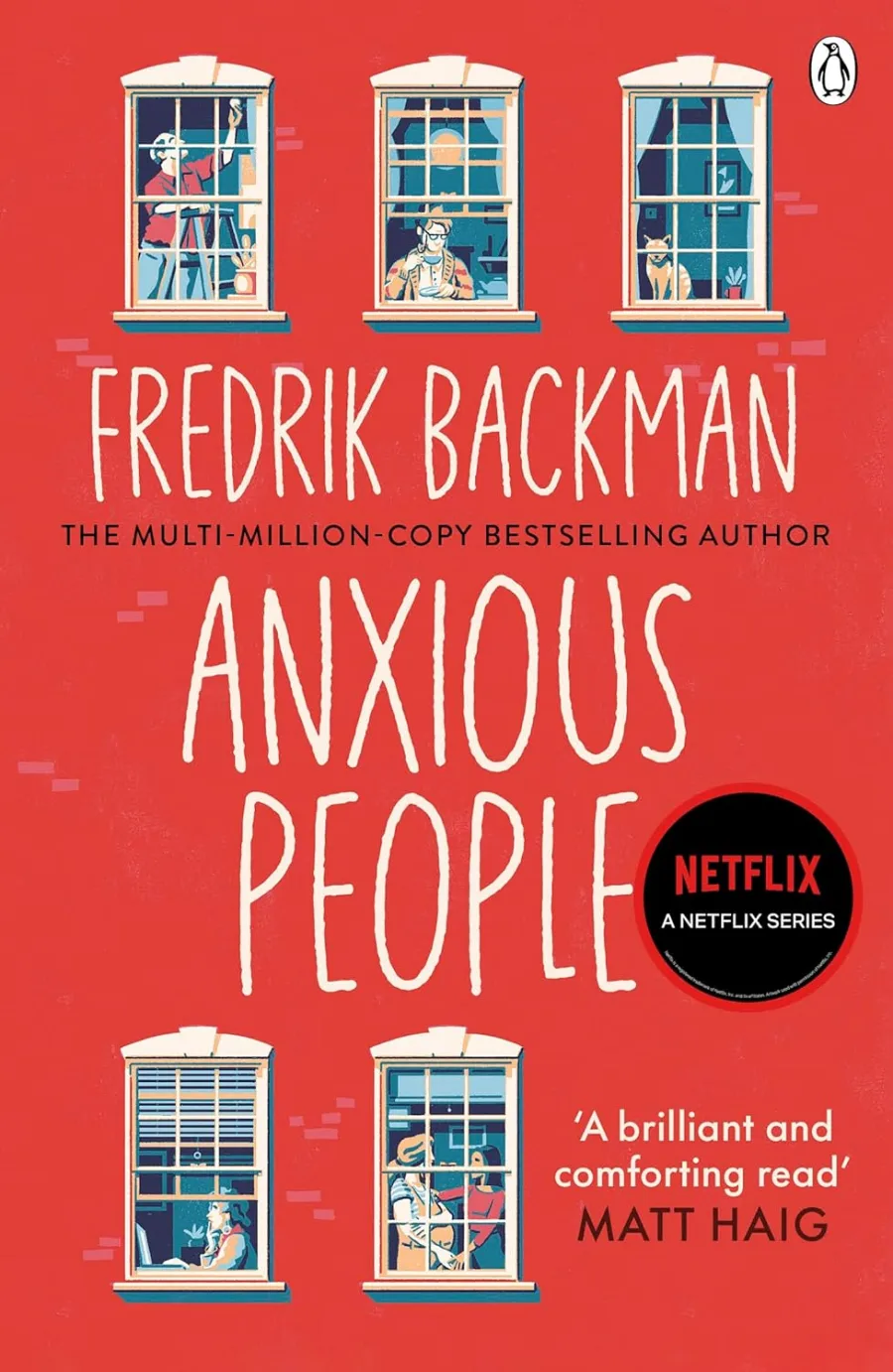
Download Cover Image
Do you want to download the full cover image for Anxious People: The No. 1 New York Times Bestseller, Now a Netflix TV Series?