Tales from Indian Mythology: Collection of 10 Books
Paperback
• 160 Pages
• ₹ 499.00
• English
• 9789354400506
No ratings yet
| Publisher | Wonder House Books |
|---|---|
| ISBN13 | 9789354400506 |
| ASIN/SKU | 9354400507 |
| Book Format | Paperback |
| Language | English |
| Pages | 160 |
| List Price | ₹ 499.00 |
| Publishing Date | 25/02/2022 |
| Dimensions | 24.2 x 1.8 x 18.5 cm |
| Weight | 503 g |
| Book Code | BD00055084 |
Buy this Book
Amazon Stores
Ebook Stores
Other Stores
Discover Tales from Indian Mythology: Collection of 10 Books by Wonder House Books. This book is published by Wonder House Books in Paperback format, ISBN 9789354400506, ASIN 9354400507, under Literature and Fiction, Children's Books on Hinduism, Religious Fiction for Children.
Book Description
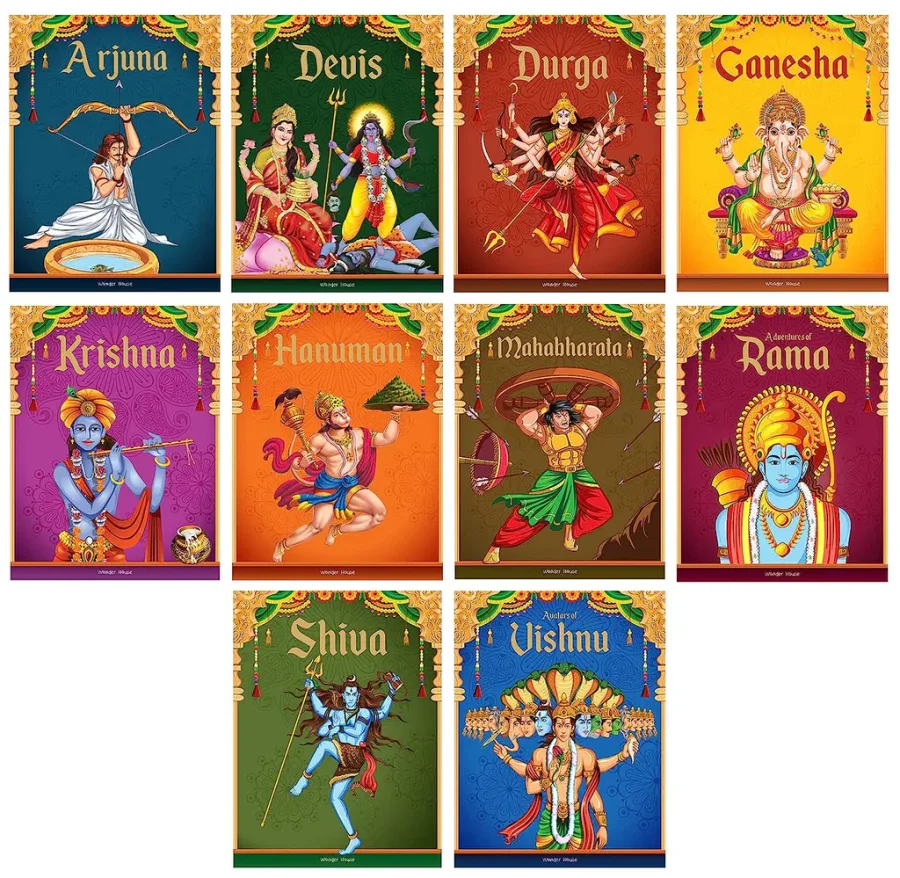
Explore the richness of Indian mythology and culture with this beautifully illustrated shrink-wrapped pack of 10 storybooks. Specially crafted for young readers, each book in the collection introduces children to legendary tales of gods, goddesses, heroes, and epic adventures from ancient India. Written in simple language and filled with vivid, engaging illustrations, these stories bring the spiritual and moral essence of Indian traditions to life.
What’s Inside the Pack:
Shiva – The destroyer and transformer
Durga – The fierce goddess of power
Ganesha – The remover of obstacles
Vishnu – The preserver of the universe
Krishna – The divine cowherd and storyteller
Hanuman – The mighty devotee and warrior
Rama – The ideal king and hero of Ramayana
Arjuna – The warrior prince of Mahabharata
Mahabharata – Tales from the epic of Dharma
Devis – Stories of divine feminine power
Why You'll Love This Collection:
Vibrant illustrations to keep children engaged
Simple retellings for easy comprehension
Promotes cultural awareness and spiritual values
Ideal for reading aloud, storytelling sessions, or gifting
Great for:
Children aged 6 and above
Parents introducing Indian gods, goddesses, and epics
Schools and libraries looking for Indian culture resources
Festive gifts or return gifts with cultural significance
Product Highlights:
Format: Shrink-wrapped pack of 10 paperback books
Size: Child-friendly dimensions with full-color pages
Language: English
Themes: Courage, devotion, dharma, wisdom, and tradition
This must-have mythology pack brings the grandeur of ancient India into your child’s hands. From divine avatars to epic battles, it’s a wonderful way to pass on India’s cultural legacy―one story at a time.
What’s Inside the Pack:
Shiva – The destroyer and transformer
Durga – The fierce goddess of power
Ganesha – The remover of obstacles
Vishnu – The preserver of the universe
Krishna – The divine cowherd and storyteller
Hanuman – The mighty devotee and warrior
Rama – The ideal king and hero of Ramayana
Arjuna – The warrior prince of Mahabharata
Mahabharata – Tales from the epic of Dharma
Devis – Stories of divine feminine power
Why You'll Love This Collection:
Vibrant illustrations to keep children engaged
Simple retellings for easy comprehension
Promotes cultural awareness and spiritual values
Ideal for reading aloud, storytelling sessions, or gifting
Great for:
Children aged 6 and above
Parents introducing Indian gods, goddesses, and epics
Schools and libraries looking for Indian culture resources
Festive gifts or return gifts with cultural significance
Product Highlights:
Format: Shrink-wrapped pack of 10 paperback books
Size: Child-friendly dimensions with full-color pages
Language: English
Themes: Courage, devotion, dharma, wisdom, and tradition
This must-have mythology pack brings the grandeur of ancient India into your child’s hands. From divine avatars to epic battles, it’s a wonderful way to pass on India’s cultural legacy―one story at a time.
Author Biography
Wonder House has a dedicated team of editors and designers involved in the development of magnificent and enriching children books. The team pays special attention to develop age appropriate content and does extensive research on every topic included in the book. Our mission is to develop highly informative content which will help the children to master different skills. At Wonder House, we strive to make learning a joy.
Editorial Reviews
Editorial Reviews will be added soon…
Book Summary
Tales from Indian Mythology: Collection of 10 Books is a vibrant introduction to the fascinating world of Indian mythology, created especially for young readers by Wonder House Books. The collection brings together ten accessible storybooks featuring some of the most beloved gods, goddesses, heroes, and epic traditions of India. Retold in simple language and supported by engaging illustrations, the series introduces children to stories that have been passed down through generations while helping them understand the cultural values behind these legends. The collection is 160 pages in total and is designed for young children, with the publisher listing a reading age of 3–5 years for this edition.
Rather than presenting Indian mythology as a difficult or scholarly subject, the collection makes these ancient stories approachable. Children encounter extraordinary characters, divine powers, heroic adventures, battles between good and evil, acts of devotion, and moments of wisdom. At the same time, the stories introduce ideas such as courage, duty, compassion, perseverance, faith, loyalty, and righteousness.
The collection includes stories centered on Shiva, Durga, Ganesha, Vishnu, Krishna, Hanuman, Rama, Arjuna, the Mahabharata, and the Devis. Each represents a different dimension of India's mythological heritage and provides children with a distinctive set of stories and values.
The book on Shiva introduces children to one of the most important figures in Hindu mythology. Shiva is associated with destruction and transformation, but his stories reveal a far richer personality. He can be powerful and fearsome, yet also compassionate, meditative, and deeply devoted to his family. Through stories about Shiva, young readers encounter the idea that destruction is not always negative; sometimes something must change or end before something new can begin.
Durga represents strength, courage, and the triumph of righteousness over evil. Her stories portray her as a powerful divine figure capable of confronting forces that threaten the world. For children, these tales can become memorable lessons about bravery and standing up against wrongdoing. Durga's character also introduces the idea of feminine strength and divine power.
The stories of Ganesha offer a gentler and often playful introduction to mythology. Known as the remover of obstacles and the elephant-headed god, Ganesha is associated with wisdom, intelligence, good beginnings, and perseverance. His stories combine humor, wonder, and moral lessons, making them particularly appealing to younger readers. Through his adventures, children learn that intelligence and thoughtful action can sometimes be more valuable than physical strength.
The section devoted to Vishnu introduces the concept of preservation and divine intervention. Vishnu is traditionally understood as the preserver of the universe and is associated with various avatars who appear when righteousness is threatened. His stories help young readers understand the recurring mythological idea that balance must be restored whenever disorder and injustice become overwhelming.
Krishna brings another distinctive tone to the collection. His stories can be playful, adventurous, mischievous, and deeply spiritual. As a child, Krishna is remembered for his charming antics, while later stories emphasize his wisdom, courage, and role in the larger events of the Mahabharata. His character allows children to see that wisdom and greatness can exist alongside playfulness and affection.
The stories of Hanuman emphasize devotion, courage, loyalty, and extraordinary strength. Hanuman's unwavering devotion to Rama is central to his character, but his stories also portray him as intelligent, resourceful, humble, and fearless. His adventures demonstrate that true strength is not merely physical. It can also come from dedication to a meaningful purpose and willingness to help others.
The collection then introduces children to Rama, one of the central figures of the Ramayana. Rama is traditionally portrayed as an ideal king and hero who values duty, truth, responsibility, and righteousness. His journey involves exile, hardship, loyalty, friendship, conflict, and the struggle against evil. In a simplified children's retelling, these episodes become accessible stories through which children can encounter the concept of dharma—the responsibility to do what is right even when circumstances are difficult.
Arjuna, the great warrior prince of the Mahabharata, provides a different kind of heroic example. Arjuna is courageous and highly skilled, but he is also capable of doubt and emotional uncertainty. His character reminds young readers that even strong and talented people can experience fear or confusion. What matters is learning to understand one's responsibilities and finding the courage to act appropriately.
The Mahabharata volume broadens the collection from individual heroes to one of India's greatest epics. The epic contains a vast network of characters, family relationships, rivalries, moral dilemmas, alliances, betrayals, and battles. For young readers, selected stories can provide an introduction to this enormous tradition without requiring them to understand the full complexity of the original epic. The central ideas of duty, justice, loyalty, consequences, and the struggle between righteousness and wrongdoing remain accessible even in simplified form.
The final volume, focused on the Devis, celebrates the many forms of divine feminine power in Indian mythology. These stories complement the tales of individual goddesses such as Durga and help children recognize that Indian mythology contains numerous representations of feminine strength, wisdom, protection, creativity, and compassion.
One of the collection's greatest strengths is its simplicity. Ancient mythology can contain complicated genealogies, philosophical ideas, unfamiliar names, and multiple versions of the same story. Wonder House Books presents these traditions in a form that young children can follow. The publisher describes the stories as being retold in simple language and accompanied by vivid illustrations, making them suitable for young readers and for adults who want to read aloud to children.
The illustrations are especially important because they give children a visual entry point into a world filled with unfamiliar characters, divine weapons, magnificent kingdoms, forests, celestial beings, and epic battles. Instead of encountering mythology only as text, children can imagine the settings and characters more vividly.
The collection also serves an educational purpose beyond entertainment. Indian mythology is closely connected with festivals, religious traditions, literature, art, dance, television, popular culture, and everyday cultural references. A child who becomes familiar with characters such as Rama, Krishna, Hanuman, Shiva, Ganesha, and Durga gains a foundation for understanding many aspects of Indian cultural life.
At the same time, the stories contain universal themes that extend beyond any particular religious or cultural setting. A child can understand the value of courage without needing to know every detail of Hindu philosophy. Loyalty, kindness, perseverance, honesty, wisdom, responsibility, and compassion are ideas that children can recognize in their own lives.
The collection is also well suited to shared reading. Parents, grandparents, teachers, and caregivers can use the stories as starting points for conversations. After reading about a heroic character, an adult can ask a child what made that character brave. After a story about a difficult decision, they can discuss what the child might have done. In this way, mythology becomes more than storytelling—it becomes a means of developing moral reasoning and imagination.
Another important quality is that the collection encourages children to see mythology as a living cultural tradition rather than something confined to the distant past. The stories remain relevant because their central questions continue to appear in ordinary life: What should we do when we are afraid? How should we treat people who depend on us? Why is courage important? What happens when pride controls our decisions? How can wisdom overcome strength?
Ultimately, Tales from Indian Mythology: Collection of 10 Books is designed to open a doorway into India's enormous mythological heritage. It does not attempt to provide an exhaustive account of every tradition or interpretation. Instead, it offers young readers a collection of memorable stories through which they can meet some of India's most enduring mythological figures.
The real charm of the collection lies in this combination of story, imagination, culture, and values. Children can enjoy the excitement of divine adventures and legendary heroes while gradually becoming familiar with ideas that have shaped Indian storytelling for centuries. The series also encourages reading, expands vocabulary, stimulates imagination, and introduces children to India's cultural heritage in an accessible way.
In the end, these ten books are not simply a collection of old myths. They are an invitation for young readers to discover a world of gods and goddesses, heroes and heroines, battles and adventures, wisdom and wonder. Through Shiva's transformation, Durga's courage, Ganesha's wisdom, Vishnu's preservation, Krishna's charm, Hanuman's devotion, Rama's sense of duty, Arjuna's struggle, the epic world of the Mahabharata, and the power of the Devis, children encounter a rich tapestry of stories that continues to influence Indian culture and imagination.
For young readers beginning their journey into Indian mythology, Tales from Indian Mythology: Collection of 10 Books offers an engaging and accessible starting point—one that makes ancient stories feel vivid, memorable, and meaningful for a new generation.
Rather than presenting Indian mythology as a difficult or scholarly subject, the collection makes these ancient stories approachable. Children encounter extraordinary characters, divine powers, heroic adventures, battles between good and evil, acts of devotion, and moments of wisdom. At the same time, the stories introduce ideas such as courage, duty, compassion, perseverance, faith, loyalty, and righteousness.
The collection includes stories centered on Shiva, Durga, Ganesha, Vishnu, Krishna, Hanuman, Rama, Arjuna, the Mahabharata, and the Devis. Each represents a different dimension of India's mythological heritage and provides children with a distinctive set of stories and values.
The book on Shiva introduces children to one of the most important figures in Hindu mythology. Shiva is associated with destruction and transformation, but his stories reveal a far richer personality. He can be powerful and fearsome, yet also compassionate, meditative, and deeply devoted to his family. Through stories about Shiva, young readers encounter the idea that destruction is not always negative; sometimes something must change or end before something new can begin.
Durga represents strength, courage, and the triumph of righteousness over evil. Her stories portray her as a powerful divine figure capable of confronting forces that threaten the world. For children, these tales can become memorable lessons about bravery and standing up against wrongdoing. Durga's character also introduces the idea of feminine strength and divine power.
The stories of Ganesha offer a gentler and often playful introduction to mythology. Known as the remover of obstacles and the elephant-headed god, Ganesha is associated with wisdom, intelligence, good beginnings, and perseverance. His stories combine humor, wonder, and moral lessons, making them particularly appealing to younger readers. Through his adventures, children learn that intelligence and thoughtful action can sometimes be more valuable than physical strength.
The section devoted to Vishnu introduces the concept of preservation and divine intervention. Vishnu is traditionally understood as the preserver of the universe and is associated with various avatars who appear when righteousness is threatened. His stories help young readers understand the recurring mythological idea that balance must be restored whenever disorder and injustice become overwhelming.
Krishna brings another distinctive tone to the collection. His stories can be playful, adventurous, mischievous, and deeply spiritual. As a child, Krishna is remembered for his charming antics, while later stories emphasize his wisdom, courage, and role in the larger events of the Mahabharata. His character allows children to see that wisdom and greatness can exist alongside playfulness and affection.
The stories of Hanuman emphasize devotion, courage, loyalty, and extraordinary strength. Hanuman's unwavering devotion to Rama is central to his character, but his stories also portray him as intelligent, resourceful, humble, and fearless. His adventures demonstrate that true strength is not merely physical. It can also come from dedication to a meaningful purpose and willingness to help others.
The collection then introduces children to Rama, one of the central figures of the Ramayana. Rama is traditionally portrayed as an ideal king and hero who values duty, truth, responsibility, and righteousness. His journey involves exile, hardship, loyalty, friendship, conflict, and the struggle against evil. In a simplified children's retelling, these episodes become accessible stories through which children can encounter the concept of dharma—the responsibility to do what is right even when circumstances are difficult.
Arjuna, the great warrior prince of the Mahabharata, provides a different kind of heroic example. Arjuna is courageous and highly skilled, but he is also capable of doubt and emotional uncertainty. His character reminds young readers that even strong and talented people can experience fear or confusion. What matters is learning to understand one's responsibilities and finding the courage to act appropriately.
The Mahabharata volume broadens the collection from individual heroes to one of India's greatest epics. The epic contains a vast network of characters, family relationships, rivalries, moral dilemmas, alliances, betrayals, and battles. For young readers, selected stories can provide an introduction to this enormous tradition without requiring them to understand the full complexity of the original epic. The central ideas of duty, justice, loyalty, consequences, and the struggle between righteousness and wrongdoing remain accessible even in simplified form.
The final volume, focused on the Devis, celebrates the many forms of divine feminine power in Indian mythology. These stories complement the tales of individual goddesses such as Durga and help children recognize that Indian mythology contains numerous representations of feminine strength, wisdom, protection, creativity, and compassion.
One of the collection's greatest strengths is its simplicity. Ancient mythology can contain complicated genealogies, philosophical ideas, unfamiliar names, and multiple versions of the same story. Wonder House Books presents these traditions in a form that young children can follow. The publisher describes the stories as being retold in simple language and accompanied by vivid illustrations, making them suitable for young readers and for adults who want to read aloud to children.
The illustrations are especially important because they give children a visual entry point into a world filled with unfamiliar characters, divine weapons, magnificent kingdoms, forests, celestial beings, and epic battles. Instead of encountering mythology only as text, children can imagine the settings and characters more vividly.
The collection also serves an educational purpose beyond entertainment. Indian mythology is closely connected with festivals, religious traditions, literature, art, dance, television, popular culture, and everyday cultural references. A child who becomes familiar with characters such as Rama, Krishna, Hanuman, Shiva, Ganesha, and Durga gains a foundation for understanding many aspects of Indian cultural life.
At the same time, the stories contain universal themes that extend beyond any particular religious or cultural setting. A child can understand the value of courage without needing to know every detail of Hindu philosophy. Loyalty, kindness, perseverance, honesty, wisdom, responsibility, and compassion are ideas that children can recognize in their own lives.
The collection is also well suited to shared reading. Parents, grandparents, teachers, and caregivers can use the stories as starting points for conversations. After reading about a heroic character, an adult can ask a child what made that character brave. After a story about a difficult decision, they can discuss what the child might have done. In this way, mythology becomes more than storytelling—it becomes a means of developing moral reasoning and imagination.
Another important quality is that the collection encourages children to see mythology as a living cultural tradition rather than something confined to the distant past. The stories remain relevant because their central questions continue to appear in ordinary life: What should we do when we are afraid? How should we treat people who depend on us? Why is courage important? What happens when pride controls our decisions? How can wisdom overcome strength?
Ultimately, Tales from Indian Mythology: Collection of 10 Books is designed to open a doorway into India's enormous mythological heritage. It does not attempt to provide an exhaustive account of every tradition or interpretation. Instead, it offers young readers a collection of memorable stories through which they can meet some of India's most enduring mythological figures.
The real charm of the collection lies in this combination of story, imagination, culture, and values. Children can enjoy the excitement of divine adventures and legendary heroes while gradually becoming familiar with ideas that have shaped Indian storytelling for centuries. The series also encourages reading, expands vocabulary, stimulates imagination, and introduces children to India's cultural heritage in an accessible way.
In the end, these ten books are not simply a collection of old myths. They are an invitation for young readers to discover a world of gods and goddesses, heroes and heroines, battles and adventures, wisdom and wonder. Through Shiva's transformation, Durga's courage, Ganesha's wisdom, Vishnu's preservation, Krishna's charm, Hanuman's devotion, Rama's sense of duty, Arjuna's struggle, the epic world of the Mahabharata, and the power of the Devis, children encounter a rich tapestry of stories that continues to influence Indian culture and imagination.
For young readers beginning their journey into Indian mythology, Tales from Indian Mythology: Collection of 10 Books offers an engaging and accessible starting point—one that makes ancient stories feel vivid, memorable, and meaningful for a new generation.
Sample Chapters
Sample Chapters will be added soon…
Reader Reviews
No reviews yet.
Tales from Indian Mythology: Collection of 10 Books
Download Cover Image
Do you want to download the full cover image for Tales from Indian Mythology: Collection of 10 Books?