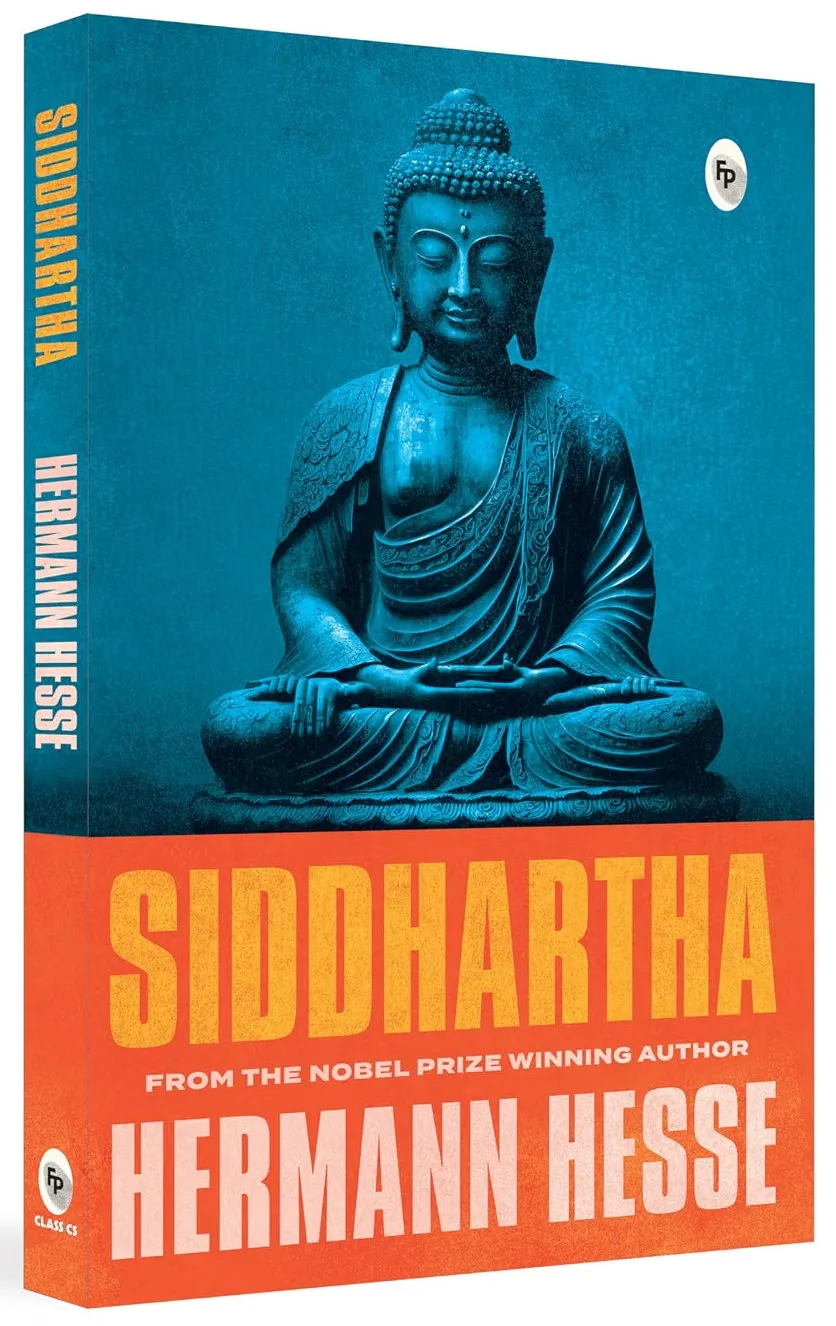
Siddhartha
Paperback
• 144 Pages
• ₹ 149.00
• English
• 9788172343682
No ratings yet
| Publisher | Fingerprint Publishing |
|---|---|
| ISBN13 | 9788172343682 |
| ASIN/SKU | 817234368X |
| Book Format | Paperback |
| Language | English |
| Pages | 144 |
| List Price | ₹ 149.00 |
| Publishing Date | 01/01/2012 |
| Dimensions | 21.5 x 14 x 1.5 cm |
| Weight | 500 g |
| Book Code | BD00055078 |
Buy this Book
Amazon Stores
Ebook Stores
Other Stores
Discover Siddhartha by Hermann Hesse. This book is published by Fingerprint Publishing in Paperback format, ISBN 9788172343682, ASIN 817234368X, under Literature and Fiction, Agnosticism, Buddhism.
Book Description
Siddhartha is Hermann Hesse’s literary masterpiece—a poetic and philosophical novel that chronicles one man’s lifelong spiritual journey in search of truth, enlightenment, and self-discovery. Set in ancient India, the novel follows Siddhartha, a young Brahmin, who renounces conventional life and undergoes a series of profound experiences—from asceticism and sensual pleasure to worldly success and eventual stillness by the river. Along the way, he explores the nature of desire, suffering, and the illusion of time—ultimately realizing that wisdom is not taught but lived.
The path to enlightenment begins within.
Explores themes of self-realization, detachment, love, and inner peace.
A profound novel that bridges Eastern spirituality and Western literary tradition.
Ideal for readers of Buddhism, Vedanta, Zen, Stoicism, and self-inquiry.
Offers a non-dogmatic approach to spiritual growth.
Continues to resonate with readers in times of personal transition or existential reflection.
The path to enlightenment begins within.
Explores themes of self-realization, detachment, love, and inner peace.
A profound novel that bridges Eastern spirituality and Western literary tradition.
Ideal for readers of Buddhism, Vedanta, Zen, Stoicism, and self-inquiry.
Offers a non-dogmatic approach to spiritual growth.
Continues to resonate with readers in times of personal transition or existential reflection.
Author Biography
Hermann Hesse was a German-Swiss poet, novelist, and painter. His best-known works include Steppenwolf, Siddhartha, and The Glass Bead Game. Hesse primarily wrote on topics like the politics of detachment, an individuals search for enlightenment, and spirituality. In 1946, he received the Nobel Prize in Literature.
Editorial Reviews
Editorial Reviews will be added soon…
Book Summary
Siddhartha by Hermann Hesse is a deeply reflective philosophical novel about self-discovery, spiritual awakening, and the search for inner peace. Published in 1922, the novel follows Siddhartha, a young man in ancient India who refuses to accept spiritual truth simply because it is taught by others. Although he is born into a respected Brahmin family and receives a privileged religious education, Siddhartha feels that rituals, doctrines, and borrowed wisdom cannot give him the direct experience of enlightenment he longs for. His journey takes him through asceticism, friendship, love, wealth, sensual pleasure, despair, and finally a profound understanding of life. At its heart, Siddhartha is a story about discovering that wisdom cannot simply be transferred from one person to another; it must ultimately be lived and experienced.
Siddhartha grows up as the beloved son of a Brahmin and is admired for his intelligence, discipline, beauty, and spiritual potential. Yet beneath this outward success lies a deep dissatisfaction. He has learned sacred prayers, rituals, and religious teachings, but he senses that knowing the words of wisdom is not the same as possessing wisdom itself. His close friend Govinda recognizes something special in him and follows him faithfully. Together, they leave the Brahmin community and join a group of wandering ascetics known as the Samanas. Siddhartha believes that by rejecting worldly comforts and disciplining his body, he can overcome the desires and limitations of the self.
Life with the Samanas is severe. Siddhartha practices fasting, meditation, physical deprivation, and detachment from ordinary desires. He learns to endure hunger, pain, exhaustion, and discomfort. He even learns techniques for temporarily escaping his own identity and entering different states of consciousness. These experiences give him remarkable self-control, but they do not give him the lasting peace he seeks. Siddhartha eventually realizes that escaping the self is not necessarily the same as understanding the self. The Samanas, despite their discipline, remain caught within their own search. Siddhartha begins to suspect that extreme denial may simply be another form of attachment.
During this period, Siddhartha and Govinda hear about Gotama, the Buddha, a spiritual teacher whose reputation has spread throughout the region. They leave the Samanas and go to hear him. Siddhartha is impressed by Gotama's presence, calmness, and the coherence of his teachings. Govinda is deeply moved and decides to become one of Gotama's followers. Siddhartha, however, chooses a different path. He does not reject the Buddha because he believes the teachings are false. Instead, he recognizes a fundamental limitation: Gotama can teach the path to enlightenment, but Siddhartha believes that enlightenment itself cannot be communicated through words.
This becomes one of the novel's central ideas. Siddhartha respects Gotama profoundly, but he does not want to become a follower who merely repeats another person's understanding. He wants to experience truth directly. He tells Govinda that he has learned much from teachers but has also learned that the most important wisdom cannot be taught. Govinda remains with the Buddha, while Siddhartha begins his journey alone.
After leaving the spiritual world, Siddhartha enters the ordinary human world. He meets Kamala, a beautiful and intelligent courtesan, who introduces him to love, sensuality, and worldly experience. Siddhartha realizes that he wants to understand another side of existence—the side of desire, pleasure, money, ambition, and human relationships. Kamala agrees to teach him about love, but she tells him that he must first acquire wealth and respectable clothing.
Siddhartha then meets Kamaswami, a wealthy merchant, and begins working in business. His natural intelligence allows him to become successful. He learns how to negotiate, trade, calculate profits, and deal with other merchants. He accumulates money and becomes increasingly comfortable. He continues his relationship with Kamala and experiences pleasures that were completely absent from his earlier ascetic life.
At first, Siddhartha approaches the material world almost like an observer. He tells himself that he is not truly attached to wealth or pleasure. Yet gradually, the world begins to change him. He becomes involved in gambling, luxury, possessions, sensual pleasure, and the constant pursuit of money. The man who once fasted effortlessly begins to crave comfort. The spiritual seeker who once viewed worldly desires with detachment becomes increasingly trapped by them.
Hesse presents this transformation without simply condemning worldly life. Siddhartha needs to experience it. His earlier rejection of pleasure was incomplete because he had never truly understood what worldly existence meant. By entering it fully, he learns something that cannot be learned through theory. At the same time, his success leaves him spiritually empty. He becomes restless, tired, and dissatisfied. His dreams reveal that something precious within him has been lost.
Eventually, Siddhartha experiences a profound spiritual crisis. He realizes that he has become almost indistinguishable from the people whose lives he once regarded as empty. He feels disgusted with himself and with the meaningless repetition of desire, pleasure, anxiety, and disappointment. He leaves his wealth and possessions behind and wanders into the forest, believing that his life has reached a dead end.
Near a river, Siddhartha considers ending his life. In a moment of despair, he hears the sacred sound Om, the ancient syllable associated with wholeness and ultimate reality. The sound awakens something within him. Instead of dying, he falls into a deep sleep and awakens with a renewed sense of life. His encounter with Om becomes a turning point. He realizes that his spiritual journey is not over. He has passed through another necessary stage.
Soon afterward, Siddhartha meets Govinda again, although Govinda does not initially recognize him. Their paths have diverged, but the meeting shows that their friendship remains meaningful. Siddhartha then returns to the river, where he meets Vasudeva, a simple ferryman. Vasudeva becomes one of the most important figures in the novel, not because he delivers elaborate teachings, but because he listens.
Vasudeva teaches Siddhartha to listen to the river. Unlike conventional teachers, he does not try to explain the meaning of life through doctrines. He encourages Siddhartha to hear the many voices within the river—laughter, sorrow, birth, death, longing, joy, fear, and love. Gradually, Siddhartha discovers that the river contains a profound lesson: life is not a series of isolated events moving toward a final destination. Everything exists together.
The river becomes the novel's central symbol. It represents time, change, unity, and the interconnectedness of all existence. At first, Siddhartha thinks of life as a journey in which one must move from ignorance toward knowledge. Eventually, he understands that life cannot be divided so neatly into past, present, and future. The river is always moving, yet it is always the river. Its different sounds are part of one whole.
Siddhartha also learns an important lesson about time. Human beings often suffer because they divide life into what has happened, what is happening, and what will happen. The river teaches him to perceive existence as a unified whole. Everything belongs together: joy and sorrow, success and failure, youth and old age, life and death. One cannot fully understand one side without accepting the other.
Another major development occurs when Kamala, now spiritually interested in the Buddha, comes to the river with Siddhartha's son. Kamala is bitten by a snake and dies. Siddhartha discovers that the boy is his son. The child is accustomed to wealth and comfort and initially resents his father's simple life by the river.
Siddhartha loves his son deeply, but the boy refuses to accept the life his father offers. Eventually, the boy runs away. Siddhartha is devastated. He wants to pursue him, protect him, and bring him back, but Vasudeva helps him understand that love itself involves letting go. Siddhartha finally recognizes that he cannot save his son from suffering. Just as Siddhartha had to experience his own mistakes and pain, his son must experience his own life.
This experience transforms Siddhartha's understanding of love. Earlier, he had thought of attachment as something that belonged to ordinary people who had not achieved spiritual freedom. Now he realizes that love can be painful precisely because it makes one vulnerable. His suffering as a father teaches him compassion. He begins to understand people whom he had previously regarded with distance or superiority.
Eventually, Vasudeva leaves the river and retreats into the forest. Siddhartha remains behind as the ferryman. His spiritual transformation is now complete enough that he no longer needs to search for a teacher. The river itself has become his teacher.
Near the end of the novel, Govinda visits Siddhartha once again. Govinda is still searching for spiritual understanding. He recognizes that Siddhartha has changed and asks him for some wisdom. Siddhartha explains that he has learned that wisdom cannot truly be expressed in doctrines or words. He can share experiences, but he cannot give Govinda his understanding as a possession.
Siddhartha tells Govinda that he has come to see the world differently. He no longer divides reality into good and evil, sacred and ordinary, desirable and undesirable. Everything belongs to a larger unity. Even suffering and sin have a place within existence. He also comes to understand that love is more important than intellectual explanations. To truly see the world, one must accept it rather than constantly judging it.
Govinda looks closely at Siddhartha and, in a deeply symbolic moment, sees his face transformed. He perceives countless faces and expressions within it—people, animals, lovers, suffering figures, joyful beings, birth and death, all appearing together. The experience suggests that the separate identities of individual beings are part of a greater unity.
The novel ends not with Siddhartha discovering a formula for enlightenment but with his transformation into someone who has learned to accept life in its totality. His journey has taken him from religious certainty to doubt, from asceticism to sensuality, from wealth to despair, and finally from searching to listening. Each stage was necessary because Siddhartha could not have reached his understanding by skipping any of them.
One of the most powerful ideas in Siddhartha is that wisdom is different from knowledge. Knowledge can be communicated through books, teachers, doctrines, and explanations. Wisdom, however, emerges from living. Siddhartha can hear the Buddha's teachings, but he cannot simply receive the Buddha's enlightenment. He must make his own mistakes, experience desire, suffer loss, love another person, become attached, and eventually learn to let go.
The novel also challenges the idea that spiritual growth requires rejecting ordinary human life. Siddhartha begins by believing that enlightenment can be achieved through escaping desire. Later, he swings to the opposite extreme and immerses himself in worldly pleasure. Neither extreme gives him fulfillment. His final understanding comes through acceptance and integration. He learns that spirituality is not necessarily separate from ordinary existence. The sacred can be found in the river, in love, in suffering, in work, in silence, and even in failure.
Siddhartha is ultimately a story about becoming fully human. Hesse does not present spiritual awakening as a simple escape from the world. Instead, Siddhartha's enlightenment grows through his willingness to experience the world honestly. He learns that life cannot be reduced to a single doctrine or divided into neat categories. The deepest truth is something one gradually feels and lives.
The river captures this wisdom beautifully. It flows continuously, carrying everything with it, yet it remains whole. Siddhartha eventually sees his own life in the same way. His childhood, his rebellion, his ascetic years, his love for Kamala, his wealth, his despair, his relationship with his son, and his years beside the river are not separate mistakes or disconnected episodes. They are all parts of one life.
In this sense, Siddhartha is not merely a novel about an ancient spiritual seeker. It is a deeply human book about the universal desire to understand who we are and why we suffer. Siddhartha's journey suggests that there may be no shortcut to genuine understanding. We learn through experience, through relationships, through loss, through mistakes, and through the gradual acceptance of things we cannot control. The final lesson is not about escaping life but about seeing it clearly, listening deeply, and recognizing the unity that connects all living things.
Siddhartha grows up as the beloved son of a Brahmin and is admired for his intelligence, discipline, beauty, and spiritual potential. Yet beneath this outward success lies a deep dissatisfaction. He has learned sacred prayers, rituals, and religious teachings, but he senses that knowing the words of wisdom is not the same as possessing wisdom itself. His close friend Govinda recognizes something special in him and follows him faithfully. Together, they leave the Brahmin community and join a group of wandering ascetics known as the Samanas. Siddhartha believes that by rejecting worldly comforts and disciplining his body, he can overcome the desires and limitations of the self.
Life with the Samanas is severe. Siddhartha practices fasting, meditation, physical deprivation, and detachment from ordinary desires. He learns to endure hunger, pain, exhaustion, and discomfort. He even learns techniques for temporarily escaping his own identity and entering different states of consciousness. These experiences give him remarkable self-control, but they do not give him the lasting peace he seeks. Siddhartha eventually realizes that escaping the self is not necessarily the same as understanding the self. The Samanas, despite their discipline, remain caught within their own search. Siddhartha begins to suspect that extreme denial may simply be another form of attachment.
During this period, Siddhartha and Govinda hear about Gotama, the Buddha, a spiritual teacher whose reputation has spread throughout the region. They leave the Samanas and go to hear him. Siddhartha is impressed by Gotama's presence, calmness, and the coherence of his teachings. Govinda is deeply moved and decides to become one of Gotama's followers. Siddhartha, however, chooses a different path. He does not reject the Buddha because he believes the teachings are false. Instead, he recognizes a fundamental limitation: Gotama can teach the path to enlightenment, but Siddhartha believes that enlightenment itself cannot be communicated through words.
This becomes one of the novel's central ideas. Siddhartha respects Gotama profoundly, but he does not want to become a follower who merely repeats another person's understanding. He wants to experience truth directly. He tells Govinda that he has learned much from teachers but has also learned that the most important wisdom cannot be taught. Govinda remains with the Buddha, while Siddhartha begins his journey alone.
After leaving the spiritual world, Siddhartha enters the ordinary human world. He meets Kamala, a beautiful and intelligent courtesan, who introduces him to love, sensuality, and worldly experience. Siddhartha realizes that he wants to understand another side of existence—the side of desire, pleasure, money, ambition, and human relationships. Kamala agrees to teach him about love, but she tells him that he must first acquire wealth and respectable clothing.
Siddhartha then meets Kamaswami, a wealthy merchant, and begins working in business. His natural intelligence allows him to become successful. He learns how to negotiate, trade, calculate profits, and deal with other merchants. He accumulates money and becomes increasingly comfortable. He continues his relationship with Kamala and experiences pleasures that were completely absent from his earlier ascetic life.
At first, Siddhartha approaches the material world almost like an observer. He tells himself that he is not truly attached to wealth or pleasure. Yet gradually, the world begins to change him. He becomes involved in gambling, luxury, possessions, sensual pleasure, and the constant pursuit of money. The man who once fasted effortlessly begins to crave comfort. The spiritual seeker who once viewed worldly desires with detachment becomes increasingly trapped by them.
Hesse presents this transformation without simply condemning worldly life. Siddhartha needs to experience it. His earlier rejection of pleasure was incomplete because he had never truly understood what worldly existence meant. By entering it fully, he learns something that cannot be learned through theory. At the same time, his success leaves him spiritually empty. He becomes restless, tired, and dissatisfied. His dreams reveal that something precious within him has been lost.
Eventually, Siddhartha experiences a profound spiritual crisis. He realizes that he has become almost indistinguishable from the people whose lives he once regarded as empty. He feels disgusted with himself and with the meaningless repetition of desire, pleasure, anxiety, and disappointment. He leaves his wealth and possessions behind and wanders into the forest, believing that his life has reached a dead end.
Near a river, Siddhartha considers ending his life. In a moment of despair, he hears the sacred sound Om, the ancient syllable associated with wholeness and ultimate reality. The sound awakens something within him. Instead of dying, he falls into a deep sleep and awakens with a renewed sense of life. His encounter with Om becomes a turning point. He realizes that his spiritual journey is not over. He has passed through another necessary stage.
Soon afterward, Siddhartha meets Govinda again, although Govinda does not initially recognize him. Their paths have diverged, but the meeting shows that their friendship remains meaningful. Siddhartha then returns to the river, where he meets Vasudeva, a simple ferryman. Vasudeva becomes one of the most important figures in the novel, not because he delivers elaborate teachings, but because he listens.
Vasudeva teaches Siddhartha to listen to the river. Unlike conventional teachers, he does not try to explain the meaning of life through doctrines. He encourages Siddhartha to hear the many voices within the river—laughter, sorrow, birth, death, longing, joy, fear, and love. Gradually, Siddhartha discovers that the river contains a profound lesson: life is not a series of isolated events moving toward a final destination. Everything exists together.
The river becomes the novel's central symbol. It represents time, change, unity, and the interconnectedness of all existence. At first, Siddhartha thinks of life as a journey in which one must move from ignorance toward knowledge. Eventually, he understands that life cannot be divided so neatly into past, present, and future. The river is always moving, yet it is always the river. Its different sounds are part of one whole.
Siddhartha also learns an important lesson about time. Human beings often suffer because they divide life into what has happened, what is happening, and what will happen. The river teaches him to perceive existence as a unified whole. Everything belongs together: joy and sorrow, success and failure, youth and old age, life and death. One cannot fully understand one side without accepting the other.
Another major development occurs when Kamala, now spiritually interested in the Buddha, comes to the river with Siddhartha's son. Kamala is bitten by a snake and dies. Siddhartha discovers that the boy is his son. The child is accustomed to wealth and comfort and initially resents his father's simple life by the river.
Siddhartha loves his son deeply, but the boy refuses to accept the life his father offers. Eventually, the boy runs away. Siddhartha is devastated. He wants to pursue him, protect him, and bring him back, but Vasudeva helps him understand that love itself involves letting go. Siddhartha finally recognizes that he cannot save his son from suffering. Just as Siddhartha had to experience his own mistakes and pain, his son must experience his own life.
This experience transforms Siddhartha's understanding of love. Earlier, he had thought of attachment as something that belonged to ordinary people who had not achieved spiritual freedom. Now he realizes that love can be painful precisely because it makes one vulnerable. His suffering as a father teaches him compassion. He begins to understand people whom he had previously regarded with distance or superiority.
Eventually, Vasudeva leaves the river and retreats into the forest. Siddhartha remains behind as the ferryman. His spiritual transformation is now complete enough that he no longer needs to search for a teacher. The river itself has become his teacher.
Near the end of the novel, Govinda visits Siddhartha once again. Govinda is still searching for spiritual understanding. He recognizes that Siddhartha has changed and asks him for some wisdom. Siddhartha explains that he has learned that wisdom cannot truly be expressed in doctrines or words. He can share experiences, but he cannot give Govinda his understanding as a possession.
Siddhartha tells Govinda that he has come to see the world differently. He no longer divides reality into good and evil, sacred and ordinary, desirable and undesirable. Everything belongs to a larger unity. Even suffering and sin have a place within existence. He also comes to understand that love is more important than intellectual explanations. To truly see the world, one must accept it rather than constantly judging it.
Govinda looks closely at Siddhartha and, in a deeply symbolic moment, sees his face transformed. He perceives countless faces and expressions within it—people, animals, lovers, suffering figures, joyful beings, birth and death, all appearing together. The experience suggests that the separate identities of individual beings are part of a greater unity.
The novel ends not with Siddhartha discovering a formula for enlightenment but with his transformation into someone who has learned to accept life in its totality. His journey has taken him from religious certainty to doubt, from asceticism to sensuality, from wealth to despair, and finally from searching to listening. Each stage was necessary because Siddhartha could not have reached his understanding by skipping any of them.
One of the most powerful ideas in Siddhartha is that wisdom is different from knowledge. Knowledge can be communicated through books, teachers, doctrines, and explanations. Wisdom, however, emerges from living. Siddhartha can hear the Buddha's teachings, but he cannot simply receive the Buddha's enlightenment. He must make his own mistakes, experience desire, suffer loss, love another person, become attached, and eventually learn to let go.
The novel also challenges the idea that spiritual growth requires rejecting ordinary human life. Siddhartha begins by believing that enlightenment can be achieved through escaping desire. Later, he swings to the opposite extreme and immerses himself in worldly pleasure. Neither extreme gives him fulfillment. His final understanding comes through acceptance and integration. He learns that spirituality is not necessarily separate from ordinary existence. The sacred can be found in the river, in love, in suffering, in work, in silence, and even in failure.
Siddhartha is ultimately a story about becoming fully human. Hesse does not present spiritual awakening as a simple escape from the world. Instead, Siddhartha's enlightenment grows through his willingness to experience the world honestly. He learns that life cannot be reduced to a single doctrine or divided into neat categories. The deepest truth is something one gradually feels and lives.
The river captures this wisdom beautifully. It flows continuously, carrying everything with it, yet it remains whole. Siddhartha eventually sees his own life in the same way. His childhood, his rebellion, his ascetic years, his love for Kamala, his wealth, his despair, his relationship with his son, and his years beside the river are not separate mistakes or disconnected episodes. They are all parts of one life.
In this sense, Siddhartha is not merely a novel about an ancient spiritual seeker. It is a deeply human book about the universal desire to understand who we are and why we suffer. Siddhartha's journey suggests that there may be no shortcut to genuine understanding. We learn through experience, through relationships, through loss, through mistakes, and through the gradual acceptance of things we cannot control. The final lesson is not about escaping life but about seeing it clearly, listening deeply, and recognizing the unity that connects all living things.
Sample Chapters
Sample Chapters will be added soon…
Reader Reviews
No reviews yet.
Siddhartha