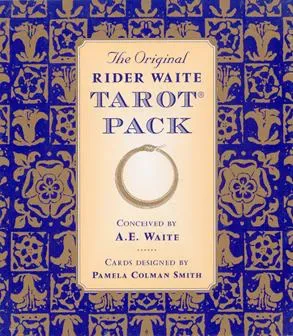
The Original Rider Waite Tarot Deck: 78 beautifully illustrated cards and instructional booklet
Unknown Format
• 80 Pages
• ₹ 1500.00
• English
• 9780712670579
No ratings yet
| Publisher | Rider |
|---|---|
| ISBN13 | 9780712670579 |
| ASIN/SKU | 0712670572 |
| Book Format | Unknown Format |
| Language | English |
| Pages | 80 |
| List Price | ₹ 1500.00 |
| Publishing Date | 10/06/1999 |
| Dimensions | 7.3 x 3.1 x 12.5 cm |
| Weight | 240 g |
| Book Code | BD00055075 |
Buy this Book
Amazon Stores
Ebook Stores
Other Stores
Discover The Original Rider Waite Tarot Deck: 78 beautifully illustrated cards and instructional booklet by A.E. Waite. This book is published by Rider in Unknown Format format, ISBN 9780712670579, ASIN 0712670572, under Literature and Fiction, Mysticism, Occult and Paranormal.
Book Description
The Original Rider Waite Tarot is the most popular and widely used tarot card deck in the world. With 78 cards and an instructional booklet, it is perfect for people beginning to connect with Tarot, and those more experienced readers.
'Extremely happy with the value and quality of these tarot cards' -- ***** Reader review
'This is my favourite deck, I love it and feel such a connection with it' -- ***** Reader review
'The only set worth having!' -- ***** Reader review
**************************************************************************************
The Original Rider Waite Tarot is the most popular and widely used tarot card deck in the world.
First issued in 1910, each card is rich in symbolism and striking in its design.
Divided into the Major and Minor Arcanas, the cards still have the original design by Pamela Colman Smith, carried out in accordance with A. E. Waite's instructions.
An instructional booklet is included, explaining the tarot card meanings and how to use the cards for divination, with an introduction by Tarot expert Stuart R. Kaplan.
Whether novice or expert, The Original Rider Waite Tarot is the only tarot card deck you need - feel the heritage, history and connection all at once...
'Extremely happy with the value and quality of these tarot cards' -- ***** Reader review
'This is my favourite deck, I love it and feel such a connection with it' -- ***** Reader review
'The only set worth having!' -- ***** Reader review
**************************************************************************************
The Original Rider Waite Tarot is the most popular and widely used tarot card deck in the world.
First issued in 1910, each card is rich in symbolism and striking in its design.
Divided into the Major and Minor Arcanas, the cards still have the original design by Pamela Colman Smith, carried out in accordance with A. E. Waite's instructions.
An instructional booklet is included, explaining the tarot card meanings and how to use the cards for divination, with an introduction by Tarot expert Stuart R. Kaplan.
Whether novice or expert, The Original Rider Waite Tarot is the only tarot card deck you need - feel the heritage, history and connection all at once...
Author Biography
About the Author: The US born Arthur Edward Waite was a British mystic who contributed nearly 50 books with an open fondness for specialising in occult texts even though his reputation for works on the Holy Grail and the Rider-Waite tarot deck remains unparalleled. His other hailed offerings include The Book of Ceremonial Magic (1911), The Holy Kabbalah (1929) and A New Encyclopedia of Freemasonry (1921).
Editorial Reviews
Editorial Reviews will be added soon…
Book Summary
The Original Rider Waite Tarot Deck is one of the most influential tarot systems in modern Western esotericism. Created by occultist and scholar A. E. Waite, with the iconic artwork illustrated by Pamela Colman Smith, the deck contains 78 illustrated cards divided into the Major Arcana and Minor Arcana. Accompanied by an instructional booklet, the deck is designed to introduce readers to the symbolism, structure, and traditional meanings of the cards while providing a foundation for tarot reading and interpretation.
Unlike a conventional book with a continuous narrative, this work is best understood as a visual and symbolic system. Its “story” emerges from the relationships among the cards and from the symbolic language they collectively create. The deck has become enormously influential because its images are detailed enough to communicate meaning visually rather than relying solely on written descriptions.
The 78 cards are divided into two principal groups: the 22 Major Arcana and the 56 Minor Arcana. Together, they create a symbolic journey that can be used for reflection, storytelling, meditation, or traditional divinatory practice.
The Major Arcana begins with The Fool, numbered zero, and progresses through a series of archetypal figures and experiences before reaching The World. The sequence is often interpreted as a symbolic journey through stages of human development.
The Fool represents beginnings, openness, innocence, spontaneity, and the willingness to step into the unknown. The card shows a traveler standing at the edge of a precipice, accompanied by a small dog. Its symbolism captures the mixture of freedom and risk that accompanies every new beginning.
From there, the journey moves to The Magician, a figure associated with will, skill, initiative, communication, and the ability to transform potential into action. The Magician's tools represent the resources available to the individual, suggesting that possibility becomes meaningful when it is consciously directed.
The High Priestess introduces a very different kind of knowledge. She represents intuition, mystery, hidden information, inner wisdom, and the unconscious. Seated between symbolic pillars, she suggests that not everything important can be discovered through ordinary logic. Some truths must be sensed, experienced, or patiently uncovered.
The Empress represents fertility, creativity, abundance, nature, nurturing, and the generative power of life. Her imagery connects physical and emotional growth with the natural world.
The Emperor, by contrast, represents structure, authority, discipline, order, responsibility, and worldly leadership. Together, the Empress and Emperor can be read as complementary forces: creation and structure, nurture and authority, intuition and organization.
The Hierophant introduces tradition, teaching, institutional knowledge, ritual, and established belief systems. The card asks questions about how knowledge is transmitted and how individuals relate to cultural or spiritual traditions.
The Lovers traditionally involves love and attraction, but its symbolism extends beyond romance. It can represent choice, values, relationships, alignment, and the consequences of important decisions. The card asks what a person truly chooses when confronted with competing possibilities.
The Chariot represents determination, movement, discipline, victory, and control. Its imagery suggests that progress requires the ability to direct opposing forces toward a common destination.
Strength presents power in a more inward form. Rather than relying on violence, the figure associated with the card controls a lion through patience, confidence, and compassion. The image suggests that genuine strength can involve self-control and gentleness.
The Hermit represents solitude, reflection, wisdom, and the search for inner truth. Carrying a lantern, the Hermit withdraws from ordinary distractions to illuminate a path through uncertainty.
The Wheel of Fortune introduces the changing nature of circumstances. Cycles of rise and decline, opportunity and difficulty, are represented through the turning wheel. The card reminds readers that no situation remains permanently fixed.
Justice emphasizes balance, truth, accountability, fairness, and consequences. Its symbolism suggests that actions must eventually be confronted and evaluated.
The Hanged Man represents suspension, surrender, sacrifice, and seeing a situation from a different perspective. The unusual posture communicates a temporary interruption of ordinary movement and perception.
Death is one of the most misunderstood cards in tarot. In the Rider-Waite imagery, it generally symbolizes transformation, endings, transition, and the beginning of a new phase rather than a literal prediction of physical death. Its presence reminds the reader that meaningful renewal often requires something old to end.
Temperance represents moderation, balance, patience, integration, and harmony. The angel's careful blending of water between two vessels suggests the process of combining opposing or separate elements into something balanced.
The Devil explores attachment, temptation, materialism, unhealthy patterns, fear, and bondage. Its imagery raises questions about the chains people accept and whether those chains are stronger psychologically than they are physically.
The Tower depicts sudden disruption. A lightning strike destroys a tower, representing collapse, revelation, upheaval, and the destruction of structures that can no longer withstand reality. The card is often unsettling because it suggests that transformation can arrive through events people cannot control.
The Star follows the destruction of the Tower with hope, renewal, healing, inspiration, and faith. Its peaceful imagery creates a powerful contrast with the chaos of the preceding card.
The Moon represents uncertainty, dreams, illusion, intuition, fear, and the unconscious. Its winding path and mysterious landscape suggest a world in which appearances cannot always be trusted.
The Sun brings clarity, vitality, confidence, happiness, openness, and success. Its bright imagery symbolizes illumination after uncertainty.
Judgement represents awakening, recognition, reckoning, renewal, and answering a call. The card can suggest a moment when a person must confront the past and make a conscious decision about the future.
Finally, The World represents completion, integration, achievement, wholeness, and the closing of a cycle. Yet the completion of one journey also implies the possibility of another.
The Major Arcana can therefore be viewed as a symbolic sequence from innocence and potential toward experience, transformation, wisdom, and completion. This interpretation is often called the Fool's Journey. The Fool encounters different archetypal experiences and gradually develops through them.
The Minor Arcana provides a more detailed picture of everyday life. It consists of 56 cards divided into four suits: Wands, Cups, Swords, and Pentacles.
The Wands are commonly associated with energy, ambition, creativity, inspiration, action, and personal drive. Their imagery is connected with fire and the active pursuit of goals. Cards from this suit often concern what a person wants to create or accomplish.
The Cups are associated with emotions, relationships, love, intuition, imagination, and the inner world. Their symbolism is connected with water, making them particularly relevant to emotional experience and interpersonal connections.
The Swords traditionally concern thought, communication, conflict, decisions, truth, and intellectual struggle. Because swords can both defend and wound, the suit often represents the double-edged nature of thought and language.
The Pentacles, sometimes called Coins, are associated with material life, work, money, health, practical responsibilities, and physical security. Their connection with earth emphasizes tangible circumstances and the resources required to build a stable life.
Each suit contains ten numbered cards, from Ace through Ten, followed by four court cards: Page, Knight, Queen, and King. The numbered cards can be interpreted as stages or situations within the broader themes of their suits, while the court cards often represent personalities, roles, approaches, or qualities.
The four Aces generally symbolize beginnings or concentrated potential. An Ace of Wands, for example, can suggest a new creative impulse, while an Ace of Cups can indicate emotional renewal or the beginning of a meaningful emotional experience. An Ace of Swords can suggest clarity or a new intellectual direction, while an Ace of Pentacles can represent a practical opportunity.
As the numbered cards progress, their meanings become increasingly complex. The Tens often suggest culmination, completion, or the consequences of everything that came before.
The court cards provide another layer of interpretation. Pages are often associated with learning, curiosity, messages, and youthful energy. Knights tend to represent movement, pursuit, action, or a particular style of advancing toward a goal. Queens frequently embody mature inward qualities, while Kings tend to represent outward authority and mastery.
One of the distinctive features of the Rider-Waite deck is the detailed imagery of the Minor Arcana. Earlier tarot decks often used relatively simple arrangements for numbered cards. Pamela Colman Smith's illustrations transformed the cards by giving each one a small scene filled with visual symbolism.
This made tarot much more accessible to beginners because the reader could interpret the images rather than memorizing entirely abstract meanings.
The imagery also creates connections among cards. A figure's posture, clothing, landscape, weather, objects, and facial expressions can all contribute to interpretation. The cards therefore operate almost like visual sentences, with meaning emerging from the combination of symbols.
The instructional material associated with the deck provides guidance for understanding these images. It introduces the structure of tarot and offers traditional interpretations, including distinctions between upright and reversed cards.
An upright card is generally interpreted according to its conventional orientation, while a reversed card may suggest blocked energy, an internalized expression, imbalance, delay, or a contrasting interpretation. Reversals are not universally interpreted in exactly the same way, and the deck's value lies partly in allowing readers to develop a personal relationship with the symbolic system.
Tarot reading itself can take many forms. Some readers approach the cards as a form of divination, while others use them as tools for reflection, storytelling, meditation, or psychological exploration. The images provide prompts that encourage people to consider circumstances from perspectives they may not have consciously considered.
This reflective quality is one reason the Rider-Waite deck has remained popular far beyond occult circles. Its cards have become part of popular culture and visual symbolism, appearing in books, films, artwork, games, and contemporary spiritual practices.
The deck's influence is largely due to the collaboration between A. E. Waite and Pamela Colman Smith. Waite developed the symbolic and occult framework, while Smith translated many of those concepts into memorable visual scenes. Her artwork gave the deck a distinctive visual language that has influenced countless later tarot decks.
The symbolism also draws upon a mixture of Western esoteric traditions, Christian imagery, astrology, numerology, alchemical ideas, and earlier tarot traditions. The cards should therefore not be understood as belonging to one simple symbolic tradition. They represent a layered system assembled from multiple historical influences.
One of the deck's enduring strengths is its ability to hold multiple meanings at once. A card does not necessarily have one fixed interpretation. Its meaning can depend on the question, surrounding cards, the reader's interpretation, and the circumstances of the person receiving the reading.
For example, Death can indicate an ending, transformation, release, or transition. The Tower can represent destruction, but it can also represent liberation from a false structure. The Devil can suggest unhealthy attachment, but it can also prompt a person to examine where they have surrendered their own agency.
This flexibility makes tarot different from a conventional dictionary of symbols. Meaning emerges through context.
The deck also encourages an important habit: reflection before reaction. When a difficult card appears, the reader is invited to ask what it might reveal rather than immediately treating it as a prediction of something terrible.
This is particularly important with cards such as Death, the Devil, and the Tower, whose imagery can initially appear frightening. Their deeper symbolic meanings often concern psychological or situational transformation rather than literal events.
The complete 78-card system can therefore be understood as a symbolic map of human experience. The Major Arcana addresses large archetypal themes, while the Minor Arcana explores the everyday details through which those themes are lived.
Together, the cards cover beginnings and endings, love and conflict, ambition and failure, material security and spiritual searching, solitude and companionship, certainty and confusion.
That breadth explains why the Rider-Waite deck has become such an enduring cultural artifact.
Ultimately, The Original Rider Waite Tarot Deck is not simply a set of illustrated cards. It is a visual language designed to encourage contemplation of human experience. Its symbols invite readers to think about choices, relationships, fears, ambitions, transitions, challenges, and possibilities.
Whether approached as a traditional tarot deck, an artistic achievement, a historical artifact, or a tool for personal reflection, its central appeal lies in the richness of its imagery.
The Fool reminds us that every journey begins with uncertainty. The Magician asks what we can do with the resources available to us. The Hermit invites reflection. Death reminds us that transformation requires endings. The Star offers hope after disruption. The World represents completion.
Taken together, the cards tell a timeless story: life is a continuous journey through change, choice, loss, discovery, and renewal.
The enduring legacy of the Rider-Waite deck lies in its ability to turn that universal journey into images that can be examined again and again. Each card offers another doorway into the human imagination, and each reading creates an opportunity to look at familiar questions from a new perspective.
Unlike a conventional book with a continuous narrative, this work is best understood as a visual and symbolic system. Its “story” emerges from the relationships among the cards and from the symbolic language they collectively create. The deck has become enormously influential because its images are detailed enough to communicate meaning visually rather than relying solely on written descriptions.
The 78 cards are divided into two principal groups: the 22 Major Arcana and the 56 Minor Arcana. Together, they create a symbolic journey that can be used for reflection, storytelling, meditation, or traditional divinatory practice.
The Major Arcana begins with The Fool, numbered zero, and progresses through a series of archetypal figures and experiences before reaching The World. The sequence is often interpreted as a symbolic journey through stages of human development.
The Fool represents beginnings, openness, innocence, spontaneity, and the willingness to step into the unknown. The card shows a traveler standing at the edge of a precipice, accompanied by a small dog. Its symbolism captures the mixture of freedom and risk that accompanies every new beginning.
From there, the journey moves to The Magician, a figure associated with will, skill, initiative, communication, and the ability to transform potential into action. The Magician's tools represent the resources available to the individual, suggesting that possibility becomes meaningful when it is consciously directed.
The High Priestess introduces a very different kind of knowledge. She represents intuition, mystery, hidden information, inner wisdom, and the unconscious. Seated between symbolic pillars, she suggests that not everything important can be discovered through ordinary logic. Some truths must be sensed, experienced, or patiently uncovered.
The Empress represents fertility, creativity, abundance, nature, nurturing, and the generative power of life. Her imagery connects physical and emotional growth with the natural world.
The Emperor, by contrast, represents structure, authority, discipline, order, responsibility, and worldly leadership. Together, the Empress and Emperor can be read as complementary forces: creation and structure, nurture and authority, intuition and organization.
The Hierophant introduces tradition, teaching, institutional knowledge, ritual, and established belief systems. The card asks questions about how knowledge is transmitted and how individuals relate to cultural or spiritual traditions.
The Lovers traditionally involves love and attraction, but its symbolism extends beyond romance. It can represent choice, values, relationships, alignment, and the consequences of important decisions. The card asks what a person truly chooses when confronted with competing possibilities.
The Chariot represents determination, movement, discipline, victory, and control. Its imagery suggests that progress requires the ability to direct opposing forces toward a common destination.
Strength presents power in a more inward form. Rather than relying on violence, the figure associated with the card controls a lion through patience, confidence, and compassion. The image suggests that genuine strength can involve self-control and gentleness.
The Hermit represents solitude, reflection, wisdom, and the search for inner truth. Carrying a lantern, the Hermit withdraws from ordinary distractions to illuminate a path through uncertainty.
The Wheel of Fortune introduces the changing nature of circumstances. Cycles of rise and decline, opportunity and difficulty, are represented through the turning wheel. The card reminds readers that no situation remains permanently fixed.
Justice emphasizes balance, truth, accountability, fairness, and consequences. Its symbolism suggests that actions must eventually be confronted and evaluated.
The Hanged Man represents suspension, surrender, sacrifice, and seeing a situation from a different perspective. The unusual posture communicates a temporary interruption of ordinary movement and perception.
Death is one of the most misunderstood cards in tarot. In the Rider-Waite imagery, it generally symbolizes transformation, endings, transition, and the beginning of a new phase rather than a literal prediction of physical death. Its presence reminds the reader that meaningful renewal often requires something old to end.
Temperance represents moderation, balance, patience, integration, and harmony. The angel's careful blending of water between two vessels suggests the process of combining opposing or separate elements into something balanced.
The Devil explores attachment, temptation, materialism, unhealthy patterns, fear, and bondage. Its imagery raises questions about the chains people accept and whether those chains are stronger psychologically than they are physically.
The Tower depicts sudden disruption. A lightning strike destroys a tower, representing collapse, revelation, upheaval, and the destruction of structures that can no longer withstand reality. The card is often unsettling because it suggests that transformation can arrive through events people cannot control.
The Star follows the destruction of the Tower with hope, renewal, healing, inspiration, and faith. Its peaceful imagery creates a powerful contrast with the chaos of the preceding card.
The Moon represents uncertainty, dreams, illusion, intuition, fear, and the unconscious. Its winding path and mysterious landscape suggest a world in which appearances cannot always be trusted.
The Sun brings clarity, vitality, confidence, happiness, openness, and success. Its bright imagery symbolizes illumination after uncertainty.
Judgement represents awakening, recognition, reckoning, renewal, and answering a call. The card can suggest a moment when a person must confront the past and make a conscious decision about the future.
Finally, The World represents completion, integration, achievement, wholeness, and the closing of a cycle. Yet the completion of one journey also implies the possibility of another.
The Major Arcana can therefore be viewed as a symbolic sequence from innocence and potential toward experience, transformation, wisdom, and completion. This interpretation is often called the Fool's Journey. The Fool encounters different archetypal experiences and gradually develops through them.
The Minor Arcana provides a more detailed picture of everyday life. It consists of 56 cards divided into four suits: Wands, Cups, Swords, and Pentacles.
The Wands are commonly associated with energy, ambition, creativity, inspiration, action, and personal drive. Their imagery is connected with fire and the active pursuit of goals. Cards from this suit often concern what a person wants to create or accomplish.
The Cups are associated with emotions, relationships, love, intuition, imagination, and the inner world. Their symbolism is connected with water, making them particularly relevant to emotional experience and interpersonal connections.
The Swords traditionally concern thought, communication, conflict, decisions, truth, and intellectual struggle. Because swords can both defend and wound, the suit often represents the double-edged nature of thought and language.
The Pentacles, sometimes called Coins, are associated with material life, work, money, health, practical responsibilities, and physical security. Their connection with earth emphasizes tangible circumstances and the resources required to build a stable life.
Each suit contains ten numbered cards, from Ace through Ten, followed by four court cards: Page, Knight, Queen, and King. The numbered cards can be interpreted as stages or situations within the broader themes of their suits, while the court cards often represent personalities, roles, approaches, or qualities.
The four Aces generally symbolize beginnings or concentrated potential. An Ace of Wands, for example, can suggest a new creative impulse, while an Ace of Cups can indicate emotional renewal or the beginning of a meaningful emotional experience. An Ace of Swords can suggest clarity or a new intellectual direction, while an Ace of Pentacles can represent a practical opportunity.
As the numbered cards progress, their meanings become increasingly complex. The Tens often suggest culmination, completion, or the consequences of everything that came before.
The court cards provide another layer of interpretation. Pages are often associated with learning, curiosity, messages, and youthful energy. Knights tend to represent movement, pursuit, action, or a particular style of advancing toward a goal. Queens frequently embody mature inward qualities, while Kings tend to represent outward authority and mastery.
One of the distinctive features of the Rider-Waite deck is the detailed imagery of the Minor Arcana. Earlier tarot decks often used relatively simple arrangements for numbered cards. Pamela Colman Smith's illustrations transformed the cards by giving each one a small scene filled with visual symbolism.
This made tarot much more accessible to beginners because the reader could interpret the images rather than memorizing entirely abstract meanings.
The imagery also creates connections among cards. A figure's posture, clothing, landscape, weather, objects, and facial expressions can all contribute to interpretation. The cards therefore operate almost like visual sentences, with meaning emerging from the combination of symbols.
The instructional material associated with the deck provides guidance for understanding these images. It introduces the structure of tarot and offers traditional interpretations, including distinctions between upright and reversed cards.
An upright card is generally interpreted according to its conventional orientation, while a reversed card may suggest blocked energy, an internalized expression, imbalance, delay, or a contrasting interpretation. Reversals are not universally interpreted in exactly the same way, and the deck's value lies partly in allowing readers to develop a personal relationship with the symbolic system.
Tarot reading itself can take many forms. Some readers approach the cards as a form of divination, while others use them as tools for reflection, storytelling, meditation, or psychological exploration. The images provide prompts that encourage people to consider circumstances from perspectives they may not have consciously considered.
This reflective quality is one reason the Rider-Waite deck has remained popular far beyond occult circles. Its cards have become part of popular culture and visual symbolism, appearing in books, films, artwork, games, and contemporary spiritual practices.
The deck's influence is largely due to the collaboration between A. E. Waite and Pamela Colman Smith. Waite developed the symbolic and occult framework, while Smith translated many of those concepts into memorable visual scenes. Her artwork gave the deck a distinctive visual language that has influenced countless later tarot decks.
The symbolism also draws upon a mixture of Western esoteric traditions, Christian imagery, astrology, numerology, alchemical ideas, and earlier tarot traditions. The cards should therefore not be understood as belonging to one simple symbolic tradition. They represent a layered system assembled from multiple historical influences.
One of the deck's enduring strengths is its ability to hold multiple meanings at once. A card does not necessarily have one fixed interpretation. Its meaning can depend on the question, surrounding cards, the reader's interpretation, and the circumstances of the person receiving the reading.
For example, Death can indicate an ending, transformation, release, or transition. The Tower can represent destruction, but it can also represent liberation from a false structure. The Devil can suggest unhealthy attachment, but it can also prompt a person to examine where they have surrendered their own agency.
This flexibility makes tarot different from a conventional dictionary of symbols. Meaning emerges through context.
The deck also encourages an important habit: reflection before reaction. When a difficult card appears, the reader is invited to ask what it might reveal rather than immediately treating it as a prediction of something terrible.
This is particularly important with cards such as Death, the Devil, and the Tower, whose imagery can initially appear frightening. Their deeper symbolic meanings often concern psychological or situational transformation rather than literal events.
The complete 78-card system can therefore be understood as a symbolic map of human experience. The Major Arcana addresses large archetypal themes, while the Minor Arcana explores the everyday details through which those themes are lived.
Together, the cards cover beginnings and endings, love and conflict, ambition and failure, material security and spiritual searching, solitude and companionship, certainty and confusion.
That breadth explains why the Rider-Waite deck has become such an enduring cultural artifact.
Ultimately, The Original Rider Waite Tarot Deck is not simply a set of illustrated cards. It is a visual language designed to encourage contemplation of human experience. Its symbols invite readers to think about choices, relationships, fears, ambitions, transitions, challenges, and possibilities.
Whether approached as a traditional tarot deck, an artistic achievement, a historical artifact, or a tool for personal reflection, its central appeal lies in the richness of its imagery.
The Fool reminds us that every journey begins with uncertainty. The Magician asks what we can do with the resources available to us. The Hermit invites reflection. Death reminds us that transformation requires endings. The Star offers hope after disruption. The World represents completion.
Taken together, the cards tell a timeless story: life is a continuous journey through change, choice, loss, discovery, and renewal.
The enduring legacy of the Rider-Waite deck lies in its ability to turn that universal journey into images that can be examined again and again. Each card offers another doorway into the human imagination, and each reading creates an opportunity to look at familiar questions from a new perspective.
Sample Chapters
Sample Chapters will be added soon…
Reader Reviews
No reviews yet.
The Original Rider Waite Tarot Deck: 78 beautifully illustrated cards and instructional booklet
Download Cover Image
Do you want to download the full cover image for The Original Rider Waite Tarot Deck: 78 beautifully illustrated cards and instructional booklet?