
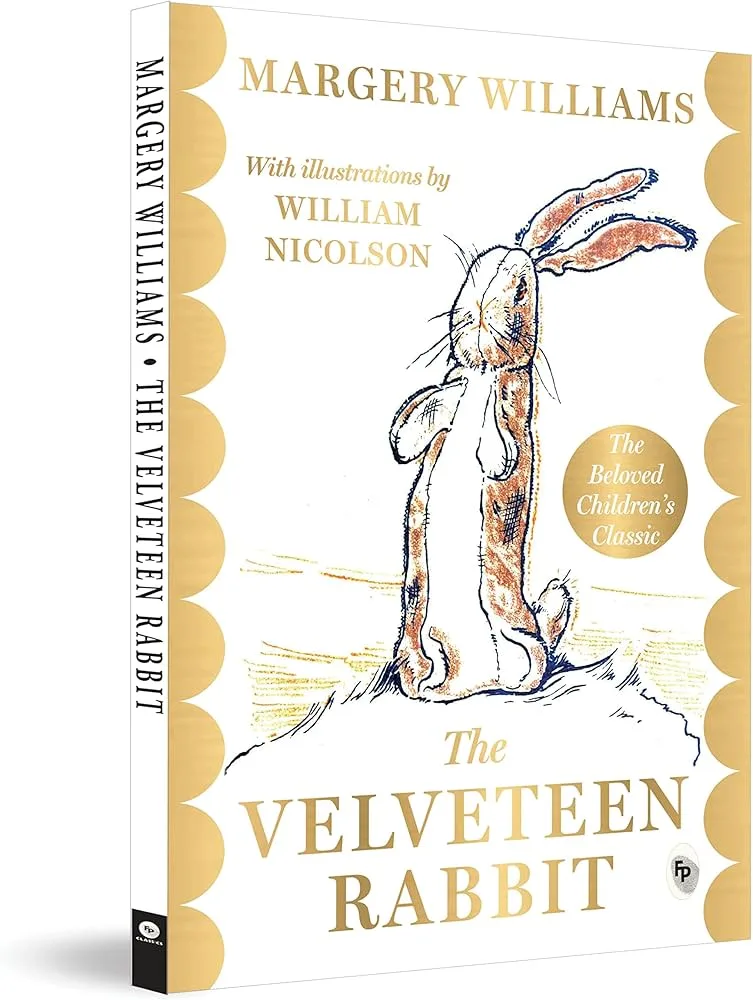
The Velveteen Rabbit
Paperback
• 56 Pages
• ₹ 149.00
• English
• 9789354406669
No ratings yet
| Publisher | Fingerprint Publishing |
|---|---|
| ISBN13 | 9789354406669 |
| ASIN/SKU | 9354406661 |
| Book Format | Paperback |
| Language | English |
| Pages | 56 |
| List Price | ₹ 149.00 |
| Publishing Date | 12/10/2022 |
| Dimensions | 12.7 x 0.41 x 19.05 cm |
| Weight | 51 g |
| Book Code | BD00055074 |
Buy this Book
Amazon Stores
Ebook Stores
Other Stores
Discover The Velveteen Rabbit by Margery Williams. This book is published by Fingerprint Publishing in Paperback format, ISBN 9789354406669, ASIN 9354406661, under Literature and Fiction, Cultural and Ethnic Studies, Literary Theory, History and Criticism.
Book Description
A lovely, fascinating tale of love and attachment, The Velveteen Rabbit, is a timeless picture book classic that has been read and cherished by many generations of children and their parents. It brings the reader wonder, heartbreak, and magic in a tale of love between a child and his favourite toy.
This classic tale is must-read for all!
It is one of the most beloved children’s tales of all times
It is a wonderful keepsake gift to treasure and share
This heart-warming story is accompanied by beautiful illustrations
The story will capture the attention of the reader and keep them hooked
It is a tale that will stay with the reader forever
This classic tale is must-read for all!
It is one of the most beloved children’s tales of all times
It is a wonderful keepsake gift to treasure and share
This heart-warming story is accompanied by beautiful illustrations
The story will capture the attention of the reader and keep them hooked
It is a tale that will stay with the reader forever
Author Biography
Margery Williams Bianco was an English–American author, primarily of popular children’s books. A professional writer since the age of nineteen, she achieved lasting fame at forty-one with the 1922 publication of the classic that is her best-known work, The Velveteen Rabbit.
Editorial Reviews
Editorial Reviews will be added soon…
Book Summary
The Velveteen Rabbit by Margery Williams is a beloved children's story about a simple stuffed rabbit who longs to become real. First published in 1922, the story explores love, friendship, childhood, sacrifice, loss, and the meaning of being “real.” Through the Rabbit's journey, Williams suggests that true worth does not come from appearance, newness, or perfection. Instead, something becomes truly precious through the love it receives and gives.
The story begins with a little boy receiving many beautiful toys for Christmas. Among them is a simple velveteen rabbit. Unlike some of the more elaborate toys, the Rabbit is not particularly impressive. It has soft brown fur, long ears, and a modest appearance.
At first, the Rabbit is largely ignored.
The boy's attention is drawn to newer and more exciting toys. The mechanical toys are especially admired because they can move and make sounds.
The Velveteen Rabbit feels insignificant.
He begins to wonder whether a toy can ever become truly important if nobody loves it.
One day, the Rabbit meets an older and wiser toy called the Skin Horse.
The Skin Horse has been in the nursery for a very long time. He is worn, faded, and missing some of the features that once made him look new.
The Rabbit is curious about him.
The Rabbit asks what it means to be Real.
The Skin Horse explains that being real does not depend upon how a toy looks or whether it is expensive or perfect.
Instead, something becomes real through love.
The Skin Horse tells the Rabbit that becoming real can take a long time. It may involve being loved so deeply that a toy becomes worn, shabby, and changed.
And sometimes, becoming real hurts.
The Rabbit is fascinated by this idea.
He wants more than anything to become real.
But he does not yet know what that will require.
The Rabbit Finds a Friend
The Rabbit eventually becomes the boy's favorite toy.
The boy begins carrying him everywhere.
They play together.
The Rabbit listens to the boy's stories and accompanies him during quiet moments.
The Rabbit becomes part of the child's world.
For the first time, the Rabbit experiences what it means to be loved.
His fur becomes worn.
His ears become softer.
His body begins to lose its original shape.
But instead of becoming less valuable, he becomes more precious.
The Rabbit is becoming Real.
This is one of the story's most beautiful ideas: wear and imperfection can be evidence of love rather than signs of worthlessness.
A new toy may look perfect.
But a well-loved toy carries memories.
Its worn appearance tells the story of all the time it has spent with someone.
Love Changes the Rabbit
As the Rabbit becomes more deeply loved, he begins to think and feel in ways that seem almost human.
He no longer worries about being the most beautiful toy.
He no longer compares himself with the newer toys.
He cares primarily about the boy.
This emotional transformation is at the center of the story.
The Rabbit becomes Real not because of magic alone, but because love changes the way he experiences the world.
He develops loyalty, tenderness, courage, and empathy.
The story therefore suggests that realness is connected to the ability to love deeply.
The Boy Becomes Ill
The happiness does not last forever.
The boy becomes seriously ill with scarlet fever.
The Rabbit remains beside him during his illness.
But after the boy recovers, the adults become concerned that the Rabbit has been exposed to the illness.
They decide that the Rabbit must be destroyed.
He is no longer seen as a beloved toy.
Instead, he is treated as something contaminated and dangerous.
The Rabbit is placed outside with other discarded objects, waiting to be burned.
This is devastating.
The Rabbit has finally become Real, yet the reward for that transformation appears to be abandonment.
He thinks about the boy.
He remembers their time together.
He feels grief because he believes that his relationship with the child has ended.
Yet even in this moment, his love remains.
He does not regret having loved the boy.
The Rabbit's Transformation
As the Rabbit waits outside, he begins to cry.
Then something magical happens.
A fairy appears.
She tells him that he is not merely a toy anymore.
Because he has been deeply loved, he has become Real.
The fairy transforms him into a living rabbit.
The Velveteen Rabbit suddenly becomes a real animal.
He can run.
He can jump.
He can live in the natural world.
The transformation is presented as the fulfillment of the Skin Horse's earlier explanation.
The Rabbit has become Real because he has experienced genuine love.
Returning to the Boy
The Rabbit eventually encounters the boy again.
The child sees a real rabbit and notices something familiar about it.
The rabbit's appearance reminds him of the old toy he once loved.
But he does not recognize the Rabbit completely.
The boy thinks the animal resembles his old Velveteen Rabbit, but he believes that his old toy was destroyed.
The Rabbit, however, recognizes the boy.
He remembers everything.
This creates a bittersweet ending.
The Rabbit has achieved his dream.
He is alive.
He is free.
He is Real.
But the person he loves no longer knows exactly who he is.
Nevertheless, the Rabbit is happy.
He has experienced something that cannot be taken away from him.
He has known love.
The Meaning of Being “Real”
The central question of The Velveteen Rabbit is simple:
What does it mean to be real?
The story's answer is not about physical existence.
The Rabbit becomes Real emotionally before he becomes Real physically.
He becomes Real because he is loved deeply enough to change.
This makes the story much more profound than a simple fairy tale.
The Rabbit begins by worrying about his appearance.
He compares himself with other toys.
He wants to be special.
But eventually he learns that being loved matters more than being perfect.
His fur becomes worn because someone has held him.
His body changes because someone has played with him.
His value increases precisely because he has been used and loved.
The story therefore challenges the idea that newness equals worth.
Love and Sacrifice
Love in the story is not presented as something comfortable or effortless.
The Rabbit suffers because he loves.
He risks being damaged.
He experiences rejection.
He faces the possibility of being destroyed.
Yet he continues to love the boy.
This suggests that genuine love requires vulnerability.
To love something means accepting that it can hurt you.
The Rabbit's transformation therefore comes through sacrifice as well as affection.
Childhood and Imagination
The story also celebrates the extraordinary imaginative world of childhood.
For the boy, toys are more than objects.
They become companions.
The boundary between imagination and reality becomes blurred.
The Rabbit's transformation into a real animal can therefore be understood as an extension of the child's imaginative world.
Children often give personality to their toys and imagine that they have feelings.
Williams takes that childhood belief seriously.
She asks readers to imagine what might happen if a beloved toy really could become alive.
The Value of Imperfection
Another important theme is imperfection.
The Rabbit becomes less attractive by ordinary standards as he is loved.
His fur becomes worn.
His body becomes shabby.
Yet these imperfections are exactly what make him special.
The Skin Horse is similarly worn and imperfect.
Both characters demonstrate that something does not become less valuable simply because it shows signs of age.
In fact, those marks can represent experience and affection.
This is a comforting message for children because it gently challenges the desire to remain perfect or new.
Friendship
The Rabbit's relationships with other toys also contribute to the story.
The Skin Horse becomes a mentor.
He explains something the Rabbit does not yet understand.
The Rabbit also learns from the other toys in the nursery that being popular or fashionable is not the same as being loved.
His friendship with the Skin Horse is particularly important because the older toy understands the pain and beauty of becoming Real.
The Skin Horse has already experienced the transformation emotionally.
He therefore becomes a source of wisdom for the Rabbit.
Loss
Although The Velveteen Rabbit is often remembered as a warm children's story, it contains a significant amount of sadness.
The Rabbit experiences abandonment.
He is separated from the boy.
He believes he is going to be destroyed.
And even after becoming real, he cannot fully return to his previous relationship with the child.
This makes the story emotionally honest.
Love does not always prevent loss.
Sometimes the things we love disappear or change.
But the story suggests that the experience of loving them remains meaningful.
A Story About Growing Up
The Rabbit's journey can also be interpreted as a metaphor for growing up.
At first, he wants to be admired.
Then he learns what it means to care for someone.
He discovers that love involves vulnerability.
He experiences suffering.
He loses something important.
And eventually, he becomes something new.
In this sense, the Rabbit's transformation resembles the emotional development that accompanies growing up.
Being “Real” means becoming capable of deeper feeling, responsibility, and love.
The Fairy as a Symbol of Love
The fairy who transforms the Rabbit can be understood in several ways.
She may represent literal magic within the story.
But she can also symbolize the power of love itself.
The Rabbit's transformation happens only after he has experienced genuine affection and sacrifice.
The fairy does not make him valuable.
She recognizes that he has already become valuable through love.
Her magic simply makes visible what has already happened emotionally.
Why the Story Remains Timeless
The Velveteen Rabbit has remained popular for generations because its emotional message is universal.
Children understand the joy of having a favorite toy.
Adults understand the deeper meaning of loving something that changes over time.
The story speaks to anyone who has ever wondered whether being imperfect makes them less valuable.
Its answer is reassuring:
No.
Love can make something more precious, not less.
A worn toy can be more meaningful than a new one.
A scar can represent survival.
An old object can carry memories.
A relationship can leave marks that are evidence of how deeply two beings have mattered to each other.
Conclusion
The Velveteen Rabbit is ultimately a story about the transformation that occurs when something is genuinely loved.
The Rabbit begins as an ordinary stuffed toy.
He wants to become special.
Through his relationship with the boy, he discovers something far more important than being beautiful or new.
He discovers love.
That love changes him.
He becomes worn, vulnerable, and imperfect—but also compassionate, loyal, and emotionally alive.
When the Rabbit is finally transformed into a real animal, the physical change simply reflects the emotional transformation that has already taken place.
The story's deepest lesson is that being Real is not about appearance.
It is about the capacity to love and to be loved.
It is about accepting that love may change us.
It is about understanding that imperfection can be beautiful because it carries the marks of experience.
And it is about recognizing that even when relationships end, the love experienced within them can remain meaningful.
The Velveteen Rabbit therefore offers children a gentle but profound message: you do not become valuable by being perfect; you become precious through the love you give and receive.
That is why this simple story about a stuffed rabbit continues to touch readers across generations. It transforms a child's favorite toy into a symbol of something much larger—the extraordinary power of love to make an ordinary life feel truly, wonderfully real.
The story begins with a little boy receiving many beautiful toys for Christmas. Among them is a simple velveteen rabbit. Unlike some of the more elaborate toys, the Rabbit is not particularly impressive. It has soft brown fur, long ears, and a modest appearance.
At first, the Rabbit is largely ignored.
The boy's attention is drawn to newer and more exciting toys. The mechanical toys are especially admired because they can move and make sounds.
The Velveteen Rabbit feels insignificant.
He begins to wonder whether a toy can ever become truly important if nobody loves it.
One day, the Rabbit meets an older and wiser toy called the Skin Horse.
The Skin Horse has been in the nursery for a very long time. He is worn, faded, and missing some of the features that once made him look new.
The Rabbit is curious about him.
The Rabbit asks what it means to be Real.
The Skin Horse explains that being real does not depend upon how a toy looks or whether it is expensive or perfect.
Instead, something becomes real through love.
The Skin Horse tells the Rabbit that becoming real can take a long time. It may involve being loved so deeply that a toy becomes worn, shabby, and changed.
And sometimes, becoming real hurts.
The Rabbit is fascinated by this idea.
He wants more than anything to become real.
But he does not yet know what that will require.
The Rabbit Finds a Friend
The Rabbit eventually becomes the boy's favorite toy.
The boy begins carrying him everywhere.
They play together.
The Rabbit listens to the boy's stories and accompanies him during quiet moments.
The Rabbit becomes part of the child's world.
For the first time, the Rabbit experiences what it means to be loved.
His fur becomes worn.
His ears become softer.
His body begins to lose its original shape.
But instead of becoming less valuable, he becomes more precious.
The Rabbit is becoming Real.
This is one of the story's most beautiful ideas: wear and imperfection can be evidence of love rather than signs of worthlessness.
A new toy may look perfect.
But a well-loved toy carries memories.
Its worn appearance tells the story of all the time it has spent with someone.
Love Changes the Rabbit
As the Rabbit becomes more deeply loved, he begins to think and feel in ways that seem almost human.
He no longer worries about being the most beautiful toy.
He no longer compares himself with the newer toys.
He cares primarily about the boy.
This emotional transformation is at the center of the story.
The Rabbit becomes Real not because of magic alone, but because love changes the way he experiences the world.
He develops loyalty, tenderness, courage, and empathy.
The story therefore suggests that realness is connected to the ability to love deeply.
The Boy Becomes Ill
The happiness does not last forever.
The boy becomes seriously ill with scarlet fever.
The Rabbit remains beside him during his illness.
But after the boy recovers, the adults become concerned that the Rabbit has been exposed to the illness.
They decide that the Rabbit must be destroyed.
He is no longer seen as a beloved toy.
Instead, he is treated as something contaminated and dangerous.
The Rabbit is placed outside with other discarded objects, waiting to be burned.
This is devastating.
The Rabbit has finally become Real, yet the reward for that transformation appears to be abandonment.
He thinks about the boy.
He remembers their time together.
He feels grief because he believes that his relationship with the child has ended.
Yet even in this moment, his love remains.
He does not regret having loved the boy.
The Rabbit's Transformation
As the Rabbit waits outside, he begins to cry.
Then something magical happens.
A fairy appears.
She tells him that he is not merely a toy anymore.
Because he has been deeply loved, he has become Real.
The fairy transforms him into a living rabbit.
The Velveteen Rabbit suddenly becomes a real animal.
He can run.
He can jump.
He can live in the natural world.
The transformation is presented as the fulfillment of the Skin Horse's earlier explanation.
The Rabbit has become Real because he has experienced genuine love.
Returning to the Boy
The Rabbit eventually encounters the boy again.
The child sees a real rabbit and notices something familiar about it.
The rabbit's appearance reminds him of the old toy he once loved.
But he does not recognize the Rabbit completely.
The boy thinks the animal resembles his old Velveteen Rabbit, but he believes that his old toy was destroyed.
The Rabbit, however, recognizes the boy.
He remembers everything.
This creates a bittersweet ending.
The Rabbit has achieved his dream.
He is alive.
He is free.
He is Real.
But the person he loves no longer knows exactly who he is.
Nevertheless, the Rabbit is happy.
He has experienced something that cannot be taken away from him.
He has known love.
The Meaning of Being “Real”
The central question of The Velveteen Rabbit is simple:
What does it mean to be real?
The story's answer is not about physical existence.
The Rabbit becomes Real emotionally before he becomes Real physically.
He becomes Real because he is loved deeply enough to change.
This makes the story much more profound than a simple fairy tale.
The Rabbit begins by worrying about his appearance.
He compares himself with other toys.
He wants to be special.
But eventually he learns that being loved matters more than being perfect.
His fur becomes worn because someone has held him.
His body changes because someone has played with him.
His value increases precisely because he has been used and loved.
The story therefore challenges the idea that newness equals worth.
Love and Sacrifice
Love in the story is not presented as something comfortable or effortless.
The Rabbit suffers because he loves.
He risks being damaged.
He experiences rejection.
He faces the possibility of being destroyed.
Yet he continues to love the boy.
This suggests that genuine love requires vulnerability.
To love something means accepting that it can hurt you.
The Rabbit's transformation therefore comes through sacrifice as well as affection.
Childhood and Imagination
The story also celebrates the extraordinary imaginative world of childhood.
For the boy, toys are more than objects.
They become companions.
The boundary between imagination and reality becomes blurred.
The Rabbit's transformation into a real animal can therefore be understood as an extension of the child's imaginative world.
Children often give personality to their toys and imagine that they have feelings.
Williams takes that childhood belief seriously.
She asks readers to imagine what might happen if a beloved toy really could become alive.
The Value of Imperfection
Another important theme is imperfection.
The Rabbit becomes less attractive by ordinary standards as he is loved.
His fur becomes worn.
His body becomes shabby.
Yet these imperfections are exactly what make him special.
The Skin Horse is similarly worn and imperfect.
Both characters demonstrate that something does not become less valuable simply because it shows signs of age.
In fact, those marks can represent experience and affection.
This is a comforting message for children because it gently challenges the desire to remain perfect or new.
Friendship
The Rabbit's relationships with other toys also contribute to the story.
The Skin Horse becomes a mentor.
He explains something the Rabbit does not yet understand.
The Rabbit also learns from the other toys in the nursery that being popular or fashionable is not the same as being loved.
His friendship with the Skin Horse is particularly important because the older toy understands the pain and beauty of becoming Real.
The Skin Horse has already experienced the transformation emotionally.
He therefore becomes a source of wisdom for the Rabbit.
Loss
Although The Velveteen Rabbit is often remembered as a warm children's story, it contains a significant amount of sadness.
The Rabbit experiences abandonment.
He is separated from the boy.
He believes he is going to be destroyed.
And even after becoming real, he cannot fully return to his previous relationship with the child.
This makes the story emotionally honest.
Love does not always prevent loss.
Sometimes the things we love disappear or change.
But the story suggests that the experience of loving them remains meaningful.
A Story About Growing Up
The Rabbit's journey can also be interpreted as a metaphor for growing up.
At first, he wants to be admired.
Then he learns what it means to care for someone.
He discovers that love involves vulnerability.
He experiences suffering.
He loses something important.
And eventually, he becomes something new.
In this sense, the Rabbit's transformation resembles the emotional development that accompanies growing up.
Being “Real” means becoming capable of deeper feeling, responsibility, and love.
The Fairy as a Symbol of Love
The fairy who transforms the Rabbit can be understood in several ways.
She may represent literal magic within the story.
But she can also symbolize the power of love itself.
The Rabbit's transformation happens only after he has experienced genuine affection and sacrifice.
The fairy does not make him valuable.
She recognizes that he has already become valuable through love.
Her magic simply makes visible what has already happened emotionally.
Why the Story Remains Timeless
The Velveteen Rabbit has remained popular for generations because its emotional message is universal.
Children understand the joy of having a favorite toy.
Adults understand the deeper meaning of loving something that changes over time.
The story speaks to anyone who has ever wondered whether being imperfect makes them less valuable.
Its answer is reassuring:
No.
Love can make something more precious, not less.
A worn toy can be more meaningful than a new one.
A scar can represent survival.
An old object can carry memories.
A relationship can leave marks that are evidence of how deeply two beings have mattered to each other.
Conclusion
The Velveteen Rabbit is ultimately a story about the transformation that occurs when something is genuinely loved.
The Rabbit begins as an ordinary stuffed toy.
He wants to become special.
Through his relationship with the boy, he discovers something far more important than being beautiful or new.
He discovers love.
That love changes him.
He becomes worn, vulnerable, and imperfect—but also compassionate, loyal, and emotionally alive.
When the Rabbit is finally transformed into a real animal, the physical change simply reflects the emotional transformation that has already taken place.
The story's deepest lesson is that being Real is not about appearance.
It is about the capacity to love and to be loved.
It is about accepting that love may change us.
It is about understanding that imperfection can be beautiful because it carries the marks of experience.
And it is about recognizing that even when relationships end, the love experienced within them can remain meaningful.
The Velveteen Rabbit therefore offers children a gentle but profound message: you do not become valuable by being perfect; you become precious through the love you give and receive.
That is why this simple story about a stuffed rabbit continues to touch readers across generations. It transforms a child's favorite toy into a symbol of something much larger—the extraordinary power of love to make an ordinary life feel truly, wonderfully real.
Sample Chapters
Sample Chapters will be added soon…
Reader Reviews
No reviews yet.
The Velveteen Rabbit
Download Cover Image
Do you want to download the full cover image for The Velveteen Rabbit?