
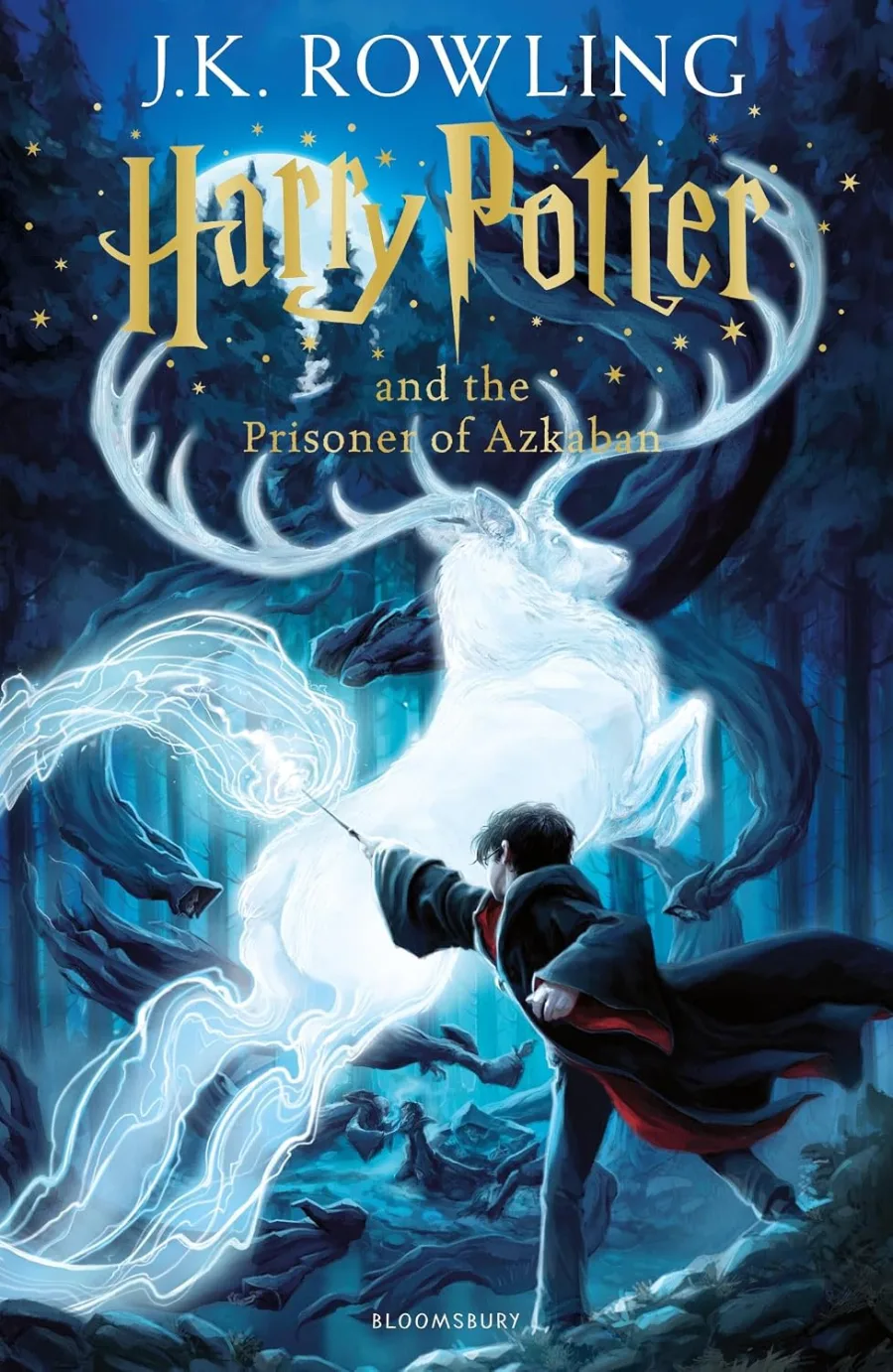
Harry Potter and the Prisoner of Azkaban
Paperback
• 480 Pages
• ₹ 390.00
• English
• 9781408855676
No ratings yet
| Publisher | Bloomsbury Children's Books |
|---|---|
| ISBN13 | 9781408855676 |
| ASIN/SKU | 1408855674 |
| Book Format | Paperback |
| Language | English |
| Pages | 480 |
| List Price | ₹ 390.00 |
| Publishing Date | 03/09/2014 |
| Dimensions | 13 x 3.1 x 19.7 cm |
| Weight | 1 kg 50 g |
| Book Code | BD00055066 |
Buy this Book
Amazon Stores
Ebook Stores
Other Stores
Discover Harry Potter and the Prisoner of Azkaban by J.K. Rowling. This book is published by Bloomsbury Children's Books in Paperback format, ISBN 9781408855676, ASIN 1408855674, under Literature and Fiction, Fantasy, Visionary and Metaphysical Fantasy Fiction for Children.
Book Description
When the Knight Bus crashes through the darkness and screeches to a halt in front of him, it's the start of another far from ordinary year at Hogwarts for Harry Potter. Sirius Black, escaped mass-murderer and follower of Lord Voldemort, is on the run - and they say he is coming after Harry. In his first ever Divination class, Professor Trelawney sees an omen of death in Harry's tea leaves . But perhaps most terrifying of all are the Dementors patrolling the school grounds, with their soul-sucking kiss.
These new editions of the classic and internationally bestselling, multi-award-winning series feature instantly pick-up-able new jackets by Jonny Duddle, with huge child appeal, to bring Harry Potter to the next generation of readers. It's time to PASS THE MAGIC ON.
These new editions of the classic and internationally bestselling, multi-award-winning series feature instantly pick-up-able new jackets by Jonny Duddle, with huge child appeal, to bring Harry Potter to the next generation of readers. It's time to PASS THE MAGIC ON.
Author Biography
J.K. Rowling is best known as the author of the seven Harry Potter books, which were published between 1997 and 2007. The enduringly popular adventures of Harry, Ron and Hermione have gone on to sell over 500 million copies, be translated into over 80 languages and made into eight blockbuster films. Alongside the Harry Potter series, she also wrote three short companion volumes for charity: Quidditch Through the Ages and Fantastic Beasts and Where to Find Them, in aid of Comic Relief and Lumos, and The Tales of Beedle the Bard, in aid of Lumos. J.K. Rowling collaborated with playwright Jack Thorne and director John Tiffany to continue Harry's story in a stage play, Harry Potter and the Cursed Child, which opened in London in 2016 and is now playing worldwide. In the same year, she made her debut as a screenwriter with the film Fantastic Beasts and Where to Find Them, the first in a series featuring Magizoologist Newt Scamander, which was inspired by the original companion volume. J.K. Rowling has also written a standalone novel, The Casual Vacancy, and is the author of the Strike crime series under the pseudonym Robert Galbraith. Both have been adapted for television. In 2020 J.K. Rowling returned to publishing for younger children with the fairy tale The Ickabog, the royalties from which she is donating to groups affected by the Covid-19 pandemic. Her latest children's novel The Christmas Pig, a standalone adventure story, was published in 2021. She has received many awards and honours, including an OBE and a Companion of Honour for services to literature and philanthropy. She lives in Scotland with her family.
Editorial Reviews
I've yet to meet a ten-year-old who hasn't been entranced by its witty, complex plot and the character of the eponymous Harry ― Independent
Spellbinding, enchanting, bewitching stuff ― Mirror
Teachers say a chapter can silence the most rowdy of classes ― Guardian
One of the greatest literary adventures of modern times ― Sunday Telegraph
The Harry Potter stories will join that small group of children's books which are read and reread into adulthood ― TLS
Book Description
It's time to PASS THE MAGIC ON - with brand new children's editions of the classic and internationally bestselling series
Spellbinding, enchanting, bewitching stuff ― Mirror
Teachers say a chapter can silence the most rowdy of classes ― Guardian
One of the greatest literary adventures of modern times ― Sunday Telegraph
The Harry Potter stories will join that small group of children's books which are read and reread into adulthood ― TLS
Book Description
It's time to PASS THE MAGIC ON - with brand new children's editions of the classic and internationally bestselling series
Book Summary
Harry Potter and the Prisoner of Azkaban is the third novel in J.K. Rowling's Harry Potter series. It is a darker and more emotionally complex story than the first two books, exploring friendship, fear, betrayal, forgiveness, identity, and the lasting effects of the past. The novel follows Harry Potter during his third year at Hogwarts, when a dangerous prisoner named Sirius Black escapes from the wizarding prison of Azkaban and appears to be coming after Harry.
The story begins during Harry's summer with the Dursleys. As usual, Harry is treated as an inconvenience rather than as part of the family. His aunt, uncle, and cousin continue to resent his magical abilities, and Harry desperately looks forward to returning to Hogwarts.
Things become particularly unpleasant when Aunt Marge, Uncle Vernon's sister, visits the Dursleys. She insults Harry and speaks cruelly about his parents. Unable to control his anger, Harry accidentally uses magic and causes Aunt Marge to inflate like a balloon and float toward the ceiling.
Realizing that he has broken the rules, Harry runs away from the Dursleys.
He expects to be punished by the Ministry of Magic, but something surprising happens. Instead of arresting him, the Ministry treats the incident with unusual understanding. Harry is taken to the Leaky Cauldron, where he discovers that the wizarding world is deeply concerned about another matter: the escape of Sirius Black.
Sirius Black is considered extremely dangerous.
He was convicted of betraying Harry's parents to Lord Voldemort and murdering several people. He has now escaped from Azkaban, the wizarding prison guarded by terrifying creatures called Dementors.
Harry soon learns that Sirius may have escaped specifically to find him.
This makes Harry afraid. Sirius is said to have been one of Voldemort's most devoted followers, and Harry believes that he may want to finish the work Voldemort began when he killed Harry's parents.
Harry returns to Hogwarts for his third year, but the atmosphere is different.
Dementors are stationed around the school grounds because the Ministry believes Sirius may attempt to enter Hogwarts. Their presence has a devastating effect on Harry.
Dementors are creatures that feed on happiness and hope. When they approach, people experience their darkest memories and deepest despair. Harry is particularly vulnerable because their presence causes him to relive the night his parents were murdered.
During the journey to Hogwarts, a Dementor enters the train compartment where Harry, Ron, and Hermione are sitting. Harry loses consciousness.
He is rescued by the new Defense Against the Dark Arts teacher, Professor Remus Lupin.
Lupin is calm, intelligent, and unusually compassionate. He teaches Harry a defensive spell called the Patronus Charm, which can repel Dementors.
Lupin becomes one of Harry's favorite teachers, but his connection to the events surrounding Harry's parents is deeper than Harry initially realizes.
At Hogwarts, the new school year brings several changes.
Hermione has an extraordinarily heavy timetable and appears to be taking more classes than should physically fit into a normal schedule. Harry and Ron notice that she frequently disappears and reappears in strange circumstances, but Hermione refuses to explain.
Another new subject is Divination, taught by the dramatic Professor Sybill Trelawney.
Trelawney constantly predicts disaster, death, and tragedy, often announcing that Harry is destined to die. Harry and Ron are skeptical of her predictions, and the scenes involving Divination provide much of the novel's humor.
Meanwhile, the students begin studying Care of Magical Creatures under Hagrid.
Hagrid introduces them to a hippogriff named Buckbeak, a magnificent creature that combines the features of an eagle and a horse.
Harry treats Buckbeak respectfully and earns the creature's trust. Draco Malfoy, however, deliberately behaves disrespectfully toward it and is injured when Buckbeak reacts defensively.
Draco's father demands that Buckbeak be executed.
This subplot becomes important because it demonstrates how power and privilege can influence justice. Hagrid is devastated because Buckbeak was not intentionally violent, yet the authorities seem more interested in protecting Draco's status than examining the circumstances fairly.
Harry, Ron, and Hermione attempt to help.
Their concern for Buckbeak also reflects one of the central themes of the novel: compassion toward vulnerable beings.
As the school year continues, Harry becomes increasingly interested in Sirius Black.
He discovers a magical map called the Marauder's Map, which shows the location of people throughout Hogwarts. The map was created by four former Hogwarts students known as the Marauders: Moony, Wormtail, Padfoot, and Prongs.
Harry initially does not understand the significance of these names.
He also begins hearing more about his father's time at Hogwarts. Lupin knew Harry's parents and appears to have been close to them.
This creates a connection between Harry's present and the mysterious past of his parents.
Harry eventually learns that Sirius Black had been one of his father's closest friends.
This makes Sirius's betrayal seem even more painful.
According to the story Harry has been told, Sirius was trusted by James and Lily Potter but betrayed them by revealing their hiding place to Voldemort. Sirius then supposedly murdered Peter Pettigrew and several Muggles.
Harry has therefore grown up believing that Sirius is responsible for his parents' deaths.
But the truth is far more complicated.
As the year progresses, Harry continues to struggle with the Dementors. Lupin teaches him the Patronus Charm, and Harry gradually becomes better at defending himself.
The Patronus becomes an important symbol of Harry's development. Unlike many magical spells, it requires positive memories and emotional strength.
Harry initially struggles because his happiest memories are connected to his parents, whose deaths are also the source of his deepest trauma.
Learning to create a Patronus therefore means learning to draw strength from memories of love rather than allowing grief to overwhelm him.
Harry eventually succeeds in producing a powerful Patronus in the form of a stag.
The stag has special significance because it is associated with his father, James Potter, whose Animagus form was a stag.
As the story approaches its climax, Harry, Ron, and Hermione discover that the mystery surrounding Sirius is connected to another figure from Harry's past.
That figure is Peter Pettigrew.
Pettigrew had supposedly been murdered by Sirius years earlier.
But the truth is shocking.
Peter Pettigrew is alive.
He has been hiding in plain sight for years in the form of Ron's pet rat, Scabbers.
The discovery completely changes the story.
Pettigrew was one of James Potter's friends and was also an Animagus. He had secretly become a servant of Voldemort and betrayed the Potters' location.
Sirius did not betray Harry's parents.
Pettigrew did.
After Voldemort attacked the Potters, Pettigrew staged his own death and framed Sirius for the crime. Sirius was arrested and sent to Azkaban without a proper trial.
For twelve years, the world believed Sirius was a murderer.
In reality, he had been imprisoned for a crime he did not commit.
This revelation transforms Sirius from a frightening villain into a tragic figure.
He is Harry's godfather.
He loved James and Lily.
He lost his friends and spent years imprisoned because of Pettigrew's betrayal.
Harry finally has the opportunity to meet the man who was supposed to be part of his family.
The reunion is emotional because Harry has spent most of his life without knowing his godfather.
Sirius tells Harry the truth about what happened to his parents.
He also explains that Pettigrew remained hidden because he feared Voldemort and wanted to protect himself.
Remus Lupin's connection to the story is also revealed.
He was one of the original Marauders.
His nickname was Moony because he is a werewolf.
James Potter, Sirius Black, and Peter Pettigrew had secretly learned to become Animagi in order to accompany Lupin during his transformations.
James became the stag, Sirius became a large black dog, and Peter became a rat.
Their friendship had once been extraordinarily close.
But Pettigrew's betrayal destroyed everything.
The revelation about Lupin adds another layer of tragedy. He has been living with the stigma of being a werewolf, which has made it difficult for him to find stable employment or relationships.
Yet he is gentle, intelligent, and compassionate.
His character demonstrates that a person's identity cannot be reduced to a condition or label.
This connects with another major theme of the novel: prejudice.
Werewolves are feared and discriminated against, much as Sirius has been judged based on a false story.
The novel repeatedly asks whether people should be defined by reputation, labels, or past assumptions.
Harry himself must learn to question what he has been told.
The confrontation in the Shrieking Shack becomes the emotional center of the story.
Harry, Ron, Hermione, Sirius, and Lupin confront Pettigrew.
For the first time, Harry sees the people responsible for the tragedy surrounding his parents gathered together.
Pettigrew is exposed as the true traitor.
Sirius wants revenge.
Harry has every reason to hate Pettigrew because Pettigrew's actions caused his parents' deaths and ruined Sirius's life.
Yet Harry ultimately refuses to allow revenge to define him.
He prevents Sirius and Lupin from killing Pettigrew.
This is an important moment in Harry's moral development.
Harry does not forgive Pettigrew for what he has done, but he chooses not to become an executioner.
He believes that his father would not want him to become a murderer.
The decision demonstrates Harry's growing ability to separate justice from revenge.
Unfortunately, the situation soon becomes complicated.
Pettigrew escapes.
The truth about Sirius is still not known publicly, and the Ministry remains convinced that he is a dangerous criminal.
Sirius is therefore forced to flee.
Before he leaves, however, Harry learns that Sirius is his godfather and that he may have a chance to live with him someday.
For Harry, this possibility represents something enormous: the possibility of finally having a family member who loves him.
But the opportunity is lost when Sirius is forced into hiding.
The emotional disappointment is painful because Harry has briefly imagined a different future.
Yet the story does not end there.
Harry eventually learns more about the importance of hope.
He discovers that although he cannot immediately change his circumstances, he now knows the truth about his parents and Sirius.
He is no longer living entirely according to someone else's version of his past.
The novel's final major revelation involves the Time-Turner, a magical device Hermione has been using to attend multiple classes.
Dumbledore and Hermione use it to travel back in time and rescue Buckbeak.
Harry and Hermione also return to the earlier events surrounding Sirius.
Harry sees a mysterious figure producing a powerful Patronus that saves him and Sirius from the Dementors.
He initially believes this person is his father.
But he later realizes the truth.
The person producing the Patronus was Harry himself.
This is one of the most beautiful moments in the novel.
Harry has been waiting for his father to rescue him, but he discovers that he is capable of becoming his own source of strength.
The Patronus represents Harry's emotional growth.
He does not need to remain permanently defined by his parents' absence.
Their love has shaped him, but he must eventually learn to carry that love within himself.
The novel therefore develops the theme of growing up in a particularly powerful way.
Harry is still a child, but he is beginning to understand that adults can make mistakes, institutions can be unjust, and the stories people tell about the past can be wrong.
He also learns that there are no simple categories of good and evil.
Sirius is a good man who has been treated as a criminal.
Pettigrew is a former friend who becomes a traitor.
Lupin is a kind teacher who is feared because of something he cannot completely control.
The Ministry represents authority but does not necessarily represent justice.
These complexities make The Prisoner of Azkaban a major turning point in the series.
The novel's title refers to Sirius, but it also has a deeper meaning.
Sirius is literally a prisoner of Azkaban for much of the story.
But Harry is also, in a sense, a prisoner of the past.
He has spent his life defined by the night his parents died. The revelation about Sirius and Pettigrew begins to free him from the false story surrounding that night.
Even Lupin is imprisoned by social prejudice surrounding werewolves.
The characters are therefore trapped in different ways.
Freedom comes through truth, compassion, and the willingness to question assumptions.
Another major theme is memory.
The Dementors force Harry to relive the most painful memory of his life. At first, these memories make him helpless.
But over time, Harry learns to face them.
The story suggests that painful memories do not necessarily have to control us forever. We cannot erase them, but we can learn to carry them differently.
This is closely connected with the novel's treatment of grief.
Harry cannot bring his parents back.
He cannot undo Sirius's imprisonment.
He cannot erase Pettigrew's betrayal.
But he can choose what to do with the truth.
He can honor his parents without allowing grief to destroy him.
The novel is also deeply concerned with friendship.
Harry, Ron, and Hermione remain loyal to one another despite disagreements and danger. Hermione's willingness to risk punishment to help Buckbeak and Sirius demonstrates how seriously she takes justice.
Ron, even when frightened, remains beside Harry.
Their friendship gives Harry the emotional support he needs while confronting increasingly difficult truths.
Ultimately, Harry Potter and the Prisoner of Azkaban is a story about discovering that the past is rarely as simple as it first appears.
The frightening prisoner turns out to be a wrongfully imprisoned godfather.
The supposedly dead friend is revealed to be a living traitor.
The beloved teacher is secretly a werewolf.
The heroic father is remembered through both his kindness and his youthful mistakes.
And the mysterious savior Harry expects to be his father turns out to be himself.
These revelations make the novel both a mystery and a coming-of-age story.
Harry begins the book frightened by a man he believes is coming to kill him.
He ends it understanding that the man he feared may actually be one of the people who loves him most.
That transformation is the emotional heart of the novel.
Harry Potter and the Prisoner of Azkaban ultimately teaches that truth can be painful, but living according to a lie can be even more damaging. It encourages readers to question assumptions, resist prejudice, distinguish justice from revenge, and understand that people are often more complicated than the labels placed upon them.
Most importantly, Harry discovers that courage does not always mean defeating an enemy.
Sometimes it means facing painful memories.
Sometimes it means refusing revenge.
Sometimes it means trusting a friend.
And sometimes it means realizing that the person capable of saving you may be yourself.
Through Sirius Black, Remus Lupin, Peter Pettigrew, the Dementors, and the mystery of Harry's parents, Rowling creates one of the series' most emotionally resonant stories—a tale in which friendship, truth, memory, and forgiveness become more powerful than fear.
The story begins during Harry's summer with the Dursleys. As usual, Harry is treated as an inconvenience rather than as part of the family. His aunt, uncle, and cousin continue to resent his magical abilities, and Harry desperately looks forward to returning to Hogwarts.
Things become particularly unpleasant when Aunt Marge, Uncle Vernon's sister, visits the Dursleys. She insults Harry and speaks cruelly about his parents. Unable to control his anger, Harry accidentally uses magic and causes Aunt Marge to inflate like a balloon and float toward the ceiling.
Realizing that he has broken the rules, Harry runs away from the Dursleys.
He expects to be punished by the Ministry of Magic, but something surprising happens. Instead of arresting him, the Ministry treats the incident with unusual understanding. Harry is taken to the Leaky Cauldron, where he discovers that the wizarding world is deeply concerned about another matter: the escape of Sirius Black.
Sirius Black is considered extremely dangerous.
He was convicted of betraying Harry's parents to Lord Voldemort and murdering several people. He has now escaped from Azkaban, the wizarding prison guarded by terrifying creatures called Dementors.
Harry soon learns that Sirius may have escaped specifically to find him.
This makes Harry afraid. Sirius is said to have been one of Voldemort's most devoted followers, and Harry believes that he may want to finish the work Voldemort began when he killed Harry's parents.
Harry returns to Hogwarts for his third year, but the atmosphere is different.
Dementors are stationed around the school grounds because the Ministry believes Sirius may attempt to enter Hogwarts. Their presence has a devastating effect on Harry.
Dementors are creatures that feed on happiness and hope. When they approach, people experience their darkest memories and deepest despair. Harry is particularly vulnerable because their presence causes him to relive the night his parents were murdered.
During the journey to Hogwarts, a Dementor enters the train compartment where Harry, Ron, and Hermione are sitting. Harry loses consciousness.
He is rescued by the new Defense Against the Dark Arts teacher, Professor Remus Lupin.
Lupin is calm, intelligent, and unusually compassionate. He teaches Harry a defensive spell called the Patronus Charm, which can repel Dementors.
Lupin becomes one of Harry's favorite teachers, but his connection to the events surrounding Harry's parents is deeper than Harry initially realizes.
At Hogwarts, the new school year brings several changes.
Hermione has an extraordinarily heavy timetable and appears to be taking more classes than should physically fit into a normal schedule. Harry and Ron notice that she frequently disappears and reappears in strange circumstances, but Hermione refuses to explain.
Another new subject is Divination, taught by the dramatic Professor Sybill Trelawney.
Trelawney constantly predicts disaster, death, and tragedy, often announcing that Harry is destined to die. Harry and Ron are skeptical of her predictions, and the scenes involving Divination provide much of the novel's humor.
Meanwhile, the students begin studying Care of Magical Creatures under Hagrid.
Hagrid introduces them to a hippogriff named Buckbeak, a magnificent creature that combines the features of an eagle and a horse.
Harry treats Buckbeak respectfully and earns the creature's trust. Draco Malfoy, however, deliberately behaves disrespectfully toward it and is injured when Buckbeak reacts defensively.
Draco's father demands that Buckbeak be executed.
This subplot becomes important because it demonstrates how power and privilege can influence justice. Hagrid is devastated because Buckbeak was not intentionally violent, yet the authorities seem more interested in protecting Draco's status than examining the circumstances fairly.
Harry, Ron, and Hermione attempt to help.
Their concern for Buckbeak also reflects one of the central themes of the novel: compassion toward vulnerable beings.
As the school year continues, Harry becomes increasingly interested in Sirius Black.
He discovers a magical map called the Marauder's Map, which shows the location of people throughout Hogwarts. The map was created by four former Hogwarts students known as the Marauders: Moony, Wormtail, Padfoot, and Prongs.
Harry initially does not understand the significance of these names.
He also begins hearing more about his father's time at Hogwarts. Lupin knew Harry's parents and appears to have been close to them.
This creates a connection between Harry's present and the mysterious past of his parents.
Harry eventually learns that Sirius Black had been one of his father's closest friends.
This makes Sirius's betrayal seem even more painful.
According to the story Harry has been told, Sirius was trusted by James and Lily Potter but betrayed them by revealing their hiding place to Voldemort. Sirius then supposedly murdered Peter Pettigrew and several Muggles.
Harry has therefore grown up believing that Sirius is responsible for his parents' deaths.
But the truth is far more complicated.
As the year progresses, Harry continues to struggle with the Dementors. Lupin teaches him the Patronus Charm, and Harry gradually becomes better at defending himself.
The Patronus becomes an important symbol of Harry's development. Unlike many magical spells, it requires positive memories and emotional strength.
Harry initially struggles because his happiest memories are connected to his parents, whose deaths are also the source of his deepest trauma.
Learning to create a Patronus therefore means learning to draw strength from memories of love rather than allowing grief to overwhelm him.
Harry eventually succeeds in producing a powerful Patronus in the form of a stag.
The stag has special significance because it is associated with his father, James Potter, whose Animagus form was a stag.
As the story approaches its climax, Harry, Ron, and Hermione discover that the mystery surrounding Sirius is connected to another figure from Harry's past.
That figure is Peter Pettigrew.
Pettigrew had supposedly been murdered by Sirius years earlier.
But the truth is shocking.
Peter Pettigrew is alive.
He has been hiding in plain sight for years in the form of Ron's pet rat, Scabbers.
The discovery completely changes the story.
Pettigrew was one of James Potter's friends and was also an Animagus. He had secretly become a servant of Voldemort and betrayed the Potters' location.
Sirius did not betray Harry's parents.
Pettigrew did.
After Voldemort attacked the Potters, Pettigrew staged his own death and framed Sirius for the crime. Sirius was arrested and sent to Azkaban without a proper trial.
For twelve years, the world believed Sirius was a murderer.
In reality, he had been imprisoned for a crime he did not commit.
This revelation transforms Sirius from a frightening villain into a tragic figure.
He is Harry's godfather.
He loved James and Lily.
He lost his friends and spent years imprisoned because of Pettigrew's betrayal.
Harry finally has the opportunity to meet the man who was supposed to be part of his family.
The reunion is emotional because Harry has spent most of his life without knowing his godfather.
Sirius tells Harry the truth about what happened to his parents.
He also explains that Pettigrew remained hidden because he feared Voldemort and wanted to protect himself.
Remus Lupin's connection to the story is also revealed.
He was one of the original Marauders.
His nickname was Moony because he is a werewolf.
James Potter, Sirius Black, and Peter Pettigrew had secretly learned to become Animagi in order to accompany Lupin during his transformations.
James became the stag, Sirius became a large black dog, and Peter became a rat.
Their friendship had once been extraordinarily close.
But Pettigrew's betrayal destroyed everything.
The revelation about Lupin adds another layer of tragedy. He has been living with the stigma of being a werewolf, which has made it difficult for him to find stable employment or relationships.
Yet he is gentle, intelligent, and compassionate.
His character demonstrates that a person's identity cannot be reduced to a condition or label.
This connects with another major theme of the novel: prejudice.
Werewolves are feared and discriminated against, much as Sirius has been judged based on a false story.
The novel repeatedly asks whether people should be defined by reputation, labels, or past assumptions.
Harry himself must learn to question what he has been told.
The confrontation in the Shrieking Shack becomes the emotional center of the story.
Harry, Ron, Hermione, Sirius, and Lupin confront Pettigrew.
For the first time, Harry sees the people responsible for the tragedy surrounding his parents gathered together.
Pettigrew is exposed as the true traitor.
Sirius wants revenge.
Harry has every reason to hate Pettigrew because Pettigrew's actions caused his parents' deaths and ruined Sirius's life.
Yet Harry ultimately refuses to allow revenge to define him.
He prevents Sirius and Lupin from killing Pettigrew.
This is an important moment in Harry's moral development.
Harry does not forgive Pettigrew for what he has done, but he chooses not to become an executioner.
He believes that his father would not want him to become a murderer.
The decision demonstrates Harry's growing ability to separate justice from revenge.
Unfortunately, the situation soon becomes complicated.
Pettigrew escapes.
The truth about Sirius is still not known publicly, and the Ministry remains convinced that he is a dangerous criminal.
Sirius is therefore forced to flee.
Before he leaves, however, Harry learns that Sirius is his godfather and that he may have a chance to live with him someday.
For Harry, this possibility represents something enormous: the possibility of finally having a family member who loves him.
But the opportunity is lost when Sirius is forced into hiding.
The emotional disappointment is painful because Harry has briefly imagined a different future.
Yet the story does not end there.
Harry eventually learns more about the importance of hope.
He discovers that although he cannot immediately change his circumstances, he now knows the truth about his parents and Sirius.
He is no longer living entirely according to someone else's version of his past.
The novel's final major revelation involves the Time-Turner, a magical device Hermione has been using to attend multiple classes.
Dumbledore and Hermione use it to travel back in time and rescue Buckbeak.
Harry and Hermione also return to the earlier events surrounding Sirius.
Harry sees a mysterious figure producing a powerful Patronus that saves him and Sirius from the Dementors.
He initially believes this person is his father.
But he later realizes the truth.
The person producing the Patronus was Harry himself.
This is one of the most beautiful moments in the novel.
Harry has been waiting for his father to rescue him, but he discovers that he is capable of becoming his own source of strength.
The Patronus represents Harry's emotional growth.
He does not need to remain permanently defined by his parents' absence.
Their love has shaped him, but he must eventually learn to carry that love within himself.
The novel therefore develops the theme of growing up in a particularly powerful way.
Harry is still a child, but he is beginning to understand that adults can make mistakes, institutions can be unjust, and the stories people tell about the past can be wrong.
He also learns that there are no simple categories of good and evil.
Sirius is a good man who has been treated as a criminal.
Pettigrew is a former friend who becomes a traitor.
Lupin is a kind teacher who is feared because of something he cannot completely control.
The Ministry represents authority but does not necessarily represent justice.
These complexities make The Prisoner of Azkaban a major turning point in the series.
The novel's title refers to Sirius, but it also has a deeper meaning.
Sirius is literally a prisoner of Azkaban for much of the story.
But Harry is also, in a sense, a prisoner of the past.
He has spent his life defined by the night his parents died. The revelation about Sirius and Pettigrew begins to free him from the false story surrounding that night.
Even Lupin is imprisoned by social prejudice surrounding werewolves.
The characters are therefore trapped in different ways.
Freedom comes through truth, compassion, and the willingness to question assumptions.
Another major theme is memory.
The Dementors force Harry to relive the most painful memory of his life. At first, these memories make him helpless.
But over time, Harry learns to face them.
The story suggests that painful memories do not necessarily have to control us forever. We cannot erase them, but we can learn to carry them differently.
This is closely connected with the novel's treatment of grief.
Harry cannot bring his parents back.
He cannot undo Sirius's imprisonment.
He cannot erase Pettigrew's betrayal.
But he can choose what to do with the truth.
He can honor his parents without allowing grief to destroy him.
The novel is also deeply concerned with friendship.
Harry, Ron, and Hermione remain loyal to one another despite disagreements and danger. Hermione's willingness to risk punishment to help Buckbeak and Sirius demonstrates how seriously she takes justice.
Ron, even when frightened, remains beside Harry.
Their friendship gives Harry the emotional support he needs while confronting increasingly difficult truths.
Ultimately, Harry Potter and the Prisoner of Azkaban is a story about discovering that the past is rarely as simple as it first appears.
The frightening prisoner turns out to be a wrongfully imprisoned godfather.
The supposedly dead friend is revealed to be a living traitor.
The beloved teacher is secretly a werewolf.
The heroic father is remembered through both his kindness and his youthful mistakes.
And the mysterious savior Harry expects to be his father turns out to be himself.
These revelations make the novel both a mystery and a coming-of-age story.
Harry begins the book frightened by a man he believes is coming to kill him.
He ends it understanding that the man he feared may actually be one of the people who loves him most.
That transformation is the emotional heart of the novel.
Harry Potter and the Prisoner of Azkaban ultimately teaches that truth can be painful, but living according to a lie can be even more damaging. It encourages readers to question assumptions, resist prejudice, distinguish justice from revenge, and understand that people are often more complicated than the labels placed upon them.
Most importantly, Harry discovers that courage does not always mean defeating an enemy.
Sometimes it means facing painful memories.
Sometimes it means refusing revenge.
Sometimes it means trusting a friend.
And sometimes it means realizing that the person capable of saving you may be yourself.
Through Sirius Black, Remus Lupin, Peter Pettigrew, the Dementors, and the mystery of Harry's parents, Rowling creates one of the series' most emotionally resonant stories—a tale in which friendship, truth, memory, and forgiveness become more powerful than fear.
Sample Chapters
Sample Chapters will be added soon…
Reader Reviews
No reviews yet.
Harry Potter and the Prisoner of Azkaban
Download Cover Image
Do you want to download the full cover image for Harry Potter and the Prisoner of Azkaban?