
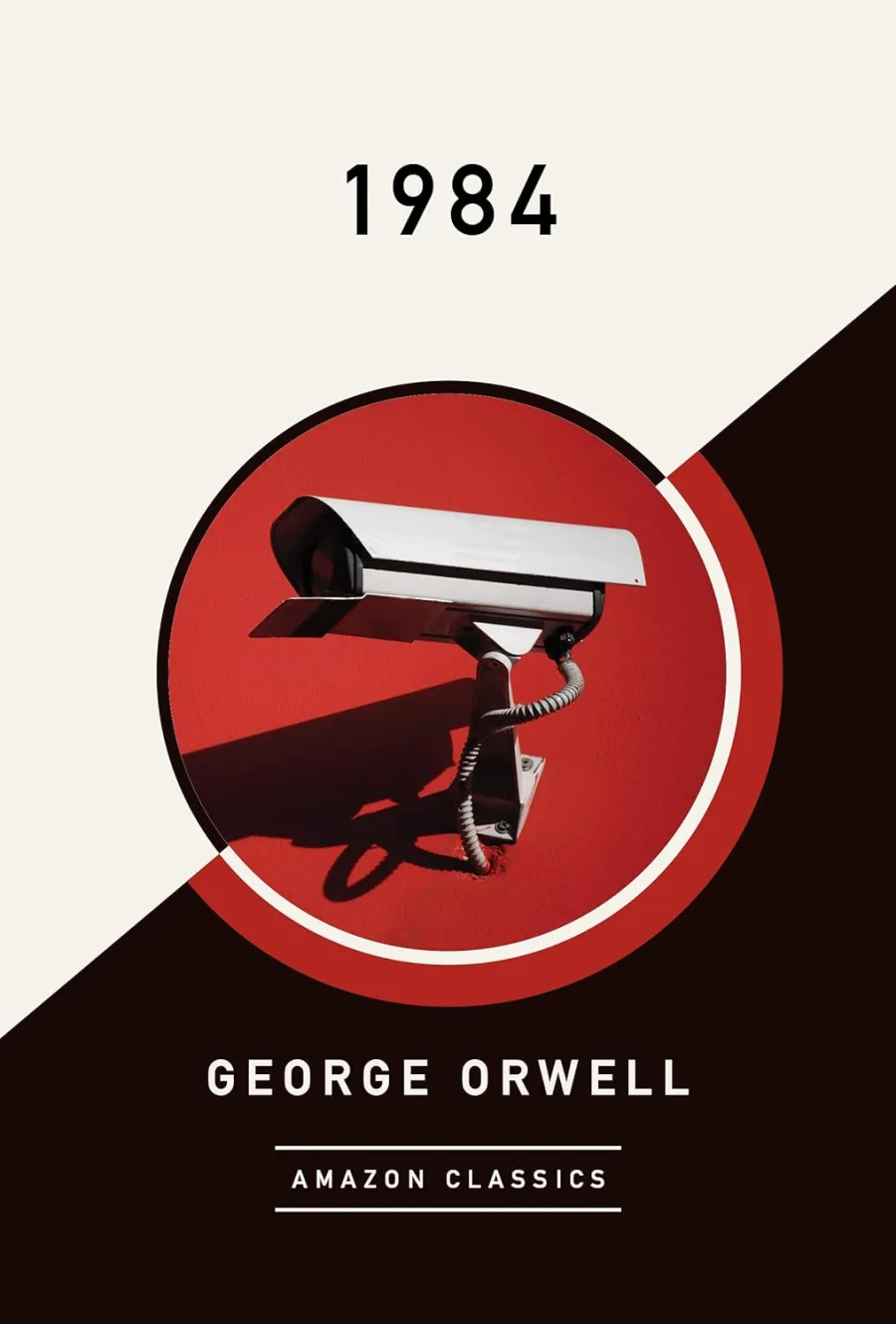
1984 (AmazonClassics Edition)
eBook
• 161 Pages
• ₹ 69.00
• English
• 9781542025799
No ratings yet
| Publisher | AmazonClassics |
|---|---|
| ISBN13 | 9781542025799 |
| ASIN/SKU | B088H7KLCG |
| Book Format | eBook |
| Language | English |
| Pages | 161 |
| List Price | ₹ 69.00 |
| Publishing Date | 05/01/2021 |
| Book Code | BD00055060 |
Buy this Book
Amazon Stores
Ebook Stores
Other Stores
Discover 1984 (AmazonClassics Edition) by George Orwell. This book is published by AmazonClassics in eBook format, ISBN 9781542025799, ASIN B088H7KLCG, under Literature and Fiction, Science Fiction, Dystopian Fiction.
Book Description
In Oceania, one of three totalitarian states that rule the world, Big Brother is watching. The Thought Police are listening. Reality is defined by the Party. And in London, at the Ministry of Truth, Winston Smith’s job is to rewrite history. His dream, however, is to rebel. Winston is beginning to think for himself. In defiance of the State, he falls into a criminal love affair with his coworker Julia. But it isn’t until he joins the Brotherhood, an underground network of revolutionaries, that Winston discovers how high the cost of freedom may be.
Cautionary, prophetic, and inescapably contemporary, George Orwell’s prescient dystopian novel speaks truth to power in resisting government overreach, totalitarianism, and oppressive mass control.
Revised edition: Previously published as 1984, this edition of 1984 (AmazonClassics Edition) includes editorial revisions.
Cautionary, prophetic, and inescapably contemporary, George Orwell’s prescient dystopian novel speaks truth to power in resisting government overreach, totalitarianism, and oppressive mass control.
Revised edition: Previously published as 1984, this edition of 1984 (AmazonClassics Edition) includes editorial revisions.
Author Biography
George Orwell is one of England's most famous writers and social commentators. Among his works are the classic political satire Animal Farm and the dystopian nightmare vision Nineteen Eighty-Four. Orwell was also a prolific essayist, and it is for these works that he was perhaps best known during his lifetime. They include Why I Write and Politics and the English Language. His writing is at once insightful, poignant and entertaining, and continues to be read widely all over the world.
Eric Arthur Blair (George Orwell) was born in 1903 in India, where his father worked for the Civil Service. The family moved to England in 1907 and in 1917 Orwell entered Eton, where he contributed regularly to the various college magazines. From 1922 to 1927 he served with the Indian Imperial Police in Burma, an experience that inspired his first novel, Burmese Days (1934). Several years of poverty followed. He lived in Paris for two years before returning to England, where he worked successively as a private tutor, schoolteacher and bookshop assistant, and contributed reviews and articles to a number of periodicals. Down and Out in Paris and London was published in 1933. In 1936 he was commissioned by Victor Gollancz to visit areas of mass unemployment in Lancashire and Yorkshire, and The Road to Wigan Pier (1937) is a powerful description of the poverty he saw there.
At the end of 1936 Orwell went to Spain to fight for the Republicans and was wounded. Homage to Catalonia is his account of the civil war. He was admitted to a sanatorium in 1938 and from then on was never fully fit. He spent six months in Morocco and there wrote Coming Up for Air. During the Second World War he served in the Home Guard and worked for the BBC Eastern Service from 1941 to 1943. As literary editor of the Tribune he contributed a regular page of political and literary commentary, and he also wrote for the Observer and later for the Manchester Evening News. His unique political allegory, Animal Farm was published in 1945, and it was this novel, together with Nineteen Eighty-Four (1949), which brought him world-wide fame.
Eric Arthur Blair (George Orwell) was born in 1903 in India, where his father worked for the Civil Service. The family moved to England in 1907 and in 1917 Orwell entered Eton, where he contributed regularly to the various college magazines. From 1922 to 1927 he served with the Indian Imperial Police in Burma, an experience that inspired his first novel, Burmese Days (1934). Several years of poverty followed. He lived in Paris for two years before returning to England, where he worked successively as a private tutor, schoolteacher and bookshop assistant, and contributed reviews and articles to a number of periodicals. Down and Out in Paris and London was published in 1933. In 1936 he was commissioned by Victor Gollancz to visit areas of mass unemployment in Lancashire and Yorkshire, and The Road to Wigan Pier (1937) is a powerful description of the poverty he saw there.
At the end of 1936 Orwell went to Spain to fight for the Republicans and was wounded. Homage to Catalonia is his account of the civil war. He was admitted to a sanatorium in 1938 and from then on was never fully fit. He spent six months in Morocco and there wrote Coming Up for Air. During the Second World War he served in the Home Guard and worked for the BBC Eastern Service from 1941 to 1943. As literary editor of the Tribune he contributed a regular page of political and literary commentary, and he also wrote for the Observer and later for the Manchester Evening News. His unique political allegory, Animal Farm was published in 1945, and it was this novel, together with Nineteen Eighty-Four (1949), which brought him world-wide fame.
Editorial Reviews
Editorial Reviews will be added soon…
Book Summary
1984 (AmazonClassics Edition) by George Orwell is one of the most influential dystopian novels in modern literature. Published in 1949, this landmark work of dystopian fiction, political literature, social criticism, and psychological fiction imagines a future society in which an authoritarian government attempts to control not only what people do, but also what they remember, what they say, what they believe, and ultimately what they are capable of thinking.
At the center of the novel is Winston Smith, an ordinary government employee living in the totalitarian state of Oceania. Winston's job is to rewrite historical records so that the past always agrees with the current claims of the ruling Party. As he becomes increasingly aware of the contradictions surrounding him, he begins questioning the system he serves.
What follows is a tense and disturbing exploration of surveillance, censorship, propaganda, political control, freedom, truth, language, individuality, and rebellion.
The World of 1984
The novel takes place in a future version of Britain that has become part of Oceania, a vast totalitarian superstate.
The country is controlled by the Party, led symbolically by Big Brother.
The Party's power extends into almost every aspect of life.
Citizens are watched.
Their conversations may be monitored.
Their behavior is carefully regulated.
Historical records are manipulated.
Political language is controlled.
Even private thoughts can become dangerous.
The terrifying feature of this society is that the government does not merely demand obedience.
It seeks to control reality itself.
Winston Smith
Winston Smith is the novel's central character.
He works at the Ministry of Truth, where his occupation involves altering old newspapers, documents, and historical records.
If the Party makes a prediction that turns out to be wrong, Winston's job is to change the historical record so that the Party appears to have been correct.
If an individual falls out of political favor, references to that person can be removed.
If the government's enemies change, old statements can be rewritten.
The past therefore becomes something that can be continuously reconstructed.
Winston participates in this process, but he does not completely believe it.
His private doubts gradually become the beginning of his rebellion.
The Ministry of Truth
The name Ministry of Truth is deliberately ironic.
The institution is responsible not for preserving truth but for manufacturing the official version of reality.
This is one of Orwell's most powerful ideas.
A government does not necessarily need to destroy information completely to control people.
It can alter information.
It can flood society with contradictory claims.
It can make people uncertain about what happened yesterday.
When people can no longer establish an independent version of history, challenging the present becomes much more difficult.
Big Brother
Big Brother is the most recognizable symbol of the Party.
His face appears on posters throughout society.
The famous message “Big Brother is watching you” captures the atmosphere of permanent surveillance that dominates the novel.
It is not always clear whether Big Brother is an actual individual or simply the symbolic face of the Party.
That uncertainty is part of the point.
The Party does not depend entirely on one person's personality.
Big Brother represents an all-encompassing political system.
The citizen does not know when they are being watched.
Because surveillance might happen at any time, people begin monitoring themselves.
Surveillance and Privacy
One of the novel's most enduring themes is the destruction of privacy.
Citizens live under constant observation through telescreens and other mechanisms of surveillance.
Even inside their homes, they cannot assume they are alone.
This creates a psychological form of control.
People do not merely behave because someone is definitely watching.
They behave because someone might be watching.
This uncertainty produces self-censorship.
The individual becomes an extension of the surveillance system.
The idea has become particularly influential in modern discussions about privacy, digital monitoring, government surveillance, and technology.
Thoughtcrime
The Party's control goes further than behavior.
It seeks to regulate thought.
A person who privately rejects Party ideology can commit thoughtcrime.
This is an extraordinary concept because it transforms internal consciousness into a political battlefield.
In most societies, a person can at least imagine ideas that they are not permitted to express publicly.
In Orwell's Oceania, even independent thought is dangerous.
Winston's private questioning therefore becomes an act of rebellion.
His struggle is not initially about overthrowing the government.
It is about maintaining the ability to think independently.
The Power of Language
Language is central to Orwell's vision.
The Party develops Newspeak, a deliberately restricted language intended to reduce the range of ideas that people can express.
The logic is frighteningly simple.
If certain concepts cannot be easily expressed, they may eventually become more difficult to think about.
Words connected with rebellion, freedom, and independent political thought can gradually disappear.
Language therefore becomes a tool of political control.
Orwell demonstrates that controlling words can influence how people understand the world.
Doublethink
Another major concept in 1984 is doublethink.
Doublethink involves accepting contradictory ideas simultaneously because the Party demands it.
Citizens are expected to believe that something is true even when they know—or once knew—that it is false.
The Party's slogans capture this contradiction:
“War is peace.”
“Freedom is slavery.”
“Ignorance is strength.”
The purpose is not logical consistency.
The purpose is obedience.
If the Party can determine what counts as truth, then contradiction itself becomes irrelevant.
Rewriting History
Winston's work illustrates the Party's control over history.
Yesterday's newspaper can be changed to match today's political position.
Once the original document disappears, citizens have little ability to prove that the earlier version ever existed.
The result is a society without a stable, independent past.
This creates a profound philosophical problem:
If the past exists only in the records controlled by the Party, who decides what really happened?
Orwell uses this question to explore the connection between historical memory and political freedom.
Reality and Truth
One of the deepest concerns of 1984 is whether objective truth can survive political power.
Winston wants to believe that some things are simply true regardless of what the Party says.
But the Party challenges this idea.
If the state can convince people that two plus two equals five, then truth itself becomes a political issue.
Winston's struggle therefore becomes philosophical as well as political.
He is fighting for the existence of a reality that exists independently of authority.
Winston's Diary
One of Winston's first acts of rebellion is beginning a private diary.
The diary is dangerous because it gives physical form to his independent thoughts.
Writing allows Winston to preserve his own version of reality.
It becomes a private space where he can express feelings that he cannot safely share.
The diary therefore represents something larger than writing.
It represents individual consciousness.
The simple act of recording one's own thoughts becomes an attempt to resist political control.
Winston and Julia
Winston eventually begins a relationship with Julia, another Party member.
Their relationship becomes an important form of resistance.
The Party attempts to control not only political beliefs but also relationships, sexuality, and personal loyalty.
By forming a private emotional connection, Winston and Julia create a small world that does not belong entirely to the Party.
Their relationship provides Winston with hope.
For a time, he begins to imagine that an alternative life might be possible.
But in Oceania, private relationships are dangerous because emotional loyalty can compete with loyalty to the state.
The Brotherhood
Winston becomes interested in the possibility of an underground resistance movement known as the Brotherhood.
He hopes that people are secretly organizing against the Party.
The idea of the Brotherhood represents the possibility that the Party is not as powerful as it appears.
But the novel deliberately keeps the resistance uncertain.
Winston cannot easily distinguish genuine rebellion from traps created by the authorities.
This uncertainty reinforces the atmosphere of paranoia.
O'Brien
O'Brien is one of the most important figures in Winston's story.
At first, Winston believes O'Brien may secretly oppose the Party.
O'Brien appears intelligent, sophisticated, and capable of understanding Winston's doubts.
Winston therefore places enormous trust in him.
But the relationship becomes central to the novel's exploration of betrayal and political power.
O'Brien represents the intellectual side of the Party's authority.
He is not simply interested in making people obey.
He wants them to accept the Party's version of reality.
Power for Its Own Sake
One of the most disturbing ideas in 1984 is that the Party does not necessarily seek power merely to achieve another social goal.
Power itself becomes the objective.
The system does not simply want to improve society.
It wants control.
This creates a radically different understanding of political authority.
If power is only a means to another end, it can theoretically be surrendered once that end is achieved.
But if power is the end itself, then control has no natural stopping point.
The Party can continue expanding its authority indefinitely.
Fear and Psychological Control
Physical punishment is important in the novel, but psychological control is even more disturbing.
The Party attempts to reshape people's emotional responses.
It can manipulate fear.
It can manipulate hatred.
It can direct public anger toward selected enemies.
The Two Minutes Hate is an example of this mass emotional control.
Citizens are encouraged to express intense hatred toward political enemies.
The exercise gives collective emotion a political direction.
People are not merely told what to think.
They are encouraged to feel particular emotions.
The Destruction of Individuality
The Party fears individuality because independent people are difficult to control.
Personal memories.
Private relationships.
Independent opinions.
Individual preferences.
All of these create spaces outside political authority.
The Party therefore attempts to eliminate those spaces.
The ideal citizen is someone whose identity is completely integrated with the state.
Winston's rebellion begins because he wants to remain an individual.
The Meaning of Freedom
Freedom in 1984 is not simply the ability to move freely or speak openly.
It is the ability to maintain an independent relationship with reality.
To say that something happened when it actually happened.
To remember.
To question.
To disagree.
To think.
These basic abilities become revolutionary under totalitarianism.
This is why Orwell's vision remains so powerful.
The novel reminds readers that political freedom depends partly on the ability to maintain independent thought.
The Role of Memory
Memory is another crucial theme.
Winston has fragments of memories from his childhood.
But he is uncertain about whether he can trust them.
The Party's manipulation of history makes personal memory politically significant.
If Winston can remember something that the Party denies, his memory becomes evidence against official reality.
But memories can also be uncertain.
This tension between personal memory and official history creates much of the novel's psychological complexity.
The Tension Between Truth and Power
The central conflict of 1984 can ultimately be understood as a struggle between truth and power.
The Party possesses enormous power.
Winston possesses very little.
Yet Winston believes there are truths that political authority should not be able to change.
The Party's objective is to prove that power can determine truth.
This conflict gives the novel its philosophical depth.
It is not simply a story about an oppressed individual fighting a government.
It is a story about whether reality itself can remain independent of political authority.
Why 1984 Remains Relevant
More than seven decades after its publication, 1984 remains one of the world's best-known dystopian novels.
Its concepts have entered everyday political vocabulary.
Words such as Orwellian, Big Brother, thoughtcrime, Newspeak, and doublethink are frequently used when discussing surveillance, propaganda, political manipulation, or the distortion of truth.
The book continues to be read because its central concerns are not limited to the specific historical circumstances in which Orwell wrote it.
It asks questions that remain relevant whenever institutions possess significant control over information and public opinion.
Orwell's Writing Style
Orwell's prose is remarkably direct.
He does not hide his ideas behind unnecessarily complicated language.
This clarity makes the novel accessible while allowing its political and philosophical themes to remain powerful.
The bleakness of the setting is balanced by the simplicity of the writing.
Readers can easily understand what is happening, even when the implications are disturbing.
This combination of accessible storytelling and complex ideas is one reason the novel remains widely taught and discussed.
Who Should Read 1984?
1984 is particularly suitable for readers interested in:
Dystopian fiction
Political novels
Classic literature
Totalitarianism
Surveillance and privacy
Propaganda
Censorship
Political philosophy
Freedom and individuality
Language and political power
Historical memory
Psychological fiction
Social criticism
George Orwell's writing
It is especially valuable for students and readers interested in politics, history, philosophy, media, language, government, and civil liberties.
Final Thoughts
1984 by George Orwell is much more than a story about a frightening future.
It is a warning about what can happen when political power becomes powerful enough to control information, language, history, privacy, and individual thought.
Winston Smith begins as an ordinary man performing an ordinary bureaucratic job.
But he gradually recognizes the contradiction between the world the Party claims exists and the world he can still remember.
His desire to preserve his own thoughts becomes an act of rebellion.
His relationship with Julia becomes an attempt to reclaim private life.
His search for the Brotherhood becomes a search for hope.
And his conflict with the Party ultimately becomes a struggle over the meaning of truth itself.
For readers searching for 1984 by George Orwell, 1984 summary, 1984 review, George Orwell books, AmazonClassics 1984, dystopian novels, classic dystopian fiction, books about surveillance, books about totalitarianism, political fiction, novels about censorship, books about propaganda, Newspeak and Big Brother, books about freedom and individuality, political philosophy novels, or classic literature about government control, 1984 remains essential reading.
Its most enduring warning is not simply that governments can watch people.
It is that a society becomes profoundly vulnerable when people lose the ability to distinguish truth from propaganda and memory from manufactured history.
The novel therefore continues to challenge readers to protect the things its fictional government tries hardest to destroy: independent thought, honest language, personal memory, human relationships, and the freedom to recognize reality for what it is.
Ultimately, 1984 remains powerful because Orwell asks a frightening but fundamental question:
If those in power can control not only what you do, but what you believe to be true, how much of your freedom remains?
At the center of the novel is Winston Smith, an ordinary government employee living in the totalitarian state of Oceania. Winston's job is to rewrite historical records so that the past always agrees with the current claims of the ruling Party. As he becomes increasingly aware of the contradictions surrounding him, he begins questioning the system he serves.
What follows is a tense and disturbing exploration of surveillance, censorship, propaganda, political control, freedom, truth, language, individuality, and rebellion.
The World of 1984
The novel takes place in a future version of Britain that has become part of Oceania, a vast totalitarian superstate.
The country is controlled by the Party, led symbolically by Big Brother.
The Party's power extends into almost every aspect of life.
Citizens are watched.
Their conversations may be monitored.
Their behavior is carefully regulated.
Historical records are manipulated.
Political language is controlled.
Even private thoughts can become dangerous.
The terrifying feature of this society is that the government does not merely demand obedience.
It seeks to control reality itself.
Winston Smith
Winston Smith is the novel's central character.
He works at the Ministry of Truth, where his occupation involves altering old newspapers, documents, and historical records.
If the Party makes a prediction that turns out to be wrong, Winston's job is to change the historical record so that the Party appears to have been correct.
If an individual falls out of political favor, references to that person can be removed.
If the government's enemies change, old statements can be rewritten.
The past therefore becomes something that can be continuously reconstructed.
Winston participates in this process, but he does not completely believe it.
His private doubts gradually become the beginning of his rebellion.
The Ministry of Truth
The name Ministry of Truth is deliberately ironic.
The institution is responsible not for preserving truth but for manufacturing the official version of reality.
This is one of Orwell's most powerful ideas.
A government does not necessarily need to destroy information completely to control people.
It can alter information.
It can flood society with contradictory claims.
It can make people uncertain about what happened yesterday.
When people can no longer establish an independent version of history, challenging the present becomes much more difficult.
Big Brother
Big Brother is the most recognizable symbol of the Party.
His face appears on posters throughout society.
The famous message “Big Brother is watching you” captures the atmosphere of permanent surveillance that dominates the novel.
It is not always clear whether Big Brother is an actual individual or simply the symbolic face of the Party.
That uncertainty is part of the point.
The Party does not depend entirely on one person's personality.
Big Brother represents an all-encompassing political system.
The citizen does not know when they are being watched.
Because surveillance might happen at any time, people begin monitoring themselves.
Surveillance and Privacy
One of the novel's most enduring themes is the destruction of privacy.
Citizens live under constant observation through telescreens and other mechanisms of surveillance.
Even inside their homes, they cannot assume they are alone.
This creates a psychological form of control.
People do not merely behave because someone is definitely watching.
They behave because someone might be watching.
This uncertainty produces self-censorship.
The individual becomes an extension of the surveillance system.
The idea has become particularly influential in modern discussions about privacy, digital monitoring, government surveillance, and technology.
Thoughtcrime
The Party's control goes further than behavior.
It seeks to regulate thought.
A person who privately rejects Party ideology can commit thoughtcrime.
This is an extraordinary concept because it transforms internal consciousness into a political battlefield.
In most societies, a person can at least imagine ideas that they are not permitted to express publicly.
In Orwell's Oceania, even independent thought is dangerous.
Winston's private questioning therefore becomes an act of rebellion.
His struggle is not initially about overthrowing the government.
It is about maintaining the ability to think independently.
The Power of Language
Language is central to Orwell's vision.
The Party develops Newspeak, a deliberately restricted language intended to reduce the range of ideas that people can express.
The logic is frighteningly simple.
If certain concepts cannot be easily expressed, they may eventually become more difficult to think about.
Words connected with rebellion, freedom, and independent political thought can gradually disappear.
Language therefore becomes a tool of political control.
Orwell demonstrates that controlling words can influence how people understand the world.
Doublethink
Another major concept in 1984 is doublethink.
Doublethink involves accepting contradictory ideas simultaneously because the Party demands it.
Citizens are expected to believe that something is true even when they know—or once knew—that it is false.
The Party's slogans capture this contradiction:
“War is peace.”
“Freedom is slavery.”
“Ignorance is strength.”
The purpose is not logical consistency.
The purpose is obedience.
If the Party can determine what counts as truth, then contradiction itself becomes irrelevant.
Rewriting History
Winston's work illustrates the Party's control over history.
Yesterday's newspaper can be changed to match today's political position.
Once the original document disappears, citizens have little ability to prove that the earlier version ever existed.
The result is a society without a stable, independent past.
This creates a profound philosophical problem:
If the past exists only in the records controlled by the Party, who decides what really happened?
Orwell uses this question to explore the connection between historical memory and political freedom.
Reality and Truth
One of the deepest concerns of 1984 is whether objective truth can survive political power.
Winston wants to believe that some things are simply true regardless of what the Party says.
But the Party challenges this idea.
If the state can convince people that two plus two equals five, then truth itself becomes a political issue.
Winston's struggle therefore becomes philosophical as well as political.
He is fighting for the existence of a reality that exists independently of authority.
Winston's Diary
One of Winston's first acts of rebellion is beginning a private diary.
The diary is dangerous because it gives physical form to his independent thoughts.
Writing allows Winston to preserve his own version of reality.
It becomes a private space where he can express feelings that he cannot safely share.
The diary therefore represents something larger than writing.
It represents individual consciousness.
The simple act of recording one's own thoughts becomes an attempt to resist political control.
Winston and Julia
Winston eventually begins a relationship with Julia, another Party member.
Their relationship becomes an important form of resistance.
The Party attempts to control not only political beliefs but also relationships, sexuality, and personal loyalty.
By forming a private emotional connection, Winston and Julia create a small world that does not belong entirely to the Party.
Their relationship provides Winston with hope.
For a time, he begins to imagine that an alternative life might be possible.
But in Oceania, private relationships are dangerous because emotional loyalty can compete with loyalty to the state.
The Brotherhood
Winston becomes interested in the possibility of an underground resistance movement known as the Brotherhood.
He hopes that people are secretly organizing against the Party.
The idea of the Brotherhood represents the possibility that the Party is not as powerful as it appears.
But the novel deliberately keeps the resistance uncertain.
Winston cannot easily distinguish genuine rebellion from traps created by the authorities.
This uncertainty reinforces the atmosphere of paranoia.
O'Brien
O'Brien is one of the most important figures in Winston's story.
At first, Winston believes O'Brien may secretly oppose the Party.
O'Brien appears intelligent, sophisticated, and capable of understanding Winston's doubts.
Winston therefore places enormous trust in him.
But the relationship becomes central to the novel's exploration of betrayal and political power.
O'Brien represents the intellectual side of the Party's authority.
He is not simply interested in making people obey.
He wants them to accept the Party's version of reality.
Power for Its Own Sake
One of the most disturbing ideas in 1984 is that the Party does not necessarily seek power merely to achieve another social goal.
Power itself becomes the objective.
The system does not simply want to improve society.
It wants control.
This creates a radically different understanding of political authority.
If power is only a means to another end, it can theoretically be surrendered once that end is achieved.
But if power is the end itself, then control has no natural stopping point.
The Party can continue expanding its authority indefinitely.
Fear and Psychological Control
Physical punishment is important in the novel, but psychological control is even more disturbing.
The Party attempts to reshape people's emotional responses.
It can manipulate fear.
It can manipulate hatred.
It can direct public anger toward selected enemies.
The Two Minutes Hate is an example of this mass emotional control.
Citizens are encouraged to express intense hatred toward political enemies.
The exercise gives collective emotion a political direction.
People are not merely told what to think.
They are encouraged to feel particular emotions.
The Destruction of Individuality
The Party fears individuality because independent people are difficult to control.
Personal memories.
Private relationships.
Independent opinions.
Individual preferences.
All of these create spaces outside political authority.
The Party therefore attempts to eliminate those spaces.
The ideal citizen is someone whose identity is completely integrated with the state.
Winston's rebellion begins because he wants to remain an individual.
The Meaning of Freedom
Freedom in 1984 is not simply the ability to move freely or speak openly.
It is the ability to maintain an independent relationship with reality.
To say that something happened when it actually happened.
To remember.
To question.
To disagree.
To think.
These basic abilities become revolutionary under totalitarianism.
This is why Orwell's vision remains so powerful.
The novel reminds readers that political freedom depends partly on the ability to maintain independent thought.
The Role of Memory
Memory is another crucial theme.
Winston has fragments of memories from his childhood.
But he is uncertain about whether he can trust them.
The Party's manipulation of history makes personal memory politically significant.
If Winston can remember something that the Party denies, his memory becomes evidence against official reality.
But memories can also be uncertain.
This tension between personal memory and official history creates much of the novel's psychological complexity.
The Tension Between Truth and Power
The central conflict of 1984 can ultimately be understood as a struggle between truth and power.
The Party possesses enormous power.
Winston possesses very little.
Yet Winston believes there are truths that political authority should not be able to change.
The Party's objective is to prove that power can determine truth.
This conflict gives the novel its philosophical depth.
It is not simply a story about an oppressed individual fighting a government.
It is a story about whether reality itself can remain independent of political authority.
Why 1984 Remains Relevant
More than seven decades after its publication, 1984 remains one of the world's best-known dystopian novels.
Its concepts have entered everyday political vocabulary.
Words such as Orwellian, Big Brother, thoughtcrime, Newspeak, and doublethink are frequently used when discussing surveillance, propaganda, political manipulation, or the distortion of truth.
The book continues to be read because its central concerns are not limited to the specific historical circumstances in which Orwell wrote it.
It asks questions that remain relevant whenever institutions possess significant control over information and public opinion.
Orwell's Writing Style
Orwell's prose is remarkably direct.
He does not hide his ideas behind unnecessarily complicated language.
This clarity makes the novel accessible while allowing its political and philosophical themes to remain powerful.
The bleakness of the setting is balanced by the simplicity of the writing.
Readers can easily understand what is happening, even when the implications are disturbing.
This combination of accessible storytelling and complex ideas is one reason the novel remains widely taught and discussed.
Who Should Read 1984?
1984 is particularly suitable for readers interested in:
Dystopian fiction
Political novels
Classic literature
Totalitarianism
Surveillance and privacy
Propaganda
Censorship
Political philosophy
Freedom and individuality
Language and political power
Historical memory
Psychological fiction
Social criticism
George Orwell's writing
It is especially valuable for students and readers interested in politics, history, philosophy, media, language, government, and civil liberties.
Final Thoughts
1984 by George Orwell is much more than a story about a frightening future.
It is a warning about what can happen when political power becomes powerful enough to control information, language, history, privacy, and individual thought.
Winston Smith begins as an ordinary man performing an ordinary bureaucratic job.
But he gradually recognizes the contradiction between the world the Party claims exists and the world he can still remember.
His desire to preserve his own thoughts becomes an act of rebellion.
His relationship with Julia becomes an attempt to reclaim private life.
His search for the Brotherhood becomes a search for hope.
And his conflict with the Party ultimately becomes a struggle over the meaning of truth itself.
For readers searching for 1984 by George Orwell, 1984 summary, 1984 review, George Orwell books, AmazonClassics 1984, dystopian novels, classic dystopian fiction, books about surveillance, books about totalitarianism, political fiction, novels about censorship, books about propaganda, Newspeak and Big Brother, books about freedom and individuality, political philosophy novels, or classic literature about government control, 1984 remains essential reading.
Its most enduring warning is not simply that governments can watch people.
It is that a society becomes profoundly vulnerable when people lose the ability to distinguish truth from propaganda and memory from manufactured history.
The novel therefore continues to challenge readers to protect the things its fictional government tries hardest to destroy: independent thought, honest language, personal memory, human relationships, and the freedom to recognize reality for what it is.
Ultimately, 1984 remains powerful because Orwell asks a frightening but fundamental question:
If those in power can control not only what you do, but what you believe to be true, how much of your freedom remains?
Sample Chapters
Sample Chapters will be added soon…
Reader Reviews
No reviews yet.
1984 (AmazonClassics Edition)
Download Cover Image
Do you want to download the full cover image for 1984 (AmazonClassics Edition)?