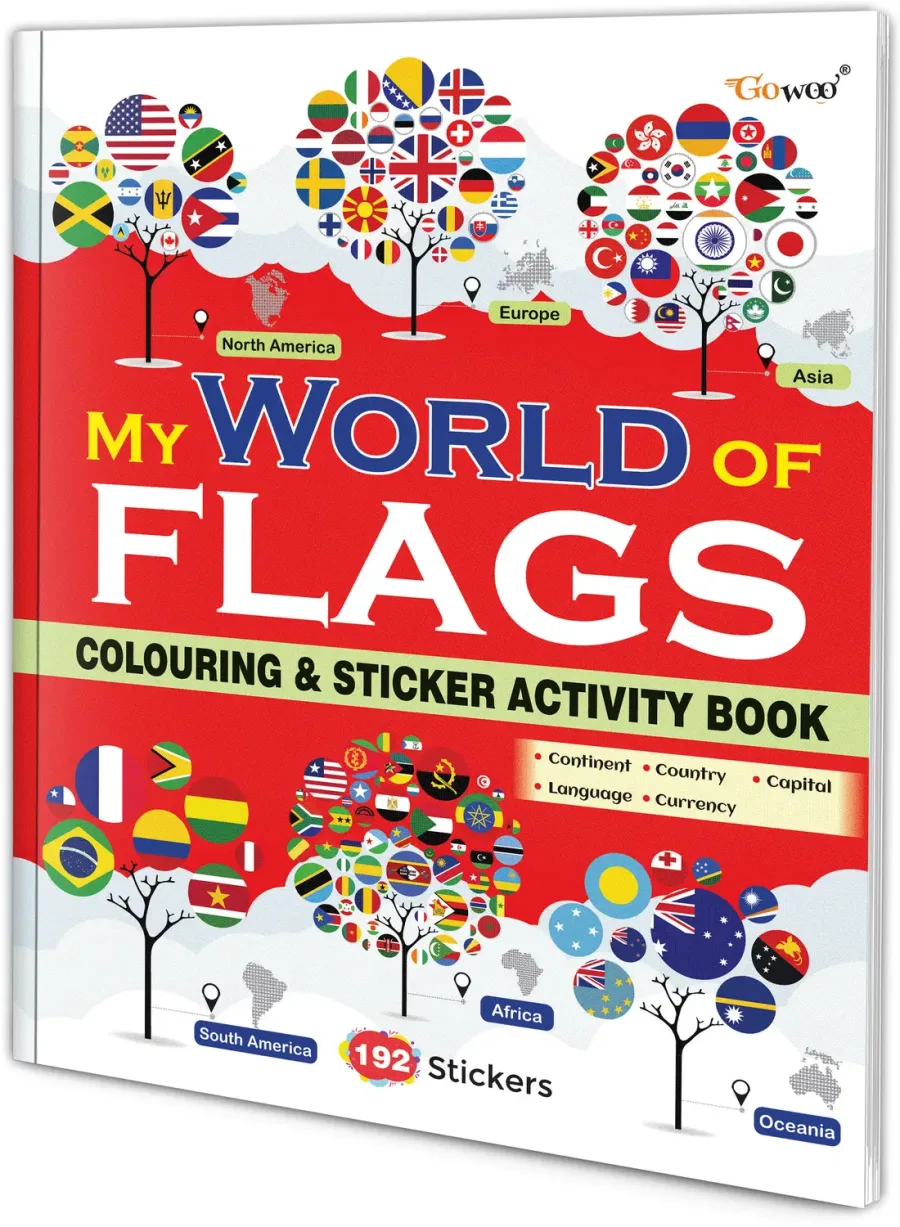
Flags of the World - Sticker Coloring Activity Book For Children : Continent, Country, Capital
Paperback
• 72 Pages
• ₹ 299.00
• English
• 9789390391608
No ratings yet
| Publisher | Wonder House Books |
|---|---|
| ISBN13 | 9789390391608 |
| ASIN/SKU | 9390391601 |
| Book Format | Paperback |
| Language | English |
| Pages | 72 |
| List Price | ₹ 299.00 |
| Publishing Date | 06/12/2020 |
| Dimensions | 21.74 x 0.48 x 28.09 cm |
| Weight | 250 g |
| Book Code | BD00055059 |
Buy this Book
Amazon Stores
Ebook Stores
Other Stores
Discover Flags of the World - Sticker Coloring Activity Book For Children : Continent, Country, Capital by Wonder House Books. This book is published by Wonder House Books in Paperback format, ISBN 9789390391608, ASIN 9390391601, under Literature and Fiction, Children's Books on Papercrafts, Horror.
Book Description
This is a one-in-all book that brushes up a child’s knowledge of countries, capitals, flags and currencies of the world. A child can identify and paste the sticker flags first and then copy color the flag in the space provided. This book is great for developing memory, and kindling curiosity. Its engaging, activity-based approach ensures quick learning.
Author Biography
Wonder House has a dedicated team of editors and designers involved in the development of magnificent and enriching children books. The team pays special attention to develop age appropriate content and does extensive research on every topic included in the book. Our mission is to develop highly informative content which will help the children to master different skills. At Wonder House, we strive to make learning a joy.
Editorial Reviews
Editorial Reviews will be added soon…
Book Summary
Flags of the World – Sticker Coloring Activity Book for Children: Continent, Country, Capital by Wonder House Books is an interactive educational activity book designed to introduce children to the flags, countries, continents, and capitals of the world through coloring, stickers, and playful learning. Rather than presenting geography as a collection of facts to memorize, the book turns the subject into an engaging hands-on activity. Children can learn while coloring flags, identifying countries, matching information, and placing stickers.
The central idea of the book is simple: children learn geography more effectively when they are actively involved in the learning process. Instead of simply reading a list of countries and capitals, young readers are encouraged to look at flags, recognize visual patterns, color them, and connect each flag with the country and capital it represents.
Flags are particularly useful for introducing geography because they are visual symbols. A child may find it difficult to remember a country's name from a list, but a distinctive flag can create a strong visual association. Colors, shapes, stars, crosses, stripes, and other symbols can become memory cues that help children recognize countries more easily.
The book begins by introducing the idea of the world's continents. Geography becomes easier to understand when countries are organized into larger regions. The major continents provide a framework through which children can gradually build a mental map of the world.
Children can learn that countries are not randomly distributed but belong to particular geographical regions. Asia, Africa, Europe, North America, South America, Australia and Oceania, and Antarctica each have distinctive geographical identities, cultures, and collections of nations.
The activity format allows these ideas to be introduced without making the experience feel like a formal geography lesson.
The book's main attraction is its collection of world flags. Each flag provides children with an opportunity to recognize the visual identity of a country. Some flags are simple, with only a few colors or shapes, while others contain intricate symbols and patterns.
Coloring these flags can help children pay attention to details.
A child may notice whether a flag contains horizontal or vertical stripes, whether it includes a star, emblem, crescent, cross, or other symbol, and how different colors are arranged.
This kind of visual observation develops concentration as well as geographical knowledge.
The book also connects each flag with its country name and capital city. This three-part connection—flag, country, and capital—is particularly useful because it turns isolated facts into a network of information.
For example, rather than simply learning the name of a capital, children can associate the capital with a country's flag and geographical location.
Over time, these associations can make later geography lessons easier.
The sticker component adds another dimension to the learning experience. Stickers transform the child from a passive reader into an active participant. Searching for the appropriate sticker, identifying where it belongs, and placing it correctly requires attention and recognition.
For young children, this kind of physical interaction can make information more memorable.
The coloring activities provide another learning advantage. Coloring requires children to focus on shapes, boundaries, patterns, and color placement. While doing so, they repeatedly look at the flag and its associated country. Repetition reinforces recognition without feeling like rote memorization.
The book can therefore function as both an activity book and an introductory geography resource.
One of its strongest educational qualities is that it encourages children to learn through multiple senses. They see the flag, read the country's name, identify the capital, color the design, and physically manipulate stickers. Combining these activities can strengthen memory because the information is encountered in several different ways.
The book also encourages curiosity about other countries.
A child who recognizes a flag may naturally begin asking questions: Where is this country? What language do people speak there? What is its culture like? What food is popular? What does its landscape look like? What animals live there?
Thus, learning flags can become the starting point for broader interest in world geography and cultures.
The emphasis on continents is particularly helpful because it introduces children to geographical organization. A child who learns that Brazil is in South America, Egypt is in Africa, Japan is in Asia, and France is in Europe begins to understand the world as a connected map rather than a collection of unrelated country names.
The concept of capital cities introduces another important geographical idea. Capitals are often centers of government and political administration, and learning them helps children begin understanding how countries are organized.
At an introductory level, the book therefore teaches three important geographical categories:
Where is the country?
What does its flag look like?
What is its capital?
These simple questions form a useful foundation for future learning.
The activity-book format also makes the material suitable for home learning, classroom enrichment, travel preparation, or quiet educational play. Parents can use the pages as conversation starters, while teachers can incorporate flag activities into geography lessons.
For younger children, adults can simplify the learning process by focusing on a few countries at a time. Instead of expecting a child to remember everything immediately, they can select several flags, color them together, and later review them through the stickers.
The book can also encourage children to compare flags.
Some countries use similar colors, while others have highly distinctive designs. Comparing them can help children develop visual discrimination—the ability to notice small differences between similar-looking objects.
This is particularly useful for young learners because visual comparison supports attention and memory.
The coloring aspect also offers benefits beyond geography. Coloring can encourage fine motor skills, hand-eye coordination, patience, and concentration. Children must control pencils or crayons carefully when working within the shapes of flags and other illustrations.
The activity therefore combines academic learning with developmental practice.
The book's design also reflects an important principle of children's education: learning should feel enjoyable. If geography is introduced only through memorizing names and capitals, children may quickly become bored. When the same information is connected with coloring and stickers, it becomes an activity they can look forward to.
This playful approach can help create a positive emotional association with learning.
The book also introduces children to the idea that the world contains tremendous cultural diversity. A collection of national flags is, in a simple visual form, a collection of identities. Each flag represents a country with its own history, people, traditions, languages, landscapes, and cultural experiences.
Although a flag cannot tell a child everything about a country, it can encourage respect and curiosity about differences.
The activity can therefore become a gentle introduction to global awareness.
Children may begin to understand that their own country is only one part of a much larger world. Other countries have their own symbols and traditions, and people around the world live in many different environments.
This can support the development of global curiosity and cultural awareness from an early age.
Another strength is the book's potential for repeated use. Children can color flags, revisit country names, review capitals, and use the sticker activities more than once as part of a broader learning routine. Parents can also turn the pages into simple quizzes: show a flag and ask the child to identify the country, or provide the country name and ask for its flag.
Such repetition can turn the activity book into an informal geography game.
The book can also be used to encourage memory games. Adults can cover the country names and ask children to identify them from the flags. Later, the process can be reversed: give the country name and ask the child to remember its capital.
These activities make learning interactive while reinforcing the information introduced in the book.
Perhaps the most valuable lesson is that geography is not simply about memorizing facts. It is about understanding the world and developing curiosity about the people and places that make it diverse.
A child who begins with flags may eventually become interested in maps, travel, history, languages, architecture, wildlife, and cultures.
The flag is simply the doorway.
Ultimately, Flags of the World – Sticker Coloring Activity Book for Children: Continent, Country, Capital offers a playful way for children to begin discovering the world. Through colorful flags, stickers, country names, capitals, and continent-based organization, the book transforms basic geography into an engaging hands-on experience.
Its educational value comes from making information visual, interactive, repetitive, and enjoyable. Children are encouraged not merely to look at facts but to participate in learning them.
The book's broader message is equally valuable: the world is enormous and diverse, but it can be explored one country at a time.
A flag becomes a symbol.
A symbol leads to a country.
A country leads to a continent.
And a simple activity can become the beginning of a lifelong curiosity about the world.
For young learners, that combination of play, creativity, geography, and discovery makes this activity book an accessible and enjoyable introduction to the countries and capitals of the world.
The central idea of the book is simple: children learn geography more effectively when they are actively involved in the learning process. Instead of simply reading a list of countries and capitals, young readers are encouraged to look at flags, recognize visual patterns, color them, and connect each flag with the country and capital it represents.
Flags are particularly useful for introducing geography because they are visual symbols. A child may find it difficult to remember a country's name from a list, but a distinctive flag can create a strong visual association. Colors, shapes, stars, crosses, stripes, and other symbols can become memory cues that help children recognize countries more easily.
The book begins by introducing the idea of the world's continents. Geography becomes easier to understand when countries are organized into larger regions. The major continents provide a framework through which children can gradually build a mental map of the world.
Children can learn that countries are not randomly distributed but belong to particular geographical regions. Asia, Africa, Europe, North America, South America, Australia and Oceania, and Antarctica each have distinctive geographical identities, cultures, and collections of nations.
The activity format allows these ideas to be introduced without making the experience feel like a formal geography lesson.
The book's main attraction is its collection of world flags. Each flag provides children with an opportunity to recognize the visual identity of a country. Some flags are simple, with only a few colors or shapes, while others contain intricate symbols and patterns.
Coloring these flags can help children pay attention to details.
A child may notice whether a flag contains horizontal or vertical stripes, whether it includes a star, emblem, crescent, cross, or other symbol, and how different colors are arranged.
This kind of visual observation develops concentration as well as geographical knowledge.
The book also connects each flag with its country name and capital city. This three-part connection—flag, country, and capital—is particularly useful because it turns isolated facts into a network of information.
For example, rather than simply learning the name of a capital, children can associate the capital with a country's flag and geographical location.
Over time, these associations can make later geography lessons easier.
The sticker component adds another dimension to the learning experience. Stickers transform the child from a passive reader into an active participant. Searching for the appropriate sticker, identifying where it belongs, and placing it correctly requires attention and recognition.
For young children, this kind of physical interaction can make information more memorable.
The coloring activities provide another learning advantage. Coloring requires children to focus on shapes, boundaries, patterns, and color placement. While doing so, they repeatedly look at the flag and its associated country. Repetition reinforces recognition without feeling like rote memorization.
The book can therefore function as both an activity book and an introductory geography resource.
One of its strongest educational qualities is that it encourages children to learn through multiple senses. They see the flag, read the country's name, identify the capital, color the design, and physically manipulate stickers. Combining these activities can strengthen memory because the information is encountered in several different ways.
The book also encourages curiosity about other countries.
A child who recognizes a flag may naturally begin asking questions: Where is this country? What language do people speak there? What is its culture like? What food is popular? What does its landscape look like? What animals live there?
Thus, learning flags can become the starting point for broader interest in world geography and cultures.
The emphasis on continents is particularly helpful because it introduces children to geographical organization. A child who learns that Brazil is in South America, Egypt is in Africa, Japan is in Asia, and France is in Europe begins to understand the world as a connected map rather than a collection of unrelated country names.
The concept of capital cities introduces another important geographical idea. Capitals are often centers of government and political administration, and learning them helps children begin understanding how countries are organized.
At an introductory level, the book therefore teaches three important geographical categories:
Where is the country?
What does its flag look like?
What is its capital?
These simple questions form a useful foundation for future learning.
The activity-book format also makes the material suitable for home learning, classroom enrichment, travel preparation, or quiet educational play. Parents can use the pages as conversation starters, while teachers can incorporate flag activities into geography lessons.
For younger children, adults can simplify the learning process by focusing on a few countries at a time. Instead of expecting a child to remember everything immediately, they can select several flags, color them together, and later review them through the stickers.
The book can also encourage children to compare flags.
Some countries use similar colors, while others have highly distinctive designs. Comparing them can help children develop visual discrimination—the ability to notice small differences between similar-looking objects.
This is particularly useful for young learners because visual comparison supports attention and memory.
The coloring aspect also offers benefits beyond geography. Coloring can encourage fine motor skills, hand-eye coordination, patience, and concentration. Children must control pencils or crayons carefully when working within the shapes of flags and other illustrations.
The activity therefore combines academic learning with developmental practice.
The book's design also reflects an important principle of children's education: learning should feel enjoyable. If geography is introduced only through memorizing names and capitals, children may quickly become bored. When the same information is connected with coloring and stickers, it becomes an activity they can look forward to.
This playful approach can help create a positive emotional association with learning.
The book also introduces children to the idea that the world contains tremendous cultural diversity. A collection of national flags is, in a simple visual form, a collection of identities. Each flag represents a country with its own history, people, traditions, languages, landscapes, and cultural experiences.
Although a flag cannot tell a child everything about a country, it can encourage respect and curiosity about differences.
The activity can therefore become a gentle introduction to global awareness.
Children may begin to understand that their own country is only one part of a much larger world. Other countries have their own symbols and traditions, and people around the world live in many different environments.
This can support the development of global curiosity and cultural awareness from an early age.
Another strength is the book's potential for repeated use. Children can color flags, revisit country names, review capitals, and use the sticker activities more than once as part of a broader learning routine. Parents can also turn the pages into simple quizzes: show a flag and ask the child to identify the country, or provide the country name and ask for its flag.
Such repetition can turn the activity book into an informal geography game.
The book can also be used to encourage memory games. Adults can cover the country names and ask children to identify them from the flags. Later, the process can be reversed: give the country name and ask the child to remember its capital.
These activities make learning interactive while reinforcing the information introduced in the book.
Perhaps the most valuable lesson is that geography is not simply about memorizing facts. It is about understanding the world and developing curiosity about the people and places that make it diverse.
A child who begins with flags may eventually become interested in maps, travel, history, languages, architecture, wildlife, and cultures.
The flag is simply the doorway.
Ultimately, Flags of the World – Sticker Coloring Activity Book for Children: Continent, Country, Capital offers a playful way for children to begin discovering the world. Through colorful flags, stickers, country names, capitals, and continent-based organization, the book transforms basic geography into an engaging hands-on experience.
Its educational value comes from making information visual, interactive, repetitive, and enjoyable. Children are encouraged not merely to look at facts but to participate in learning them.
The book's broader message is equally valuable: the world is enormous and diverse, but it can be explored one country at a time.
A flag becomes a symbol.
A symbol leads to a country.
A country leads to a continent.
And a simple activity can become the beginning of a lifelong curiosity about the world.
For young learners, that combination of play, creativity, geography, and discovery makes this activity book an accessible and enjoyable introduction to the countries and capitals of the world.
Sample Chapters
Sample Chapters will be added soon…
Reader Reviews
No reviews yet.
Flags of the World - Sticker Coloring Activity Book For Children : Continent, Country, Capital
Download Cover Image
Do you want to download the full cover image for Flags of the World - Sticker Coloring Activity Book For Children : Continent, Country, Capital?