
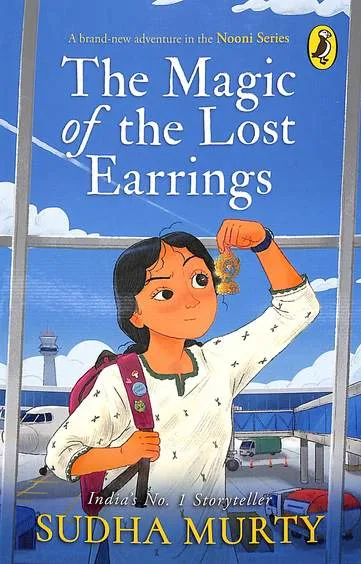
The Magic of the Lost Earrings: A New Nooni Adventure by Sudha Murty
Paperback
• 176 Pages
• ₹ 299.00
• English
• 9780143479802
No ratings yet
| Publisher | Puffin |
|---|---|
| ISBN13 | 9780143479802 |
| ASIN/SKU | 0143479806 |
| Book Format | Paperback |
| Language | English |
| Pages | 176 |
| List Price | ₹ 299.00 |
| Publishing Date | 30/10/2025 |
| Dimensions | 19.9 x 1.2 x 13.3 cm |
| Weight | 50 g |
| Book Code | BD00055058 |
Buy this Book
Amazon Stores
Ebook Stores
Other Stores
Discover The Magic of the Lost Earrings: A New Nooni Adventure by Sudha Murty by Sudha Murty. This book is published by Puffin in Paperback format, ISBN 9780143479802, ASIN 0143479806, under Literature and Fiction, Children's Historical Fiction, Children's Books on Grandparents.
Book Description
When a pair of antique earrings lands in Nooni’s hands, her quiet holiday with Ajja and Ajji turns into the adventure of a lifetime. From the sacred ghats of Ujjain to the buzzing streets of Amritsar, the storied lanes of Delhi and all the way to London, Nooni follows a trail shimmering with mystery and history.
Each step brings her face to face with forgotten tales of love and loss, revealing that true treasures aren’t just beautiful―they hold memories worth keeping alive.
Told in India’s favourite storyteller’s inimitable style, The Magic of the Lost Earrings is a heart-warming tale of togetherness, courage and heritage―one that lingers
long after the last page.
Each step brings her face to face with forgotten tales of love and loss, revealing that true treasures aren’t just beautiful―they hold memories worth keeping alive.
Told in India’s favourite storyteller’s inimitable style, The Magic of the Lost Earrings is a heart-warming tale of togetherness, courage and heritage―one that lingers
long after the last page.
Author Biography
Sudha Murty was born in 1950, in Shiggaon, north Karnataka. Author, philanthropist, educator, public speaker and engineer, Sudha Murty completed her master’s in computer science from IISc, Bangalore.
Editorial Reviews
Editorial Reviews will be added soon…
Book Summary
The Magic of the Lost Earrings by Sudha Murty is a warm, engaging children's adventure that blends mystery, family, history, travel, and cultural heritage. It is a new story in the popular Nooni series and is aimed at young readers aged around nine and above. Published by Puffin in 2025, the book follows Nooni as an ordinary holiday unexpectedly turns into a journey filled with clues, forgotten stories, and discoveries stretching from India to London.
Nooni begins the story in the comforting company of her grandparents, Ajja and Ajji. What should have been a peaceful holiday changes dramatically when an unexpected pair of antique earrings comes into her possession. At first, the earrings seem like beautiful old objects. But Nooni soon realizes that they are connected to a much larger story—one involving the past, family memories, forgotten relationships, and pieces of history that have survived across generations.
The earrings become the central mystery of the adventure. Rather than treating them simply as valuable jewellery, Nooni begins to see them as clues to a story that someone has carried for years. Their importance lies not only in their beauty or age but in the memories attached to them. This becomes one of the book's most meaningful ideas: objects from the past can preserve emotions and stories long after the people who experienced them are gone.
Nooni's curiosity is what sets the adventure in motion. She does not simply accept the earrings as an interesting discovery. She wants to know where they came from, who owned them, why they were separated from their original story, and what happened to the people connected with them. Her questions gradually transform a family holiday into a search for answers.
The journey takes Nooni across several remarkable locations. She travels from the sacred ghats of Ujjain to the lively streets of Amritsar, through the historic lanes of Delhi, and eventually all the way to London. Each place contributes another piece to the larger mystery.
Ujjain introduces the story to India's deep historical and spiritual landscape. The city, with its ancient traditions and sacred spaces, provides an evocative beginning for Nooni's search. The setting reminds readers that India's history is not something confined to museums or textbooks. It can be found in temples, streets, family stories, objects, customs, and places that people continue to visit today.
From Ujjain, the mystery leads toward Amritsar. The change in setting broadens Nooni's understanding of the country and shows her how different regions can carry their own memories and traditions. The journey becomes more than a physical trip: Nooni is gradually discovering how interconnected people's stories can be.
Delhi adds another layer to the adventure. Its historic streets and monuments provide a natural backdrop for a story about the past resurfacing in the present. As Nooni follows the trail, she learns that history is often made up of individual experiences—people who loved, lost, travelled, separated, remembered, and sometimes left behind objects that became silent witnesses to their lives.
Eventually, the trail takes Nooni beyond India to London. This international dimension makes the story particularly interesting for young readers because it shows how personal and cultural histories can travel across borders. A story that begins with a small object in Nooni's hands ultimately connects different places and generations.
At the heart of the narrative is family. Nooni's relationship with Ajja and Ajji gives the story its emotional warmth. Her grandparents are not simply background characters; they represent a living connection between generations. Through them, Nooni learns that the past is not necessarily distant. Older family members can carry memories and knowledge that younger people may never discover unless they take the time to ask questions.
This emphasis on intergenerational storytelling is one of Sudha Murty's recurring strengths. She often presents children as curious explorers who learn from older generations while also bringing their own energy and questions to the relationship. In The Magic of the Lost Earrings, Nooni's curiosity helps uncover a story that might otherwise have remained forgotten.
The book also places considerable importance on heritage. The earrings become a symbol of cultural and personal inheritance. Heritage is not presented merely as monuments, dates, or historical facts. It is something emotional and human. It survives through stories, family traditions, objects, memories, and the ways people choose to preserve the past.
This is why the title's use of the word “magic” is significant. The earrings do not need supernatural powers to be magical. Their magic comes from the human stories attached to them. They become extraordinary because they connect the present with people and experiences from another time.
Nooni's adventure also demonstrates the value of curiosity. She keeps asking questions even when the answers are not immediately available. Instead of being discouraged by uncertainty, she treats each discovery as another clue. Her curiosity becomes a form of courage.
That courage is important because Nooni's journey is not simply a sightseeing trip. Following an old mystery requires her to move beyond what is familiar and comfortable. She encounters unfamiliar places and stories and must remain observant enough to understand what they mean.
The story also explores love and loss. The history surrounding the earrings is not merely an exciting puzzle. As Nooni follows the trail, she encounters forgotten stories involving human emotions and relationships. These stories help her understand that historical objects often survive because they once mattered deeply to someone.
This gives the adventure an emotional dimension. The real treasure is not necessarily the earrings themselves. Their greatest value lies in the memories they preserve and the people whose stories might otherwise disappear.
The novel therefore teaches young readers an important lesson about remembering. A person can be forgotten, but a story can keep something of that person's life alive. Objects can help preserve those stories, but ultimately it is people who must choose to listen, remember, and pass them on.
Nooni's travels also make the book a gentle introduction to Indian geography and cultural diversity. Moving from Ujjain to Amritsar and Delhi before eventually reaching London allows children to experience a variety of landscapes and cultural environments through the eyes of a young protagonist. The journey makes history feel active rather than static.
The book's adventure structure keeps these ideas from becoming overly instructional. Children encounter history because Nooni is following a mystery. They learn about places because she travels through them. They think about family because her discoveries lead her back to questions of memory and belonging.
This balance between entertainment and learning is characteristic of Sudha Murty's children's writing. She presents meaningful lessons through stories rather than turning the narrative into a lesson book. The publisher describes the novel as a heart-warming story of togetherness, courage, and heritage, and its central mystery provides the framework through which these themes emerge naturally.
The book is also concerned with the idea that history should remain alive. At the launch of the book, Sudha Murty described the Nooni story as travelling through India, Pakistan, and London and emphasized the idea that history is not a dead subject. This perspective is central to the novel's appeal. History becomes meaningful when young people can connect it to real places, emotions, families, and stories.
Nooni is therefore more than an adventurous child. She becomes a bridge between generations. Her willingness to investigate gives older stories a new audience, while her journey allows readers to see the past through the perspective of someone young and curious.
Another important quality of the story is its sense of togetherness. Although the mystery provides the narrative momentum, relationships give the adventure its emotional foundation. Nooni does not experience the journey simply as an isolated investigator. Her family connections help her understand the significance of what she discovers.
The story also encourages children to appreciate the value of asking older relatives about their experiences. Grandparents and other family members may possess stories that cannot be found in ordinary history books. A seemingly small memory can sometimes reveal an entire world of people, places, and events.
The earrings themselves become a powerful metaphor for this process. They have survived while the circumstances surrounding them have changed. Their physical existence creates an opportunity for forgotten memories to return. In this sense, the earrings represent the way the past can quietly remain present in everyday life.
The adventure also suggests that travelling can be a form of learning. Nooni's journey is not about visiting famous places simply for sightseeing. Each destination adds context to the mystery and changes her understanding of what she is searching for. Travel becomes a way of seeing history from multiple perspectives.
Ultimately, The Magic of the Lost Earrings is a story about discovery in its broadest sense. Nooni discovers clues, places, historical connections, and forgotten stories, but she also discovers something about the importance of memory and family.
The greatest treasure she encounters is therefore not material. The antique earrings may be beautiful and mysterious, but their true significance comes from the stories they carry. They remind Nooni—and the reader—that memories are precious because they connect generations and give meaning to objects, places, and family traditions.
The novel's charm lies in the way it makes these ideas accessible to children. It offers mystery without becoming frightening, history without becoming dry, and moral lessons without becoming preachy. The result is a lively adventure that encourages young readers to be curious about the world around them.
In the end, The Magic of the Lost Earrings invites children to look more closely at the ordinary objects and stories that surround them. A pair of old earrings can become a doorway into the past. A family conversation can reveal a forgotten chapter of history. A journey can become an education. And a child's simple question—“What happened?”—can bring an entire story back to life.
Through Nooni's adventure across Ujjain, Amritsar, Delhi, and London, Sudha Murty creates a warm celebration of family, courage, curiosity, travel, memory, and heritage. The book ultimately reminds young readers that the past is not truly gone when people continue to remember and share its stories.
Nooni begins the story in the comforting company of her grandparents, Ajja and Ajji. What should have been a peaceful holiday changes dramatically when an unexpected pair of antique earrings comes into her possession. At first, the earrings seem like beautiful old objects. But Nooni soon realizes that they are connected to a much larger story—one involving the past, family memories, forgotten relationships, and pieces of history that have survived across generations.
The earrings become the central mystery of the adventure. Rather than treating them simply as valuable jewellery, Nooni begins to see them as clues to a story that someone has carried for years. Their importance lies not only in their beauty or age but in the memories attached to them. This becomes one of the book's most meaningful ideas: objects from the past can preserve emotions and stories long after the people who experienced them are gone.
Nooni's curiosity is what sets the adventure in motion. She does not simply accept the earrings as an interesting discovery. She wants to know where they came from, who owned them, why they were separated from their original story, and what happened to the people connected with them. Her questions gradually transform a family holiday into a search for answers.
The journey takes Nooni across several remarkable locations. She travels from the sacred ghats of Ujjain to the lively streets of Amritsar, through the historic lanes of Delhi, and eventually all the way to London. Each place contributes another piece to the larger mystery.
Ujjain introduces the story to India's deep historical and spiritual landscape. The city, with its ancient traditions and sacred spaces, provides an evocative beginning for Nooni's search. The setting reminds readers that India's history is not something confined to museums or textbooks. It can be found in temples, streets, family stories, objects, customs, and places that people continue to visit today.
From Ujjain, the mystery leads toward Amritsar. The change in setting broadens Nooni's understanding of the country and shows her how different regions can carry their own memories and traditions. The journey becomes more than a physical trip: Nooni is gradually discovering how interconnected people's stories can be.
Delhi adds another layer to the adventure. Its historic streets and monuments provide a natural backdrop for a story about the past resurfacing in the present. As Nooni follows the trail, she learns that history is often made up of individual experiences—people who loved, lost, travelled, separated, remembered, and sometimes left behind objects that became silent witnesses to their lives.
Eventually, the trail takes Nooni beyond India to London. This international dimension makes the story particularly interesting for young readers because it shows how personal and cultural histories can travel across borders. A story that begins with a small object in Nooni's hands ultimately connects different places and generations.
At the heart of the narrative is family. Nooni's relationship with Ajja and Ajji gives the story its emotional warmth. Her grandparents are not simply background characters; they represent a living connection between generations. Through them, Nooni learns that the past is not necessarily distant. Older family members can carry memories and knowledge that younger people may never discover unless they take the time to ask questions.
This emphasis on intergenerational storytelling is one of Sudha Murty's recurring strengths. She often presents children as curious explorers who learn from older generations while also bringing their own energy and questions to the relationship. In The Magic of the Lost Earrings, Nooni's curiosity helps uncover a story that might otherwise have remained forgotten.
The book also places considerable importance on heritage. The earrings become a symbol of cultural and personal inheritance. Heritage is not presented merely as monuments, dates, or historical facts. It is something emotional and human. It survives through stories, family traditions, objects, memories, and the ways people choose to preserve the past.
This is why the title's use of the word “magic” is significant. The earrings do not need supernatural powers to be magical. Their magic comes from the human stories attached to them. They become extraordinary because they connect the present with people and experiences from another time.
Nooni's adventure also demonstrates the value of curiosity. She keeps asking questions even when the answers are not immediately available. Instead of being discouraged by uncertainty, she treats each discovery as another clue. Her curiosity becomes a form of courage.
That courage is important because Nooni's journey is not simply a sightseeing trip. Following an old mystery requires her to move beyond what is familiar and comfortable. She encounters unfamiliar places and stories and must remain observant enough to understand what they mean.
The story also explores love and loss. The history surrounding the earrings is not merely an exciting puzzle. As Nooni follows the trail, she encounters forgotten stories involving human emotions and relationships. These stories help her understand that historical objects often survive because they once mattered deeply to someone.
This gives the adventure an emotional dimension. The real treasure is not necessarily the earrings themselves. Their greatest value lies in the memories they preserve and the people whose stories might otherwise disappear.
The novel therefore teaches young readers an important lesson about remembering. A person can be forgotten, but a story can keep something of that person's life alive. Objects can help preserve those stories, but ultimately it is people who must choose to listen, remember, and pass them on.
Nooni's travels also make the book a gentle introduction to Indian geography and cultural diversity. Moving from Ujjain to Amritsar and Delhi before eventually reaching London allows children to experience a variety of landscapes and cultural environments through the eyes of a young protagonist. The journey makes history feel active rather than static.
The book's adventure structure keeps these ideas from becoming overly instructional. Children encounter history because Nooni is following a mystery. They learn about places because she travels through them. They think about family because her discoveries lead her back to questions of memory and belonging.
This balance between entertainment and learning is characteristic of Sudha Murty's children's writing. She presents meaningful lessons through stories rather than turning the narrative into a lesson book. The publisher describes the novel as a heart-warming story of togetherness, courage, and heritage, and its central mystery provides the framework through which these themes emerge naturally.
The book is also concerned with the idea that history should remain alive. At the launch of the book, Sudha Murty described the Nooni story as travelling through India, Pakistan, and London and emphasized the idea that history is not a dead subject. This perspective is central to the novel's appeal. History becomes meaningful when young people can connect it to real places, emotions, families, and stories.
Nooni is therefore more than an adventurous child. She becomes a bridge between generations. Her willingness to investigate gives older stories a new audience, while her journey allows readers to see the past through the perspective of someone young and curious.
Another important quality of the story is its sense of togetherness. Although the mystery provides the narrative momentum, relationships give the adventure its emotional foundation. Nooni does not experience the journey simply as an isolated investigator. Her family connections help her understand the significance of what she discovers.
The story also encourages children to appreciate the value of asking older relatives about their experiences. Grandparents and other family members may possess stories that cannot be found in ordinary history books. A seemingly small memory can sometimes reveal an entire world of people, places, and events.
The earrings themselves become a powerful metaphor for this process. They have survived while the circumstances surrounding them have changed. Their physical existence creates an opportunity for forgotten memories to return. In this sense, the earrings represent the way the past can quietly remain present in everyday life.
The adventure also suggests that travelling can be a form of learning. Nooni's journey is not about visiting famous places simply for sightseeing. Each destination adds context to the mystery and changes her understanding of what she is searching for. Travel becomes a way of seeing history from multiple perspectives.
Ultimately, The Magic of the Lost Earrings is a story about discovery in its broadest sense. Nooni discovers clues, places, historical connections, and forgotten stories, but she also discovers something about the importance of memory and family.
The greatest treasure she encounters is therefore not material. The antique earrings may be beautiful and mysterious, but their true significance comes from the stories they carry. They remind Nooni—and the reader—that memories are precious because they connect generations and give meaning to objects, places, and family traditions.
The novel's charm lies in the way it makes these ideas accessible to children. It offers mystery without becoming frightening, history without becoming dry, and moral lessons without becoming preachy. The result is a lively adventure that encourages young readers to be curious about the world around them.
In the end, The Magic of the Lost Earrings invites children to look more closely at the ordinary objects and stories that surround them. A pair of old earrings can become a doorway into the past. A family conversation can reveal a forgotten chapter of history. A journey can become an education. And a child's simple question—“What happened?”—can bring an entire story back to life.
Through Nooni's adventure across Ujjain, Amritsar, Delhi, and London, Sudha Murty creates a warm celebration of family, courage, curiosity, travel, memory, and heritage. The book ultimately reminds young readers that the past is not truly gone when people continue to remember and share its stories.
Sample Chapters
Sample Chapters will be added soon…
Reader Reviews
No reviews yet.
The Magic of the Lost Earrings: A New Nooni Adventure by Sudha Murty
Download Cover Image
Do you want to download the full cover image for The Magic of the Lost Earrings: A New Nooni Adventure by Sudha Murty?