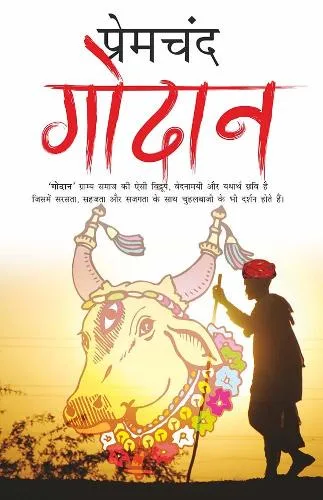
Godaan (Hindi)
Paperback
• 432 Pages
• ₹ 299.00
• Hindi
• 9789388810470
No ratings yet
| Publisher | Fingerprint! Publishing |
|---|---|
| ISBN13 | 9789388810470 |
| ASIN/SKU | 9388810473 |
| Book Format | Paperback |
| Language | Hindi |
| Pages | 432 |
| List Price | ₹ 299.00 |
| Publishing Date | 01/02/2019 |
| Dimensions | 19.5 x 12.5 x 3.75 cm |
| Weight | 220 g |
| Book Code | BD00055056 |
Buy this Book
Amazon Stores
Ebook Stores
Other Stores
Discover Godaan (Hindi) by Munshi Premchand. This book is published by Fingerprint! Publishing in Paperback format, ISBN 9789388810470, ASIN 9388810473, under Literature and Fiction, Indian Writing, Literary Theory, History and Criticism.
Book Description
Godaan is a masterpiece of Indian literature that explores the complex themes of social inequality, rural life, and the struggles of the marginalized. Written by Munshi Premchand, this timeless novel takes you on a poignant journey through the lives of characters grappling with poverty, morality, and the pursuit of a better life.
Compelling storytelling that immerses you in the vibrant world of rural India.
Thought-provoking social commentary that sheds light on caste dynamics and societal injustices.
Memorable characters whose stories evoke empathy and reflection.
A powerful portrayal of the human condition and the search for meaning.
A must-read for those interested in Indian literature and a deeper understanding of society.
Compelling storytelling that immerses you in the vibrant world of rural India.
Thought-provoking social commentary that sheds light on caste dynamics and societal injustices.
Memorable characters whose stories evoke empathy and reflection.
A powerful portrayal of the human condition and the search for meaning.
A must-read for those interested in Indian literature and a deeper understanding of society.
Author Biography
Born Dhanpat Rai Shrivastava on 31 July 1880 in Lamhi village near Varanasi, India, Munshi Premchand began his writing career in 1901. His first short novel, Asrar e Ma’abid (Secrets of God’s Abode), written in Urdu was published in a weekly between 8 October 1903 to February 1905. He wrote on a variety of topics including prostitution, poverty, dowry, child widowhood, and feudal system, using his works as a vehicle for arousing public awareness. He was the first Hindi author whose works featured social realism. Premchand has penned down hundreds of short stories, more than a dozen novels, plays, and several critical essays. His most celebrated works include Vardaan (1912), Seva Sadan (1918), Premashram (1922), Rangbhoomi (1925), Nirmala (1927), Pratigya (1927), Gaban (1931), Karmabhoomi (1932), Godaan (1936). Premchand breathed his last on 8 October 1936. One of the most influential writers of Indian literature, his works continue to remain popular and are translated in various foreign languages across the world.
Editorial Reviews
Editorial Reviews will be added soon…
Book Summary
Munshi Premchand’s Godaan, translated as "The Gift of a Cow," stands as the crowning achievement of Hindi literature and a monumental epic of the Indian peasantry. Published in 1936, the novel is a searing, realistic portrayal of rural India under the crushing weight of British colonialism, feudalism, and a deeply entrenched caste system. It is a story devoid of romanticized village life; instead, it offers a stark, unflinching look at the daily struggle for survival. Through its sweeping narrative, Premchand masterfully intertwines the lives of the rural poor and the urban elite, exposing the hypocrisy and exploitation that defined the era. At its heart, it is the deeply tragic and profoundly human story of a simple farmer's unyielding struggle to maintain his dignity in a world determined to strip him of it.
The narrative anchors itself on Hori Mahato, a poor, god-fearing peasant living in the village of Belari. Hori is the quintessential Indian farmer of the time—bound by tradition, deeply respectful of the social hierarchy, and trapped in an inescapable cycle of poverty. Alongside him is his fiercely outspoken and resilient wife, Dhania, who serves as the moral compass and the voice of rebellion against the injustices they face. Hori harbors one simple, lifelong dream: to own a cow. In his agrarian society, a cow is a symbol of prestige, a source of sustenance, and a vehicle for religious merit. His desperate desire sets the tragic events into motion when he manages to acquire a beautiful cow on credit from Bhola, a cowherd, bringing immense, albeit fleeting, joy to his family.
This joy turns to ashes almost immediately when Hori’s younger brother, Heera, driven by bitter jealousy, poisons the cow. This single act of malice plunges Hori into an abyss from which he will never recover. To protect his brother from the police, Hori is forced to pay exorbitant bribes, requiring him to borrow heavily from the village moneylenders. This marks the beginning of Hori’s descent into a fatal debt trap. The village is controlled by a network of exploiters—the wealthy landlord Rai Sahab, the corrupt village priest, and ruthless moneylenders—who use religion and complex interest rates to bleed the peasantry dry. Bound by his rigid sense of dharma and misplaced loyalty to the system that oppresses him, Hori refuses to rebel, choosing instead to silently bear the impossible burdens.
As Hori struggles to keep his family afloat, his troubles are compounded by his rebellious son, Gobar. Disgusted by his father's submissive nature, Gobar begins a clandestine affair with Bhola’s widowed daughter, Jhunia. When Jhunia becomes pregnant, Gobar cowardly flees to the city of Lucknow to escape the consequences, leaving the young woman at his parents' doorstep. Despite the severe social stigma and the threat of excommunication by the village council, Dhania’s fierce maternal instinct and inherent sense of justice compel her to take Jhunia in. For this act of humanity, the council imposes a crippling financial fine on Hori, driving him further into debt. The family’s land is gradually auctioned off, yet Dhania's unyielding spirit prevents them from completely breaking under the pressure.
Parallel to the rural tragedy, Premchand weaves an urban narrative set in Lucknow, involving Rai Sahab, an opportunistic industrialist named Mr. Khanna, a modern doctor named Miss Malti, and a principled philosopher, Professor Mehta. This urban subplot serves as a sharp contrast to the village, highlighting that exploitation is not confined to rural areas; it merely changes forms. The city characters engage in intellectual debates about socialism, nationalism, and women's rights, yet their lives are heavily clouded with moral compromises. When Gobar arrives in the city, he becomes part of the urban working class, experiencing a different kind of exploitation as a factory worker. Though he returns to the village briefly with some money and an arrogant sense of superiority, he ultimately abandons his parents to their fate.
The climax of the novel is one of the most heartbreaking sequences in Indian literature. Stripped of his land, his pride, and his health, Hori is reduced to working as a landless daily wage laborer. To pay off the unrelenting interest on his debts and feed his family, he takes on backbreaking road construction work under the scorching summer sun. Exhausted, malnourished, and pushed far beyond human endurance, Hori collapses from a fatal heatstroke. In his final, agonizing moments, the village priest arrives, callously demanding that the dying man perform the Godaan—the traditional offering of a cow to a Brahmin to ensure the soul’s safe passage to the afterlife. With no cow and absolutely nothing left, a devastated Dhania places her last twenty annas into the priest's hands, declaring with chilling finality that this is the only Godaan they have. Hori dies, leaving behind a legacy that continues to resonate as a powerful, devastating indictment of social injustice.
The narrative anchors itself on Hori Mahato, a poor, god-fearing peasant living in the village of Belari. Hori is the quintessential Indian farmer of the time—bound by tradition, deeply respectful of the social hierarchy, and trapped in an inescapable cycle of poverty. Alongside him is his fiercely outspoken and resilient wife, Dhania, who serves as the moral compass and the voice of rebellion against the injustices they face. Hori harbors one simple, lifelong dream: to own a cow. In his agrarian society, a cow is a symbol of prestige, a source of sustenance, and a vehicle for religious merit. His desperate desire sets the tragic events into motion when he manages to acquire a beautiful cow on credit from Bhola, a cowherd, bringing immense, albeit fleeting, joy to his family.
This joy turns to ashes almost immediately when Hori’s younger brother, Heera, driven by bitter jealousy, poisons the cow. This single act of malice plunges Hori into an abyss from which he will never recover. To protect his brother from the police, Hori is forced to pay exorbitant bribes, requiring him to borrow heavily from the village moneylenders. This marks the beginning of Hori’s descent into a fatal debt trap. The village is controlled by a network of exploiters—the wealthy landlord Rai Sahab, the corrupt village priest, and ruthless moneylenders—who use religion and complex interest rates to bleed the peasantry dry. Bound by his rigid sense of dharma and misplaced loyalty to the system that oppresses him, Hori refuses to rebel, choosing instead to silently bear the impossible burdens.
As Hori struggles to keep his family afloat, his troubles are compounded by his rebellious son, Gobar. Disgusted by his father's submissive nature, Gobar begins a clandestine affair with Bhola’s widowed daughter, Jhunia. When Jhunia becomes pregnant, Gobar cowardly flees to the city of Lucknow to escape the consequences, leaving the young woman at his parents' doorstep. Despite the severe social stigma and the threat of excommunication by the village council, Dhania’s fierce maternal instinct and inherent sense of justice compel her to take Jhunia in. For this act of humanity, the council imposes a crippling financial fine on Hori, driving him further into debt. The family’s land is gradually auctioned off, yet Dhania's unyielding spirit prevents them from completely breaking under the pressure.
Parallel to the rural tragedy, Premchand weaves an urban narrative set in Lucknow, involving Rai Sahab, an opportunistic industrialist named Mr. Khanna, a modern doctor named Miss Malti, and a principled philosopher, Professor Mehta. This urban subplot serves as a sharp contrast to the village, highlighting that exploitation is not confined to rural areas; it merely changes forms. The city characters engage in intellectual debates about socialism, nationalism, and women's rights, yet their lives are heavily clouded with moral compromises. When Gobar arrives in the city, he becomes part of the urban working class, experiencing a different kind of exploitation as a factory worker. Though he returns to the village briefly with some money and an arrogant sense of superiority, he ultimately abandons his parents to their fate.
The climax of the novel is one of the most heartbreaking sequences in Indian literature. Stripped of his land, his pride, and his health, Hori is reduced to working as a landless daily wage laborer. To pay off the unrelenting interest on his debts and feed his family, he takes on backbreaking road construction work under the scorching summer sun. Exhausted, malnourished, and pushed far beyond human endurance, Hori collapses from a fatal heatstroke. In his final, agonizing moments, the village priest arrives, callously demanding that the dying man perform the Godaan—the traditional offering of a cow to a Brahmin to ensure the soul’s safe passage to the afterlife. With no cow and absolutely nothing left, a devastated Dhania places her last twenty annas into the priest's hands, declaring with chilling finality that this is the only Godaan they have. Hori dies, leaving behind a legacy that continues to resonate as a powerful, devastating indictment of social injustice.
Sample Chapters
Sample Chapters will be added soon…
Reader Reviews
No reviews yet.
Godaan (Hindi)