
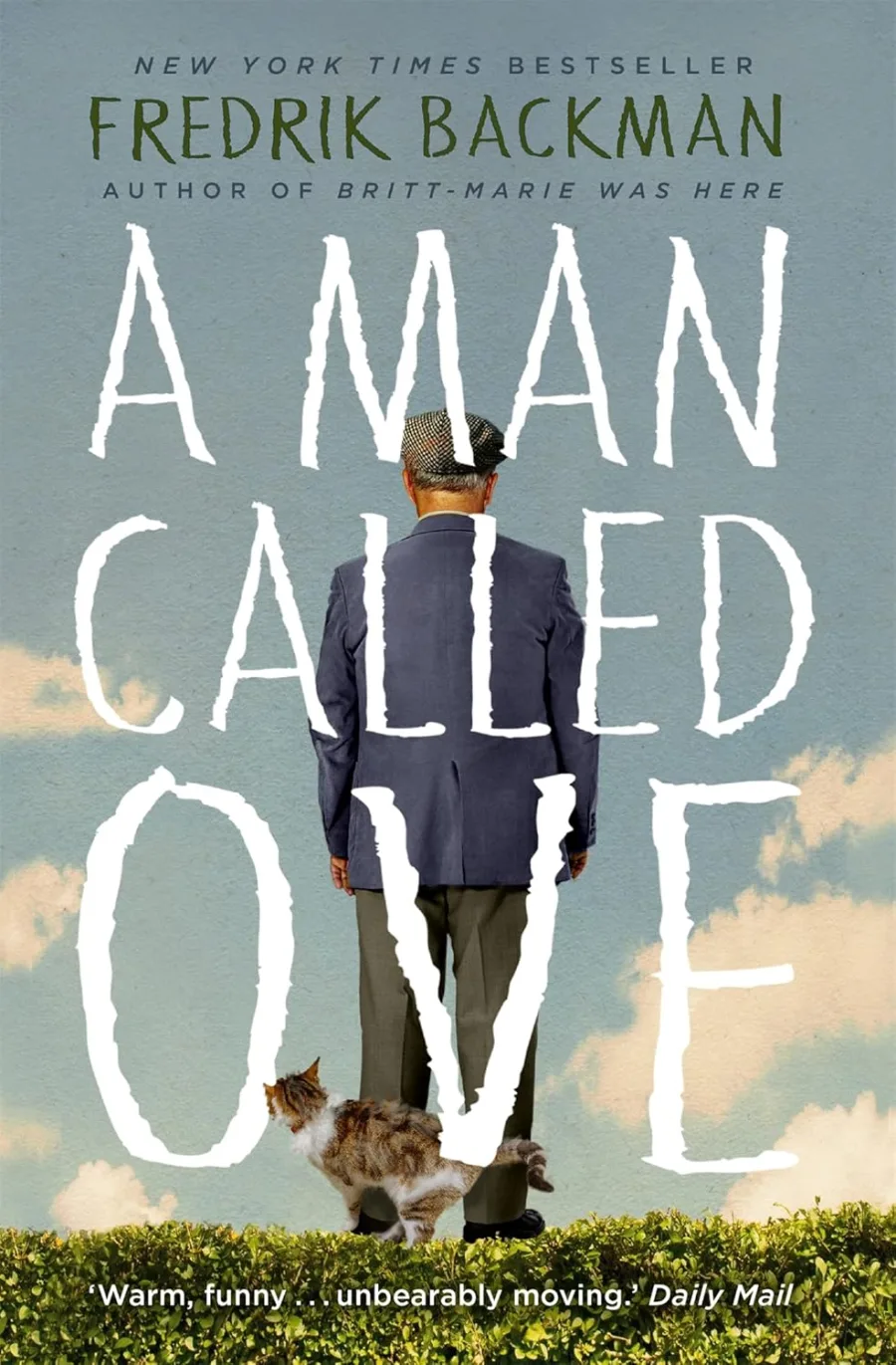
A Man Called Ove (B Format)
Paperback
• 320 Pages
• ₹ 270.00
• English
• 9781444775815
No ratings yet
| Publisher | Sceptre |
|---|---|
| ISBN13 | 9781444775815 |
| ASIN/SKU | 1444775812 |
| Book Format | Paperback |
| Language | English |
| Pages | 320 |
| List Price | ₹ 270.00 |
| Publishing Date | 07/05/2015 |
| Dimensions | 12.6 x 3 x 19.6 cm |
| Weight | 228 g |
| Book Code | BD00055053 |
Buy this Book
Amazon Stores
Ebook Stores
Other Stores
Discover A Man Called Ove (B Format) by Fredrik Backman. This book is published by Sceptre in Paperback format, ISBN 9781444775815, ASIN 1444775812, under Literature and Fiction, Humour, Society and Culture.
Book Description
The million-copy bestselling phenomenon: a funny, moving, uplifting tale of love and community that will leave you with a spring in your step.
'Warm, funny, and almost unbearably moving' Daily Mail
'Delightful . . . the perfect holiday read'
Evening Standard
Ove is almost certainly the grumpiest man you will ever meet. He thinks himself surrounded by idiots - joggers, neighbours who can't reverse a trailer properly and shop assistants who talk in code.
But isn't it rare, these days, to find such old-fashioned clarity of belief and deed? Such unswerving conviction about what the world should be, and a lifelong dedication to making it just so?
In the end, you will see, there is something about Ove that is quite irresistible . . .
'Hilarious and heart-breaking'
Stylist
'Rescued all those men who constantly mean to read novels but never get round to it'
Spectator Books of the Year
NOW A MAJOR FILM STARRING TOM HANKS
'Warm, funny, and almost unbearably moving' Daily Mail
'Delightful . . . the perfect holiday read'
Evening Standard
Ove is almost certainly the grumpiest man you will ever meet. He thinks himself surrounded by idiots - joggers, neighbours who can't reverse a trailer properly and shop assistants who talk in code.
But isn't it rare, these days, to find such old-fashioned clarity of belief and deed? Such unswerving conviction about what the world should be, and a lifelong dedication to making it just so?
In the end, you will see, there is something about Ove that is quite irresistible . . .
'Hilarious and heart-breaking'
Stylist
'Rescued all those men who constantly mean to read novels but never get round to it'
Spectator Books of the Year
NOW A MAJOR FILM STARRING TOM HANKS
Author Biography
Fredrik Backman is a Swedish blogger, columnist and author. His debut novel A MAN CALLED OVE was a number 1 bestseller across Scandinavia, has sold over one million copies worldwide, was a Richard & Judy summer read in the UK and an instant New York Times paperback bestseller, and has been made into an acclaimed film. Fredrik's subsequent novels, MY GRANDMOTHER SENDS HER REGARDS AND APOLOGISES and BRITT-MARIE WAS HERE, also went straight to number 1 in Sweden on publication.
Editorial Reviews
Editorial Reviews will be added soon…
Book Summary
A Man Called Ove by Fredrik Backman is a warm, humorous, bittersweet, and deeply human novel about grief, loneliness, friendship, love, community, second chances, and the hidden goodness in people who may initially seem difficult. First published in Swedish in 2012, it is Backman's debut novel and has become an internationally beloved bestseller. The English-language edition was translated by Henning Koch.
At the center of the story is Ove, a fifty-nine-year-old Swedish man who has earned a reputation as the grumpiest person in his neighborhood. He is rigid about rules, suspicious of modern technology, particular about cars, obsessed with routines, and easily irritated by what he considers other people's incompetence. Yet beneath his difficult exterior is a man shaped by love, loss, loyalty, responsibility, and an unusually strong sense of right and wrong.
What initially looks like the story of an unpleasant old man gradually becomes something much more moving: a story about how human connection can give meaning to a life that has begun to feel empty.
Who Is Ove?
Ove is not an easy person to like when readers first meet him.
He believes things should be done properly. Cars should be driven correctly. Rules should be followed. People should take responsibility for their actions. Neighbors should respect the community. Technology should not make ordinary tasks unnecessarily complicated.
He has little patience for people who do not share his principles.
His daily routine is carefully organized, and he regularly walks around his neighborhood inspecting things and making sure everything is as it should be.
To his neighbors, Ove can appear rude, stubborn, and unnecessarily argumentative.
But Backman gradually reveals that Ove's difficult personality is only one part of who he is.
Behind his anger is a man who has experienced profound loss.
The Grief Behind the Grumpiness
Ove's life has been profoundly affected by the death of his wife, Sonja.
Sonja was one of the most important people in his life. She brought warmth, energy, and emotional openness into his much more rigid personality.
After losing her, Ove becomes increasingly isolated.
His retirement removes another important source of purpose.
The combination of grief and the feeling that he is no longer needed leaves him struggling to understand what his life is for.
This is one of the novel's deepest themes.
Ove is not simply angry at the world.
He is grieving.
His irritation, strict routines, and obsession with rules are partly ways of maintaining control in a life that has otherwise become painfully uncertain.
The novel explores grief not only as sadness but also as the loss of purpose, identity, routine, and connection.
The New Neighbors
Everything begins to change when a new family moves into the neighborhood.
The family includes Parvaneh, her husband Patrick, and their two young daughters.
Their arrival immediately disrupts Ove's carefully controlled world.
They accidentally damage his mailbox while attempting to maneuver a vehicle, an incident that perfectly captures the clash between Ove's obsession with order and the family's chaotic, energetic personality.
Instead of leaving Ove alone, however, Parvaneh gradually forces her way into his life.
She asks him for help.
She talks to him.
She challenges him.
She refuses to be intimidated by his grumpiness.
And slowly, almost without realizing it, Ove begins becoming part of their family.
The publisher describes this encounter as the beginning of a chain of unexpected friendships and events that ultimately changes both Ove and the neighborhood around him.
Parvaneh and Ove's Unlikely Friendship
The relationship between Ove and Parvaneh is one of the novel's greatest strengths.
They are very different.
Ove is rigid, traditional, and reserved.
Parvaneh is energetic, outspoken, warm, and persistent.
She does not allow Ove to retreat into his loneliness.
Instead, she keeps giving him reasons to interact with other people.
Their relationship demonstrates how friendship does not always develop between people who appear compatible.
Sometimes the person who irritates us the most can become the person who changes our life.
Parvaneh gradually sees beyond Ove's anger.
She recognizes that beneath the complaints is someone who is dependable, generous, and deeply caring.
Ove's Relationship With Sonja
The novel's flashbacks provide a fuller understanding of Ove's personality and his relationship with Sonja.
Their love story helps explain why Ove is so deeply affected by her absence.
Sonja was very different from him, but their differences made their relationship meaningful.
She encouraged him to experience life more openly.
She brought warmth into his rigid world.
She helped him understand that life could contain joy even when circumstances were difficult.
Their relationship is central to understanding the man Ove has become.
His grief is not simply about losing a spouse.
He has lost the person who helped him see the world differently.
Rules, Principles, and Justice
Ove has an unusually strong belief in rules.
But the novel makes an important distinction between following rules and doing what is right.
Ove may complain about regulations, bureaucracy, and people who fail to follow procedures, but when a rule produces an outcome he considers unjust, he is willing to fight against it.
His sense of morality is based on principles such as fairness, loyalty, responsibility, and doing a job properly.
This gives his character greater complexity.
Ove may be difficult, but he is not morally careless.
In fact, his stubbornness often comes from caring deeply about what he believes is right.
Community and Belonging
The neighborhood becomes increasingly important as the story develops.
At first, Ove sees himself as separate from everyone else.
He observes his neighbors and criticizes them.
But gradually, the people around him begin to become part of his life.
He helps them.
They help him.
They depend on one another.
The neighborhood begins to function almost like an extended family.
This is one of the book's most powerful ideas: people do not always realize how much they need one another until circumstances bring them together.
Ove believes he is alone, but the community repeatedly demonstrates that he matters to them.
The Importance of Being Useful
Ove has a strong belief that people should be useful.
He values practical skills and tangible contributions.
This becomes particularly important after retirement.
If work has been one of the things that gave his life structure, what happens when that work disappears?
Ove begins to feel that he has lost his purpose.
But his neighbors gradually show him that being useful does not have to mean having a formal job.
He can help someone learn to drive.
He can fix something.
He can protect a neighbor.
He can care for a child.
He can look after a cat.
He can simply be there when someone needs him.
The novel suggests that purpose can be found in relationships and acts of care as much as in employment.
The Cat
An important and memorable addition to Ove's life is a stray cat.
Ove initially does not particularly want the animal around.
Naturally, this does not stop the cat from becoming part of his life.
The cat becomes another unexpected connection that slowly draws Ove away from isolation.
This relationship also reveals Ove's softer side.
He may insist that he does not care, but his actions repeatedly prove otherwise.
The cat becomes part of the strange little family that gradually forms around him.
Humor and Heartbreak
One of the most distinctive qualities of A Man Called Ove is the way Backman combines comedy with sadness.
Ove's frustration with technology, neighbors, cars, bureaucracy, and everyday incompetence can be genuinely funny.
His blunt observations and inability to understand why other people behave as they do create many comic situations.
But the humor exists alongside grief.
Readers may laugh at Ove in one scene and feel deep sympathy for him in another.
This emotional contrast is what makes the novel particularly memorable.
It does not ask readers to choose between laughter and sadness.
It shows that both can exist at the same time.
The Danger of First Impressions
One of the novel's most important lessons is that first impressions can be profoundly misleading.
Ove looks like an angry, unpleasant old man.
But as readers learn more about him, that impression becomes increasingly incomplete.
His neighbors also begin to understand him differently.
Someone who seems rude may actually be trying to help.
Someone who seems emotionally distant may simply be protecting themselves from pain.
Someone who appears difficult may have spent their entire life expressing love through actions rather than words.
The publisher specifically describes the novel as an exploration of the unreliability of first impressions.
This message gives the book a universal quality.
It encourages readers to look beyond difficult personalities and consider what experiences may exist underneath them.
Love Beyond Romance
Although Ove's relationship with Sonja is central to the story, A Man Called Ove is not simply a romantic novel.
It is a broader story about love.
Love between spouses.
Love between friends.
Love between neighbors.
Love between parents and children.
Love for animals.
Love expressed through responsibility and loyalty.
Ove is not naturally expressive with words.
Instead, he often shows affection by doing things.
He fixes things.
He protects people.
He solves problems.
He appears when someone needs help.
This suggests that love does not always look sentimental.
Sometimes love looks like simply showing up.
Immigration and Different Ways of Living
Parvaneh's family also introduces cultural and generational differences into the story.
She and Ove do not always understand each other, and their approaches to life can be dramatically different.
Yet their friendship develops despite those differences.
The novel demonstrates how communities can be strengthened when people who initially seem completely incompatible learn to depend on one another.
Their relationship becomes an example of how human connection can cross differences in background, personality, and experience.
Ove and Modern Life
Ove has a difficult relationship with the modern world.
He distrusts technology and dislikes systems that seem unnecessarily complicated.
He prefers things that are practical and understandable.
This creates many humorous moments, especially when he encounters computers, automated systems, and modern bureaucracy.
But his resistance to change has a deeper meaning.
Ove is also resisting a world in which much of what once gave him identity has disappeared.
His routines connect him to the life he knew.
Change therefore feels threatening not simply because it is inconvenient but because it reminds him that his old world is gone.
The Meaning of Second Chances
The novel is ultimately a story about second chances.
Ove believes that his meaningful life has already ended.
But the people around him gradually prove otherwise.
He discovers new relationships.
He develops new responsibilities.
He becomes important to people who need him.
He begins to experience moments of happiness that he never expected.
This does not erase his past.
Sonja remains important.
His grief does not simply disappear.
Instead, Ove learns that loving someone he has lost does not mean he must stop living.
The future can contain new relationships without replacing old ones.
That is one of the novel's most compassionate ideas.
Why the Story Is So Emotional
The emotional impact of A Man Called Ove comes from the gradual revelation of his life.
Readers do not immediately receive the full explanation for his behavior.
Instead, Backman reveals pieces of Ove's past over time.
As those pieces accumulate, the reader's understanding changes.
The grumpy neighbor becomes a widower.
The difficult man becomes someone who has experienced extraordinary loss.
The isolated individual becomes someone who once loved deeply and was deeply loved in return.
This gradual revelation makes the emotional payoff particularly powerful. The publisher similarly notes that Ove's past is revealed piece by piece, allowing readers to reconsider their understanding of him.
A Story About Human Connection
At its deepest level, A Man Called Ove is about connection.
People need other people, even when they insist that they do not.
Ove initially believes that solitude is preferable.
But his neighbors repeatedly enter his life.
They ask for help.
They annoy him.
They challenge him.
They depend on him.
And eventually, they become essential to him.
The story suggests that community does not have to be perfect.
Neighbors can be irritating.
Friends can be inconvenient.
Families can be complicated.
But connection gives life meaning in ways that isolation cannot.
Who Should Read A Man Called Ove?
This novel is particularly suitable for readers who enjoy:
Contemporary literary fiction
Heartwarming novels
Humorous fiction
Emotional family stories
Books about grief and healing
Stories about friendship and community
Character-driven novels
Stories about second chances
Books about loneliness and belonging
Feel-good fiction with emotional depth
Swedish and Scandinavian fiction
Novels about older protagonists
Stories that combine comedy and heartbreak
It is especially appealing to readers who enjoy novels where the character is more complicated than the first impression suggests.
Final Thoughts
A Man Called Ove by Fredrik Backman is much more than a story about a grumpy old man.
It is a story about a person who has lost much of what gave his life meaning and has forgotten that he can still matter to others.
Ove begins the novel believing that the world has moved on without him. His routines, rules, and anger help him maintain a sense of control, while his grief keeps him emotionally connected to the life he has lost.
Then his new neighbors arrive.
Parvaneh refuses to leave him alone.
Her family gradually becomes part of his life.
A stray cat appears.
Other neighbors begin relying on him.
And slowly, Ove discovers that his life is not as empty as he believed.
The novel's greatest strength is its ability to make readers laugh at Ove while simultaneously inviting them to understand him. His stubbornness is funny, but it also has a history. His anger can be frustrating, but underneath it is grief. His silence can appear cold, but his actions often reveal extraordinary loyalty and care.
For readers searching for A Man Called Ove by Fredrik Backman, A Man Called Ove summary, A Man Called Ove review, Fredrik Backman books, books like A Man Called Ove, emotional contemporary fiction, heartwarming novels, books about grief and healing, books about loneliness, friendship novels, community stories, feel-good books with emotional depth, Swedish fiction, humorous literary fiction, novels about second chances, or books about finding purpose, this novel offers a deeply rewarding reading experience.
The novel has also become a major international bestseller, with the publisher reporting more than three million copies sold, and it was adapted into the film A Man Called Otto, starring Tom Hanks.
Ultimately, A Man Called Ove reminds us that a person's rough exterior rarely tells the whole story.
People carry histories we cannot see.
They experience losses we may not understand.
They may express love differently from us.
And sometimes, the person who seems least interested in other people may be the person who cares most deeply.
Ove's story is therefore a celebration of love, loyalty, community, kindness, resilience, and the possibility of beginning again.
It is funny when it needs to be funny, heartbreaking when it needs to be heartbreaking, and ultimately hopeful.
Most importantly, it leaves the reader with a gentle reminder: life can still surprise us with friendship and purpose, even after we believe there is nothing left to look forward to.
At the center of the story is Ove, a fifty-nine-year-old Swedish man who has earned a reputation as the grumpiest person in his neighborhood. He is rigid about rules, suspicious of modern technology, particular about cars, obsessed with routines, and easily irritated by what he considers other people's incompetence. Yet beneath his difficult exterior is a man shaped by love, loss, loyalty, responsibility, and an unusually strong sense of right and wrong.
What initially looks like the story of an unpleasant old man gradually becomes something much more moving: a story about how human connection can give meaning to a life that has begun to feel empty.
Who Is Ove?
Ove is not an easy person to like when readers first meet him.
He believes things should be done properly. Cars should be driven correctly. Rules should be followed. People should take responsibility for their actions. Neighbors should respect the community. Technology should not make ordinary tasks unnecessarily complicated.
He has little patience for people who do not share his principles.
His daily routine is carefully organized, and he regularly walks around his neighborhood inspecting things and making sure everything is as it should be.
To his neighbors, Ove can appear rude, stubborn, and unnecessarily argumentative.
But Backman gradually reveals that Ove's difficult personality is only one part of who he is.
Behind his anger is a man who has experienced profound loss.
The Grief Behind the Grumpiness
Ove's life has been profoundly affected by the death of his wife, Sonja.
Sonja was one of the most important people in his life. She brought warmth, energy, and emotional openness into his much more rigid personality.
After losing her, Ove becomes increasingly isolated.
His retirement removes another important source of purpose.
The combination of grief and the feeling that he is no longer needed leaves him struggling to understand what his life is for.
This is one of the novel's deepest themes.
Ove is not simply angry at the world.
He is grieving.
His irritation, strict routines, and obsession with rules are partly ways of maintaining control in a life that has otherwise become painfully uncertain.
The novel explores grief not only as sadness but also as the loss of purpose, identity, routine, and connection.
The New Neighbors
Everything begins to change when a new family moves into the neighborhood.
The family includes Parvaneh, her husband Patrick, and their two young daughters.
Their arrival immediately disrupts Ove's carefully controlled world.
They accidentally damage his mailbox while attempting to maneuver a vehicle, an incident that perfectly captures the clash between Ove's obsession with order and the family's chaotic, energetic personality.
Instead of leaving Ove alone, however, Parvaneh gradually forces her way into his life.
She asks him for help.
She talks to him.
She challenges him.
She refuses to be intimidated by his grumpiness.
And slowly, almost without realizing it, Ove begins becoming part of their family.
The publisher describes this encounter as the beginning of a chain of unexpected friendships and events that ultimately changes both Ove and the neighborhood around him.
Parvaneh and Ove's Unlikely Friendship
The relationship between Ove and Parvaneh is one of the novel's greatest strengths.
They are very different.
Ove is rigid, traditional, and reserved.
Parvaneh is energetic, outspoken, warm, and persistent.
She does not allow Ove to retreat into his loneliness.
Instead, she keeps giving him reasons to interact with other people.
Their relationship demonstrates how friendship does not always develop between people who appear compatible.
Sometimes the person who irritates us the most can become the person who changes our life.
Parvaneh gradually sees beyond Ove's anger.
She recognizes that beneath the complaints is someone who is dependable, generous, and deeply caring.
Ove's Relationship With Sonja
The novel's flashbacks provide a fuller understanding of Ove's personality and his relationship with Sonja.
Their love story helps explain why Ove is so deeply affected by her absence.
Sonja was very different from him, but their differences made their relationship meaningful.
She encouraged him to experience life more openly.
She brought warmth into his rigid world.
She helped him understand that life could contain joy even when circumstances were difficult.
Their relationship is central to understanding the man Ove has become.
His grief is not simply about losing a spouse.
He has lost the person who helped him see the world differently.
Rules, Principles, and Justice
Ove has an unusually strong belief in rules.
But the novel makes an important distinction between following rules and doing what is right.
Ove may complain about regulations, bureaucracy, and people who fail to follow procedures, but when a rule produces an outcome he considers unjust, he is willing to fight against it.
His sense of morality is based on principles such as fairness, loyalty, responsibility, and doing a job properly.
This gives his character greater complexity.
Ove may be difficult, but he is not morally careless.
In fact, his stubbornness often comes from caring deeply about what he believes is right.
Community and Belonging
The neighborhood becomes increasingly important as the story develops.
At first, Ove sees himself as separate from everyone else.
He observes his neighbors and criticizes them.
But gradually, the people around him begin to become part of his life.
He helps them.
They help him.
They depend on one another.
The neighborhood begins to function almost like an extended family.
This is one of the book's most powerful ideas: people do not always realize how much they need one another until circumstances bring them together.
Ove believes he is alone, but the community repeatedly demonstrates that he matters to them.
The Importance of Being Useful
Ove has a strong belief that people should be useful.
He values practical skills and tangible contributions.
This becomes particularly important after retirement.
If work has been one of the things that gave his life structure, what happens when that work disappears?
Ove begins to feel that he has lost his purpose.
But his neighbors gradually show him that being useful does not have to mean having a formal job.
He can help someone learn to drive.
He can fix something.
He can protect a neighbor.
He can care for a child.
He can look after a cat.
He can simply be there when someone needs him.
The novel suggests that purpose can be found in relationships and acts of care as much as in employment.
The Cat
An important and memorable addition to Ove's life is a stray cat.
Ove initially does not particularly want the animal around.
Naturally, this does not stop the cat from becoming part of his life.
The cat becomes another unexpected connection that slowly draws Ove away from isolation.
This relationship also reveals Ove's softer side.
He may insist that he does not care, but his actions repeatedly prove otherwise.
The cat becomes part of the strange little family that gradually forms around him.
Humor and Heartbreak
One of the most distinctive qualities of A Man Called Ove is the way Backman combines comedy with sadness.
Ove's frustration with technology, neighbors, cars, bureaucracy, and everyday incompetence can be genuinely funny.
His blunt observations and inability to understand why other people behave as they do create many comic situations.
But the humor exists alongside grief.
Readers may laugh at Ove in one scene and feel deep sympathy for him in another.
This emotional contrast is what makes the novel particularly memorable.
It does not ask readers to choose between laughter and sadness.
It shows that both can exist at the same time.
The Danger of First Impressions
One of the novel's most important lessons is that first impressions can be profoundly misleading.
Ove looks like an angry, unpleasant old man.
But as readers learn more about him, that impression becomes increasingly incomplete.
His neighbors also begin to understand him differently.
Someone who seems rude may actually be trying to help.
Someone who seems emotionally distant may simply be protecting themselves from pain.
Someone who appears difficult may have spent their entire life expressing love through actions rather than words.
The publisher specifically describes the novel as an exploration of the unreliability of first impressions.
This message gives the book a universal quality.
It encourages readers to look beyond difficult personalities and consider what experiences may exist underneath them.
Love Beyond Romance
Although Ove's relationship with Sonja is central to the story, A Man Called Ove is not simply a romantic novel.
It is a broader story about love.
Love between spouses.
Love between friends.
Love between neighbors.
Love between parents and children.
Love for animals.
Love expressed through responsibility and loyalty.
Ove is not naturally expressive with words.
Instead, he often shows affection by doing things.
He fixes things.
He protects people.
He solves problems.
He appears when someone needs help.
This suggests that love does not always look sentimental.
Sometimes love looks like simply showing up.
Immigration and Different Ways of Living
Parvaneh's family also introduces cultural and generational differences into the story.
She and Ove do not always understand each other, and their approaches to life can be dramatically different.
Yet their friendship develops despite those differences.
The novel demonstrates how communities can be strengthened when people who initially seem completely incompatible learn to depend on one another.
Their relationship becomes an example of how human connection can cross differences in background, personality, and experience.
Ove and Modern Life
Ove has a difficult relationship with the modern world.
He distrusts technology and dislikes systems that seem unnecessarily complicated.
He prefers things that are practical and understandable.
This creates many humorous moments, especially when he encounters computers, automated systems, and modern bureaucracy.
But his resistance to change has a deeper meaning.
Ove is also resisting a world in which much of what once gave him identity has disappeared.
His routines connect him to the life he knew.
Change therefore feels threatening not simply because it is inconvenient but because it reminds him that his old world is gone.
The Meaning of Second Chances
The novel is ultimately a story about second chances.
Ove believes that his meaningful life has already ended.
But the people around him gradually prove otherwise.
He discovers new relationships.
He develops new responsibilities.
He becomes important to people who need him.
He begins to experience moments of happiness that he never expected.
This does not erase his past.
Sonja remains important.
His grief does not simply disappear.
Instead, Ove learns that loving someone he has lost does not mean he must stop living.
The future can contain new relationships without replacing old ones.
That is one of the novel's most compassionate ideas.
Why the Story Is So Emotional
The emotional impact of A Man Called Ove comes from the gradual revelation of his life.
Readers do not immediately receive the full explanation for his behavior.
Instead, Backman reveals pieces of Ove's past over time.
As those pieces accumulate, the reader's understanding changes.
The grumpy neighbor becomes a widower.
The difficult man becomes someone who has experienced extraordinary loss.
The isolated individual becomes someone who once loved deeply and was deeply loved in return.
This gradual revelation makes the emotional payoff particularly powerful. The publisher similarly notes that Ove's past is revealed piece by piece, allowing readers to reconsider their understanding of him.
A Story About Human Connection
At its deepest level, A Man Called Ove is about connection.
People need other people, even when they insist that they do not.
Ove initially believes that solitude is preferable.
But his neighbors repeatedly enter his life.
They ask for help.
They annoy him.
They challenge him.
They depend on him.
And eventually, they become essential to him.
The story suggests that community does not have to be perfect.
Neighbors can be irritating.
Friends can be inconvenient.
Families can be complicated.
But connection gives life meaning in ways that isolation cannot.
Who Should Read A Man Called Ove?
This novel is particularly suitable for readers who enjoy:
Contemporary literary fiction
Heartwarming novels
Humorous fiction
Emotional family stories
Books about grief and healing
Stories about friendship and community
Character-driven novels
Stories about second chances
Books about loneliness and belonging
Feel-good fiction with emotional depth
Swedish and Scandinavian fiction
Novels about older protagonists
Stories that combine comedy and heartbreak
It is especially appealing to readers who enjoy novels where the character is more complicated than the first impression suggests.
Final Thoughts
A Man Called Ove by Fredrik Backman is much more than a story about a grumpy old man.
It is a story about a person who has lost much of what gave his life meaning and has forgotten that he can still matter to others.
Ove begins the novel believing that the world has moved on without him. His routines, rules, and anger help him maintain a sense of control, while his grief keeps him emotionally connected to the life he has lost.
Then his new neighbors arrive.
Parvaneh refuses to leave him alone.
Her family gradually becomes part of his life.
A stray cat appears.
Other neighbors begin relying on him.
And slowly, Ove discovers that his life is not as empty as he believed.
The novel's greatest strength is its ability to make readers laugh at Ove while simultaneously inviting them to understand him. His stubbornness is funny, but it also has a history. His anger can be frustrating, but underneath it is grief. His silence can appear cold, but his actions often reveal extraordinary loyalty and care.
For readers searching for A Man Called Ove by Fredrik Backman, A Man Called Ove summary, A Man Called Ove review, Fredrik Backman books, books like A Man Called Ove, emotional contemporary fiction, heartwarming novels, books about grief and healing, books about loneliness, friendship novels, community stories, feel-good books with emotional depth, Swedish fiction, humorous literary fiction, novels about second chances, or books about finding purpose, this novel offers a deeply rewarding reading experience.
The novel has also become a major international bestseller, with the publisher reporting more than three million copies sold, and it was adapted into the film A Man Called Otto, starring Tom Hanks.
Ultimately, A Man Called Ove reminds us that a person's rough exterior rarely tells the whole story.
People carry histories we cannot see.
They experience losses we may not understand.
They may express love differently from us.
And sometimes, the person who seems least interested in other people may be the person who cares most deeply.
Ove's story is therefore a celebration of love, loyalty, community, kindness, resilience, and the possibility of beginning again.
It is funny when it needs to be funny, heartbreaking when it needs to be heartbreaking, and ultimately hopeful.
Most importantly, it leaves the reader with a gentle reminder: life can still surprise us with friendship and purpose, even after we believe there is nothing left to look forward to.
Sample Chapters
Sample Chapters will be added soon…
Reader Reviews
No reviews yet.
A Man Called Ove (B Format)
Download Cover Image
Do you want to download the full cover image for A Man Called Ove (B Format)?