
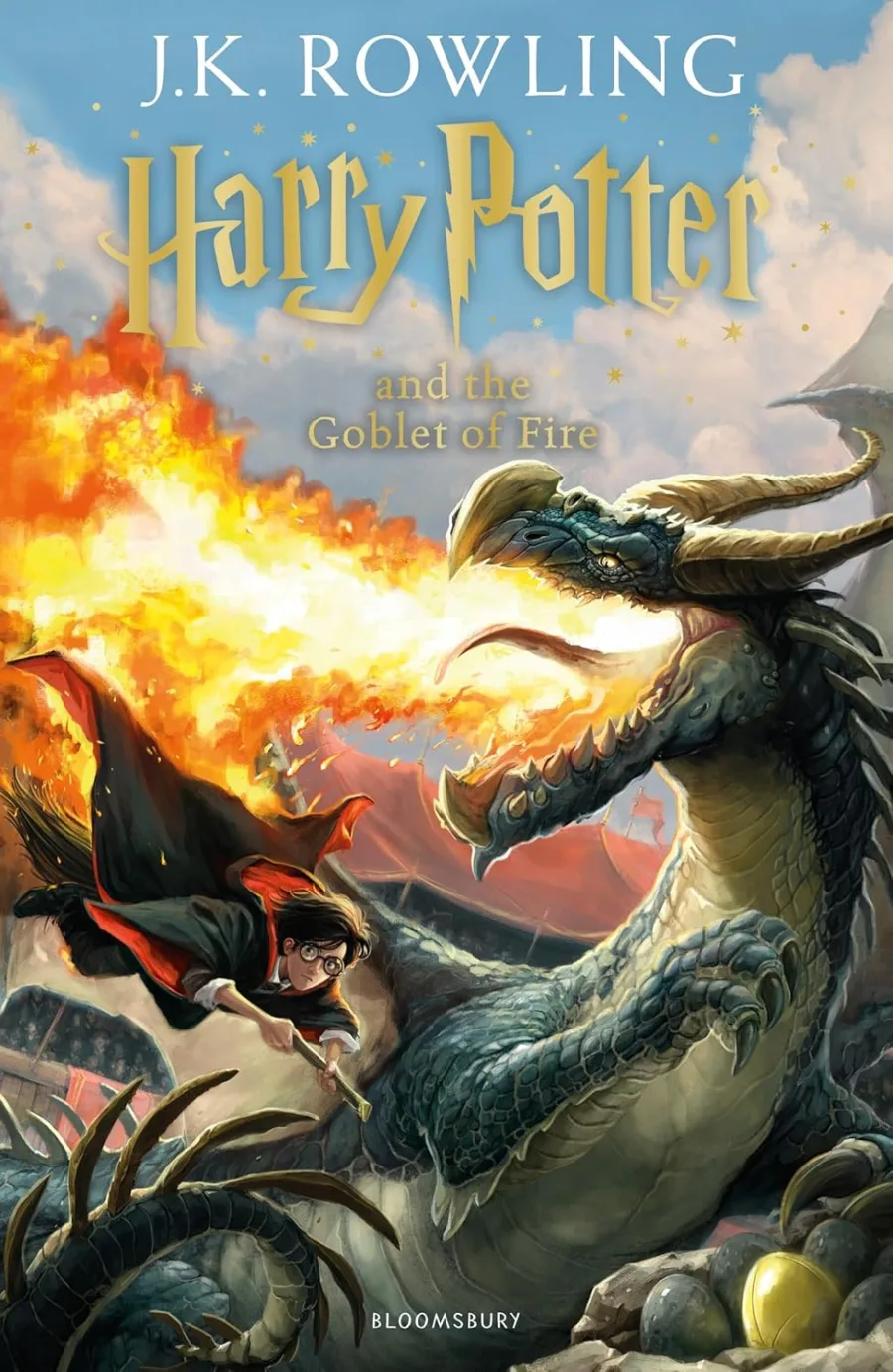
Harry Potter and the Goblet of Fire
Paperback
• 640 Pages
• ₹ 495.00
• English
• 9781408855683
No ratings yet
| Publisher | Bloomsbury Children's Books |
|---|---|
| ISBN13 | 9781408855683 |
| ASIN/SKU | 1408855682 |
| Book Format | Paperback |
| Language | English |
| Pages | 640 |
| List Price | ₹ 495.00 |
| Publishing Date | 03/09/2014 |
| Dimensions | 12.9 x 4.1 x 19.8 cm |
| Weight | 500 g |
| Book Code | BD00055052 |
Buy this Book
Amazon Stores
Ebook Stores
Other Stores
Discover Harry Potter and the Goblet of Fire by J.K. Rowling. This book is published by Bloomsbury Children's Books in Paperback format, ISBN 9781408855683, ASIN 1408855682, under Children's Books, Fantasy, Visionary and Metaphysical Fantasy Fiction for Children.
Book Description
The Triwizard Tournament is to be held at Hogwarts. Only wizards who are over seventeen are allowed to enter - but that doesn't stop Harry dreaming that he will win the competition. Then at Hallowe'en, when the Goblet of Fire makes its selection, Harry is amazed to find his name is one of those that the magical cup picks out. He will face death-defying tasks, dragons and Dark wizards, but with the help of his best friends, Ron and Hermione, he might just make it through - alive!These new editions of the classic and internationally bestselling, multi-award-winning series feature instantly pick-up-able new jackets by Jonny Duddle, with huge child appeal, to bring Harry Potter to the next generation of readers. It's time to PASS THE MAGIC ON.
Author Biography
Harry Potter and the Philosopher's Stone was J.K. Rowling's first novel, followed by the subsequent six titles in the Harry Potter series, as well as three books written for charity: Fantastic Beasts and Where to Find Them, Quidditch Through the Ages and The Tales of Beedle the Bard. The Harry Potter novels have now sold over 450 million copies worldwide and been translated into 78 languages.
Editorial Reviews
Editorial Reviews will be added soon…
Book Summary
Harry Potter and the Goblet of Fire is the fourth novel in J.K. Rowling's Harry Potter series and marks a major turning point in Harry's life. The story begins with the excitement of the Quidditch World Cup and the arrival of students from two foreign wizarding schools at Hogwarts for the legendary Triwizard Tournament. What initially appears to be a thrilling year of magical competition gradually becomes something much darker when Harry is unexpectedly selected as a fourth champion and the shadow of Lord Voldemort begins to return.
Harry starts the story at the Dursleys' house, where he is spending another unpleasant summer. His ordinary misery is interrupted when he receives an invitation to attend the Quidditch World Cup with the Weasley family. Harry is delighted to escape the Dursleys and spend time with people who treat him as part of their family.
The Quidditch World Cup is a spectacular event. Wizards from across the world gather to watch the match between Ireland and Bulgaria, with the brilliant Bulgarian Seeker Viktor Krum attracting enormous attention. The event gives Harry a glimpse of the wider magical community beyond Britain and Hogwarts.
But the celebration ends in chaos.
After the match, Death Eaters appear and terrorize the spectators. They attack and frighten people, reminding the wizarding community that the followers of Lord Voldemort have not disappeared completely. The appearance of the Dark Mark in the sky creates even greater panic.
The incident is significant because it suggests that Voldemort's influence may be returning.
Back at Hogwarts, Harry learns that the school year will be very different from previous years. Hogwarts is hosting the Triwizard Tournament, an ancient magical competition involving three schools: Hogwarts, Beauxbatons Academy of Magic, and Durmstrang Institute.
Each participating school traditionally chooses one champion.
The Hogwarts champion is selected by the Goblet of Fire, a magical object that chooses the student considered most suitable to represent each school.
Students must be at least seventeen years old to enter.
Harry is therefore surprised when the Goblet unexpectedly chooses Cedric Diggory as Hogwarts's champion.
The Beauxbatons champion is Fleur Delacour, while the Durmstrang champion is Viktor Krum.
Then something extraordinary happens.
The Goblet selects another name.
Harry Potter.
Harry is stunned. He never entered the tournament and insists that he did not put his name into the Goblet. Yet the magical rules appear to require him to compete.
The situation immediately creates tension.
Some students believe Harry cheated in order to gain attention. Ron Weasley, hurt and jealous that Harry has been chosen while he has not, temporarily stops speaking to him. Harry is suddenly isolated at a time when he needs his friends more than ever.
Hermione, however, continues to believe Harry's explanation.
The tournament consists of three dangerous tasks. Harry must compete against older and more experienced students while also dealing with suspicion, jealousy, media attention, and the growing sense that something is deeply wrong.
The first task involves dragons.
Each champion must retrieve a golden egg from a dragon while avoiding serious injury. Harry is assigned a Hungarian Horntail, one of the most dangerous dragons in the competition.
Harry initially has no idea how he can possibly survive.
With help from Hagrid, who secretly shows him the dragons, and advice from Sirius Black, Harry prepares for the challenge. He eventually uses his broomstick and flying skills to outmaneuver the dragon and retrieve the egg.
His performance earns him respect and helps repair his friendship with Ron.
The golden egg contains an important clue, but when Harry first opens it, it produces an unbearable screeching sound. He eventually discovers that the clue can be understood underwater.
Meanwhile, Hogwarts life continues with all its ordinary complications.
Harry and his friends encounter the pressure of adolescence, changing friendships, romantic feelings, schoolwork, and social competition. Hermione becomes increasingly involved in promoting the rights of house-elves through her campaign known as S.P.E.W., reflecting her strong sense of justice.
The novel also introduces Rita Skeeter, a journalist who writes sensational and often dishonest stories about Harry and the other champions.
Rita's reporting demonstrates how easily public opinion can be manipulated. She turns private situations into dramatic stories and frequently exaggerates or invents details. Harry learns that fame can be dangerous because other people may decide who you are before they know the truth.
The second Triwizard task requires each champion to rescue someone important to them from the bottom of the Hogwarts lake.
Harry discovers that Ron has been chosen as the person he must rescue. Using gillyweed, which allows him to breathe underwater, Harry descends into the lake.
He discovers that the champions are expected to rescue their assigned people within a limited time. Harry succeeds in saving Ron and also helps Fleur's younger sister, Gabrielle, when Fleur is unable to complete the task.
His decision to help another competitor rather than simply protect his own position demonstrates Harry's compassion.
Although winning the tournament matters, Harry instinctively values another person's safety more highly.
The third task is a giant maze filled with magical obstacles and dangerous creatures. The champions must navigate the maze and reach the Triwizard Cup first.
The maze represents a significant escalation in the story. The tournament has already been dangerous, but the final task creates an environment in which the champions can become isolated from everyone else.
Harry and Cedric eventually reach the center of the maze together.
Rather than competing against one another, they decide to take the Triwizard Cup together.
But the Cup is a Portkey.
When Harry and Cedric touch it, they are transported to a graveyard far from Hogwarts.
There, the story changes completely.
Harry and Cedric encounter Peter Pettigrew, who had been hiding for years after betraying Harry's parents. Pettigrew is carrying out a plan to restore Lord Voldemort to physical form.
Harry is forced to watch as Pettigrew performs a dark ritual.
Voldemort returns.
The resurrection is one of the most important turning points in the entire Harry Potter series. Until this point, Voldemort has been a distant threat, a figure from Harry's past who has been trying to regain his strength.
Now he has returned in a physical body.
Voldemort gathers his Death Eaters and declares that he intends to reclaim power over the wizarding world. He also reveals his obsession with defeating Harry.
Harry is forced into a confrontation with Voldemort.
During the duel, something extraordinary happens: their wands connect because they share a magical connection. This produces the phenomenon known as Priori Incantatem, causing previous spells from Voldemort's wand to appear.
Harry witnesses the echoes of people Voldemort has killed, including his parents.
The appearance of Harry's parents gives the scene enormous emotional power. Harry is reminded of the people he lost as a baby, and their presence helps him resist Voldemort long enough to escape.
Harry eventually manages to reach the Portkey and return to Hogwarts with Cedric's body.
Cedric's death transforms the entire meaning of the tournament.
The competition that began as an exciting celebration has ended in tragedy.
For Harry, the experience is traumatic. He has not simply witnessed the return of Voldemort; he has lost someone his own age who had competed fairly beside him.
The emotional impact is enormous.
The return to Hogwarts does not bring immediate safety because Harry still does not know whom he can trust.
A major revelation follows.
The person who has been teaching Defense Against the Dark Arts as Alastor “Mad-Eye” Moody is revealed to be an impostor.
The real Moody has been captured and imprisoned.
The impostor is actually Barty Crouch Jr., a devoted follower of Voldemort who has used Polyjuice Potion to disguise himself as Moody.
This explains many of the strange events surrounding the tournament.
Barty Crouch Jr. manipulated the Goblet of Fire so that Harry would be selected as a fourth champion. He then secretly guided Harry through the tournament tasks, ensuring that Harry would eventually reach the Triwizard Cup.
The Cup had been turned into a Portkey that transported Harry to Voldemort.
The entire tournament had therefore been manipulated as part of a plan to resurrect Voldemort.
This revelation changes the reader's understanding of the entire story. What seemed to be a school competition was actually a carefully designed trap.
The Ministry of Magic, however, is reluctant to accept that Voldemort has returned.
Cornelius Fudge, the Minister for Magic, refuses to believe Harry's account. He fears that acknowledging Voldemort's return would create panic and undermine his own authority.
This introduces another important theme: denial in the face of uncomfortable truth.
Harry has seen Voldemort with his own eyes. Yet powerful adults prefer not to believe him because accepting the truth would require them to change their behavior.
The novel therefore moves beyond the simple conflict between Harry and Voldemort. It begins to examine how institutions respond when reality threatens their political interests.
The Ministry's refusal to acknowledge Voldemort's return becomes increasingly dangerous.
Dumbledore understands that the threat is real and begins preparing for the conflict that lies ahead.
Harry's experience also forces him to grow emotionally.
In the earlier books, Hogwarts often feels like a refuge from the dangers of the outside world. In Goblet of Fire, that sense of safety begins to disappear.
The magical world is becoming more dangerous, and Harry is growing old enough to understand that evil does not always announce itself openly.
The novel also explores friendship and loyalty.
Harry and Ron's temporary disagreement demonstrates how insecurity can damage relationships. Ron is jealous because Harry has achieved something he secretly wanted, even though Harry never asked for it. Their reconciliation shows that genuine friendship can survive misunderstandings when people are willing to admit their mistakes.
Hermione remains the intellectual and moral center of the trio. She helps Harry investigate the tournament, supports him when others doubt him, and continues to challenge unfairness.
The story also deepens Harry's relationship with Sirius Black, who provides emotional support despite being unable to live openly. Sirius understands the danger Harry faces because he knows Voldemort's followers and the history surrounding Harry's parents.
The novel's treatment of fame becomes increasingly complicated as well. Harry is famous because of something that happened when he was a baby, but he has little control over how other people perceive him.
The Triwizard Tournament makes that problem worse. Students gossip about him, journalists distort his story, and some people accuse him of seeking attention.
Harry learns that being famous does not mean being understood.
Another significant theme is courage under pressure.
Harry is younger than the other champions and has not chosen to participate in the tournament. Yet he continues because the rules force him to compete. He prepares despite his fear, faces dragons, enters the lake, navigates the maze, and eventually confronts Voldemort.
His courage is not based on confidence that he will win.
It comes from his willingness to act even when he is afraid.
The story also introduces the concept of sacrifice. Harry repeatedly chooses to help others even when doing so puts him at a disadvantage. He helps Gabrielle in the lake, shares the Triwizard Cup with Cedric, and ultimately tries to protect himself and others during the confrontation with Voldemort.
These decisions reveal that Harry's greatest strength is not his magical ability. It is his willingness to care about other people.
The death of Cedric also demonstrates the terrible consequences of Voldemort's return. Cedric represents fairness, talent, decency, and the possibility that young people can compete without becoming enemies.
His death therefore symbolizes the end of innocence.
The wizarding world can no longer pretend that the conflict belongs only to adults or to the past.
The novel's ending is consequently much darker than the beginning. Harry returns to Hogwarts physically alive but emotionally changed. He has seen a friend die and witnessed the return of the greatest dark wizard of his generation.
Dumbledore recognizes that the magical world has entered a new phase.
The coming conflict will require people to choose sides.
In this sense, Harry Potter and the Goblet of Fire serves as a bridge between the relatively self-contained adventures of the first three novels and the darker, larger conflict that dominates the later books.
The story expands the magical world beyond Hogwarts. Readers encounter international wizarding communities, foreign schools, professional Quidditch, the Ministry of Magic, the Death Eaters, and a wider network of political and social forces.
But the novel's emotional core remains Harry's struggle to understand what it means to grow up in a dangerous world.
He begins the year expecting another year at school.
He ends it knowing that Voldemort has returned.
The transformation is profound.
Ultimately, Harry Potter and the Goblet of Fire is a story about competition, friendship, manipulation, courage, loss, and the return of evil. The Triwizard Tournament provides the exciting framework, but beneath the magical spectacle lies a darker story about how easily appearances can hide dangerous intentions.
The Goblet of Fire chooses Harry, but the real choice throughout the novel is Harry's own: how will he respond when fear, injustice, jealousy, and danger surround him?
He chooses to keep helping others.
He chooses friendship over rivalry.
He chooses courage over surrender.
And when confronted with Voldemort himself, he chooses to survive.
The novel ultimately marks the moment when Harry's childhood begins to end. The magical world he once imagined as an escape from the ordinary world is revealed to be as vulnerable to fear, politics, prejudice, manipulation, and violence as any other society.
Yet Rowling also shows that darkness does not erase goodness.
Harry, Ron, Hermione, Dumbledore, Sirius, and countless others continue to resist.
The return of Voldemort may change the world, but it does not determine how people must respond to it.
That is the lasting message of Harry Potter and the Goblet of Fire: courage is not the absence of fear, but the decision to stand for what is right when fear would be the easier choice.
Harry starts the story at the Dursleys' house, where he is spending another unpleasant summer. His ordinary misery is interrupted when he receives an invitation to attend the Quidditch World Cup with the Weasley family. Harry is delighted to escape the Dursleys and spend time with people who treat him as part of their family.
The Quidditch World Cup is a spectacular event. Wizards from across the world gather to watch the match between Ireland and Bulgaria, with the brilliant Bulgarian Seeker Viktor Krum attracting enormous attention. The event gives Harry a glimpse of the wider magical community beyond Britain and Hogwarts.
But the celebration ends in chaos.
After the match, Death Eaters appear and terrorize the spectators. They attack and frighten people, reminding the wizarding community that the followers of Lord Voldemort have not disappeared completely. The appearance of the Dark Mark in the sky creates even greater panic.
The incident is significant because it suggests that Voldemort's influence may be returning.
Back at Hogwarts, Harry learns that the school year will be very different from previous years. Hogwarts is hosting the Triwizard Tournament, an ancient magical competition involving three schools: Hogwarts, Beauxbatons Academy of Magic, and Durmstrang Institute.
Each participating school traditionally chooses one champion.
The Hogwarts champion is selected by the Goblet of Fire, a magical object that chooses the student considered most suitable to represent each school.
Students must be at least seventeen years old to enter.
Harry is therefore surprised when the Goblet unexpectedly chooses Cedric Diggory as Hogwarts's champion.
The Beauxbatons champion is Fleur Delacour, while the Durmstrang champion is Viktor Krum.
Then something extraordinary happens.
The Goblet selects another name.
Harry Potter.
Harry is stunned. He never entered the tournament and insists that he did not put his name into the Goblet. Yet the magical rules appear to require him to compete.
The situation immediately creates tension.
Some students believe Harry cheated in order to gain attention. Ron Weasley, hurt and jealous that Harry has been chosen while he has not, temporarily stops speaking to him. Harry is suddenly isolated at a time when he needs his friends more than ever.
Hermione, however, continues to believe Harry's explanation.
The tournament consists of three dangerous tasks. Harry must compete against older and more experienced students while also dealing with suspicion, jealousy, media attention, and the growing sense that something is deeply wrong.
The first task involves dragons.
Each champion must retrieve a golden egg from a dragon while avoiding serious injury. Harry is assigned a Hungarian Horntail, one of the most dangerous dragons in the competition.
Harry initially has no idea how he can possibly survive.
With help from Hagrid, who secretly shows him the dragons, and advice from Sirius Black, Harry prepares for the challenge. He eventually uses his broomstick and flying skills to outmaneuver the dragon and retrieve the egg.
His performance earns him respect and helps repair his friendship with Ron.
The golden egg contains an important clue, but when Harry first opens it, it produces an unbearable screeching sound. He eventually discovers that the clue can be understood underwater.
Meanwhile, Hogwarts life continues with all its ordinary complications.
Harry and his friends encounter the pressure of adolescence, changing friendships, romantic feelings, schoolwork, and social competition. Hermione becomes increasingly involved in promoting the rights of house-elves through her campaign known as S.P.E.W., reflecting her strong sense of justice.
The novel also introduces Rita Skeeter, a journalist who writes sensational and often dishonest stories about Harry and the other champions.
Rita's reporting demonstrates how easily public opinion can be manipulated. She turns private situations into dramatic stories and frequently exaggerates or invents details. Harry learns that fame can be dangerous because other people may decide who you are before they know the truth.
The second Triwizard task requires each champion to rescue someone important to them from the bottom of the Hogwarts lake.
Harry discovers that Ron has been chosen as the person he must rescue. Using gillyweed, which allows him to breathe underwater, Harry descends into the lake.
He discovers that the champions are expected to rescue their assigned people within a limited time. Harry succeeds in saving Ron and also helps Fleur's younger sister, Gabrielle, when Fleur is unable to complete the task.
His decision to help another competitor rather than simply protect his own position demonstrates Harry's compassion.
Although winning the tournament matters, Harry instinctively values another person's safety more highly.
The third task is a giant maze filled with magical obstacles and dangerous creatures. The champions must navigate the maze and reach the Triwizard Cup first.
The maze represents a significant escalation in the story. The tournament has already been dangerous, but the final task creates an environment in which the champions can become isolated from everyone else.
Harry and Cedric eventually reach the center of the maze together.
Rather than competing against one another, they decide to take the Triwizard Cup together.
But the Cup is a Portkey.
When Harry and Cedric touch it, they are transported to a graveyard far from Hogwarts.
There, the story changes completely.
Harry and Cedric encounter Peter Pettigrew, who had been hiding for years after betraying Harry's parents. Pettigrew is carrying out a plan to restore Lord Voldemort to physical form.
Harry is forced to watch as Pettigrew performs a dark ritual.
Voldemort returns.
The resurrection is one of the most important turning points in the entire Harry Potter series. Until this point, Voldemort has been a distant threat, a figure from Harry's past who has been trying to regain his strength.
Now he has returned in a physical body.
Voldemort gathers his Death Eaters and declares that he intends to reclaim power over the wizarding world. He also reveals his obsession with defeating Harry.
Harry is forced into a confrontation with Voldemort.
During the duel, something extraordinary happens: their wands connect because they share a magical connection. This produces the phenomenon known as Priori Incantatem, causing previous spells from Voldemort's wand to appear.
Harry witnesses the echoes of people Voldemort has killed, including his parents.
The appearance of Harry's parents gives the scene enormous emotional power. Harry is reminded of the people he lost as a baby, and their presence helps him resist Voldemort long enough to escape.
Harry eventually manages to reach the Portkey and return to Hogwarts with Cedric's body.
Cedric's death transforms the entire meaning of the tournament.
The competition that began as an exciting celebration has ended in tragedy.
For Harry, the experience is traumatic. He has not simply witnessed the return of Voldemort; he has lost someone his own age who had competed fairly beside him.
The emotional impact is enormous.
The return to Hogwarts does not bring immediate safety because Harry still does not know whom he can trust.
A major revelation follows.
The person who has been teaching Defense Against the Dark Arts as Alastor “Mad-Eye” Moody is revealed to be an impostor.
The real Moody has been captured and imprisoned.
The impostor is actually Barty Crouch Jr., a devoted follower of Voldemort who has used Polyjuice Potion to disguise himself as Moody.
This explains many of the strange events surrounding the tournament.
Barty Crouch Jr. manipulated the Goblet of Fire so that Harry would be selected as a fourth champion. He then secretly guided Harry through the tournament tasks, ensuring that Harry would eventually reach the Triwizard Cup.
The Cup had been turned into a Portkey that transported Harry to Voldemort.
The entire tournament had therefore been manipulated as part of a plan to resurrect Voldemort.
This revelation changes the reader's understanding of the entire story. What seemed to be a school competition was actually a carefully designed trap.
The Ministry of Magic, however, is reluctant to accept that Voldemort has returned.
Cornelius Fudge, the Minister for Magic, refuses to believe Harry's account. He fears that acknowledging Voldemort's return would create panic and undermine his own authority.
This introduces another important theme: denial in the face of uncomfortable truth.
Harry has seen Voldemort with his own eyes. Yet powerful adults prefer not to believe him because accepting the truth would require them to change their behavior.
The novel therefore moves beyond the simple conflict between Harry and Voldemort. It begins to examine how institutions respond when reality threatens their political interests.
The Ministry's refusal to acknowledge Voldemort's return becomes increasingly dangerous.
Dumbledore understands that the threat is real and begins preparing for the conflict that lies ahead.
Harry's experience also forces him to grow emotionally.
In the earlier books, Hogwarts often feels like a refuge from the dangers of the outside world. In Goblet of Fire, that sense of safety begins to disappear.
The magical world is becoming more dangerous, and Harry is growing old enough to understand that evil does not always announce itself openly.
The novel also explores friendship and loyalty.
Harry and Ron's temporary disagreement demonstrates how insecurity can damage relationships. Ron is jealous because Harry has achieved something he secretly wanted, even though Harry never asked for it. Their reconciliation shows that genuine friendship can survive misunderstandings when people are willing to admit their mistakes.
Hermione remains the intellectual and moral center of the trio. She helps Harry investigate the tournament, supports him when others doubt him, and continues to challenge unfairness.
The story also deepens Harry's relationship with Sirius Black, who provides emotional support despite being unable to live openly. Sirius understands the danger Harry faces because he knows Voldemort's followers and the history surrounding Harry's parents.
The novel's treatment of fame becomes increasingly complicated as well. Harry is famous because of something that happened when he was a baby, but he has little control over how other people perceive him.
The Triwizard Tournament makes that problem worse. Students gossip about him, journalists distort his story, and some people accuse him of seeking attention.
Harry learns that being famous does not mean being understood.
Another significant theme is courage under pressure.
Harry is younger than the other champions and has not chosen to participate in the tournament. Yet he continues because the rules force him to compete. He prepares despite his fear, faces dragons, enters the lake, navigates the maze, and eventually confronts Voldemort.
His courage is not based on confidence that he will win.
It comes from his willingness to act even when he is afraid.
The story also introduces the concept of sacrifice. Harry repeatedly chooses to help others even when doing so puts him at a disadvantage. He helps Gabrielle in the lake, shares the Triwizard Cup with Cedric, and ultimately tries to protect himself and others during the confrontation with Voldemort.
These decisions reveal that Harry's greatest strength is not his magical ability. It is his willingness to care about other people.
The death of Cedric also demonstrates the terrible consequences of Voldemort's return. Cedric represents fairness, talent, decency, and the possibility that young people can compete without becoming enemies.
His death therefore symbolizes the end of innocence.
The wizarding world can no longer pretend that the conflict belongs only to adults or to the past.
The novel's ending is consequently much darker than the beginning. Harry returns to Hogwarts physically alive but emotionally changed. He has seen a friend die and witnessed the return of the greatest dark wizard of his generation.
Dumbledore recognizes that the magical world has entered a new phase.
The coming conflict will require people to choose sides.
In this sense, Harry Potter and the Goblet of Fire serves as a bridge between the relatively self-contained adventures of the first three novels and the darker, larger conflict that dominates the later books.
The story expands the magical world beyond Hogwarts. Readers encounter international wizarding communities, foreign schools, professional Quidditch, the Ministry of Magic, the Death Eaters, and a wider network of political and social forces.
But the novel's emotional core remains Harry's struggle to understand what it means to grow up in a dangerous world.
He begins the year expecting another year at school.
He ends it knowing that Voldemort has returned.
The transformation is profound.
Ultimately, Harry Potter and the Goblet of Fire is a story about competition, friendship, manipulation, courage, loss, and the return of evil. The Triwizard Tournament provides the exciting framework, but beneath the magical spectacle lies a darker story about how easily appearances can hide dangerous intentions.
The Goblet of Fire chooses Harry, but the real choice throughout the novel is Harry's own: how will he respond when fear, injustice, jealousy, and danger surround him?
He chooses to keep helping others.
He chooses friendship over rivalry.
He chooses courage over surrender.
And when confronted with Voldemort himself, he chooses to survive.
The novel ultimately marks the moment when Harry's childhood begins to end. The magical world he once imagined as an escape from the ordinary world is revealed to be as vulnerable to fear, politics, prejudice, manipulation, and violence as any other society.
Yet Rowling also shows that darkness does not erase goodness.
Harry, Ron, Hermione, Dumbledore, Sirius, and countless others continue to resist.
The return of Voldemort may change the world, but it does not determine how people must respond to it.
That is the lasting message of Harry Potter and the Goblet of Fire: courage is not the absence of fear, but the decision to stand for what is right when fear would be the easier choice.
Sample Chapters
Sample Chapters will be added soon…
Reader Reviews
No reviews yet.
Harry Potter and the Goblet of Fire
Download Cover Image
Do you want to download the full cover image for Harry Potter and the Goblet of Fire?