
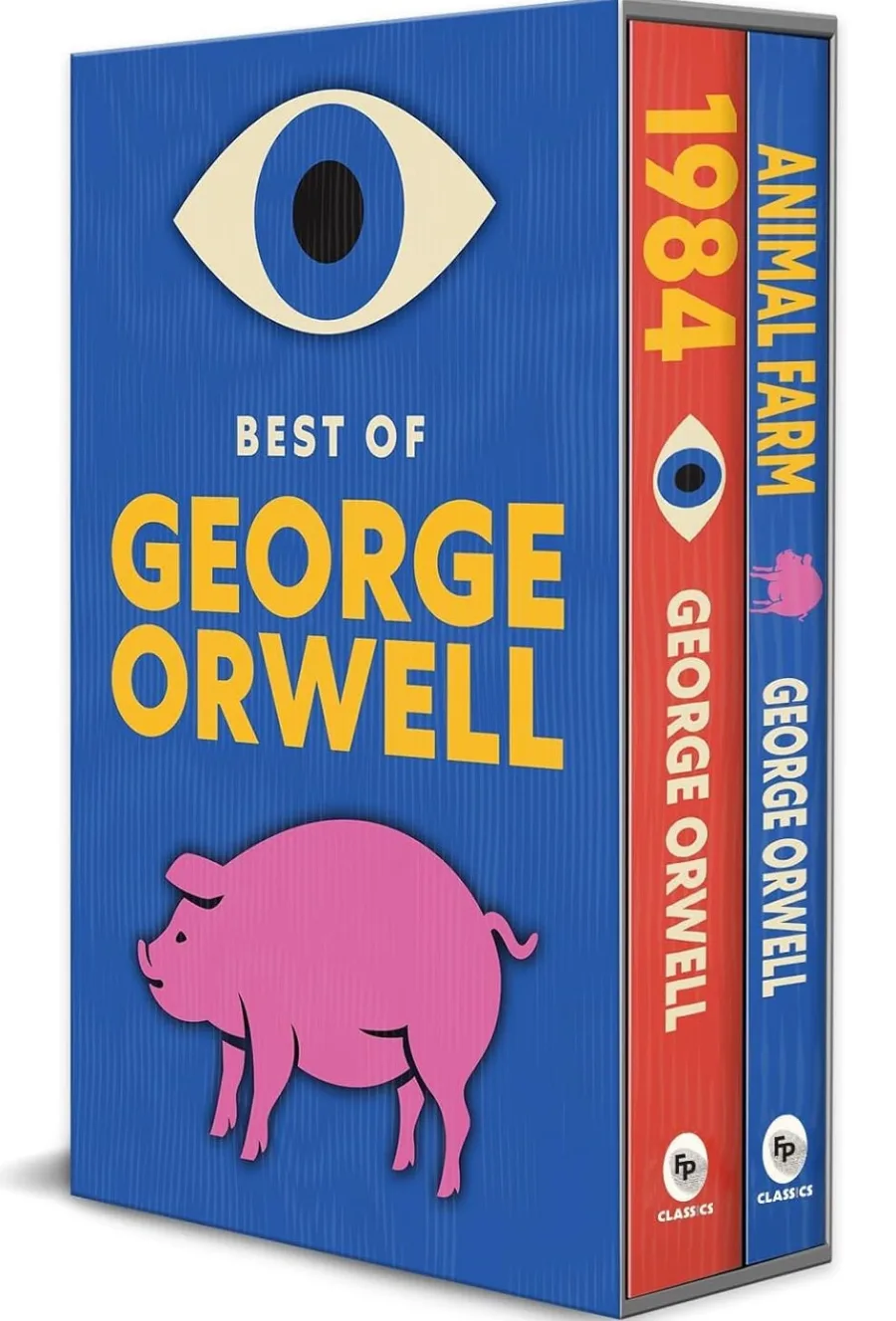
Best of George Orwell Boxed Set (Animal Farm & 1984) Set of 2 Books
Paperback
• 448 Pages
• ₹ 399.00
• English
• 9789358561180
No ratings yet
| Publisher | Fingerprint! Publishing |
|---|---|
| ISBN13 | 9789358561180 |
| ASIN/SKU | 9358561181 |
| Book Format | Paperback |
| Language | English |
| Pages | 448 |
| List Price | ₹ 399.00 |
| Publishing Date | 10/07/2023 |
| Dimensions | 20 x 13 x 3 cm |
| Weight | 360 g |
| Book Code | BD00055049 |
Buy this Book
Amazon Stores
Ebook Stores
Other Stores
Discover Best of George Orwell Boxed Set (Animal Farm and 1984) Set of 2 Books by George Orwell. This book is published by Fingerprint! Publishing in Paperback format, ISBN 9789358561180, ASIN 9358561181, under Literature and Fiction, Social Welfare and Social Services, Architecture.
Book Description
Immerse yourself in the brilliant works of George Orwell with this Boxed Set: Best of George Orwell. It includes two iconic novels, Animal Farm and 1984, both offering gripping tales of dystopian societies and thought-provoking social commentary. This collection is a must-have for fans of Orwell's writing and those seeking profound literary experiences.
Features two timeless classics by George Orwell: Animal Farm and 1984
Dive into Orwell's captivating storytelling and thought-provoking exploration of dystopian societies
Perfect for fans of classic literature and those interested in social and political commentary
Beautifully packaged boxed set for gifting or adding to your personal library s
Experience the genius of Ge
Features two timeless classics by George Orwell: Animal Farm and 1984
Dive into Orwell's captivating storytelling and thought-provoking exploration of dystopian societies
Perfect for fans of classic literature and those interested in social and political commentary
Beautifully packaged boxed set for gifting or adding to your personal library s
Experience the genius of Ge
Author Biography
George Orwell is one of England's most famous writers and social commentators. Among his works are the classic political satire Animal Farm and the dystopian nightmare vision Nineteen Eighty-Four. Orwell was also a prolific essayist, and it is for these works that he was perhaps best known during his lifetime. They include Why I Write and Politics and the English Language. His writing is at once insightful, poignant and entertaining, and continues to be read widely all over the world.
Eric Arthur Blair (George Orwell) was born in 1903 in India, where his father worked for the Civil Service. The family moved to England in 1907 and in 1917 Orwell entered Eton, where he contributed regularly to the various college magazines. From 1922 to 1927 he served with the Indian Imperial Police in Burma, an experience that inspired his first novel, Burmese Days (1934). Several years of poverty followed. He lived in Paris for two years before returning to England, where he worked successively as a private tutor, schoolteacher and bookshop assistant, and contributed reviews and articles to a number of periodicals. Down and Out in Paris and London was published in 1933. In 1936 he was commissioned by Victor Gollancz to visit areas of mass unemployment in Lancashire and Yorkshire, and The Road to Wigan Pier (1937) is a powerful description of the poverty he saw there.
At the end of 1936 Orwell went to Spain to fight for the Republicans and was wounded. Homage to Catalonia is his account of the civil war. He was admitted to a sanatorium in 1938 and from then on was never fully fit. He spent six months in Morocco and there wrote Coming Up for Air. During the Second World War he served in the Home Guard and worked for the BBC Eastern Service from 1941 to 1943. As literary editor of the Tribune he contributed a regular page of political and literary commentary, and he also wrote for the Observer and later for the Manchester Evening News. His unique political allegory, Animal Farm was published in 1945, and it was this novel, together with Nineteen Eighty-Four (1949), which brought him world-wide fame.
It was around this time that Orwell's unique political allegory Animal Farm (1945) was published. The novel is recognised as a classic of modern political satire and is simultaneously an engaging story and convincing allegory. It was this novel, together with Nineteen Eighty-Four (1949), which finally brought him world-wide fame. Nineteen Eighty-Four's ominous depiction of a repressive, totalitarian regime shocked contemporary readers, but ensures that the book remains perhaps the preeminent dystopian novel of modern literature.
Eric Arthur Blair (George Orwell) was born in 1903 in India, where his father worked for the Civil Service. The family moved to England in 1907 and in 1917 Orwell entered Eton, where he contributed regularly to the various college magazines. From 1922 to 1927 he served with the Indian Imperial Police in Burma, an experience that inspired his first novel, Burmese Days (1934). Several years of poverty followed. He lived in Paris for two years before returning to England, where he worked successively as a private tutor, schoolteacher and bookshop assistant, and contributed reviews and articles to a number of periodicals. Down and Out in Paris and London was published in 1933. In 1936 he was commissioned by Victor Gollancz to visit areas of mass unemployment in Lancashire and Yorkshire, and The Road to Wigan Pier (1937) is a powerful description of the poverty he saw there.
At the end of 1936 Orwell went to Spain to fight for the Republicans and was wounded. Homage to Catalonia is his account of the civil war. He was admitted to a sanatorium in 1938 and from then on was never fully fit. He spent six months in Morocco and there wrote Coming Up for Air. During the Second World War he served in the Home Guard and worked for the BBC Eastern Service from 1941 to 1943. As literary editor of the Tribune he contributed a regular page of political and literary commentary, and he also wrote for the Observer and later for the Manchester Evening News. His unique political allegory, Animal Farm was published in 1945, and it was this novel, together with Nineteen Eighty-Four (1949), which brought him world-wide fame.
It was around this time that Orwell's unique political allegory Animal Farm (1945) was published. The novel is recognised as a classic of modern political satire and is simultaneously an engaging story and convincing allegory. It was this novel, together with Nineteen Eighty-Four (1949), which finally brought him world-wide fame. Nineteen Eighty-Four's ominous depiction of a repressive, totalitarian regime shocked contemporary readers, but ensures that the book remains perhaps the preeminent dystopian novel of modern literature.
Editorial Reviews
Editorial Reviews will be added soon…
Book Summary
Best of George Orwell Boxed Set: Animal Farm & 1984 brings together two of George Orwell's most influential and enduring works in a two-book collection. The set pairs Animal Farm, a sharp political allegory about revolution, inequality, propaganda, and the corruption of power, with 1984, a landmark dystopian novel about surveillance, authoritarianism, censorship, language, and the destruction of individual freedom. Together, the books provide a powerful introduction to Orwell's literary and political vision.
Orwell, whose real name was Eric Arthur Blair, was one of the most influential English writers and journalists of the twentieth century. His reputation rests especially on Animal Farm and Nineteen Eighty-Four, two books that transformed political ideas into memorable fictional worlds.
Although the two books are very different in setting and style, they share a central concern: what happens when power becomes more important than truth, freedom, justice, and human dignity?
Animal Farm: A Revolution That Goes Wrong
Animal Farm begins on Manor Farm, where the animals are exhausted by the cruelty and exploitation of their human owner, Mr. Jones.
The animals dream of creating a society in which they will be free from human oppression. Inspired by the ideas of the elderly pig Old Major, they imagine a future based on equality and shared prosperity.
Eventually, the animals rebel and successfully drive Mr. Jones away.
At first, the revolution appears to have succeeded.
The farm belongs to the animals.
They believe they have created a new society.
But their idealistic vision gradually begins to collapse.
The pigs, particularly Napoleon, acquire increasing political power. Rules that were supposed to guarantee equality are gradually changed. Propaganda replaces honest discussion, fear replaces freedom, and the other animals become increasingly unable to challenge those in authority.
Penguin Random House describes Animal Farm as Orwell's political satire of the Russian Revolution, in which oppressed animals overthrow their human master but subsequently face a new form of tyranny.
Napoleon and the Corruption of Power
Napoleon is one of the most important characters in Animal Farm.
At first, the revolution is presented as a collective effort. But Napoleon gradually concentrates authority in his own hands.
His rise demonstrates one of Orwell's central political concerns: a revolution intended to destroy oppression can itself become oppressive when power is allowed to concentrate without accountability.
Napoleon does not need to maintain control through physical force alone.
He also relies on manipulation.
The animals are given carefully constructed explanations for political decisions. Their memories are weakened, their understanding of history is altered, and slogans replace independent thought.
This makes Animal Farm a powerful study of political propaganda.
The Manipulation of Language
Language is one of the most important weapons in Orwell's fictional political worlds.
In Animal Farm, language is repeatedly manipulated to make injustice appear reasonable.
The pigs gradually alter the meaning of the principles that originally inspired the revolution.
Statements that once promised equality are reinterpreted.
Slogans become substitutes for genuine political thought.
The character Squealer is especially important because he specializes in explaining away contradictions and convincing the other animals that the pigs' behavior is justified.
The animals may see that their lives are becoming harder, but they struggle to articulate why.
Orwell demonstrates how controlling language can help those in power control people's understanding of reality.
Boxer and the Working Class
Boxer, the hardworking horse, represents another important dimension of the novel.
He is loyal, physically strong, and willing to work extremely hard for the revolution.
His simple faith in authority makes him admirable but also vulnerable.
Boxer's tragedy demonstrates the danger of unquestioning loyalty.
The novel asks readers to consider what happens when ordinary people work tirelessly for a political system without examining whether that system continues to serve them.
His story is one of the book's most emotionally powerful elements.
Equality and Inequality
The animals begin their revolution with an ideal of equality.
But gradually, inequality returns.
The pigs acquire privileges.
Other animals work harder while receiving fewer benefits.
The original revolutionary principles are manipulated to justify these differences.
The result is one of Orwell's sharpest observations: political systems can claim to represent equality while creating entirely new hierarchies.
This is why Animal Farm remains relevant far beyond the historical events that inspired it.
Its central warning concerns the behavior of power itself.
1984: A World Without Privacy
If Animal Farm examines the corruption of revolutionary ideals, 1984 imagines a society in which authoritarian power has become almost total.
The novel takes place in Oceania, a totalitarian state ruled by the mysterious Party and its symbolic leader, Big Brother.
Citizens are constantly monitored.
Their actions are watched.
Their conversations can be observed.
Even their thoughts are treated as potential crimes.
At the center of this world is Winston Smith, a government employee who works at the Ministry of Truth.
His job is to alter historical records so that the official version of the past always agrees with the Party's current claims.
The publisher describes 1984 as Orwell's dystopian vision of a society controlled by a totalitarian regime in which Big Brother is always watching.
Winston Smith
Winston is not a conventional revolutionary hero.
He is an ordinary man who gradually becomes aware that something is deeply wrong with the society around him.
He remembers fragments of a past that the Party has attempted to erase.
He begins writing privately.
He questions official history.
He wants to preserve his own ability to think independently.
His resistance begins with something very small: the desire to maintain an inner life that the government cannot completely control.
But in Oceania, even private thought can become dangerous.
Big Brother and Surveillance
One of the most enduring concepts introduced by 1984 is Big Brother.
Big Brother represents the omnipresence of government surveillance and political authority.
Citizens never know exactly when they are being watched.
That uncertainty itself becomes a method of control.
People begin monitoring their own behavior because they fear that someone else may be monitoring them.
The result is a society in which surveillance does not merely control public behavior.
It enters people's private psychological lives.
This makes 1984 one of the defining works of dystopian fiction.
Thoughtcrime
The Party does not merely want citizens to obey.
It wants them to think correctly.
This creates the concept of thoughtcrime.
In Orwell's world, an independent thought can itself become an act of rebellion.
This is one of the novel's most frightening ideas because it removes the boundary between public behavior and private consciousness.
A government that controls actions is authoritarian.
A government that attempts to control thoughts is something even more extreme.
Winston's struggle is therefore fundamentally about preserving his ability to think for himself.
Newspeak and Control of Language
Another major concept in 1984 is Newspeak, the language developed by the Party.
The purpose of Newspeak is not simply to create new vocabulary.
It is intended to reduce the range of ideas that people can express.
If language becomes sufficiently limited, the ability to formulate certain kinds of thoughts can also become more difficult.
This connects directly with Orwell's broader interest in language and political power.
Words can describe reality.
But they can also distort it.
When those in authority control language, they gain influence over how people understand events.
The Destruction of Historical Truth
One of the most disturbing elements of 1984 is the Party's ability to rewrite history.
Winston's job is to alter old documents so that they support the government's current narrative.
If the Party changes its position, the historical record changes too.
The past is therefore not treated as something fixed.
It becomes whatever the authorities say it was.
This produces a society in which objective truth becomes increasingly difficult to establish.
The question becomes:
If nobody can prove what happened yesterday, how can anyone challenge what the government says today?
Winston and Julia
Winston's relationship with Julia provides another form of rebellion.
Their relationship is important not simply because they fall in love, but because their private connection becomes an attempt to reclaim a part of their humanity from the Party.
In a society that wants to control people's emotions, relationships, sexuality, and loyalties, private affection becomes politically significant.
Winston and Julia attempt to create a small space that belongs to them rather than to the state.
Their relationship gives the novel emotional depth while also demonstrating how far authoritarian power can reach.
The Brotherhood
Winston eventually becomes interested in the possibility of organized resistance through the mysterious Brotherhood.
He begins to believe that an underground movement may exist to oppose the Party.
But in Orwell's world, certainty is dangerous.
Winston never fully knows whom he can trust.
The possibility of rebellion may itself be part of a larger system of control.
This uncertainty contributes to the novel's psychological tension.
What Connects Animal Farm and 1984?
The two books are different, but their thematic connection is striking.
Animal Farm asks what can happen when revolutionary ideals are corrupted by those who gain power.
1984 asks what happens when authoritarian power becomes so extensive that it attempts to control reality itself.
Both novels examine:
Political oppression
Propaganda
Manipulation of language
Control of information
Abuse of authority
Destruction of individuality
Fear and obedience
The relationship between power and truth
The consequences of political apathy
Together, they provide a remarkably broad picture of Orwell's concerns.
Why These Books Still Matter
Both novels were written in the first half of the twentieth century, yet their ideas continue to influence discussions about politics, propaganda, surveillance, censorship, language, and freedom.
The Penguin India edition specifically presents the two novels together as works whose warnings remain relevant in the modern world.
Their continued relevance does not depend on assuming that modern society is identical to Orwell's fictional worlds.
Instead, their value lies in the questions they encourage readers to ask.
Who controls information?
Can political language hide injustice?
What happens when people stop questioning authority?
How easily can fear influence behavior?
What happens when a society loses a shared understanding of truth?
These questions remain important in any era.
Orwell's Writing Style
Orwell's prose is generally clear, direct, and accessible.
He does not depend on unnecessarily complicated language.
This simplicity makes his political ideas particularly effective.
Animal Farm uses the form of a fable, making complex political developments easier to understand through animals and a farm.
1984, by contrast, creates a much darker and more detailed dystopian world.
The difference in style allows Orwell to explore similar concerns from different directions.
One book uses satire and allegory.
The other uses dystopian fiction and psychological suspense.
A Powerful Introduction to George Orwell
For someone discovering George Orwell for the first time, this two-book collection is particularly useful because it brings together his two most famous novels.
Animal Farm is relatively short and straightforward, making it an accessible introduction to Orwell's political thinking.
1984 then expands those concerns into a much larger and more psychologically complex world.
Reading them together allows readers to notice recurring ideas about power, truth, language, and freedom.
Orwell's political writing was shaped by his experiences and observations during a period of enormous political upheaval. His two best-known novels eventually made him one of the defining literary voices of the twentieth century.
Who Should Read This Boxed Set?
The Best of George Orwell Boxed Set is particularly suitable for readers interested in:
Classic English literature
Political fiction
Dystopian novels
Political satire
Allegorical fiction
Totalitarianism and authoritarianism
Propaganda and censorship
Surveillance and privacy
Freedom and individual rights
Classic literature collections
George Orwell's major works
Books about political power
Social commentary
Modern dystopian fiction
It is also an excellent choice for students and readers who want to understand why Animal Farm and 1984 remain central texts in discussions of twentieth-century literature.
Final Thoughts
Best of George Orwell Boxed Set: Animal Farm & 1984 brings together two books that examine one of the most important questions in political literature:
What happens when power is allowed to control truth?
In Animal Farm, the animals overthrow their human oppressor and attempt to create an equal society. But gradually, a new ruling class emerges, and the principles of the revolution are manipulated to justify inequality and authoritarian control.
In 1984, the problem has become even more extreme. The Party does not merely control people's actions. It attempts to control language, history, information, relationships, and even thought.
The two books therefore complement each other remarkably well.
Animal Farm demonstrates how political ideals can be corrupted.
1984 demonstrates what life can become when that corruption develops into comprehensive authoritarian control.
For readers searching for Best of George Orwell Boxed Set, George Orwell two-book set, Animal Farm and 1984, George Orwell books, Animal Farm summary, 1984 summary, dystopian fiction, political satire, classic political novels, books about totalitarianism, books about surveillance, propaganda and censorship books, political allegory, classic English literature, Orwellian fiction, or books about freedom and power, this collection offers an excellent introduction to Orwell's most famous works.
Ultimately, Orwell's warning is not limited to one country, one political ideology, or one historical period.
His deeper concern is the human tendency to surrender independent judgment when fear, propaganda, ambition, or unquestioned authority becomes stronger than the desire for truth.
That is what makes Animal Farm and 1984 such enduring classics.
They are not simply stories about fictional governments.
They are reminders to remain alert to the ways language can be manipulated, history can be rewritten, power can be abused, and freedom can gradually disappear when people stop questioning what they are told.
Orwell, whose real name was Eric Arthur Blair, was one of the most influential English writers and journalists of the twentieth century. His reputation rests especially on Animal Farm and Nineteen Eighty-Four, two books that transformed political ideas into memorable fictional worlds.
Although the two books are very different in setting and style, they share a central concern: what happens when power becomes more important than truth, freedom, justice, and human dignity?
Animal Farm: A Revolution That Goes Wrong
Animal Farm begins on Manor Farm, where the animals are exhausted by the cruelty and exploitation of their human owner, Mr. Jones.
The animals dream of creating a society in which they will be free from human oppression. Inspired by the ideas of the elderly pig Old Major, they imagine a future based on equality and shared prosperity.
Eventually, the animals rebel and successfully drive Mr. Jones away.
At first, the revolution appears to have succeeded.
The farm belongs to the animals.
They believe they have created a new society.
But their idealistic vision gradually begins to collapse.
The pigs, particularly Napoleon, acquire increasing political power. Rules that were supposed to guarantee equality are gradually changed. Propaganda replaces honest discussion, fear replaces freedom, and the other animals become increasingly unable to challenge those in authority.
Penguin Random House describes Animal Farm as Orwell's political satire of the Russian Revolution, in which oppressed animals overthrow their human master but subsequently face a new form of tyranny.
Napoleon and the Corruption of Power
Napoleon is one of the most important characters in Animal Farm.
At first, the revolution is presented as a collective effort. But Napoleon gradually concentrates authority in his own hands.
His rise demonstrates one of Orwell's central political concerns: a revolution intended to destroy oppression can itself become oppressive when power is allowed to concentrate without accountability.
Napoleon does not need to maintain control through physical force alone.
He also relies on manipulation.
The animals are given carefully constructed explanations for political decisions. Their memories are weakened, their understanding of history is altered, and slogans replace independent thought.
This makes Animal Farm a powerful study of political propaganda.
The Manipulation of Language
Language is one of the most important weapons in Orwell's fictional political worlds.
In Animal Farm, language is repeatedly manipulated to make injustice appear reasonable.
The pigs gradually alter the meaning of the principles that originally inspired the revolution.
Statements that once promised equality are reinterpreted.
Slogans become substitutes for genuine political thought.
The character Squealer is especially important because he specializes in explaining away contradictions and convincing the other animals that the pigs' behavior is justified.
The animals may see that their lives are becoming harder, but they struggle to articulate why.
Orwell demonstrates how controlling language can help those in power control people's understanding of reality.
Boxer and the Working Class
Boxer, the hardworking horse, represents another important dimension of the novel.
He is loyal, physically strong, and willing to work extremely hard for the revolution.
His simple faith in authority makes him admirable but also vulnerable.
Boxer's tragedy demonstrates the danger of unquestioning loyalty.
The novel asks readers to consider what happens when ordinary people work tirelessly for a political system without examining whether that system continues to serve them.
His story is one of the book's most emotionally powerful elements.
Equality and Inequality
The animals begin their revolution with an ideal of equality.
But gradually, inequality returns.
The pigs acquire privileges.
Other animals work harder while receiving fewer benefits.
The original revolutionary principles are manipulated to justify these differences.
The result is one of Orwell's sharpest observations: political systems can claim to represent equality while creating entirely new hierarchies.
This is why Animal Farm remains relevant far beyond the historical events that inspired it.
Its central warning concerns the behavior of power itself.
1984: A World Without Privacy
If Animal Farm examines the corruption of revolutionary ideals, 1984 imagines a society in which authoritarian power has become almost total.
The novel takes place in Oceania, a totalitarian state ruled by the mysterious Party and its symbolic leader, Big Brother.
Citizens are constantly monitored.
Their actions are watched.
Their conversations can be observed.
Even their thoughts are treated as potential crimes.
At the center of this world is Winston Smith, a government employee who works at the Ministry of Truth.
His job is to alter historical records so that the official version of the past always agrees with the Party's current claims.
The publisher describes 1984 as Orwell's dystopian vision of a society controlled by a totalitarian regime in which Big Brother is always watching.
Winston Smith
Winston is not a conventional revolutionary hero.
He is an ordinary man who gradually becomes aware that something is deeply wrong with the society around him.
He remembers fragments of a past that the Party has attempted to erase.
He begins writing privately.
He questions official history.
He wants to preserve his own ability to think independently.
His resistance begins with something very small: the desire to maintain an inner life that the government cannot completely control.
But in Oceania, even private thought can become dangerous.
Big Brother and Surveillance
One of the most enduring concepts introduced by 1984 is Big Brother.
Big Brother represents the omnipresence of government surveillance and political authority.
Citizens never know exactly when they are being watched.
That uncertainty itself becomes a method of control.
People begin monitoring their own behavior because they fear that someone else may be monitoring them.
The result is a society in which surveillance does not merely control public behavior.
It enters people's private psychological lives.
This makes 1984 one of the defining works of dystopian fiction.
Thoughtcrime
The Party does not merely want citizens to obey.
It wants them to think correctly.
This creates the concept of thoughtcrime.
In Orwell's world, an independent thought can itself become an act of rebellion.
This is one of the novel's most frightening ideas because it removes the boundary between public behavior and private consciousness.
A government that controls actions is authoritarian.
A government that attempts to control thoughts is something even more extreme.
Winston's struggle is therefore fundamentally about preserving his ability to think for himself.
Newspeak and Control of Language
Another major concept in 1984 is Newspeak, the language developed by the Party.
The purpose of Newspeak is not simply to create new vocabulary.
It is intended to reduce the range of ideas that people can express.
If language becomes sufficiently limited, the ability to formulate certain kinds of thoughts can also become more difficult.
This connects directly with Orwell's broader interest in language and political power.
Words can describe reality.
But they can also distort it.
When those in authority control language, they gain influence over how people understand events.
The Destruction of Historical Truth
One of the most disturbing elements of 1984 is the Party's ability to rewrite history.
Winston's job is to alter old documents so that they support the government's current narrative.
If the Party changes its position, the historical record changes too.
The past is therefore not treated as something fixed.
It becomes whatever the authorities say it was.
This produces a society in which objective truth becomes increasingly difficult to establish.
The question becomes:
If nobody can prove what happened yesterday, how can anyone challenge what the government says today?
Winston and Julia
Winston's relationship with Julia provides another form of rebellion.
Their relationship is important not simply because they fall in love, but because their private connection becomes an attempt to reclaim a part of their humanity from the Party.
In a society that wants to control people's emotions, relationships, sexuality, and loyalties, private affection becomes politically significant.
Winston and Julia attempt to create a small space that belongs to them rather than to the state.
Their relationship gives the novel emotional depth while also demonstrating how far authoritarian power can reach.
The Brotherhood
Winston eventually becomes interested in the possibility of organized resistance through the mysterious Brotherhood.
He begins to believe that an underground movement may exist to oppose the Party.
But in Orwell's world, certainty is dangerous.
Winston never fully knows whom he can trust.
The possibility of rebellion may itself be part of a larger system of control.
This uncertainty contributes to the novel's psychological tension.
What Connects Animal Farm and 1984?
The two books are different, but their thematic connection is striking.
Animal Farm asks what can happen when revolutionary ideals are corrupted by those who gain power.
1984 asks what happens when authoritarian power becomes so extensive that it attempts to control reality itself.
Both novels examine:
Political oppression
Propaganda
Manipulation of language
Control of information
Abuse of authority
Destruction of individuality
Fear and obedience
The relationship between power and truth
The consequences of political apathy
Together, they provide a remarkably broad picture of Orwell's concerns.
Why These Books Still Matter
Both novels were written in the first half of the twentieth century, yet their ideas continue to influence discussions about politics, propaganda, surveillance, censorship, language, and freedom.
The Penguin India edition specifically presents the two novels together as works whose warnings remain relevant in the modern world.
Their continued relevance does not depend on assuming that modern society is identical to Orwell's fictional worlds.
Instead, their value lies in the questions they encourage readers to ask.
Who controls information?
Can political language hide injustice?
What happens when people stop questioning authority?
How easily can fear influence behavior?
What happens when a society loses a shared understanding of truth?
These questions remain important in any era.
Orwell's Writing Style
Orwell's prose is generally clear, direct, and accessible.
He does not depend on unnecessarily complicated language.
This simplicity makes his political ideas particularly effective.
Animal Farm uses the form of a fable, making complex political developments easier to understand through animals and a farm.
1984, by contrast, creates a much darker and more detailed dystopian world.
The difference in style allows Orwell to explore similar concerns from different directions.
One book uses satire and allegory.
The other uses dystopian fiction and psychological suspense.
A Powerful Introduction to George Orwell
For someone discovering George Orwell for the first time, this two-book collection is particularly useful because it brings together his two most famous novels.
Animal Farm is relatively short and straightforward, making it an accessible introduction to Orwell's political thinking.
1984 then expands those concerns into a much larger and more psychologically complex world.
Reading them together allows readers to notice recurring ideas about power, truth, language, and freedom.
Orwell's political writing was shaped by his experiences and observations during a period of enormous political upheaval. His two best-known novels eventually made him one of the defining literary voices of the twentieth century.
Who Should Read This Boxed Set?
The Best of George Orwell Boxed Set is particularly suitable for readers interested in:
Classic English literature
Political fiction
Dystopian novels
Political satire
Allegorical fiction
Totalitarianism and authoritarianism
Propaganda and censorship
Surveillance and privacy
Freedom and individual rights
Classic literature collections
George Orwell's major works
Books about political power
Social commentary
Modern dystopian fiction
It is also an excellent choice for students and readers who want to understand why Animal Farm and 1984 remain central texts in discussions of twentieth-century literature.
Final Thoughts
Best of George Orwell Boxed Set: Animal Farm & 1984 brings together two books that examine one of the most important questions in political literature:
What happens when power is allowed to control truth?
In Animal Farm, the animals overthrow their human oppressor and attempt to create an equal society. But gradually, a new ruling class emerges, and the principles of the revolution are manipulated to justify inequality and authoritarian control.
In 1984, the problem has become even more extreme. The Party does not merely control people's actions. It attempts to control language, history, information, relationships, and even thought.
The two books therefore complement each other remarkably well.
Animal Farm demonstrates how political ideals can be corrupted.
1984 demonstrates what life can become when that corruption develops into comprehensive authoritarian control.
For readers searching for Best of George Orwell Boxed Set, George Orwell two-book set, Animal Farm and 1984, George Orwell books, Animal Farm summary, 1984 summary, dystopian fiction, political satire, classic political novels, books about totalitarianism, books about surveillance, propaganda and censorship books, political allegory, classic English literature, Orwellian fiction, or books about freedom and power, this collection offers an excellent introduction to Orwell's most famous works.
Ultimately, Orwell's warning is not limited to one country, one political ideology, or one historical period.
His deeper concern is the human tendency to surrender independent judgment when fear, propaganda, ambition, or unquestioned authority becomes stronger than the desire for truth.
That is what makes Animal Farm and 1984 such enduring classics.
They are not simply stories about fictional governments.
They are reminders to remain alert to the ways language can be manipulated, history can be rewritten, power can be abused, and freedom can gradually disappear when people stop questioning what they are told.
Sample Chapters
Sample Chapters will be added soon…
Reader Reviews
No reviews yet.
Best of George Orwell Boxed Set (Animal Farm & 1984) Set of 2 Books
Download Cover Image
Do you want to download the full cover image for Best of George Orwell Boxed Set (Animal Farm & 1984) Set of 2 Books?