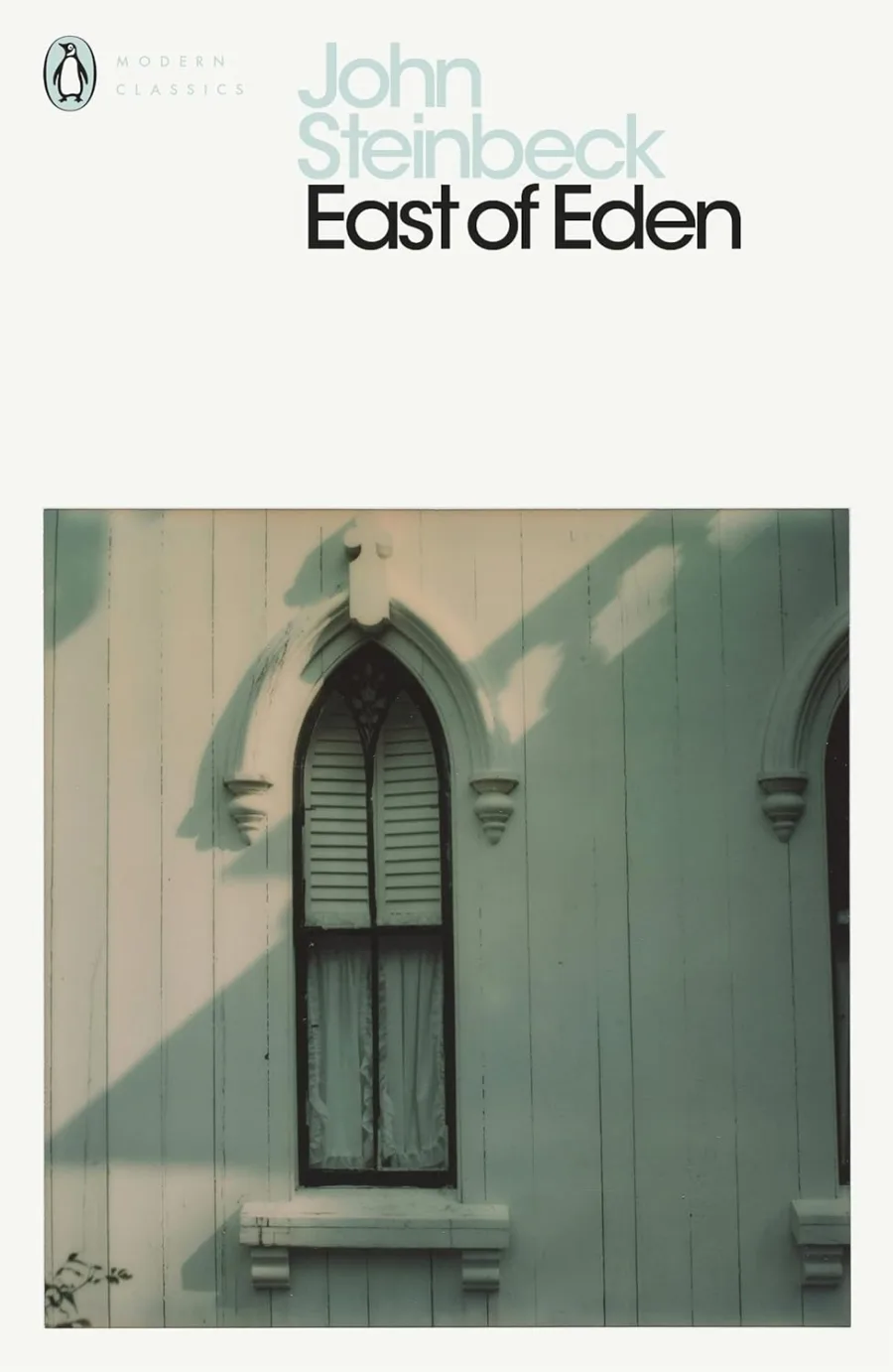
East of Eden
Paperback
• 640 Pages
• ₹ 599.00
• English
• 9780141185071
No ratings yet
| Publisher | Penguin Classics |
|---|---|
| ISBN13 | 9780141185071 |
| ASIN/SKU | 0141185074 |
| Book Format | Paperback |
| Language | English |
| Pages | 640 |
| List Price | ₹ 599.00 |
| Publishing Date | 07/09/2000 |
| Dimensions | 12.8 x 2.8 x 19.7 cm |
| Weight | 437 g |
| Book Code | BD00055044 |
Buy this Book
Amazon Stores
Ebook Stores
Other Stores
Discover East of Eden by John Steinbeck. This book is published by Penguin Classics in Paperback format, ISBN 9780141185071, ASIN 0141185074, under Literature and Fiction, Classic Fiction, Contemporary Fiction.
Book Description
'There is only one book to a man,' Steinbeck wrote of East of Eden, his most ambitious novel. Set in the rich farmland of the Salinas Valley, California, this powerful, often brutal novel, follows the intertwined destinies of two families - the Trasks and the Hamiltons - whose generations hopelessly re-enact the fall of Adam and Eve and the poisonous rivalry of Cain and Abel. Here Steinbeck created some of his most memorable characters and explored his most enduring themes: the mystery of identity; the inexplicability of love, and the murderous consequences of love's absence.
Author Biography
John Steinbeck (1902-1968), winner of the Nobel Prize in Literature, achieved popular success in 1935 when he published Tortilla Flat. He went on to write more than twenty-five novels, including The Grapes of Wrath and Of Mice and Men.
Photo by JohnSteinbeck.JPG: US Government derivative work: Homonihilis (JohnSteinbeck.JPG) [Public domain], via Wikimedia Commons
Photo by JohnSteinbeck.JPG: US Government derivative work: Homonihilis (JohnSteinbeck.JPG) [Public domain], via Wikimedia Commons
Editorial Reviews
Editorial Reviews will be added soon…
Book Summary
John Steinbeck Centennial Edition (1902-2002)
EAST OF EDEN
Born in Salinas, California, in 1902, John Steinbeck grew up in a fertile agricultural valley about twenty-five miles from the Pacific Coast—and both valley and coast would serve as settings for some of his best fiction. In 1919 he went to Stanford University, where he intermittently enrolled in literature and writing courses until he left in 1925 without taking a degree. During the next five years he supported himself as a laborer and journalist in New York City and then as a caretaker for a Lake Tahoe estate, all the time working on his first novel, Cup of Gold (1929). After marriage and a move to Pacific Grove, he published two California fictions, The Pastures of Heaven (1932) and To a God Unknown (1933), and worked on short stories later collected in The Long Valley (1938). Popular success and financial security came only with Tortilla Flat (1935), stories about Monterey’s paisanos. A ceaseless experimenter throughout his career, Steinbeck changed courses regularly. Three powerful novels of the late 1930s focused on the California laboring class: In Dubious Battle (1936), Of Mice and Men (1937), and the book considered by many his finest, The Grapes of Wrath (1939). Early in the 1940s, Steinbeck became a film-maker with The Forgotten Village (1941) and a serious student of marine biology with Sea of Cortez (1941). He devoted his services to the war, writing Bombs Away (1942) and the controversial play-novelette The Moon Is Down (1942). Cannery Row (1945), The Wayward Bus (1947), The Pearl (1947), A Russian Journal (1948), another experimental drama, Burning Bright (1950), and The Log from the Sea of Cortez (1951) preceded publication of the monumental East of Eden (1952), an ambitious saga of the Salinas Valley and his own family’s history. The last decades of his life were spent in New York City and Sag Harbor with his third wife, with whom he traveled widely. Later books include Sweet Thursday (1954), The Short Reign of Pippin IV: A Fabrication (1957), Once There Was a War (1958), The Winter of Our Discontent (1961), Travels with Charley in Search of America (1962), America and Americans (1966), and the posthumously published Journal of a Novel: The East of Eden Letters (1969), Viva Zapata! (1975), The Acts of King Arthur and his Noble Knights (1976), and Working Days: The Journals of The Grapes of Wrath (1989). He died in 1968, having won a Nobel Prize in 1962.
Throughout his life Steinbeck signed his letters with his personal “Pigasus” logo, symbolizing himself “a lumbering soul but trying to fly.” The Latin motto Ad Astra Per Alia Porci translates “To the stars on the wings of a pig.”
PENGUIN BOOKS
Published by the Penguin Group
Penguin Putnam Inc., 375 Hudson Street,
New York, New York 10014, U.S.A.
Penguin Books Ltd, 80 Strand, London WC2R 0RL, England
Penguin Books Australia Ltd, 250 Camberwell Road,
Camberwell, Victoria 3124, Australia
Penguin Books Canada Ltd, 10 Alcorn Avenue,
Toronto, Ontario, Canada M4V 3B2
Penguin Books India (P) Ltd, 11 Community Centre,
Panchsheel Park, New Delhi-110 017, India
Penguin Books (N.Z.) Ltd, Cnr Rosedale and Airborne Roads,
Albany, Auckland, New Zealand
Penguin Books (South Africa) (Pty) Ltd, 24 Sturdee Avenue,
Rosebank, Johannesburg 2196, South Africa
Penguin Books Ltd, Registered Offices:
Harmondsworth, Middlesex, England
First published in the United States of America by The Viking Press 1952
Viking Compass Edition published 1970
Published with an introduction by David Wyatt in Penguin Books 1992
This edition published 2002
Copyright John Steinbeck, 1952
Copyright renewed Elaine Steinbeck, Thom Steinbeck, and John Steinbeck IV, 1980
All rights reserved
A portion of this book first appeared in Collier’s as The Sons of Cyrus Trask.
LIBRARY OF CONGRESS CATALOGING IN PUBLICATION DATA
Steinbeck, John, 1902-1968.
East of Eden/John Steinbeck: introduction by David Wyatt.
p. cm.
ISBN: 9781440631320
I. Title.
PS3537.T3234E3 1992
813’.52—dc20 92-12135
PASCAL COVICI
Dear Pat,
You came upon me carving some kind of little figure out of wood and you said, “Why don’t you make something for me?”
I asked you what you wanted, and you said, “A box.”
“What for?”
“To put things in.”
“What things?”
“Whatever you have,” you said.
Well, here’s your box. Nearly everything I have is in it, and it is not full. Pain and excitement are in it, and feeling good or bad and evil thoughts and good thoughts—the pleasure of design and some despair and the indescribable joy of creation.
And on top of these are all the gratitude and love I have for you.
And still the box is not full.
JOHN
PART ONE
Chapter 1
[1]
THE SALINAS VALLEY is in Northern California. It is a long narrow swale between two ranges of mountains, and the Salinas River winds and twists up the center until it falls at last into Monterey Bay.
I remember my childhood names for grasses and secret flowers. I remember where a toad may live and what time the birds awaken in the summer—and what trees and seasons smelled like—how people looked and walked and smelled even. The memory of odors is very rich.
I remember that the Gabilan Mountains to the east of the valley were light gay mountains full of sun and loveliness and a kind of invitation, so that you wanted to climb into their warm foothills almost as you want to climb into the lap of a beloved mother. They were beckoning mountains with a brown grass love. The Santa Lucias stood up against the sky to the west and kept the valley from the open sea, and they were dark and brooding—unfriendly and dangerous. I always found in myself a dread of west and a love of east. Where I ever got such an idea I cannot say, unless it could be that the morning came over the peaks of the Gabilans and the night drifted back from the ridges of the Santa Lucias. It may be that the birth and death of the day had some part in my feeling about the two ranges of mountains.
From both sides of the valley little streams slipped out of the hill canyons and fell into the bed of the Salinas River. In the winter of wet years the streams ran full-freshet, and they swelled the river until sometimes it raged and boiled, bank full, and then it was a destroyer. The river tore the edges of the farm lands and washed whole acres down; it toppled barns and houses into itself, to go floating and bobbing away. It trapped cows and pigs and sheep and drowned them in its muddy brown water and carried them to the sea. Then when the late spring came, the river drew in from its edges and the sand banks appeared. And in the summer the river didn’t run at all above ground. Some pools would be left in the deep swirl places under a high bank. The tules and grasses grew back, and willows straightened up with the flood debris in their upper branches. The Salinas was only a part-time river. The summer sun drove it underground. It was not a fine river at all, but it was the only one we had and so we boasted about it—how dangerous it was in a wet winter and how dry it was in a dry summer. You can boast about anything if it’s all you have. Maybe the less you have, the more you are required to boast.
The floor of the Salinas Valley, between the ranges and below the foothills, is level because this valley used to be the bottom of a hundred-mile inlet from the sea. The river mouth at Moss Landing was centuries ago the entrance to this long inland water. Once, fifty miles down the valley, my father bored a well. The drill came up first with topsoil and then with gravel and then with white sea sand full of shells and even pieces of whalebone. There were twenty feet of sand and then black earth again, and even a piece of redwood, that imperishable wood that does not rot. Before the inland sea the valley must have been a forest. And those things had happened right under our feet. And it seemed to me sometimes at night that I could feel both the sea and the redwood forest before it.
On the wide level acres of the valley the topsoil lay deep and fertile. It required only a rich winter of rain to make it break forth in grass and flowers. The spring flowers in a wet year were unbelievable. The whole valley floor, and the foothills too,
EAST OF EDEN
Born in Salinas, California, in 1902, John Steinbeck grew up in a fertile agricultural valley about twenty-five miles from the Pacific Coast—and both valley and coast would serve as settings for some of his best fiction. In 1919 he went to Stanford University, where he intermittently enrolled in literature and writing courses until he left in 1925 without taking a degree. During the next five years he supported himself as a laborer and journalist in New York City and then as a caretaker for a Lake Tahoe estate, all the time working on his first novel, Cup of Gold (1929). After marriage and a move to Pacific Grove, he published two California fictions, The Pastures of Heaven (1932) and To a God Unknown (1933), and worked on short stories later collected in The Long Valley (1938). Popular success and financial security came only with Tortilla Flat (1935), stories about Monterey’s paisanos. A ceaseless experimenter throughout his career, Steinbeck changed courses regularly. Three powerful novels of the late 1930s focused on the California laboring class: In Dubious Battle (1936), Of Mice and Men (1937), and the book considered by many his finest, The Grapes of Wrath (1939). Early in the 1940s, Steinbeck became a film-maker with The Forgotten Village (1941) and a serious student of marine biology with Sea of Cortez (1941). He devoted his services to the war, writing Bombs Away (1942) and the controversial play-novelette The Moon Is Down (1942). Cannery Row (1945), The Wayward Bus (1947), The Pearl (1947), A Russian Journal (1948), another experimental drama, Burning Bright (1950), and The Log from the Sea of Cortez (1951) preceded publication of the monumental East of Eden (1952), an ambitious saga of the Salinas Valley and his own family’s history. The last decades of his life were spent in New York City and Sag Harbor with his third wife, with whom he traveled widely. Later books include Sweet Thursday (1954), The Short Reign of Pippin IV: A Fabrication (1957), Once There Was a War (1958), The Winter of Our Discontent (1961), Travels with Charley in Search of America (1962), America and Americans (1966), and the posthumously published Journal of a Novel: The East of Eden Letters (1969), Viva Zapata! (1975), The Acts of King Arthur and his Noble Knights (1976), and Working Days: The Journals of The Grapes of Wrath (1989). He died in 1968, having won a Nobel Prize in 1962.
Throughout his life Steinbeck signed his letters with his personal “Pigasus” logo, symbolizing himself “a lumbering soul but trying to fly.” The Latin motto Ad Astra Per Alia Porci translates “To the stars on the wings of a pig.”
PENGUIN BOOKS
Published by the Penguin Group
Penguin Putnam Inc., 375 Hudson Street,
New York, New York 10014, U.S.A.
Penguin Books Ltd, 80 Strand, London WC2R 0RL, England
Penguin Books Australia Ltd, 250 Camberwell Road,
Camberwell, Victoria 3124, Australia
Penguin Books Canada Ltd, 10 Alcorn Avenue,
Toronto, Ontario, Canada M4V 3B2
Penguin Books India (P) Ltd, 11 Community Centre,
Panchsheel Park, New Delhi-110 017, India
Penguin Books (N.Z.) Ltd, Cnr Rosedale and Airborne Roads,
Albany, Auckland, New Zealand
Penguin Books (South Africa) (Pty) Ltd, 24 Sturdee Avenue,
Rosebank, Johannesburg 2196, South Africa
Penguin Books Ltd, Registered Offices:
Harmondsworth, Middlesex, England
First published in the United States of America by The Viking Press 1952
Viking Compass Edition published 1970
Published with an introduction by David Wyatt in Penguin Books 1992
This edition published 2002
Copyright John Steinbeck, 1952
Copyright renewed Elaine Steinbeck, Thom Steinbeck, and John Steinbeck IV, 1980
All rights reserved
A portion of this book first appeared in Collier’s as The Sons of Cyrus Trask.
LIBRARY OF CONGRESS CATALOGING IN PUBLICATION DATA
Steinbeck, John, 1902-1968.
East of Eden/John Steinbeck: introduction by David Wyatt.
p. cm.
ISBN: 9781440631320
I. Title.
PS3537.T3234E3 1992
813’.52—dc20 92-12135
PASCAL COVICI
Dear Pat,
You came upon me carving some kind of little figure out of wood and you said, “Why don’t you make something for me?”
I asked you what you wanted, and you said, “A box.”
“What for?”
“To put things in.”
“What things?”
“Whatever you have,” you said.
Well, here’s your box. Nearly everything I have is in it, and it is not full. Pain and excitement are in it, and feeling good or bad and evil thoughts and good thoughts—the pleasure of design and some despair and the indescribable joy of creation.
And on top of these are all the gratitude and love I have for you.
And still the box is not full.
JOHN
PART ONE
Chapter 1
[1]
THE SALINAS VALLEY is in Northern California. It is a long narrow swale between two ranges of mountains, and the Salinas River winds and twists up the center until it falls at last into Monterey Bay.
I remember my childhood names for grasses and secret flowers. I remember where a toad may live and what time the birds awaken in the summer—and what trees and seasons smelled like—how people looked and walked and smelled even. The memory of odors is very rich.
I remember that the Gabilan Mountains to the east of the valley were light gay mountains full of sun and loveliness and a kind of invitation, so that you wanted to climb into their warm foothills almost as you want to climb into the lap of a beloved mother. They were beckoning mountains with a brown grass love. The Santa Lucias stood up against the sky to the west and kept the valley from the open sea, and they were dark and brooding—unfriendly and dangerous. I always found in myself a dread of west and a love of east. Where I ever got such an idea I cannot say, unless it could be that the morning came over the peaks of the Gabilans and the night drifted back from the ridges of the Santa Lucias. It may be that the birth and death of the day had some part in my feeling about the two ranges of mountains.
From both sides of the valley little streams slipped out of the hill canyons and fell into the bed of the Salinas River. In the winter of wet years the streams ran full-freshet, and they swelled the river until sometimes it raged and boiled, bank full, and then it was a destroyer. The river tore the edges of the farm lands and washed whole acres down; it toppled barns and houses into itself, to go floating and bobbing away. It trapped cows and pigs and sheep and drowned them in its muddy brown water and carried them to the sea. Then when the late spring came, the river drew in from its edges and the sand banks appeared. And in the summer the river didn’t run at all above ground. Some pools would be left in the deep swirl places under a high bank. The tules and grasses grew back, and willows straightened up with the flood debris in their upper branches. The Salinas was only a part-time river. The summer sun drove it underground. It was not a fine river at all, but it was the only one we had and so we boasted about it—how dangerous it was in a wet winter and how dry it was in a dry summer. You can boast about anything if it’s all you have. Maybe the less you have, the more you are required to boast.
The floor of the Salinas Valley, between the ranges and below the foothills, is level because this valley used to be the bottom of a hundred-mile inlet from the sea. The river mouth at Moss Landing was centuries ago the entrance to this long inland water. Once, fifty miles down the valley, my father bored a well. The drill came up first with topsoil and then with gravel and then with white sea sand full of shells and even pieces of whalebone. There were twenty feet of sand and then black earth again, and even a piece of redwood, that imperishable wood that does not rot. Before the inland sea the valley must have been a forest. And those things had happened right under our feet. And it seemed to me sometimes at night that I could feel both the sea and the redwood forest before it.
On the wide level acres of the valley the topsoil lay deep and fertile. It required only a rich winter of rain to make it break forth in grass and flowers. The spring flowers in a wet year were unbelievable. The whole valley floor, and the foothills too,
Sample Chapters
Sample Chapters will be added soon…
Reader Reviews
No reviews yet.
East of Eden