
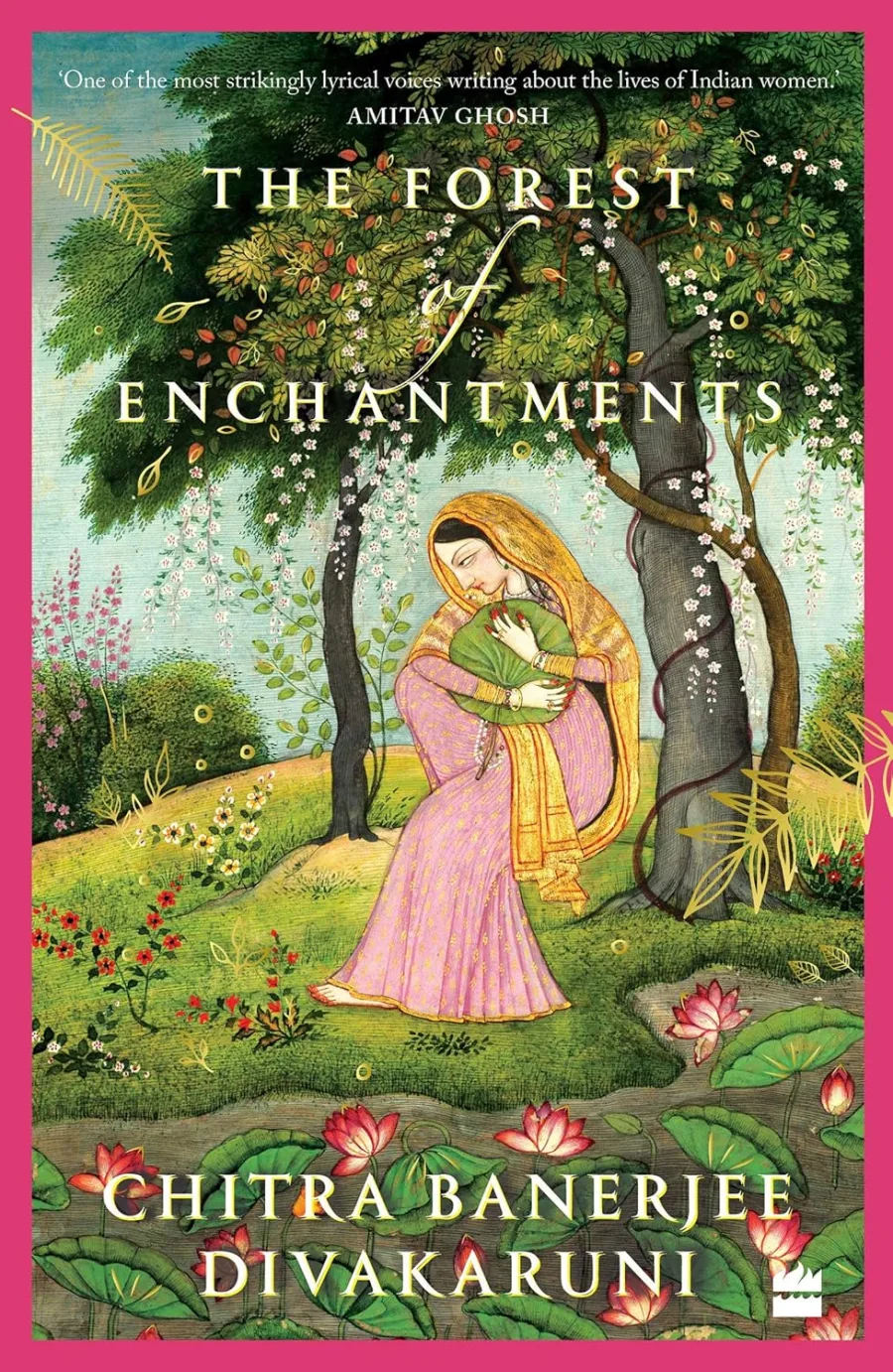
The Forest of Enchantments
Paperback
• 372 Pages
• ₹ 499.00
• English
• 9789353573577
No ratings yet
| Publisher | HarperCollins India |
|---|---|
| ISBN13 | 9789353573577 |
| ASIN/SKU | 9789353573577 |
| Book Format | Paperback |
| Language | English |
| Pages | 372 |
| List Price | ₹ 499.00 |
| Publishing Date | 31/10/2019 |
| Dimensions | 22.23 x 14.61 x 2.54 cm |
| Weight | 294 g |
| Book Code | BD00055043 |
Buy this Book
Amazon Stores
Ebook Stores
Other Stores
Discover The Forest of Enchantments by Chitra Banerjee Divakaruni. This book is published by HarperCollins India in Paperback format, ISBN 9789353573577, ASIN 9789353573577, under Literature and Fiction, Myths, Legends and Sagas, Contemporary Fiction.
Book Description
The Ramayana, one of the world's greatest epics, is also a tragic love story. In this brilliant retelling, Chitra Banerjee Divakaruni places Sita at the centre of the novel: this is Sita's version. The Forest of Enchantments is also a very human story of some of the other women in the epic, often misunderstood and relegated to the margins: Kaikeyi, Surpanakha, Mandodari. A powerful comment on duty, betrayal, infidelity and honour, it is also about women's struggle to retain autonomy in a world that privileges men, as Chitra transforms an ancient story into a gripping, contemporary battle of wills. While the Ramayana resonates even today, she makes it more relevant than ever, in the underlying questions in the novel: How should women be treated by their loved ones? What are their rights in a relationship? When does a woman need to stand up and say, 'Enough!'
Author Biography
Chitra Banerjee Divakaruni is the award-winning author of 18 books. Her themes include the Indian experience, contemporary America, women, immigration, history, myth, and the joys and challenges of living in a multicultural world. Her work has been published in over 100 magazines and anthologies and translated into 29 languages, including Dutch, Hebrew, Hindi and Japanese. She has won numerous awards, including an American
Book Award and the internation Premio Scanno Prize. Divakaruni also writes for children and young adults.
Her latest novel is Oleander Girl (Simon and Schuster, 2013). Her upcoming novel is Before We Visit the Goddess (about 3 generations of women-- grandmother, mother and daughter-- who each examine the question "what does it mean to be a successful woman." April 2016, Simon & Schuster.)
Two of her books, The Mistress of Spices and Sister of My Heart, have been made into movies. Her novels One Amazing Thing and Palace of Illusions have been optioned. Her collection of stories, Arranged Marriage has been made into a play.
She was born in India and came to the United States to continue her education, receiving a Master’s degree from Wright State University in Dayton, Ohio and a Ph.D. from the University of California, Berkeley.
She currently teaches in the nationally ranked Creative Writing program at the Univ. of Houston. She serves on the Advisory board of Maitri in the San Francisco Bay Area and Daya in Houston, organizations that help South Asian or South Asian American women in abusive situations. She is also closely involved with Pratham, an organization that helps educate children (especially those living in urban slums) in India.
She has judged several prestigious awards, such as the National Book Award and the PEN Faulkner Award.
She lives in Houston with her husband Murthy and has two sons, Anand and Abhay (whose names she has used in her children’s novels).
Book Award and the internation Premio Scanno Prize. Divakaruni also writes for children and young adults.
Her latest novel is Oleander Girl (Simon and Schuster, 2013). Her upcoming novel is Before We Visit the Goddess (about 3 generations of women-- grandmother, mother and daughter-- who each examine the question "what does it mean to be a successful woman." April 2016, Simon & Schuster.)
Two of her books, The Mistress of Spices and Sister of My Heart, have been made into movies. Her novels One Amazing Thing and Palace of Illusions have been optioned. Her collection of stories, Arranged Marriage has been made into a play.
She was born in India and came to the United States to continue her education, receiving a Master’s degree from Wright State University in Dayton, Ohio and a Ph.D. from the University of California, Berkeley.
She currently teaches in the nationally ranked Creative Writing program at the Univ. of Houston. She serves on the Advisory board of Maitri in the San Francisco Bay Area and Daya in Houston, organizations that help South Asian or South Asian American women in abusive situations. She is also closely involved with Pratham, an organization that helps educate children (especially those living in urban slums) in India.
She has judged several prestigious awards, such as the National Book Award and the PEN Faulkner Award.
She lives in Houston with her husband Murthy and has two sons, Anand and Abhay (whose names she has used in her children’s novels).
Editorial Reviews
Editorial Reviews will be added soon…
Book Summary
The Forest of Enchantments by Chitra Banerjee Divakaruni is a powerful retelling of the Ramayana from the perspective of Sita, one of Indian literature's most enduring female figures. Instead of presenting Sita primarily as the obedient wife who follows Rama into exile, Divakaruni gives her a distinct voice, inner life, intelligence, desires, doubts, and emotional strength. The novel asks readers to look at the ancient epic through the eyes of a woman whose life is shaped by love, duty, exile, motherhood, sacrifice, and the expectations placed upon her.
The novel is not simply a retelling of familiar events. It is an attempt to imagine what Sita might have thought and felt during the experiences that the traditional epic often describes from a male or heroic perspective. Divakaruni brings the private emotions behind the public story to the foreground.
At its heart, The Forest of Enchantments is a story about Sita's search for her own identity in a world that repeatedly asks her to sacrifice herself for others.
Sita's Childhood
Sita is born in an unusual and almost miraculous manner. She is discovered by King Janaka while he is ploughing the earth.
Janaka and his wife, Sunaina, raise her with love.
From childhood, Sita is different from what people expect a princess to be.
She is intelligent, observant, independent-minded, and deeply connected to nature.
She develops a particular affection for plants, trees, flowers, and the natural world.
This connection becomes important throughout the novel.
For Sita, nature provides a place where she can experience freedom from the rigid expectations of royal life.
She also grows up with an awareness that she is somehow connected to the earth.
This gives her identity a deeper symbolic meaning.
She is not merely a princess.
She is a daughter of the earth.
Sita and Rama
Sita's life changes when she meets Rama, the prince of Ayodhya.
Their relationship develops into love.
Rama is noble, disciplined, compassionate, and committed to dharma.
Sita admires these qualities.
Their marriage appears to promise a life of happiness.
Yet Divakaruni does not present their relationship as a simple fairy tale.
Sita loves Rama deeply, but she also recognizes that he is shaped by his responsibilities as a prince and later as a king.
His understanding of duty sometimes conflicts with her emotional needs.
This tension becomes one of the most important elements of the novel.
The Bow of Shiva
Sita's marriage to Rama is connected with the famous swayamvara.
Many powerful princes come to seek her hand.
The challenge is to lift and string the enormous bow associated with Shiva.
Rama succeeds.
Sita chooses him.
Their marriage is celebrated as an ideal union.
But the novel also emphasizes Sita's own choice.
She is not merely awarded to Rama because he wins a contest.
She loves him and willingly chooses him.
This distinction is important because Divakaruni's Sita is not a passive figure.
She has desires and makes decisions.
Exile
The happiness of Sita and Rama does not last long.
Because of a promise made by King Dasharatha to Kaikeyi, Rama is ordered to leave Ayodhya and live in exile for fourteen years.
Rama accepts the decision because he believes that keeping his father's promise is part of his duty.
Sita refuses to remain safely in the palace.
She chooses to accompany Rama.
She explains that a wife should share her husband's life, but her decision is more than obedience.
She wants to remain with the person she loves.
She is also unwilling to accept a comfortable life while Rama suffers in the forest.
Lakshmana joins them as well.
The three leave Ayodhya and enter the forest.
Life in the Forest
The forest becomes one of the most important spaces in the novel.
For Sita, it is frightening but also liberating.
Away from the palace, she experiences a different kind of existence.
She discovers new landscapes, plants, animals, sages, and communities.
She begins to understand the forest as a living world rather than merely a place of exile.
The forest also allows her to develop a relationship with nature that becomes almost spiritual.
At the same time, danger is always present.
Demons and supernatural forces inhabit the wilderness.
Sita gradually realizes that the forest contains both beauty and violence.
This duality is reflected in the novel's title.
The forest is enchanted because it is mysterious, beautiful, unpredictable, and transformative.
The Golden Deer
One of the turning points comes with the appearance of the golden deer.
Sita is enchanted by its beauty and asks Rama to capture it.
The deer is actually Maricha, a demon working with Ravana.
Rama pursues it.
When Maricha cries out in Rama's voice, Sita becomes frightened.
She urges Lakshmana to go and help Rama.
Lakshmana initially refuses because he believes Rama is safe.
But Sita's fear and anger eventually force him to leave.
This leaves her alone.
The event becomes the opening through which Ravana, the king of Lanka, enters her life.
Ravana's Abduction
Ravana disguises himself as a holy man and approaches Sita.
Sita follows the conventions of hospitality and offers him food.
Then Ravana reveals his true identity.
He abducts her and carries her away to Lanka.
Sita is devastated.
Yet she refuses to surrender her dignity.
Ravana attempts to persuade her to become his queen.
She rejects him.
He can imprison her body.
He cannot control her mind.
This becomes one of the novel's central ideas.
Sita's strength is not primarily physical.
It comes from her ability to preserve her inner identity even when everything external has been taken from her.
Sita in Lanka
Ravana places Sita in the Ashoka grove.
There she waits.
She is surrounded by guards and repeatedly pressured to accept Ravana.
But she refuses.
The traditional story often focuses on Sita's chastity.
Divakaruni expands this idea into something broader.
Sita's refusal is also about autonomy.
She will not allow Ravana to define her.
She will not allow captivity to determine her worth.
She remembers Rama, but she also begins understanding herself more deeply.
Her time in Lanka becomes a period of psychological endurance.
Hanuman
Eventually, Hanuman reaches Sita.
He comes as Rama's messenger and gives her proof that Rama is searching for her.
Hanuman's arrival restores hope.
He offers to carry Sita away from Lanka, but she refuses.
She wants Rama to come for her.
Her decision is not simply about pride.
She wants the injustice of her abduction to be confronted openly.
She does not want her rescue to remain a secret escape.
Hanuman becomes one of the novel's most compassionate figures.
His devotion to Rama is powerful, but his respect for Sita is equally important.
The War in Lanka
Rama gathers an army of allies and attacks Lanka.
The battle between Rama and Ravana becomes one of the great conflicts of the Ramayana.
Ravana is eventually defeated.
Sita is finally free.
But her suffering is not over.
The people around her question whether she has remained faithful during her captivity.
Sita is forced to undergo a trial by fire to prove her purity.
This is one of the most painful moments in the novel.
She has been abducted against her will.
Yet she is the one who must prove that she is innocent.
Divakaruni uses this episode to expose the cruelty of a social system in which a woman's honor can be questioned because of something done to her.
Return to Ayodhya
Rama and Sita return to Ayodhya.
Rama becomes king.
For a time, it appears that Sita's suffering has finally ended.
She is pregnant.
She is preparing for motherhood.
She hopes to build a peaceful life.
But public opinion begins to turn against her.
Rumors spread about her time in Lanka.
Rama is placed in a terrible position between his love for Sita and his responsibilities as king.
Eventually, he decides that Sita must leave.
Sita's Second Exile
Sita is sent away to the forest while she is pregnant.
This is one of the most devastating moments in the novel.
She is not given a genuine opportunity to defend herself.
She is abandoned because of the fears and judgments of society.
The woman who had voluntarily followed Rama into exile is now exiled by him.
This time, however, she does not have the same emotional dependence on Rama.
She begins building a life of her own.
She is taken in by the sage Valmiki.
There she gives birth to her twin sons, Lava and Kusha.
Motherhood
Motherhood transforms Sita.
Lava and Kusha become the center of her world.
She raises them with love and teaches them values.
She does not fill their minds with hatred toward their father.
Instead, she allows them to discover their own understanding of the world.
Her motherhood becomes another form of strength.
She no longer defines herself primarily as Rama's wife.
She is a mother.
She is an individual.
She is a woman with her own history.
The forest becomes less a place of exile and more a place where she can finally create a life according to her own values.
The Role of Valmiki
Valmiki provides Sita with safety and dignity.
He becomes an important figure in her second life.
He also writes the story of Rama and Sita.
This creates an interesting literary dimension to the novel.
Sita is living inside the story that others will eventually tell.
But her own perspective is different.
The official version of an epic cannot always capture the private emotions of the people inside it.
Divakaruni's novel attempts to recover that hidden emotional history.
Lava and Kusha Meet Rama
Eventually, Lava and Kusha encounter Rama.
They do not initially understand that he is their father.
They become connected with the larger story of Ayodhya and Rama's kingdom.
Their presence forces Rama to confront the consequences of his decision.
He learns that he has sons.
He learns what Sita's life has become.
The past returns.
Sita's Final Choice
Sita is eventually brought back into the public world.
Rama wants her to return.
But she has changed.
She is no longer the young woman who believed that her identity was inseparable from her husband's.
She has suffered too much.
She has learned to live without him.
She understands that love alone cannot justify every action.
When she is once again asked to prove her purity, she refuses to participate in the cycle.
Instead, she calls upon Mother Earth to receive her.
The earth opens.
Sita returns to the source from which she came.
This is not presented simply as a tragic death.
It is an act of agency.
She refuses to continue allowing other people to define her worth.
The Meaning of the Forest
The forest is more than a setting.
It represents freedom.
It is a place where Sita can exist outside the strict structures of palace life.
In the forest, she discovers her relationship with nature and with herself.
The forest is also a place of danger and transformation.
Sita enters it as a princess.
She leaves it as a woman who understands her own strength.
The forest therefore becomes a metaphor for the inner journey.
Sita's Voice
The greatest achievement of The Forest of Enchantments is its focus on Sita's voice.
Traditional epic narratives often place heroes and wars at the center.
Divakaruni shifts attention toward women's experiences.
What does it feel like to be a wife whose husband chooses duty over love?
What does it feel like to be abducted and then questioned about your purity?
What does it mean to become a mother while living in exile?
What happens when society expects a woman to sacrifice everything without questioning the sacrifice?
By asking these questions, Divakaruni makes Sita emotionally accessible to modern readers.
Love and Sacrifice
The novel does not reject Sita's love for Rama.
Her love is genuine.
But it questions the assumption that love requires unlimited sacrifice.
Sita repeatedly sacrifices herself.
She follows Rama into exile.
She endures captivity.
She undergoes the trial by fire.
She accepts separation.
But eventually she recognizes that sacrifice has limits.
A person cannot lose herself completely and still call that life.
The novel therefore presents a mature understanding of love: love should not require the destruction of one's identity.
Conclusion
The Forest of Enchantments is ultimately a story about a woman reclaiming her voice from a story that has been told about her for thousands of years.
Sita begins as a beloved princess and wife.
She becomes an exile.
Then a captive.
Then a mother.
And finally, a woman who chooses her own destiny.
Her journey is filled with extraordinary events—the forest, demons, Lanka, Hanuman, the war, the trial by fire—but the deepest conflict is internal.
She must discover who she is when she is no longer defined by her relationship with Rama.
Divakaruni's Sita is neither simply a perfect goddess nor merely a victim.
She is intelligent, loving, sometimes uncertain, sometimes angry, and capable of making mistakes.
She loves deeply, but she also learns that love does not mean surrendering one's entire self.
Her relationship with nature provides another dimension to her character. The forest gives her something the palace cannot: a sense of belonging that does not depend upon social status or approval.
The novel also challenges traditional ideas of female virtue.
Sita's purity is not ultimately about what happens to her body.
It is about the integrity of her inner self.
Ravana can imprison her.
Society can judge her.
Rama can abandon her.
But none of them can determine who she is.
Her final return to the earth is therefore both heartbreaking and powerful.
She does not return because she has been defeated.
She returns because she refuses to spend the rest of her life proving herself to people who have repeatedly doubted her.
At its deepest level, The Forest of Enchantments asks us to reconsider the meaning of strength.
Strength is not always fighting.
Sometimes it is enduring.
Sometimes it is leaving.
Sometimes it is raising children alone.
Sometimes it is refusing to accept an unjust judgment.
And sometimes it is having the courage to say that one's own dignity matters.
Through Sita's journey, Chitra Banerjee Divakaruni transforms one of India's most familiar stories into an intimate exploration of a woman's inner life.
The novel reminds us that behind every great epic are human beings whose private feelings may never have been fully recorded.
And perhaps its most enduring message is this:
A woman can love deeply without losing herself, sacrifice without surrendering her dignity, and walk away from the world that refuses to recognize her worth.
The novel is not simply a retelling of familiar events. It is an attempt to imagine what Sita might have thought and felt during the experiences that the traditional epic often describes from a male or heroic perspective. Divakaruni brings the private emotions behind the public story to the foreground.
At its heart, The Forest of Enchantments is a story about Sita's search for her own identity in a world that repeatedly asks her to sacrifice herself for others.
Sita's Childhood
Sita is born in an unusual and almost miraculous manner. She is discovered by King Janaka while he is ploughing the earth.
Janaka and his wife, Sunaina, raise her with love.
From childhood, Sita is different from what people expect a princess to be.
She is intelligent, observant, independent-minded, and deeply connected to nature.
She develops a particular affection for plants, trees, flowers, and the natural world.
This connection becomes important throughout the novel.
For Sita, nature provides a place where she can experience freedom from the rigid expectations of royal life.
She also grows up with an awareness that she is somehow connected to the earth.
This gives her identity a deeper symbolic meaning.
She is not merely a princess.
She is a daughter of the earth.
Sita and Rama
Sita's life changes when she meets Rama, the prince of Ayodhya.
Their relationship develops into love.
Rama is noble, disciplined, compassionate, and committed to dharma.
Sita admires these qualities.
Their marriage appears to promise a life of happiness.
Yet Divakaruni does not present their relationship as a simple fairy tale.
Sita loves Rama deeply, but she also recognizes that he is shaped by his responsibilities as a prince and later as a king.
His understanding of duty sometimes conflicts with her emotional needs.
This tension becomes one of the most important elements of the novel.
The Bow of Shiva
Sita's marriage to Rama is connected with the famous swayamvara.
Many powerful princes come to seek her hand.
The challenge is to lift and string the enormous bow associated with Shiva.
Rama succeeds.
Sita chooses him.
Their marriage is celebrated as an ideal union.
But the novel also emphasizes Sita's own choice.
She is not merely awarded to Rama because he wins a contest.
She loves him and willingly chooses him.
This distinction is important because Divakaruni's Sita is not a passive figure.
She has desires and makes decisions.
Exile
The happiness of Sita and Rama does not last long.
Because of a promise made by King Dasharatha to Kaikeyi, Rama is ordered to leave Ayodhya and live in exile for fourteen years.
Rama accepts the decision because he believes that keeping his father's promise is part of his duty.
Sita refuses to remain safely in the palace.
She chooses to accompany Rama.
She explains that a wife should share her husband's life, but her decision is more than obedience.
She wants to remain with the person she loves.
She is also unwilling to accept a comfortable life while Rama suffers in the forest.
Lakshmana joins them as well.
The three leave Ayodhya and enter the forest.
Life in the Forest
The forest becomes one of the most important spaces in the novel.
For Sita, it is frightening but also liberating.
Away from the palace, she experiences a different kind of existence.
She discovers new landscapes, plants, animals, sages, and communities.
She begins to understand the forest as a living world rather than merely a place of exile.
The forest also allows her to develop a relationship with nature that becomes almost spiritual.
At the same time, danger is always present.
Demons and supernatural forces inhabit the wilderness.
Sita gradually realizes that the forest contains both beauty and violence.
This duality is reflected in the novel's title.
The forest is enchanted because it is mysterious, beautiful, unpredictable, and transformative.
The Golden Deer
One of the turning points comes with the appearance of the golden deer.
Sita is enchanted by its beauty and asks Rama to capture it.
The deer is actually Maricha, a demon working with Ravana.
Rama pursues it.
When Maricha cries out in Rama's voice, Sita becomes frightened.
She urges Lakshmana to go and help Rama.
Lakshmana initially refuses because he believes Rama is safe.
But Sita's fear and anger eventually force him to leave.
This leaves her alone.
The event becomes the opening through which Ravana, the king of Lanka, enters her life.
Ravana's Abduction
Ravana disguises himself as a holy man and approaches Sita.
Sita follows the conventions of hospitality and offers him food.
Then Ravana reveals his true identity.
He abducts her and carries her away to Lanka.
Sita is devastated.
Yet she refuses to surrender her dignity.
Ravana attempts to persuade her to become his queen.
She rejects him.
He can imprison her body.
He cannot control her mind.
This becomes one of the novel's central ideas.
Sita's strength is not primarily physical.
It comes from her ability to preserve her inner identity even when everything external has been taken from her.
Sita in Lanka
Ravana places Sita in the Ashoka grove.
There she waits.
She is surrounded by guards and repeatedly pressured to accept Ravana.
But she refuses.
The traditional story often focuses on Sita's chastity.
Divakaruni expands this idea into something broader.
Sita's refusal is also about autonomy.
She will not allow Ravana to define her.
She will not allow captivity to determine her worth.
She remembers Rama, but she also begins understanding herself more deeply.
Her time in Lanka becomes a period of psychological endurance.
Hanuman
Eventually, Hanuman reaches Sita.
He comes as Rama's messenger and gives her proof that Rama is searching for her.
Hanuman's arrival restores hope.
He offers to carry Sita away from Lanka, but she refuses.
She wants Rama to come for her.
Her decision is not simply about pride.
She wants the injustice of her abduction to be confronted openly.
She does not want her rescue to remain a secret escape.
Hanuman becomes one of the novel's most compassionate figures.
His devotion to Rama is powerful, but his respect for Sita is equally important.
The War in Lanka
Rama gathers an army of allies and attacks Lanka.
The battle between Rama and Ravana becomes one of the great conflicts of the Ramayana.
Ravana is eventually defeated.
Sita is finally free.
But her suffering is not over.
The people around her question whether she has remained faithful during her captivity.
Sita is forced to undergo a trial by fire to prove her purity.
This is one of the most painful moments in the novel.
She has been abducted against her will.
Yet she is the one who must prove that she is innocent.
Divakaruni uses this episode to expose the cruelty of a social system in which a woman's honor can be questioned because of something done to her.
Return to Ayodhya
Rama and Sita return to Ayodhya.
Rama becomes king.
For a time, it appears that Sita's suffering has finally ended.
She is pregnant.
She is preparing for motherhood.
She hopes to build a peaceful life.
But public opinion begins to turn against her.
Rumors spread about her time in Lanka.
Rama is placed in a terrible position between his love for Sita and his responsibilities as king.
Eventually, he decides that Sita must leave.
Sita's Second Exile
Sita is sent away to the forest while she is pregnant.
This is one of the most devastating moments in the novel.
She is not given a genuine opportunity to defend herself.
She is abandoned because of the fears and judgments of society.
The woman who had voluntarily followed Rama into exile is now exiled by him.
This time, however, she does not have the same emotional dependence on Rama.
She begins building a life of her own.
She is taken in by the sage Valmiki.
There she gives birth to her twin sons, Lava and Kusha.
Motherhood
Motherhood transforms Sita.
Lava and Kusha become the center of her world.
She raises them with love and teaches them values.
She does not fill their minds with hatred toward their father.
Instead, she allows them to discover their own understanding of the world.
Her motherhood becomes another form of strength.
She no longer defines herself primarily as Rama's wife.
She is a mother.
She is an individual.
She is a woman with her own history.
The forest becomes less a place of exile and more a place where she can finally create a life according to her own values.
The Role of Valmiki
Valmiki provides Sita with safety and dignity.
He becomes an important figure in her second life.
He also writes the story of Rama and Sita.
This creates an interesting literary dimension to the novel.
Sita is living inside the story that others will eventually tell.
But her own perspective is different.
The official version of an epic cannot always capture the private emotions of the people inside it.
Divakaruni's novel attempts to recover that hidden emotional history.
Lava and Kusha Meet Rama
Eventually, Lava and Kusha encounter Rama.
They do not initially understand that he is their father.
They become connected with the larger story of Ayodhya and Rama's kingdom.
Their presence forces Rama to confront the consequences of his decision.
He learns that he has sons.
He learns what Sita's life has become.
The past returns.
Sita's Final Choice
Sita is eventually brought back into the public world.
Rama wants her to return.
But she has changed.
She is no longer the young woman who believed that her identity was inseparable from her husband's.
She has suffered too much.
She has learned to live without him.
She understands that love alone cannot justify every action.
When she is once again asked to prove her purity, she refuses to participate in the cycle.
Instead, she calls upon Mother Earth to receive her.
The earth opens.
Sita returns to the source from which she came.
This is not presented simply as a tragic death.
It is an act of agency.
She refuses to continue allowing other people to define her worth.
The Meaning of the Forest
The forest is more than a setting.
It represents freedom.
It is a place where Sita can exist outside the strict structures of palace life.
In the forest, she discovers her relationship with nature and with herself.
The forest is also a place of danger and transformation.
Sita enters it as a princess.
She leaves it as a woman who understands her own strength.
The forest therefore becomes a metaphor for the inner journey.
Sita's Voice
The greatest achievement of The Forest of Enchantments is its focus on Sita's voice.
Traditional epic narratives often place heroes and wars at the center.
Divakaruni shifts attention toward women's experiences.
What does it feel like to be a wife whose husband chooses duty over love?
What does it feel like to be abducted and then questioned about your purity?
What does it mean to become a mother while living in exile?
What happens when society expects a woman to sacrifice everything without questioning the sacrifice?
By asking these questions, Divakaruni makes Sita emotionally accessible to modern readers.
Love and Sacrifice
The novel does not reject Sita's love for Rama.
Her love is genuine.
But it questions the assumption that love requires unlimited sacrifice.
Sita repeatedly sacrifices herself.
She follows Rama into exile.
She endures captivity.
She undergoes the trial by fire.
She accepts separation.
But eventually she recognizes that sacrifice has limits.
A person cannot lose herself completely and still call that life.
The novel therefore presents a mature understanding of love: love should not require the destruction of one's identity.
Conclusion
The Forest of Enchantments is ultimately a story about a woman reclaiming her voice from a story that has been told about her for thousands of years.
Sita begins as a beloved princess and wife.
She becomes an exile.
Then a captive.
Then a mother.
And finally, a woman who chooses her own destiny.
Her journey is filled with extraordinary events—the forest, demons, Lanka, Hanuman, the war, the trial by fire—but the deepest conflict is internal.
She must discover who she is when she is no longer defined by her relationship with Rama.
Divakaruni's Sita is neither simply a perfect goddess nor merely a victim.
She is intelligent, loving, sometimes uncertain, sometimes angry, and capable of making mistakes.
She loves deeply, but she also learns that love does not mean surrendering one's entire self.
Her relationship with nature provides another dimension to her character. The forest gives her something the palace cannot: a sense of belonging that does not depend upon social status or approval.
The novel also challenges traditional ideas of female virtue.
Sita's purity is not ultimately about what happens to her body.
It is about the integrity of her inner self.
Ravana can imprison her.
Society can judge her.
Rama can abandon her.
But none of them can determine who she is.
Her final return to the earth is therefore both heartbreaking and powerful.
She does not return because she has been defeated.
She returns because she refuses to spend the rest of her life proving herself to people who have repeatedly doubted her.
At its deepest level, The Forest of Enchantments asks us to reconsider the meaning of strength.
Strength is not always fighting.
Sometimes it is enduring.
Sometimes it is leaving.
Sometimes it is raising children alone.
Sometimes it is refusing to accept an unjust judgment.
And sometimes it is having the courage to say that one's own dignity matters.
Through Sita's journey, Chitra Banerjee Divakaruni transforms one of India's most familiar stories into an intimate exploration of a woman's inner life.
The novel reminds us that behind every great epic are human beings whose private feelings may never have been fully recorded.
And perhaps its most enduring message is this:
A woman can love deeply without losing herself, sacrifice without surrendering her dignity, and walk away from the world that refuses to recognize her worth.
Sample Chapters
Sample Chapters will be added soon…
Reader Reviews
No reviews yet.
The Forest of Enchantments
Download Cover Image
Do you want to download the full cover image for The Forest of Enchantments?