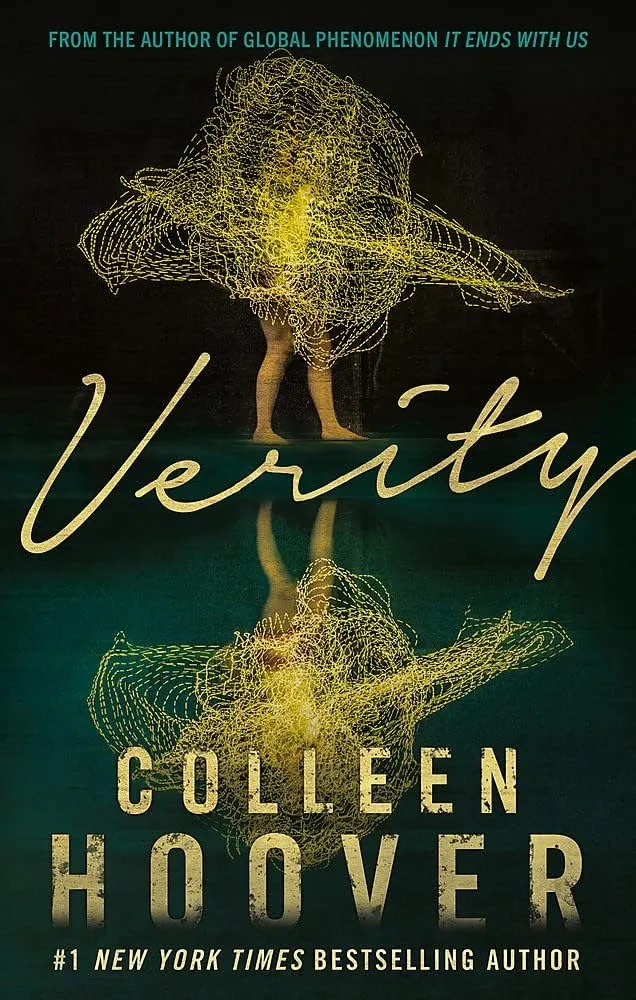
Verity
Paperback
• 368 Pages
• ₹ 499.00
• English
• 9781408726600
No ratings yet
| Publisher | Sphere |
|---|---|
| ISBN13 | 9781408726600 |
| ASIN/SKU | 1408726602 |
| Book Format | Paperback |
| Language | English |
| Pages | 368 |
| List Price | ₹ 499.00 |
| Publishing Date | 18/02/2022 |
| Dimensions | 12.6 x 2.6 x 19.6 cm |
| Weight | 234 g |
| Book Code | BD00055042 |
Buy this Book
Amazon Stores
Ebook Stores
Other Stores
Discover Verity by Colleen Hoover. This book is published by Sphere in Paperback format, ISBN 9781408726600, ASIN 1408726602, under Literature and Fiction, Science Fiction Crime and Mystery, Thrillers and Suspense.
Book Description
Colleen Hoover brought you the beautiful, unforgettable It Ends With Us. Now, discover her thriller with a twist that will leave you reeling . . . Verity is a global word-of-mouth hit, with over a million five-star reviews from readers, and now adapted into a major film starring Anne Hathaway and Dakota Johnson.
Lowen Ashleigh is a struggling writer on the brink of financial ruin when she accepts the job offer of a lifetime. Jeremy Crawford, husband of bestselling author Verity Crawford, has hired Lowen to complete the remaining books in a successful series his injured wife is unable to finish.
Lowen arrives at the Crawford home, ready to sort through years of Verity's notes and outlines, hoping to find enough material to get her started. What Lowen doesn't expect to uncover in the chaotic office is an unfinished autobiography Verity never intended for anyone to read. Page after page of bone-chilling admissions, including Verity's recollection of the night their family was forever altered.
Lowen decides to keep the manuscript hidden from Jeremy, knowing its contents would devastate the already-grieving father. But as Lowen's feelings for Jeremy begin to intensify, she recognizes all the ways she could benefit if he were to read his wife's words. After all, no matter how devoted Jeremy is to his injured wife, a truth this horrifying would make it impossible for him to continue loving her . . .
Lowen Ashleigh is a struggling writer on the brink of financial ruin when she accepts the job offer of a lifetime. Jeremy Crawford, husband of bestselling author Verity Crawford, has hired Lowen to complete the remaining books in a successful series his injured wife is unable to finish.
Lowen arrives at the Crawford home, ready to sort through years of Verity's notes and outlines, hoping to find enough material to get her started. What Lowen doesn't expect to uncover in the chaotic office is an unfinished autobiography Verity never intended for anyone to read. Page after page of bone-chilling admissions, including Verity's recollection of the night their family was forever altered.
Lowen decides to keep the manuscript hidden from Jeremy, knowing its contents would devastate the already-grieving father. But as Lowen's feelings for Jeremy begin to intensify, she recognizes all the ways she could benefit if he were to read his wife's words. After all, no matter how devoted Jeremy is to his injured wife, a truth this horrifying would make it impossible for him to continue loving her . . .
Author Biography
Colleen Hoover is the #1 New York Times and International bestselling author of multiple novels and novellas. She lives in Texas with her husband and their three boys. She is the founder of The Bookworm Box, a non-profit book subscription service and bookstore in Sulphur Springs, Texas.
For more information and for a schedule of events, please visit colleenhoover.com.
To contact Colleen and her team (Her team's name is Stephanie), please email [email protected]
For more information and for a schedule of events, please visit colleenhoover.com.
To contact Colleen and her team (Her team's name is Stephanie), please email [email protected]
Editorial Reviews
Editorial Reviews will be added soon…
Book Summary
Verity by Colleen Hoover is a psychological thriller about secrets, manipulation, obsession, grief, and the dangerous uncertainty that arises when a person can no longer tell which version of the truth to believe. The novel follows Lowen Ashleigh, a struggling writer whose life changes when she is offered an unusual opportunity: to finish a successful author's bestselling book series after the author, Verity Crawford, is seriously injured and unable to continue writing. What begins as a professional assignment gradually turns into a disturbing investigation into the Crawford family, forcing Lowen to question what she knows about Verity, her husband Jeremy, and even herself.
Lowen Ashleigh is a relatively unsuccessful writer who is struggling financially. She lives a quiet and isolated life and is not in a position to refuse an important professional opportunity. She is approached by Jeremy Crawford, the husband of Verity Crawford, a highly successful novelist. Verity has written a popular series of books, but after a serious accident leaves her incapacitated, the publishing company needs someone to complete the remaining novels. Lowen is invited to take over the writing. The offer is attractive because it could significantly change her career, but accepting it means entering the private world of the Crawford family.
Lowen travels to the Crawford home to examine Verity's work and gather the information necessary to continue the series. The house immediately creates an unsettling atmosphere. Verity is still alive but severely disabled, and Lowen initially expects to find an ordinary home affected by a tragic accident. Instead, she encounters a family carrying deep grief. Jeremy and Verity have suffered devastating losses, and the emotional atmosphere of the household is tense and uncomfortable.
Lowen also meets the couple's young son, Crew. She begins spending time with him and gradually becomes emotionally connected to both Crew and Jeremy. This creates a complicated situation because Jeremy is still married to Verity, even though Verity is physically incapable of participating normally in family life. Lowen tries to maintain professional boundaries, but her growing feelings for Jeremy make the situation increasingly difficult.
While searching through Verity's office and manuscripts, Lowen discovers something she was never supposed to read. Hidden among Verity's papers is an unfinished autobiography written in the first person. The document is not another novel. It appears to be a brutally honest account of Verity's private thoughts, marriage, motherhood, and life inside the Crawford family. At first, Lowen is shocked by what she reads, but she continues because she feels compelled to understand the woman whose books she is supposed to complete.
The manuscript presents a deeply disturbing portrait of Verity. It describes her relationship with Jeremy in ways that are intimate, obsessive, and morally troubling. More disturbing are the revelations about motherhood. Verity's account suggests that she experienced intense and disturbing feelings toward her children and describes events surrounding them in ways that make Lowen question whether Verity was responsible for terrible tragedies in the family.
One of the most disturbing parts of the manuscript concerns the deaths of Verity and Jeremy's twin daughters. The girls died in separate incidents, and their deaths have left Jeremy devastated. From the outside, these tragedies appear to be heartbreaking accidents. The autobiography, however, raises the possibility that they may not have been accidents at all. Lowen begins to wonder whether Verity could have played a role in what happened.
The manuscript also describes Verity's feelings toward her children and her jealousy of Jeremy's attention. The revelations are so horrifying that Lowen begins to see Verity not as a helpless victim of an accident but as a potentially dangerous person. She becomes increasingly frightened by the possibility that Verity may have deliberately harmed her own children.
Lowen's discovery creates a moral dilemma. If the manuscript is genuine, Jeremy may need to know what his wife has written. But revealing it could destroy the family and potentially have serious consequences for Verity. Lowen is also aware that the document could be a work of fiction. Verity is a novelist, after all, and Lowen cannot be certain whether the autobiography is a truthful confession or simply an extremely dark piece of writing.
This uncertainty becomes one of the novel's central sources of suspense. The reader, like Lowen, must constantly question what is real. Verity cannot explain herself because of her condition, and Lowen has only the manuscript and her own observations to rely on. The story therefore creates an atmosphere in which every character's motives become questionable.
As Lowen spends more time in the Crawford household, her relationship with Jeremy becomes increasingly intimate. Their shared grief creates emotional closeness, and Lowen begins to imagine a future with him. At the same time, her presence in the house becomes increasingly complicated because Verity remains there. Lowen feels guilty about her growing relationship with Jeremy, but she also believes that Verity may be responsible for terrible crimes.
The contrast between Verity's public image and the person presented in the manuscript is particularly important. To the outside world, Verity is a successful, talented author and devoted wife and mother. The manuscript presents another version of her—one filled with disturbing thoughts, jealousy, manipulation, and possible violence. This contrast raises questions about how well anyone can truly know another person.
The novel also explores the power of written words. Verity's career is based on her ability to create stories, and her manuscript becomes the most powerful object in the novel. Words can reveal secrets, manipulate readers, create doubt, and potentially destroy relationships. Because Verity is a professional writer, Lowen cannot easily determine whether she is reading a confession or an elaborate piece of fiction.
Lowen's own identity as a writer makes this issue even more complicated. She understands that writers can create fictional characters who think and behave in horrifying ways without personally sharing those beliefs. This gives her a reason to doubt the manuscript. Yet the apparent connection between some of the writing and real events makes it difficult for her to dismiss completely.
The novel also examines grief and the way people respond to traumatic loss. Jeremy is deeply affected by the deaths of his daughters, and the family remains emotionally shaped by those tragedies. Grief influences his relationships, decisions, and ability to trust. Lowen becomes drawn into this grief and begins to see herself as someone who might help Jeremy rebuild his life.
Another important theme is obsession. Several characters become increasingly consumed by their relationships with one another. Love and obsession begin to overlap, making it difficult to determine whether certain actions are motivated by genuine affection, jealousy, fear, or a desire for control. The novel repeatedly shows how emotional attachment can become dangerous when boundaries disappear.
As Lowen gets closer to the truth, her fear of Verity grows. Although Verity appears physically helpless, Lowen begins to feel that she is still capable of influencing the people around her. Small gestures and expressions take on sinister meanings. Lowen starts wondering whether Verity knows that the manuscript has been discovered and whether she is somehow aware of what is happening in the house.
The tension eventually reaches a point where Lowen feels she must protect herself and the people she cares about. Her growing belief that Verity is dangerous influences her decisions. She also becomes increasingly aware that her relationship with Jeremy could place her in a morally complicated position. If Verity is innocent, Lowen has entered a marriage that is not hers. If Verity is guilty, Lowen may be protecting Jeremy from someone who has already caused terrible harm.
The ending introduces a major reversal that changes the reader's understanding of the story. After Lowen believes she has discovered the truth about Verity, another piece of writing appears—a letter that presents an entirely different explanation for the manuscript. The letter claims that the disturbing autobiography was not a genuine confession but an exercise in writing from the perspective of a fictional villain. This revelation creates a second possible version of events.
Lowen Ashleigh is a relatively unsuccessful writer who is struggling financially. She lives a quiet and isolated life and is not in a position to refuse an important professional opportunity. She is approached by Jeremy Crawford, the husband of Verity Crawford, a highly successful novelist. Verity has written a popular series of books, but after a serious accident leaves her incapacitated, the publishing company needs someone to complete the remaining novels. Lowen is invited to take over the writing. The offer is attractive because it could significantly change her career, but accepting it means entering the private world of the Crawford family.
Lowen travels to the Crawford home to examine Verity's work and gather the information necessary to continue the series. The house immediately creates an unsettling atmosphere. Verity is still alive but severely disabled, and Lowen initially expects to find an ordinary home affected by a tragic accident. Instead, she encounters a family carrying deep grief. Jeremy and Verity have suffered devastating losses, and the emotional atmosphere of the household is tense and uncomfortable.
Lowen also meets the couple's young son, Crew. She begins spending time with him and gradually becomes emotionally connected to both Crew and Jeremy. This creates a complicated situation because Jeremy is still married to Verity, even though Verity is physically incapable of participating normally in family life. Lowen tries to maintain professional boundaries, but her growing feelings for Jeremy make the situation increasingly difficult.
While searching through Verity's office and manuscripts, Lowen discovers something she was never supposed to read. Hidden among Verity's papers is an unfinished autobiography written in the first person. The document is not another novel. It appears to be a brutally honest account of Verity's private thoughts, marriage, motherhood, and life inside the Crawford family. At first, Lowen is shocked by what she reads, but she continues because she feels compelled to understand the woman whose books she is supposed to complete.
The manuscript presents a deeply disturbing portrait of Verity. It describes her relationship with Jeremy in ways that are intimate, obsessive, and morally troubling. More disturbing are the revelations about motherhood. Verity's account suggests that she experienced intense and disturbing feelings toward her children and describes events surrounding them in ways that make Lowen question whether Verity was responsible for terrible tragedies in the family.
One of the most disturbing parts of the manuscript concerns the deaths of Verity and Jeremy's twin daughters. The girls died in separate incidents, and their deaths have left Jeremy devastated. From the outside, these tragedies appear to be heartbreaking accidents. The autobiography, however, raises the possibility that they may not have been accidents at all. Lowen begins to wonder whether Verity could have played a role in what happened.
The manuscript also describes Verity's feelings toward her children and her jealousy of Jeremy's attention. The revelations are so horrifying that Lowen begins to see Verity not as a helpless victim of an accident but as a potentially dangerous person. She becomes increasingly frightened by the possibility that Verity may have deliberately harmed her own children.
Lowen's discovery creates a moral dilemma. If the manuscript is genuine, Jeremy may need to know what his wife has written. But revealing it could destroy the family and potentially have serious consequences for Verity. Lowen is also aware that the document could be a work of fiction. Verity is a novelist, after all, and Lowen cannot be certain whether the autobiography is a truthful confession or simply an extremely dark piece of writing.
This uncertainty becomes one of the novel's central sources of suspense. The reader, like Lowen, must constantly question what is real. Verity cannot explain herself because of her condition, and Lowen has only the manuscript and her own observations to rely on. The story therefore creates an atmosphere in which every character's motives become questionable.
As Lowen spends more time in the Crawford household, her relationship with Jeremy becomes increasingly intimate. Their shared grief creates emotional closeness, and Lowen begins to imagine a future with him. At the same time, her presence in the house becomes increasingly complicated because Verity remains there. Lowen feels guilty about her growing relationship with Jeremy, but she also believes that Verity may be responsible for terrible crimes.
The contrast between Verity's public image and the person presented in the manuscript is particularly important. To the outside world, Verity is a successful, talented author and devoted wife and mother. The manuscript presents another version of her—one filled with disturbing thoughts, jealousy, manipulation, and possible violence. This contrast raises questions about how well anyone can truly know another person.
The novel also explores the power of written words. Verity's career is based on her ability to create stories, and her manuscript becomes the most powerful object in the novel. Words can reveal secrets, manipulate readers, create doubt, and potentially destroy relationships. Because Verity is a professional writer, Lowen cannot easily determine whether she is reading a confession or an elaborate piece of fiction.
Lowen's own identity as a writer makes this issue even more complicated. She understands that writers can create fictional characters who think and behave in horrifying ways without personally sharing those beliefs. This gives her a reason to doubt the manuscript. Yet the apparent connection between some of the writing and real events makes it difficult for her to dismiss completely.
The novel also examines grief and the way people respond to traumatic loss. Jeremy is deeply affected by the deaths of his daughters, and the family remains emotionally shaped by those tragedies. Grief influences his relationships, decisions, and ability to trust. Lowen becomes drawn into this grief and begins to see herself as someone who might help Jeremy rebuild his life.
Another important theme is obsession. Several characters become increasingly consumed by their relationships with one another. Love and obsession begin to overlap, making it difficult to determine whether certain actions are motivated by genuine affection, jealousy, fear, or a desire for control. The novel repeatedly shows how emotional attachment can become dangerous when boundaries disappear.
As Lowen gets closer to the truth, her fear of Verity grows. Although Verity appears physically helpless, Lowen begins to feel that she is still capable of influencing the people around her. Small gestures and expressions take on sinister meanings. Lowen starts wondering whether Verity knows that the manuscript has been discovered and whether she is somehow aware of what is happening in the house.
The tension eventually reaches a point where Lowen feels she must protect herself and the people she cares about. Her growing belief that Verity is dangerous influences her decisions. She also becomes increasingly aware that her relationship with Jeremy could place her in a morally complicated position. If Verity is innocent, Lowen has entered a marriage that is not hers. If Verity is guilty, Lowen may be protecting Jeremy from someone who has already caused terrible harm.
The ending introduces a major reversal that changes the reader's understanding of the story. After Lowen believes she has discovered the truth about Verity, another piece of writing appears—a letter that presents an entirely different explanation for the manuscript. The letter claims that the disturbing autobiography was not a genuine confession but an exercise in writing from the perspective of a fictional villain. This revelation creates a second possible version of events.
Sample Chapters
Sample Chapters will be added soon…
Reader Reviews
No reviews yet.
Verity