
Penguin Select Classics: Crime And Punishment
Hardcover
• 512 Pages
• ₹ 599.00
• English
• 9789815162493
No ratings yet
| Publisher | Penguin Select Classics |
|---|---|
| ISBN13 | 9789815162493 |
| ASIN/SKU | 9815162497 |
| Book Format | Hardcover |
| Language | English |
| Pages | 512 |
| List Price | ₹ 599.00 |
| Publishing Date | 11/04/2024 |
| Dimensions | 12.9 x 3.2 x 19.8 cm |
| Weight | 559 g |
| Book Code | BD00055041 |
Buy this Book
Amazon Stores
Ebook Stores
Other Stores
Discover Penguin Select Classics: Crime And Punishment by Fyodor Dostoyevsky. This book is published by Penguin Select Classics in Hardcover format, ISBN 9789815162493, ASIN 9815162497, under Literature and Fiction, Science Fiction Crime and Mystery, Crime Fiction.
Book Description
"Nothing in the world is harder than speaking the truth and nothing easier than flattery.”
What happens when paramount self-belief leads to self-destruction. Raskolnikov’s is a student who believes he has the responsibility of using evil means to bring good to people; thereby committing murders.
As Raskolnikov is chased by a relentless investigator, his conscience starts to haunt him, tightening the grip of guilt. Amidst this turmoil, only Sonya, a marginalized sex worker, holds the key to his salvation.
Ultimately, Raskolnikov’s path leads him to a profound reckoning. Through suffering and self-realization, Raskolnikov discovers the true nature of happiness and the power of accepting and reciprocating love.
Crime and Punishment stands as a testament to Dostoevsky’s unparalleled ability to explore the depths of the human psyche, the complexities of truth, guilt, and the search for redemption.
What happens when paramount self-belief leads to self-destruction. Raskolnikov’s is a student who believes he has the responsibility of using evil means to bring good to people; thereby committing murders.
As Raskolnikov is chased by a relentless investigator, his conscience starts to haunt him, tightening the grip of guilt. Amidst this turmoil, only Sonya, a marginalized sex worker, holds the key to his salvation.
Ultimately, Raskolnikov’s path leads him to a profound reckoning. Through suffering and self-realization, Raskolnikov discovers the true nature of happiness and the power of accepting and reciprocating love.
Crime and Punishment stands as a testament to Dostoevsky’s unparalleled ability to explore the depths of the human psyche, the complexities of truth, guilt, and the search for redemption.
Author Biography
Fyodor Mikhailovich Dostoyevsky (/ˌdɒstəˈjɛfski, ˌdʌs-/; Russian: Фёдор Миха́йлович Достое́вский; IPA: [ˈfʲɵdər mʲɪˈxajləvʲɪtɕ dəstɐˈjɛfskʲɪj]; 11 November 1821 – 9 February 1881), sometimes transliterated Dostoevsky, was a Russian novelist, short story writer, essayist, journalist and philosopher. Dostoyevsky's literary works explore human psychology in the troubled political, social, and spiritual atmosphere of 19th-century Russia. Many of his works are marked by a preoccupation with Christianity, explored through the prism of the individual confronted with life's hardships and beauty.
He began writing in his 20s, and his first novel, Poor Folk, was published in 1846 when he was 25. His major works include Crime and Punishment (1866), The Idiot (1869), Demons (1872) and The Brothers Karamazov (1880). His output consists of 11 novels, three novellas, 17 short novels and numerous other works. Many literary critics rate him as one of the greatest psychologists in world literature. His 1864 novella Notes from Underground is considered to be one of the first works of existentialist literature.
Born in Moscow in 1821, Dostoyevsky was introduced to literature at an early age through fairy tales and legends, and through books by Russian and foreign authors. His mother died in 1837, when he was 15, and around the same time he left school to enter the Nikolayev Military Engineering Institute. After graduating, he worked as an engineer and briefly enjoyed a lavish lifestyle, translating books to earn extra money. In the mid-1840s he wrote his first novel, Poor Folk, which gained him entry into St. Petersburg's literary circles.
In the following years, Dostoyevsky worked as a journalist, publishing and editing several magazines of his own and later A Writer's Diary, a collection of his writings. He began to travel around western Europe and developed a gambling addiction, which led to financial hardship. For a time, he had to beg for money, but he eventually became one of the most widely read and highly regarded Russian writers. His books have been translated into more than 170 languages. Dostoyevsky influenced a multitude of writers and philosophers, from Anton Chekhov and Ernest Hemingway to Friedrich Nietzsche and Jean-Paul Sartre.
Bio from Wikipedia, the free encyclopedia.
He began writing in his 20s, and his first novel, Poor Folk, was published in 1846 when he was 25. His major works include Crime and Punishment (1866), The Idiot (1869), Demons (1872) and The Brothers Karamazov (1880). His output consists of 11 novels, three novellas, 17 short novels and numerous other works. Many literary critics rate him as one of the greatest psychologists in world literature. His 1864 novella Notes from Underground is considered to be one of the first works of existentialist literature.
Born in Moscow in 1821, Dostoyevsky was introduced to literature at an early age through fairy tales and legends, and through books by Russian and foreign authors. His mother died in 1837, when he was 15, and around the same time he left school to enter the Nikolayev Military Engineering Institute. After graduating, he worked as an engineer and briefly enjoyed a lavish lifestyle, translating books to earn extra money. In the mid-1840s he wrote his first novel, Poor Folk, which gained him entry into St. Petersburg's literary circles.
In the following years, Dostoyevsky worked as a journalist, publishing and editing several magazines of his own and later A Writer's Diary, a collection of his writings. He began to travel around western Europe and developed a gambling addiction, which led to financial hardship. For a time, he had to beg for money, but he eventually became one of the most widely read and highly regarded Russian writers. His books have been translated into more than 170 languages. Dostoyevsky influenced a multitude of writers and philosophers, from Anton Chekhov and Ernest Hemingway to Friedrich Nietzsche and Jean-Paul Sartre.
Bio from Wikipedia, the free encyclopedia.
Editorial Reviews
Editorial Reviews will be added soon…
Book Summary
Crime and Punishment by Fyodor Dostoyevsky is one of the greatest psychological novels ever written. First published in 1866, it follows Rodion Raskolnikov, an impoverished former student living in the slums of St Petersburg, as he develops a dangerous theory about morality, commits murder, and gradually becomes consumed by guilt, fear, isolation, and psychological torment. Penguin describes the novel as an exploration of truth, guilt, conscience, and redemption, while its wider literary significance comes from Dostoyevsky's extraordinary examination of the human mind.
At the center of the story is Raskolnikov, a young intellectual who has abandoned his studies because of poverty. He lives in a tiny, miserable room and struggles to afford even the necessities of life. His financial circumstances are humiliating, but his poverty is not the only source of his distress. He has become increasingly isolated from society and absorbed in his own ideas.
Raskolnikov develops a theory that divides human beings into ordinary and extraordinary individuals. Ordinary people, he believes, are required to obey conventional moral laws. Extraordinary individuals, however, may possess the right to violate those laws if their actions serve a supposedly greater purpose. He thinks of figures such as Napoleon, who caused enormous suffering but believed himself entitled to act beyond ordinary morality.
This theory becomes more than an intellectual exercise.
Raskolnikov begins to believe that certain people may be sacrificed if their deaths could ultimately benefit society. He focuses his attention on an old pawnbroker, Alyona Ivanovna, whom he considers greedy, exploitative, and morally worthless. He convinces himself that killing her could be justified because her money might be used for better purposes.
The idea gradually becomes an obsession.
Eventually, Raskolnikov murders the pawnbroker with an axe. But the crime does not proceed according to his carefully constructed plan. Her innocent half-sister, Lizaveta, unexpectedly enters the apartment, and Raskolnikov kills her as well. The second murder is particularly devastating because it exposes the gap between his abstract theory and the unpredictable reality of violence.
After the murders, Raskolnikov manages to escape without being identified. Yet escaping the physical scene does not mean escaping the crime.
Almost immediately, his mind begins to collapse under the pressure of guilt and fear. He becomes feverish, paranoid, confused, and increasingly detached from reality. He worries about the evidence he may have left behind and about whether the authorities suspect him.
More importantly, he begins to discover that his theory has failed.
He had imagined himself capable of committing murder rationally and without remorse. Instead, his conscience becomes impossible to silence. He cannot enjoy the supposed benefits of his crime because his own mind continually returns him to the victims and to the meaning of what he has done.
This is the central psychological conflict of the novel: Raskolnikov has escaped punishment in the legal sense, but he cannot escape punishment within himself.
Dostoyevsky makes the reader experience this internal struggle from close to Raskolnikov's perspective. The novel is therefore not simply a detective story about discovering a murderer. It is a study of what happens inside the mind of someone who has committed a terrible act and attempted to justify it philosophically. Penguin's reader's guide emphasizes that the novel places readers inside Raskolnikov's fevered consciousness and explores whether evil means can ever produce honorable ends.
The investigation is led by Porfiry Petrovich, an intelligent and psychologically perceptive investigator. Porfiry does not behave like a conventional detective who simply collects physical evidence and announces an arrest. Instead, he studies Raskolnikov's personality and attempts to draw him into psychological conversations.
Porfiry suspects Raskolnikov but does not immediately arrest him. He understands that guilt can sometimes be more powerful than physical evidence. His conversations with Raskolnikov become a psychological chess match in which both men try to understand and outmaneuver one another.
Raskolnikov's pride makes these encounters especially tense. He wants to prove that his intellectual theory is valid, but he also fears that Porfiry can see through him. The investigator gradually presses on the weaknesses in Raskolnikov's reasoning, forcing him to confront the contradiction between his theory and his behavior.
While Raskolnikov is struggling with the consequences of his crime, his family becomes an important part of the story. His mother and sister, Pulcheria Alexandrovna and Avdotya Romanovna (Dunya), care deeply about him despite his increasingly strange behavior.
Dunya is intelligent, strong-willed, and determined to protect her family. She is preparing to marry Pyotr Luzhin, a wealthy but controlling man who believes that his financial position gives him power over her. Raskolnikov immediately distrusts Luzhin, and their conflict becomes another exploration of pride, manipulation, and the misuse of power.
Raskolnikov's family situation also reveals how poverty affects people's choices. His sister is willing to make personal sacrifices to help the family financially, while his mother worries constantly about her children's future. Dostoyevsky shows that economic desperation can push people toward difficult and morally complicated decisions.
Another major character is Sofya Semyonovna Marmeladova, usually known as Sonya. She comes from an impoverished family and has been forced into prostitution to support her father and family. Despite her circumstances, Sonya remains compassionate, gentle, and deeply religious.
Sonya becomes one of the most important people in Raskolnikov's life.
Unlike Raskolnikov, Sonya does not try to solve suffering through intellectual theories. She accepts the reality of human weakness and responds to it with compassion. Her faith gives her a different understanding of suffering, responsibility, and redemption.
Raskolnikov is drawn to Sonya because she represents qualities that his own philosophy has rejected. He has attempted to place himself above conventional morality, while Sonya has endured humiliation without abandoning her sense of compassion.
Their relationship becomes the emotional and spiritual heart of the novel.
Raskolnikov eventually tells Sonya that he committed the murders. Her reaction is crucial. She does not excuse what he has done, but neither does she abandon him. Instead, she encourages him to acknowledge his guilt and accept responsibility.
Sonya's influence gradually changes the meaning of punishment for Raskolnikov. At first, he thinks of punishment primarily as something imposed by courts and prisons. Sonya helps him understand that genuine punishment involves recognizing the suffering he has caused and accepting responsibility for it.
The novel therefore distinguishes between legal punishment and moral punishment.
Raskolnikov's greatest suffering begins long before his formal sentence. His guilt isolates him from other people, destroys his peace of mind, and undermines his confidence in the theory that led him to murder.
His intellectual pride is gradually broken down.
This is one of Dostoyevsky's central ideas: human beings cannot always construct moral systems that allow them to escape their own consciences. Raskolnikov believes that reason can justify his actions, but his emotional and moral nature refuses to accept the conclusion.
The novel repeatedly asks whether ends can justify means. Raskolnikov believes that an extraordinary person might be permitted to commit evil if the ultimate result is good. But Dostoyevsky subjects this argument to a devastating practical test.
Raskolnikov does not become happier after committing murder.
He does not become freer.
He does not become more powerful.
Instead, he becomes frightened, isolated, sick, and increasingly alienated from the people around him.
The murders also demonstrate that human beings cannot always control the consequences of their actions. Raskolnikov imagines a single, rational act, but the crime immediately expands beyond his expectations when Lizaveta appears. His attempt to reduce human life to an abstract calculation collapses when confronted with actual human suffering.
The novel's title therefore refers not only to the criminal act but also to the psychological and moral consequences that follow it.
Crime and punishment grow from the same seed.
Raskolnikov's punishment begins the moment he commits the crime because his conscience makes continued isolation unbearable.
The theme of isolation runs throughout the novel. Raskolnikov deliberately separates himself from society because he believes he is intellectually superior to ordinary people. But after the murders, his isolation becomes painful rather than empowering.
Sonya provides the possibility of connection.
She does not demand that Raskolnikov become perfect before he deserves compassion. Instead, she stays beside him as he confronts the truth. Her presence suggests that redemption begins when a person stops defending himself and becomes willing to accept responsibility.
The novel's religious dimension becomes increasingly important through Sonya. Her faith emphasizes suffering, humility, compassion, and resurrection. Dostoyevsky contrasts this spiritual vision with Raskolnikov's intellectual arrogance.
The contrast is not simply between religion and philosophy. It is between two ways of understanding human beings. Raskolnikov sees people partly as problems to be solved through ideas. Sonya sees them as suffering individuals who require compassion.
This difference gradually changes him.
The social world surrounding Raskolnikov is also filled with poverty, desperation, exploitation, and moral ambiguity. Dostoyevsky does not portray St Petersburg merely as a geographical setting. The city's cramped rooms, crowded streets, taverns, and impoverished neighborhoods reflect the psychological atmosphere of the novel.
Poverty affects nearly every major character. The Marmeladov family suffers because of alcoholism and financial desperation. Sonya sacrifices her dignity to support them. Dunya faces pressure to marry for economic security. Raskolnikov's own poverty contributes to his isolation and distorted thinking.
Yet Dostoyevsky does not suggest that poverty automatically creates criminality. Instead, he examines how economic hardship interacts with pride, ideology, desperation, and personal responsibility.
One of the novel's most disturbing characters is Arkady Svidrigailov, a wealthy man whose moral life is deeply compromised. His presence provides another contrast with Raskolnikov. Like Raskolnikov, he operates outside conventional moral boundaries, but his relationship with morality is different.
Svidrigailov demonstrates what happens when a person becomes detached from moral responsibility without experiencing the same kind of inner transformation that Raskolnikov eventually undergoes. His story adds another dimension to the novel's exploration of freedom, desire, guilt, and emptiness.
The characters surrounding Raskolnikov therefore function almost like different answers to the same philosophical questions. Luzhin represents selfish calculation. Svidrigailov represents moral corruption and spiritual emptiness. Sonya represents compassion and faith. Porfiry represents psychological insight and the force of justice.
Raskolnikov stands between these possibilities.
His journey is the movement from intellectual isolation toward moral recognition.
The final part of the novel brings Raskolnikov to Siberia after he confesses and receives his sentence. Sonya follows him and remains devoted to him. Although his legal punishment is severe, the deeper transformation is only beginning.
At first, Raskolnikov does not fully understand the meaning of his confession. He has surrendered to the law, but he has not yet completely surrendered his pride. His intellectual theory has been damaged, but his emotional acceptance of guilt remains incomplete.
Sonya's continued presence becomes essential.
Through suffering, companionship, and self-reflection, Raskolnikov gradually begins to move toward genuine repentance. His transformation is deliberately incomplete rather than instantaneous. Dostoyevsky does not present redemption as a simple moment in which all guilt disappears.
Instead, redemption begins when a person becomes capable of accepting love and recognizing the humanity of others.
The novel's conclusion therefore offers hope without pretending that the past can be erased. Raskolnikov cannot undo the murders. He cannot restore Lizaveta and Alyona to life. He cannot recover the innocence he possessed before the crime.
But he can change what happens next.
This is the profound meaning of redemption in the novel. Redemption does not cancel consequences. It changes the way a person lives with them.
Sonya's love is especially important because it shows Raskolnikov that accepting another person's love requires vulnerability. He had believed strength meant standing above others. He gradually learns that genuine strength can involve admitting weakness and allowing another person to share one's suffering.
Ultimately, Crime and Punishment is not simply a novel about a murderer being caught. It is a philosophical and psychological investigation into what happens when a human being attempts to place himself above morality.
Dostoyevsky asks whether intelligence can replace conscience, whether suffering can lead to transformation, whether people can be redeemed after terrible acts, and whether love can reach someone who has deliberately isolated himself from humanity.
The answers emerge through Raskolnikov's experience rather than through abstract argument.
His theory promises freedom but produces imprisonment.
His attempt to rise above morality leads to psychological collapse.
His rejection of human connection leads to loneliness.
And his eventual acceptance of responsibility opens the possibility of renewal.
That progression gives the novel its extraordinary power.
Crime and Punishment remains relevant because its central questions extend far beyond nineteenth-century Russia. People continue to debate whether a noble goal can justify immoral actions, whether individuals can place themselves above social rules, and whether guilt is imposed externally or created internally.
The novel also reminds readers that human beings are rarely governed by reason alone. We can construct elaborate arguments to justify our actions, but conscience, emotion, empathy, and relationships can challenge those arguments in ways we cannot predict.
In the end, Raskolnikov's greatest discovery is not that crime leads to legal punishment. He already understands that possibility.
His deeper discovery is that a human being cannot become fully alive by denying his connection to other human beings.
Through suffering, confession, Sonya's compassion, and the gradual collapse of his intellectual pride, Raskolnikov begins the long journey toward becoming human in a fuller sense.
That is why Crime and Punishment remains such a powerful classic. It is simultaneously a murder mystery, psychological thriller, social novel, philosophical inquiry, and spiritual journey. Penguin describes it as a work that explores the depths of the criminal mind while confronting truth, guilt, morality, and redemption.
Ultimately, Dostoyevsky's masterpiece suggests that the greatest punishment may not come from a courtroom at all. It may come from the moment we are forced to confront ourselves honestly. And the greatest possibility after that confrontation is not escape, but repentance, human connection, and the difficult beginning of redemption.
At the center of the story is Raskolnikov, a young intellectual who has abandoned his studies because of poverty. He lives in a tiny, miserable room and struggles to afford even the necessities of life. His financial circumstances are humiliating, but his poverty is not the only source of his distress. He has become increasingly isolated from society and absorbed in his own ideas.
Raskolnikov develops a theory that divides human beings into ordinary and extraordinary individuals. Ordinary people, he believes, are required to obey conventional moral laws. Extraordinary individuals, however, may possess the right to violate those laws if their actions serve a supposedly greater purpose. He thinks of figures such as Napoleon, who caused enormous suffering but believed himself entitled to act beyond ordinary morality.
This theory becomes more than an intellectual exercise.
Raskolnikov begins to believe that certain people may be sacrificed if their deaths could ultimately benefit society. He focuses his attention on an old pawnbroker, Alyona Ivanovna, whom he considers greedy, exploitative, and morally worthless. He convinces himself that killing her could be justified because her money might be used for better purposes.
The idea gradually becomes an obsession.
Eventually, Raskolnikov murders the pawnbroker with an axe. But the crime does not proceed according to his carefully constructed plan. Her innocent half-sister, Lizaveta, unexpectedly enters the apartment, and Raskolnikov kills her as well. The second murder is particularly devastating because it exposes the gap between his abstract theory and the unpredictable reality of violence.
After the murders, Raskolnikov manages to escape without being identified. Yet escaping the physical scene does not mean escaping the crime.
Almost immediately, his mind begins to collapse under the pressure of guilt and fear. He becomes feverish, paranoid, confused, and increasingly detached from reality. He worries about the evidence he may have left behind and about whether the authorities suspect him.
More importantly, he begins to discover that his theory has failed.
He had imagined himself capable of committing murder rationally and without remorse. Instead, his conscience becomes impossible to silence. He cannot enjoy the supposed benefits of his crime because his own mind continually returns him to the victims and to the meaning of what he has done.
This is the central psychological conflict of the novel: Raskolnikov has escaped punishment in the legal sense, but he cannot escape punishment within himself.
Dostoyevsky makes the reader experience this internal struggle from close to Raskolnikov's perspective. The novel is therefore not simply a detective story about discovering a murderer. It is a study of what happens inside the mind of someone who has committed a terrible act and attempted to justify it philosophically. Penguin's reader's guide emphasizes that the novel places readers inside Raskolnikov's fevered consciousness and explores whether evil means can ever produce honorable ends.
The investigation is led by Porfiry Petrovich, an intelligent and psychologically perceptive investigator. Porfiry does not behave like a conventional detective who simply collects physical evidence and announces an arrest. Instead, he studies Raskolnikov's personality and attempts to draw him into psychological conversations.
Porfiry suspects Raskolnikov but does not immediately arrest him. He understands that guilt can sometimes be more powerful than physical evidence. His conversations with Raskolnikov become a psychological chess match in which both men try to understand and outmaneuver one another.
Raskolnikov's pride makes these encounters especially tense. He wants to prove that his intellectual theory is valid, but he also fears that Porfiry can see through him. The investigator gradually presses on the weaknesses in Raskolnikov's reasoning, forcing him to confront the contradiction between his theory and his behavior.
While Raskolnikov is struggling with the consequences of his crime, his family becomes an important part of the story. His mother and sister, Pulcheria Alexandrovna and Avdotya Romanovna (Dunya), care deeply about him despite his increasingly strange behavior.
Dunya is intelligent, strong-willed, and determined to protect her family. She is preparing to marry Pyotr Luzhin, a wealthy but controlling man who believes that his financial position gives him power over her. Raskolnikov immediately distrusts Luzhin, and their conflict becomes another exploration of pride, manipulation, and the misuse of power.
Raskolnikov's family situation also reveals how poverty affects people's choices. His sister is willing to make personal sacrifices to help the family financially, while his mother worries constantly about her children's future. Dostoyevsky shows that economic desperation can push people toward difficult and morally complicated decisions.
Another major character is Sofya Semyonovna Marmeladova, usually known as Sonya. She comes from an impoverished family and has been forced into prostitution to support her father and family. Despite her circumstances, Sonya remains compassionate, gentle, and deeply religious.
Sonya becomes one of the most important people in Raskolnikov's life.
Unlike Raskolnikov, Sonya does not try to solve suffering through intellectual theories. She accepts the reality of human weakness and responds to it with compassion. Her faith gives her a different understanding of suffering, responsibility, and redemption.
Raskolnikov is drawn to Sonya because she represents qualities that his own philosophy has rejected. He has attempted to place himself above conventional morality, while Sonya has endured humiliation without abandoning her sense of compassion.
Their relationship becomes the emotional and spiritual heart of the novel.
Raskolnikov eventually tells Sonya that he committed the murders. Her reaction is crucial. She does not excuse what he has done, but neither does she abandon him. Instead, she encourages him to acknowledge his guilt and accept responsibility.
Sonya's influence gradually changes the meaning of punishment for Raskolnikov. At first, he thinks of punishment primarily as something imposed by courts and prisons. Sonya helps him understand that genuine punishment involves recognizing the suffering he has caused and accepting responsibility for it.
The novel therefore distinguishes between legal punishment and moral punishment.
Raskolnikov's greatest suffering begins long before his formal sentence. His guilt isolates him from other people, destroys his peace of mind, and undermines his confidence in the theory that led him to murder.
His intellectual pride is gradually broken down.
This is one of Dostoyevsky's central ideas: human beings cannot always construct moral systems that allow them to escape their own consciences. Raskolnikov believes that reason can justify his actions, but his emotional and moral nature refuses to accept the conclusion.
The novel repeatedly asks whether ends can justify means. Raskolnikov believes that an extraordinary person might be permitted to commit evil if the ultimate result is good. But Dostoyevsky subjects this argument to a devastating practical test.
Raskolnikov does not become happier after committing murder.
He does not become freer.
He does not become more powerful.
Instead, he becomes frightened, isolated, sick, and increasingly alienated from the people around him.
The murders also demonstrate that human beings cannot always control the consequences of their actions. Raskolnikov imagines a single, rational act, but the crime immediately expands beyond his expectations when Lizaveta appears. His attempt to reduce human life to an abstract calculation collapses when confronted with actual human suffering.
The novel's title therefore refers not only to the criminal act but also to the psychological and moral consequences that follow it.
Crime and punishment grow from the same seed.
Raskolnikov's punishment begins the moment he commits the crime because his conscience makes continued isolation unbearable.
The theme of isolation runs throughout the novel. Raskolnikov deliberately separates himself from society because he believes he is intellectually superior to ordinary people. But after the murders, his isolation becomes painful rather than empowering.
Sonya provides the possibility of connection.
She does not demand that Raskolnikov become perfect before he deserves compassion. Instead, she stays beside him as he confronts the truth. Her presence suggests that redemption begins when a person stops defending himself and becomes willing to accept responsibility.
The novel's religious dimension becomes increasingly important through Sonya. Her faith emphasizes suffering, humility, compassion, and resurrection. Dostoyevsky contrasts this spiritual vision with Raskolnikov's intellectual arrogance.
The contrast is not simply between religion and philosophy. It is between two ways of understanding human beings. Raskolnikov sees people partly as problems to be solved through ideas. Sonya sees them as suffering individuals who require compassion.
This difference gradually changes him.
The social world surrounding Raskolnikov is also filled with poverty, desperation, exploitation, and moral ambiguity. Dostoyevsky does not portray St Petersburg merely as a geographical setting. The city's cramped rooms, crowded streets, taverns, and impoverished neighborhoods reflect the psychological atmosphere of the novel.
Poverty affects nearly every major character. The Marmeladov family suffers because of alcoholism and financial desperation. Sonya sacrifices her dignity to support them. Dunya faces pressure to marry for economic security. Raskolnikov's own poverty contributes to his isolation and distorted thinking.
Yet Dostoyevsky does not suggest that poverty automatically creates criminality. Instead, he examines how economic hardship interacts with pride, ideology, desperation, and personal responsibility.
One of the novel's most disturbing characters is Arkady Svidrigailov, a wealthy man whose moral life is deeply compromised. His presence provides another contrast with Raskolnikov. Like Raskolnikov, he operates outside conventional moral boundaries, but his relationship with morality is different.
Svidrigailov demonstrates what happens when a person becomes detached from moral responsibility without experiencing the same kind of inner transformation that Raskolnikov eventually undergoes. His story adds another dimension to the novel's exploration of freedom, desire, guilt, and emptiness.
The characters surrounding Raskolnikov therefore function almost like different answers to the same philosophical questions. Luzhin represents selfish calculation. Svidrigailov represents moral corruption and spiritual emptiness. Sonya represents compassion and faith. Porfiry represents psychological insight and the force of justice.
Raskolnikov stands between these possibilities.
His journey is the movement from intellectual isolation toward moral recognition.
The final part of the novel brings Raskolnikov to Siberia after he confesses and receives his sentence. Sonya follows him and remains devoted to him. Although his legal punishment is severe, the deeper transformation is only beginning.
At first, Raskolnikov does not fully understand the meaning of his confession. He has surrendered to the law, but he has not yet completely surrendered his pride. His intellectual theory has been damaged, but his emotional acceptance of guilt remains incomplete.
Sonya's continued presence becomes essential.
Through suffering, companionship, and self-reflection, Raskolnikov gradually begins to move toward genuine repentance. His transformation is deliberately incomplete rather than instantaneous. Dostoyevsky does not present redemption as a simple moment in which all guilt disappears.
Instead, redemption begins when a person becomes capable of accepting love and recognizing the humanity of others.
The novel's conclusion therefore offers hope without pretending that the past can be erased. Raskolnikov cannot undo the murders. He cannot restore Lizaveta and Alyona to life. He cannot recover the innocence he possessed before the crime.
But he can change what happens next.
This is the profound meaning of redemption in the novel. Redemption does not cancel consequences. It changes the way a person lives with them.
Sonya's love is especially important because it shows Raskolnikov that accepting another person's love requires vulnerability. He had believed strength meant standing above others. He gradually learns that genuine strength can involve admitting weakness and allowing another person to share one's suffering.
Ultimately, Crime and Punishment is not simply a novel about a murderer being caught. It is a philosophical and psychological investigation into what happens when a human being attempts to place himself above morality.
Dostoyevsky asks whether intelligence can replace conscience, whether suffering can lead to transformation, whether people can be redeemed after terrible acts, and whether love can reach someone who has deliberately isolated himself from humanity.
The answers emerge through Raskolnikov's experience rather than through abstract argument.
His theory promises freedom but produces imprisonment.
His attempt to rise above morality leads to psychological collapse.
His rejection of human connection leads to loneliness.
And his eventual acceptance of responsibility opens the possibility of renewal.
That progression gives the novel its extraordinary power.
Crime and Punishment remains relevant because its central questions extend far beyond nineteenth-century Russia. People continue to debate whether a noble goal can justify immoral actions, whether individuals can place themselves above social rules, and whether guilt is imposed externally or created internally.
The novel also reminds readers that human beings are rarely governed by reason alone. We can construct elaborate arguments to justify our actions, but conscience, emotion, empathy, and relationships can challenge those arguments in ways we cannot predict.
In the end, Raskolnikov's greatest discovery is not that crime leads to legal punishment. He already understands that possibility.
His deeper discovery is that a human being cannot become fully alive by denying his connection to other human beings.
Through suffering, confession, Sonya's compassion, and the gradual collapse of his intellectual pride, Raskolnikov begins the long journey toward becoming human in a fuller sense.
That is why Crime and Punishment remains such a powerful classic. It is simultaneously a murder mystery, psychological thriller, social novel, philosophical inquiry, and spiritual journey. Penguin describes it as a work that explores the depths of the criminal mind while confronting truth, guilt, morality, and redemption.
Ultimately, Dostoyevsky's masterpiece suggests that the greatest punishment may not come from a courtroom at all. It may come from the moment we are forced to confront ourselves honestly. And the greatest possibility after that confrontation is not escape, but repentance, human connection, and the difficult beginning of redemption.
Sample Chapters
Sample Chapters will be added soon…
Reader Reviews
No reviews yet.
Penguin Select Classics: Crime And Punishment
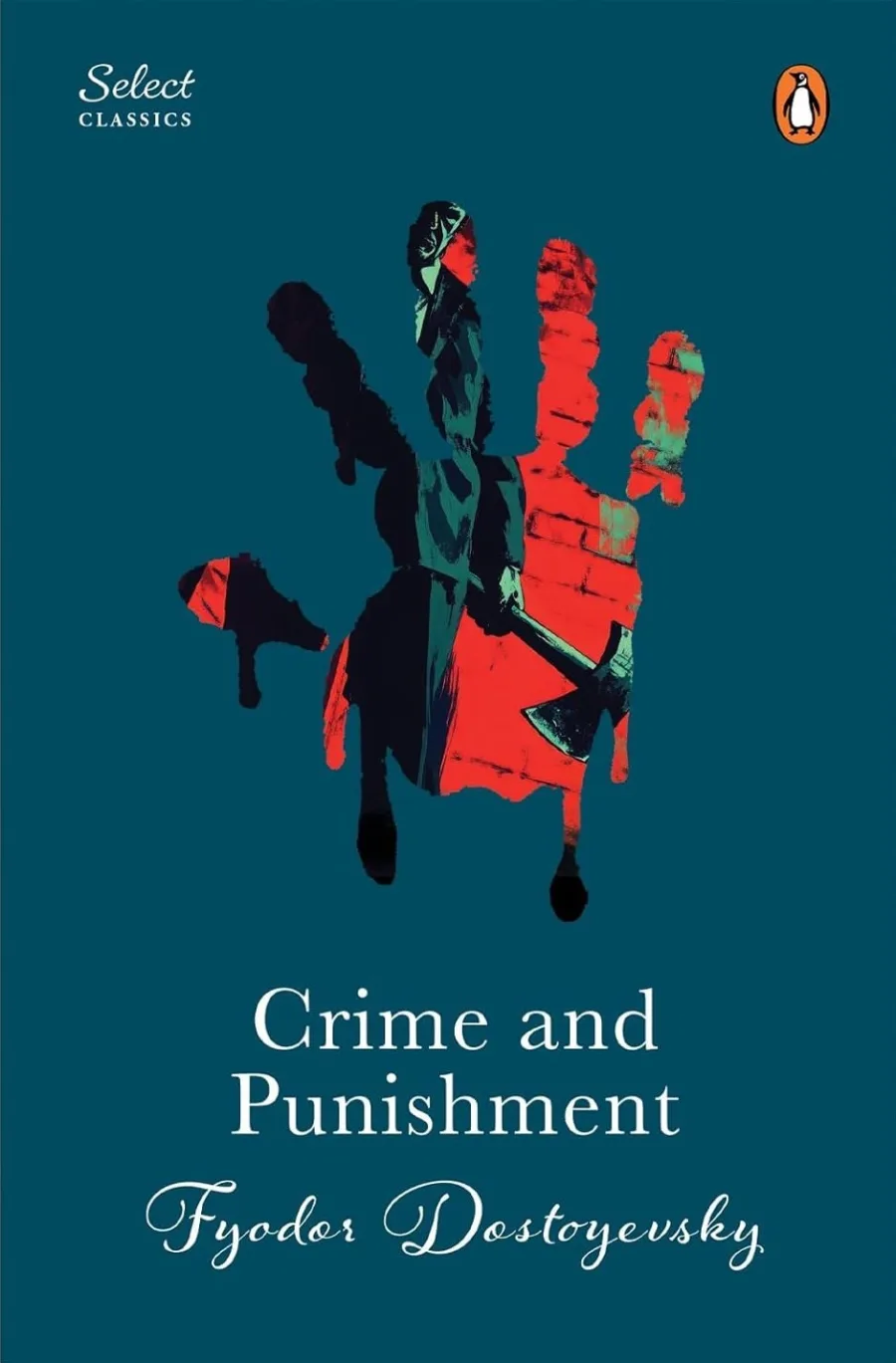
Download Cover Image
Do you want to download the full cover image for Penguin Select Classics: Crime And Punishment?