
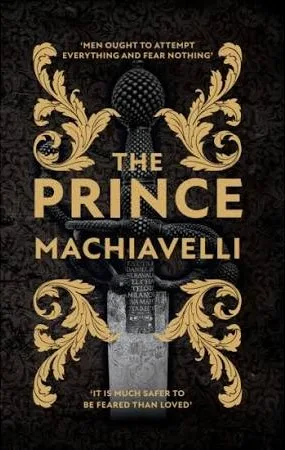
The Prince (Deluxe Hardbound Edition)
Hardcover
• 176 Pages
• ₹ 399.00
• English
• 9789354406683
No ratings yet
| Publisher | Fingerprint Publishing |
|---|---|
| ISBN13 | 9789354406683 |
| ASIN/SKU | 9354406688 |
| Book Format | Hardcover |
| Language | English |
| Pages | 176 |
| List Price | ₹ 399.00 |
| Publishing Date | 12/10/2002 |
| Book Code | BD00055040 |
Buy this Book
Amazon Stores
Ebook Stores
Other Stores
Discover The Prince (Deluxe Hardbound Edition) by Niccolo Machiavelli. This book is published by Fingerprint Publishing in Hardcover format, ISBN 9789354406683, ASIN 9354406688, under Literature and Fiction, European History, Military History.
Book Description
“It is not titles that honour men, but men that honour titles.”
How can a prince rise to power? What must he do to remain in it? What is expected of a good ruler? Which is better—to be feared or to be loved?
Offering an explicit insight into the minds of a ruler, here is a practical handbook and a political treatise exploring the attainment, maintenance, and utilization of political power in the Western world. It warns that if a state is not governed properly it shall collapse on the ruler. It elaborates on the qualities of a prince and his prudence. One of the first works of modern political philosophy, Niccolò Machiavelli’s The Prince expounds on why the princes of Italy lost their states. He dedicates the book to Lorenzo de’ Medici, believing that it is he who can bring salvation for Italy.
This classic edition is a must-have for all!
The book continues to influence its readers and the hidden ruler in them
It describes the art and craft of war
It gives lessons in statesmanship and on judging the strength of principalities
This hardbound edition comes with gilded edges, a ribbon bookmark, and beautiful endpapers
It is perfect for gifting and will make a good addition to any library
How can a prince rise to power? What must he do to remain in it? What is expected of a good ruler? Which is better—to be feared or to be loved?
Offering an explicit insight into the minds of a ruler, here is a practical handbook and a political treatise exploring the attainment, maintenance, and utilization of political power in the Western world. It warns that if a state is not governed properly it shall collapse on the ruler. It elaborates on the qualities of a prince and his prudence. One of the first works of modern political philosophy, Niccolò Machiavelli’s The Prince expounds on why the princes of Italy lost their states. He dedicates the book to Lorenzo de’ Medici, believing that it is he who can bring salvation for Italy.
This classic edition is a must-have for all!
The book continues to influence its readers and the hidden ruler in them
It describes the art and craft of war
It gives lessons in statesmanship and on judging the strength of principalities
This hardbound edition comes with gilded edges, a ribbon bookmark, and beautiful endpapers
It is perfect for gifting and will make a good addition to any library
Author Biography
Niccolò Machiavelli was born in Florence, Italy, on May 3, 1469. He was the second son of Bernardo di Niccolò Machiavelli, a lawyer of some repute, and of Bartolommea di Stefano Nelli, his wife. Both parents were members of the old Florentine nobility. His life falls naturally into three periods, each of which is enough to constitute a distinct and important era in the history of Florence. No one can say where the bones of Machiavelli rest, but modern Florence has decreed him a stately cenotaph in Santa Croce, by the side of her most famous sons; recognizing that, whatever other nations may have found in his works, Italy found in them the idea of her unity and the germs of her renaissance among the nations of Europe.
Editorial Reviews
Editorial Reviews will be added soon…
Book Summary
The Prince (Deluxe Hardbound Edition) by Niccolò Machiavelli is one of the most influential and controversial works ever written about power, leadership, politics, ambition, strategy, human nature, and statecraft. Written in the early sixteenth century, the book examines how rulers acquire political power, how they maintain it, how they respond to threats, and why conventional ideas of morality do not always correspond to the practical realities of political life. Machiavelli drew heavily on his experience as a Florentine statesman during a period of intense political instability in Renaissance Italy.
Although The Prince was written centuries ago, its questions remain surprisingly familiar. What makes a leader successful? Should a ruler always act morally? Is it better for a leader to be loved or feared? How should a ruler respond to opposition? Can appearances be more important than reality in politics? And what happens when the survival of the state comes into conflict with ordinary ethical standards?
These questions have made The Prince a foundational text in political thought and a lasting source of debate.
Who Was Niccolò Machiavelli?
Niccolò Machiavelli (1469–1527) was a Florentine statesman, diplomat, historian, philosopher, and writer who lived during the Italian Renaissance. He served in Florence during a period characterized by political rivalries, warfare, shifting alliances, foreign intervention, and struggles among powerful families and city-states.
His political experience strongly influenced The Prince.
Machiavelli was not writing about politics from a purely theoretical perspective. He had observed political leaders, military campaigns, diplomatic negotiations, betrayals, alliances, and changes of government firsthand.
This practical experience shaped his approach.
Instead of describing how an ideal ruler should behave according to traditional moral philosophy, Machiavelli was interested in how rulers actually behave and what they must do to obtain and preserve political authority.
That practical approach is one of the reasons the book was so controversial.
What Is The Prince About?
The Prince is essentially a treatise on political power and rulership.
Machiavelli examines different types of principalities and considers the problems faced by rulers who inherit territories, acquire them through conquest, or establish new political regimes.
He discusses military strength, alliances, public opinion, political opposition, reputation, leadership qualities, and the difficulties involved in governing newly acquired territories.
The book was written as advice for a ruler, traditionally associated with Lorenzo de' Medici, and its purpose is practical rather than purely philosophical.
Machiavelli repeatedly asks what actually enables a ruler to maintain control.
His answers are often uncomfortable.
He argues that political success cannot always depend on conventional morality because rulers operate in circumstances where difficult and sometimes ruthless decisions may be necessary.
The Difference Between Ideal Politics and Real Politics
One of Machiavelli's most important contributions is his rejection of an overly idealistic approach to political leadership.
Traditional political writing often described the qualities of a morally good ruler.
Machiavelli instead examines the world as it exists.
A ruler may want to be generous, honest, merciful, and just.
But what happens when generosity weakens the state's finances?
What happens when mercy encourages rebellion?
What happens when complete honesty makes a ruler vulnerable to political enemies?
For Machiavelli, these are not abstract questions.
They are practical problems.
He argues that a ruler must understand the difference between how people ought to behave and how political circumstances actually work.
This realistic approach is one reason The Prince is frequently associated with political realism.
Power and Its Preservation
Acquiring power is only the beginning.
For Machiavelli, the greater challenge is keeping it.
A ruler who gains authority but cannot defend it is ultimately unsuccessful.
This is why the book spends considerable attention on military organization, political stability, alliances, public opinion, and the management of opposition.
A prince must understand the conditions that produced his power and recognize the threats that could undermine it.
He must also be prepared for circumstances to change.
Political success is never completely permanent.
Fortunes shift.
Allies change.
Enemies emerge.
Popular opinion can turn.
A successful ruler therefore needs flexibility and judgment.
Virtù and Political Skill
One of Machiavelli's most important concepts is virtù.
The word should not be understood simply as moral virtue.
In Machiavelli's political context, virtù refers more broadly to qualities such as strength, ability, courage, intelligence, adaptability, decisiveness, strategic skill, and political effectiveness.
A successful ruler must be capable of responding to changing circumstances.
He cannot rely on one fixed formula.
Sometimes he must be diplomatic.
Sometimes forceful.
Sometimes generous.
Sometimes cautious.
Sometimes deceptive.
The important question is whether his actions preserve his political position and the stability of his state.
This idea distinguishes Machiavelli's concept of leadership from the traditional image of the morally virtuous ruler.
Fortune and Circumstance
Another major concept is fortuna, or fortune.
Machiavelli recognizes that rulers cannot control everything.
Unexpected events occur.
Wars begin.
Allies betray one another.
Political opportunities appear suddenly.
Natural disasters, economic changes, popular unrest, and foreign intervention can alter political circumstances.
A ruler must therefore be prepared for uncertainty.
The successful leader is not simply lucky.
He or she must be capable of responding effectively when circumstances change.
This creates an important tension between ability and chance.
A leader cannot control fortune completely, but preparation and adaptability can influence how effectively fortune is handled.
Should a Prince Be Loved or Feared?
Perhaps the most famous question in The Prince concerns whether a ruler should be loved or feared.
Machiavelli's answer is deliberately provocative.
Ideally, he says, a ruler would be both loved and feared. But if it is impossible to achieve both, he argues that fear can be more reliable than love, provided that the ruler avoids becoming hated.
The reasoning is practical.
Love depends partly on the willingness of other people.
Fear, when carefully maintained, can be more predictable.
But Machiavelli distinguishes fear from hatred.
A ruler who becomes hated creates dangerous enemies.
This distinction demonstrates the pragmatic nature of his political thinking.
He is not simply recommending cruelty.
He is asking what forms of authority are most stable under difficult political conditions.
Appearance and Reality
Another important theme is the difference between appearing virtuous and actually being virtuous.
Machiavelli recognizes that political leaders are constantly being judged by their subjects.
A ruler who appears compassionate, honest, religious, generous, and trustworthy may gain public support.
But circumstances may sometimes require behavior that conflicts with those qualities.
Therefore, Machiavelli suggests that a successful ruler must understand the importance of appearances.
This is one of the most controversial aspects of the book.
It raises a difficult question:
If political leadership requires deception, can appearance become more important than truth?
Machiavelli's analysis is less interested in giving a moral answer than in explaining how political perception operates.
Deception and Strategy
Machiavelli also discusses deception as a political tool.
A ruler may need to act like both a fox and a lion—the fox representing cleverness and the lion representing force.
The metaphor captures an important principle.
Strength alone is not enough.
A ruler who relies entirely on force can become predictable and vulnerable.
Cleverness alone is also insufficient.
A leader needs the ability to recognize traps, anticipate opposition, negotiate when necessary, and use strength when required.
Political leadership therefore involves both intelligence and power.
Military Strength
Machiavelli places enormous importance on military power.
A state that cannot defend itself is vulnerable to foreign enemies and internal instability.
He is skeptical of rulers who depend too heavily on mercenary or foreign forces.
For him, a ruler needs reliable military strength connected to the state itself.
This emphasis reflects the political conditions of Renaissance Italy, where fragmented states were frequently vulnerable to invasion and foreign intervention.
Military preparedness was therefore not simply a theoretical issue.
It was a matter of survival.
Human Nature
Underlying much of The Prince is a particular view of human behavior.
Machiavelli is skeptical of the assumption that people will always act according to loyalty, gratitude, or morality.
People may be self-interested.
They may change their loyalties.
They may support a ruler when circumstances are favorable and abandon that ruler when conditions change.
A successful leader must therefore understand human behavior realistically.
This is one of the reasons the book continues to attract readers interested not only in politics but also in leadership, psychology, negotiation, strategy, and influence.
The Importance of Public Opinion
Although Machiavelli is often remembered for his emphasis on force and manipulation, he also recognizes the importance of public support.
A ruler cannot survive indefinitely by making the entire population his enemy.
The population's attitude toward the ruler matters.
Maintaining public goodwill can make political authority more stable.
This creates an interesting balance in Machiavelli's thinking.
A ruler must be strong enough to suppress serious threats, but clever enough not to create unnecessary hatred.
Political power therefore involves understanding the difference between authority and oppression.
New States and Political Change
A significant portion of The Prince examines the problems faced by rulers who acquire new territories.
A newly conquered territory presents different challenges from a state that has been ruled by the same family for generations.
People may resist the new ruler.
Old political structures may remain influential.
Former leaders may attempt to regain power.
Cultural differences may complicate governance.
Machiavelli therefore examines strategies for consolidating authority after political change.
His advice reflects the turbulent political environment of Renaissance Italy, but the underlying questions have broader applications to political transitions and leadership.
Why The Prince Became Controversial
The book's reputation for ruthlessness comes from its willingness to discuss actions that conventional morality would condemn.
Machiavelli openly considers situations in which deception, manipulation, violence, or political cruelty might be useful to a ruler.
This seemed deeply disturbing to many readers.
The term “Machiavellian” eventually became associated with cunning, manipulation, and unscrupulous political behavior.
But reducing Machiavelli to a simple advocate of cruelty misses the complexity of the book.
His central concern is political survival and effectiveness.
He is analyzing what rulers actually do and what circumstances may require, rather than simply celebrating immoral behavior.
The Stanford Encyclopedia of Philosophy notes that Machiavelli's criticism was directed against the traditional moralistic understanding of political authority.
The Historical Context
Understanding Renaissance Italy is essential for appreciating The Prince.
Italy was not a unified modern nation-state.
Instead, it consisted of competing political entities and powerful families.
Foreign powers also intervened in Italian affairs.
Political alliances could change rapidly.
Military conflicts and diplomatic maneuvering were common.
Machiavelli's experiences in this unstable environment influenced his desire for a stronger and more unified political order.
The conclusion of The Prince turns toward Italy's political fragmentation and includes an appeal for Italian liberation and unity.
This historical dimension is sometimes overlooked when the book is treated merely as a manual for ruthless leadership.
A Book About Leadership Beyond Politics
Although The Prince is fundamentally a work of political thought, modern readers often apply its ideas more broadly.
Business leaders, managers, strategists, entrepreneurs, and students of organizational behavior sometimes read Machiavelli to understand power, influence, competition, negotiation, reputation, and leadership.
The book can certainly provide useful questions in these areas.
However, its original context matters.
Machiavelli was writing about rulers and states, not modern corporations or personal relationships.
Applying his ideas outside politics therefore requires interpretation rather than literal imitation.
Why The Prince Remains Relevant
More than five centuries after it was written, The Prince continues to provoke discussion because the problems it explores have not disappeared.
Political leaders still have to balance ideals against practical constraints.
Governments still use persuasion and public messaging.
Leaders still worry about reputation.
States still make strategic alliances.
Political opponents still compete for influence.
Public opinion still matters.
And the relationship between morality and political necessity remains deeply contested.
This continued relevance is one reason publishers describe The Prince as a seminal work of modern political thought.
The Deluxe Hardbound Edition
A Deluxe Hardbound Edition makes the work particularly attractive to readers who want a lasting physical copy of this classic.
Because The Prince is a book that readers often return to for study, quotation, discussion, or reference, a durable hardbound edition can work well as part of a personal library.
The exact physical specifications—such as page count, publisher, translator, ISBN, and cover design—can vary considerably between hardbound editions. Different publishers have issued The Prince in multiple formats and translations.
For that reason, the content of the particular deluxe edition should be checked against its ISBN or publisher listing when bibliographic details are important.
Who Should Read The Prince?
This classic is particularly suitable for readers interested in:
Political philosophy
Political science
Leadership
Strategy and power
History
Renaissance literature
Statecraft
Political realism
Human nature
Psychology of power
Diplomacy
Political strategy
Classic nonfiction
Philosophy of leadership
Ethics and politics
Influence and decision-making
It is especially valuable for students of political science, philosophy, history, international relations, and leadership studies.
Final Thoughts
The Prince by Niccolò Machiavelli remains one of the most provocative books ever written about political power.
It does not present leadership as a simple matter of being good, honest, generous, or morally admirable.
Instead, Machiavelli asks readers to confront the complicated realities of political life.
A ruler may need to make unpopular decisions.
A leader may have to choose between competing forms of harm.
Public perception may matter as much as private intention.
A military weakness can destroy political independence.
An apparently virtuous decision can sometimes create instability.
And a ruler who refuses to adapt to changing circumstances may lose everything.
For readers searching for The Prince by Niccolò Machiavelli, The Prince summary, The Prince book review, Machiavelli books, Machiavelli political philosophy, books about power and politics, political strategy books, leadership books, books about human nature and power, political realism, Renaissance political philosophy, classic philosophy books, statecraft books, books about influence and leadership, or Deluxe Hardbound editions of The Prince, this work remains essential reading.
Ultimately, The Prince is not important because every piece of Machiavelli's advice should be followed.
It is important because it forces readers to examine how power actually works—and what happens when political necessity, morality, ambition, and survival come into conflict.
That uncomfortable examination is precisely what has kept the book alive for centuries.
Machiavelli's great achievement was to strip away comforting assumptions and ask readers to look directly at the mechanics of power.
The result is a short but extraordinarily influential work that continues to challenge anyone interested in leadership, ambition, politics, strategy, morality, and the human desire to control events.
Although The Prince was written centuries ago, its questions remain surprisingly familiar. What makes a leader successful? Should a ruler always act morally? Is it better for a leader to be loved or feared? How should a ruler respond to opposition? Can appearances be more important than reality in politics? And what happens when the survival of the state comes into conflict with ordinary ethical standards?
These questions have made The Prince a foundational text in political thought and a lasting source of debate.
Who Was Niccolò Machiavelli?
Niccolò Machiavelli (1469–1527) was a Florentine statesman, diplomat, historian, philosopher, and writer who lived during the Italian Renaissance. He served in Florence during a period characterized by political rivalries, warfare, shifting alliances, foreign intervention, and struggles among powerful families and city-states.
His political experience strongly influenced The Prince.
Machiavelli was not writing about politics from a purely theoretical perspective. He had observed political leaders, military campaigns, diplomatic negotiations, betrayals, alliances, and changes of government firsthand.
This practical experience shaped his approach.
Instead of describing how an ideal ruler should behave according to traditional moral philosophy, Machiavelli was interested in how rulers actually behave and what they must do to obtain and preserve political authority.
That practical approach is one of the reasons the book was so controversial.
What Is The Prince About?
The Prince is essentially a treatise on political power and rulership.
Machiavelli examines different types of principalities and considers the problems faced by rulers who inherit territories, acquire them through conquest, or establish new political regimes.
He discusses military strength, alliances, public opinion, political opposition, reputation, leadership qualities, and the difficulties involved in governing newly acquired territories.
The book was written as advice for a ruler, traditionally associated with Lorenzo de' Medici, and its purpose is practical rather than purely philosophical.
Machiavelli repeatedly asks what actually enables a ruler to maintain control.
His answers are often uncomfortable.
He argues that political success cannot always depend on conventional morality because rulers operate in circumstances where difficult and sometimes ruthless decisions may be necessary.
The Difference Between Ideal Politics and Real Politics
One of Machiavelli's most important contributions is his rejection of an overly idealistic approach to political leadership.
Traditional political writing often described the qualities of a morally good ruler.
Machiavelli instead examines the world as it exists.
A ruler may want to be generous, honest, merciful, and just.
But what happens when generosity weakens the state's finances?
What happens when mercy encourages rebellion?
What happens when complete honesty makes a ruler vulnerable to political enemies?
For Machiavelli, these are not abstract questions.
They are practical problems.
He argues that a ruler must understand the difference between how people ought to behave and how political circumstances actually work.
This realistic approach is one reason The Prince is frequently associated with political realism.
Power and Its Preservation
Acquiring power is only the beginning.
For Machiavelli, the greater challenge is keeping it.
A ruler who gains authority but cannot defend it is ultimately unsuccessful.
This is why the book spends considerable attention on military organization, political stability, alliances, public opinion, and the management of opposition.
A prince must understand the conditions that produced his power and recognize the threats that could undermine it.
He must also be prepared for circumstances to change.
Political success is never completely permanent.
Fortunes shift.
Allies change.
Enemies emerge.
Popular opinion can turn.
A successful ruler therefore needs flexibility and judgment.
Virtù and Political Skill
One of Machiavelli's most important concepts is virtù.
The word should not be understood simply as moral virtue.
In Machiavelli's political context, virtù refers more broadly to qualities such as strength, ability, courage, intelligence, adaptability, decisiveness, strategic skill, and political effectiveness.
A successful ruler must be capable of responding to changing circumstances.
He cannot rely on one fixed formula.
Sometimes he must be diplomatic.
Sometimes forceful.
Sometimes generous.
Sometimes cautious.
Sometimes deceptive.
The important question is whether his actions preserve his political position and the stability of his state.
This idea distinguishes Machiavelli's concept of leadership from the traditional image of the morally virtuous ruler.
Fortune and Circumstance
Another major concept is fortuna, or fortune.
Machiavelli recognizes that rulers cannot control everything.
Unexpected events occur.
Wars begin.
Allies betray one another.
Political opportunities appear suddenly.
Natural disasters, economic changes, popular unrest, and foreign intervention can alter political circumstances.
A ruler must therefore be prepared for uncertainty.
The successful leader is not simply lucky.
He or she must be capable of responding effectively when circumstances change.
This creates an important tension between ability and chance.
A leader cannot control fortune completely, but preparation and adaptability can influence how effectively fortune is handled.
Should a Prince Be Loved or Feared?
Perhaps the most famous question in The Prince concerns whether a ruler should be loved or feared.
Machiavelli's answer is deliberately provocative.
Ideally, he says, a ruler would be both loved and feared. But if it is impossible to achieve both, he argues that fear can be more reliable than love, provided that the ruler avoids becoming hated.
The reasoning is practical.
Love depends partly on the willingness of other people.
Fear, when carefully maintained, can be more predictable.
But Machiavelli distinguishes fear from hatred.
A ruler who becomes hated creates dangerous enemies.
This distinction demonstrates the pragmatic nature of his political thinking.
He is not simply recommending cruelty.
He is asking what forms of authority are most stable under difficult political conditions.
Appearance and Reality
Another important theme is the difference between appearing virtuous and actually being virtuous.
Machiavelli recognizes that political leaders are constantly being judged by their subjects.
A ruler who appears compassionate, honest, religious, generous, and trustworthy may gain public support.
But circumstances may sometimes require behavior that conflicts with those qualities.
Therefore, Machiavelli suggests that a successful ruler must understand the importance of appearances.
This is one of the most controversial aspects of the book.
It raises a difficult question:
If political leadership requires deception, can appearance become more important than truth?
Machiavelli's analysis is less interested in giving a moral answer than in explaining how political perception operates.
Deception and Strategy
Machiavelli also discusses deception as a political tool.
A ruler may need to act like both a fox and a lion—the fox representing cleverness and the lion representing force.
The metaphor captures an important principle.
Strength alone is not enough.
A ruler who relies entirely on force can become predictable and vulnerable.
Cleverness alone is also insufficient.
A leader needs the ability to recognize traps, anticipate opposition, negotiate when necessary, and use strength when required.
Political leadership therefore involves both intelligence and power.
Military Strength
Machiavelli places enormous importance on military power.
A state that cannot defend itself is vulnerable to foreign enemies and internal instability.
He is skeptical of rulers who depend too heavily on mercenary or foreign forces.
For him, a ruler needs reliable military strength connected to the state itself.
This emphasis reflects the political conditions of Renaissance Italy, where fragmented states were frequently vulnerable to invasion and foreign intervention.
Military preparedness was therefore not simply a theoretical issue.
It was a matter of survival.
Human Nature
Underlying much of The Prince is a particular view of human behavior.
Machiavelli is skeptical of the assumption that people will always act according to loyalty, gratitude, or morality.
People may be self-interested.
They may change their loyalties.
They may support a ruler when circumstances are favorable and abandon that ruler when conditions change.
A successful leader must therefore understand human behavior realistically.
This is one of the reasons the book continues to attract readers interested not only in politics but also in leadership, psychology, negotiation, strategy, and influence.
The Importance of Public Opinion
Although Machiavelli is often remembered for his emphasis on force and manipulation, he also recognizes the importance of public support.
A ruler cannot survive indefinitely by making the entire population his enemy.
The population's attitude toward the ruler matters.
Maintaining public goodwill can make political authority more stable.
This creates an interesting balance in Machiavelli's thinking.
A ruler must be strong enough to suppress serious threats, but clever enough not to create unnecessary hatred.
Political power therefore involves understanding the difference between authority and oppression.
New States and Political Change
A significant portion of The Prince examines the problems faced by rulers who acquire new territories.
A newly conquered territory presents different challenges from a state that has been ruled by the same family for generations.
People may resist the new ruler.
Old political structures may remain influential.
Former leaders may attempt to regain power.
Cultural differences may complicate governance.
Machiavelli therefore examines strategies for consolidating authority after political change.
His advice reflects the turbulent political environment of Renaissance Italy, but the underlying questions have broader applications to political transitions and leadership.
Why The Prince Became Controversial
The book's reputation for ruthlessness comes from its willingness to discuss actions that conventional morality would condemn.
Machiavelli openly considers situations in which deception, manipulation, violence, or political cruelty might be useful to a ruler.
This seemed deeply disturbing to many readers.
The term “Machiavellian” eventually became associated with cunning, manipulation, and unscrupulous political behavior.
But reducing Machiavelli to a simple advocate of cruelty misses the complexity of the book.
His central concern is political survival and effectiveness.
He is analyzing what rulers actually do and what circumstances may require, rather than simply celebrating immoral behavior.
The Stanford Encyclopedia of Philosophy notes that Machiavelli's criticism was directed against the traditional moralistic understanding of political authority.
The Historical Context
Understanding Renaissance Italy is essential for appreciating The Prince.
Italy was not a unified modern nation-state.
Instead, it consisted of competing political entities and powerful families.
Foreign powers also intervened in Italian affairs.
Political alliances could change rapidly.
Military conflicts and diplomatic maneuvering were common.
Machiavelli's experiences in this unstable environment influenced his desire for a stronger and more unified political order.
The conclusion of The Prince turns toward Italy's political fragmentation and includes an appeal for Italian liberation and unity.
This historical dimension is sometimes overlooked when the book is treated merely as a manual for ruthless leadership.
A Book About Leadership Beyond Politics
Although The Prince is fundamentally a work of political thought, modern readers often apply its ideas more broadly.
Business leaders, managers, strategists, entrepreneurs, and students of organizational behavior sometimes read Machiavelli to understand power, influence, competition, negotiation, reputation, and leadership.
The book can certainly provide useful questions in these areas.
However, its original context matters.
Machiavelli was writing about rulers and states, not modern corporations or personal relationships.
Applying his ideas outside politics therefore requires interpretation rather than literal imitation.
Why The Prince Remains Relevant
More than five centuries after it was written, The Prince continues to provoke discussion because the problems it explores have not disappeared.
Political leaders still have to balance ideals against practical constraints.
Governments still use persuasion and public messaging.
Leaders still worry about reputation.
States still make strategic alliances.
Political opponents still compete for influence.
Public opinion still matters.
And the relationship between morality and political necessity remains deeply contested.
This continued relevance is one reason publishers describe The Prince as a seminal work of modern political thought.
The Deluxe Hardbound Edition
A Deluxe Hardbound Edition makes the work particularly attractive to readers who want a lasting physical copy of this classic.
Because The Prince is a book that readers often return to for study, quotation, discussion, or reference, a durable hardbound edition can work well as part of a personal library.
The exact physical specifications—such as page count, publisher, translator, ISBN, and cover design—can vary considerably between hardbound editions. Different publishers have issued The Prince in multiple formats and translations.
For that reason, the content of the particular deluxe edition should be checked against its ISBN or publisher listing when bibliographic details are important.
Who Should Read The Prince?
This classic is particularly suitable for readers interested in:
Political philosophy
Political science
Leadership
Strategy and power
History
Renaissance literature
Statecraft
Political realism
Human nature
Psychology of power
Diplomacy
Political strategy
Classic nonfiction
Philosophy of leadership
Ethics and politics
Influence and decision-making
It is especially valuable for students of political science, philosophy, history, international relations, and leadership studies.
Final Thoughts
The Prince by Niccolò Machiavelli remains one of the most provocative books ever written about political power.
It does not present leadership as a simple matter of being good, honest, generous, or morally admirable.
Instead, Machiavelli asks readers to confront the complicated realities of political life.
A ruler may need to make unpopular decisions.
A leader may have to choose between competing forms of harm.
Public perception may matter as much as private intention.
A military weakness can destroy political independence.
An apparently virtuous decision can sometimes create instability.
And a ruler who refuses to adapt to changing circumstances may lose everything.
For readers searching for The Prince by Niccolò Machiavelli, The Prince summary, The Prince book review, Machiavelli books, Machiavelli political philosophy, books about power and politics, political strategy books, leadership books, books about human nature and power, political realism, Renaissance political philosophy, classic philosophy books, statecraft books, books about influence and leadership, or Deluxe Hardbound editions of The Prince, this work remains essential reading.
Ultimately, The Prince is not important because every piece of Machiavelli's advice should be followed.
It is important because it forces readers to examine how power actually works—and what happens when political necessity, morality, ambition, and survival come into conflict.
That uncomfortable examination is precisely what has kept the book alive for centuries.
Machiavelli's great achievement was to strip away comforting assumptions and ask readers to look directly at the mechanics of power.
The result is a short but extraordinarily influential work that continues to challenge anyone interested in leadership, ambition, politics, strategy, morality, and the human desire to control events.
Sample Chapters
Sample Chapters will be added soon…
Reader Reviews
No reviews yet.
The Prince (Deluxe Hardbound Edition)
Download Cover Image
Do you want to download the full cover image for The Prince (Deluxe Hardbound Edition)?