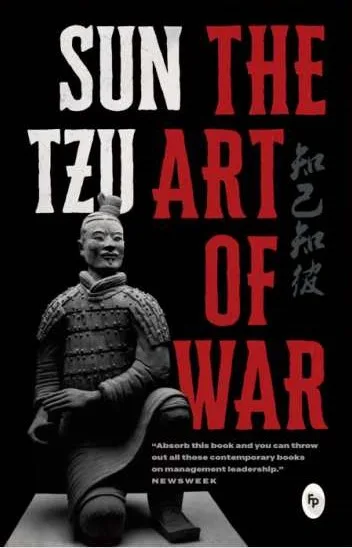
The Art of War
Paperback
• 100 Pages
• ₹ 129.00
• English
• 9788172345242
No ratings yet
| Publisher | Fingerprint! Publishing |
|---|---|
| ISBN13 | 9788172345242 |
| ASIN/SKU | 8172345240 |
| Book Format | Paperback |
| Language | English |
| Pages | 100 |
| List Price | ₹ 129.00 |
| Publishing Date | 01/01/2014 |
| Dimensions | 21.75 x 14 x 0.8 cm |
| Weight | 110 g |
| Book Code | BD00055039 |
Buy this Book
Amazon Stores
Ebook Stores
Other Stores
Discover The Art of War by Sun Tzu. This book is published by Fingerprint! Publishing in Paperback format, ISBN 9788172345242, ASIN 8172345240, under Literature and Fiction, Military History for Young Adults, Political Theory.
Book Description
Unleash your strategic prowess with Sun Tzu's timeless masterpiece, "The Art of War." This influential book provides profound insights into warfare, leadership, and the art of achieving victory. A must-read for military enthusiasts, business leaders, and those seeking personal growth.
Explore the mind of a Warrior!
Sun Tzu's classic treatise, "The Art of War"
Unlock the secrets of successful warfare and strategic thinking
Learn timeless lessons on leadership and achieving victory
Perfect for military enthusiasts, business leaders, and strategic thinkers
A valuable addition to any book collection, offering wisdom applicable to various aspects of life.
Explore the mind of a Warrior!
Sun Tzu's classic treatise, "The Art of War"
Unlock the secrets of successful warfare and strategic thinking
Learn timeless lessons on leadership and achieving victory
Perfect for military enthusiasts, business leaders, and strategic thinkers
A valuable addition to any book collection, offering wisdom applicable to various aspects of life.
Author Biography
Sun Tzu, a military general and strategist who lived in ancient China, is one of East Asia’ s most important historical figures. Traditional historians believe that he lived between 544– 496 B.C. Sun Tzu’ s birth name was Sun Wu; the name he is well known with is an honorific that means “ Master Sun.” He is most famous for writing The Art of War, a timeless classic and one of the most important works of Eastern literature.
Editorial Reviews
Editorial Reviews will be added soon…
Book Summary
The Art of War by Sun Tzu is one of the most influential works on strategy ever written. Composed in ancient China, the concise treatise examines warfare, leadership, planning, intelligence, deception, competition, and the importance of adapting to changing circumstances. Although written for military commanders, its principles have been applied far beyond the battlefield—to politics, business, negotiation, sports, management, and personal decision-making.
At the heart of Sun Tzu's philosophy is a simple but powerful idea: the best victory is achieved with the least unnecessary conflict. A wise strategist does not seek battle merely to demonstrate strength. Instead, the strategist studies the situation carefully, understands the opponent, prepares thoroughly, and looks for ways to achieve the objective before a costly confrontation becomes necessary.
The opening chapter emphasizes the importance of careful planning. Sun Tzu argues that war is too serious to be approached casually. Before any conflict begins, a commander must evaluate numerous factors, including political unity, weather, terrain, leadership, discipline, and the relative strength of the opposing forces.
The essential lesson is that success begins before the fighting starts.
A commander who understands the conditions of a conflict can anticipate difficulties and identify opportunities. A commander who ignores them may be defeated regardless of courage or numbers.
Sun Tzu therefore treats strategy as an intellectual discipline. Victory depends not only on soldiers and weapons but on judgment, preparation, timing, and information.
One of the most famous principles in the book is the importance of knowing both oneself and one's opponent. A strategist who understands their own strengths and weaknesses while also understanding the enemy's capabilities is far more likely to succeed.
Self-knowledge prevents overconfidence.
Knowledge of the opponent prevents dangerous assumptions.
Together, they create strategic awareness.
Sun Tzu repeatedly emphasizes the importance of deception. War involves opposing interests, and each side attempts to predict what the other will do. A capable commander therefore avoids revealing intentions unnecessarily.
If you are strong, you may sometimes appear weak.
If you are near, you may appear far away.
If you intend to attack, you may create uncertainty about where the attack will occur.
The purpose is not deception for its own sake. It is to make the opponent respond to a false picture of reality.
This idea reflects a larger principle that runs throughout the book: control the conditions under which the opponent must make decisions.
Rather than simply reacting to the enemy, a strategist should shape the situation so that the enemy's available choices become increasingly unfavorable.
Sun Tzu also places enormous importance on speed and timing. A well-prepared opportunity can disappear if action is delayed. Conversely, rushing into conflict before conditions are favorable can produce disaster.
The successful strategist therefore understands when to act and when to wait.
Timing is connected to flexibility. Sun Tzu does not recommend following one rigid strategy regardless of circumstances. He argues that conditions are constantly changing, and a commander must adapt accordingly.
A plan that works in one situation may fail in another.
A tactic that succeeds against one opponent may be ineffective against another.
Strategy must therefore remain responsive to reality.
One of the book's strongest warnings concerns the cost of prolonged warfare. Long campaigns consume resources, weaken morale, damage economies, and exhaust soldiers. Even a victorious army can emerge from a conflict severely weakened.
Sun Tzu consequently encourages commanders to seek efficient victories rather than allowing conflicts to continue unnecessarily.
This leads to another central principle: winning without fighting is often the highest form of victory.
If an enemy can be persuaded, isolated, outmaneuvered, or strategically defeated without a direct battle, the commander has achieved the objective while avoiding unnecessary destruction.
Sun Tzu therefore ranks different forms of strategic success. The highest achievement is to undermine the enemy's plans. The next is to disrupt alliances and strategic relationships. Direct attacks on fortified positions are less desirable because they tend to be costly.
The lesson extends beyond warfare: attacking a problem at its source is usually more effective than repeatedly fighting its visible consequences.
Sun Tzu also emphasizes intelligence. Reliable information is essential because decisions based on false assumptions can be disastrous.
He describes different categories of spies and stresses the importance of gathering information about the opponent's plans, movements, strengths, weaknesses, and intentions.
The broader principle is that uncertainty should be reduced wherever possible.
A strategist should not assume.
A strategist should investigate.
This emphasis on information makes The Art of War remarkably relevant to modern competition. Businesses, political organizations, and individuals frequently make decisions in environments where information is incomplete. Understanding competitors, markets, incentives, and changing conditions can provide a significant advantage.
Another major theme is terrain. Sun Tzu discusses different types of physical environments and explains how commanders should adjust their tactics accordingly.
Terrain can create opportunities or disadvantages. Mountains, rivers, narrow passages, open plains, forests, and other environments influence movement and combat.
But the deeper lesson is that strategy is always contextual.
The same action can be brilliant in one environment and disastrous in another.
A good strategist therefore studies the environment before deciding what to do.
Sun Tzu also distinguishes between different kinds of military situations and explains how troops should respond to each. Some situations favor direct action, while others require patience, withdrawal, concealment, or repositioning.
This leads to one of the book's most important ideas: flexibility is a form of strength.
A commander who refuses to change course because of pride may turn a manageable problem into a catastrophe.
A commander who recognizes changing conditions can retreat when necessary, redirect resources, or exploit a new opportunity.
The book therefore challenges the simplistic idea that courage always means advancing.
Sometimes courage means knowing when not to fight.
Leadership is another essential component of Sun Tzu's philosophy. A commander must inspire discipline and trust while maintaining authority.
Soldiers need clear instructions, but they also need confidence that their leader understands the situation.
Sun Tzu warns against several destructive leadership qualities, including recklessness, excessive caution, emotional instability, pride, and concern for personal reputation.
A leader who is reckless may endanger everyone.
A leader who is too cautious may miss opportunities.
A leader who becomes emotionally reactive can be manipulated.
A leader who is obsessed with personal honor may sacrifice the larger objective merely to avoid appearing weak.
Good leadership therefore requires emotional discipline.
The commander must be capable of remaining calm under pressure.
This principle is closely related to Sun Tzu's understanding of morale. An army's effectiveness depends not only on weapons and numbers but also on confidence, discipline, organization, and trust.
A frightened or exhausted army can be defeated even when it has superior resources.
A disciplined force can sometimes succeed against a stronger opponent by using terrain, timing, and strategy intelligently.
Sun Tzu also discusses the importance of organization and clear communication. Orders must be understandable, responsibilities must be defined, and discipline must be consistent.
If soldiers do not understand what is expected of them, confusion spreads.
Leadership therefore involves both strategic vision and practical execution.
Another important theme is resource management. War consumes food, equipment, transportation, money, and human energy. A commander must therefore consider logistics rather than focusing only on battlefield tactics.
An army cannot fight effectively if it cannot be supplied.
This may seem obvious, but Sun Tzu's inclusion of logistics reflects his broader understanding of strategy: success depends on the entire system, not just the dramatic moment of confrontation.
He also discusses the importance of understanding one's own strengths and using them efficiently. A smaller force does not necessarily need to imitate the tactics of a larger force. Instead, it can exploit speed, surprise, terrain, or concentration of resources.
The strategist's task is to create advantage.
Advantage is not necessarily something that exists naturally.
It can be constructed.
Through preparation, positioning, deception, timing, and information, a commander can make victory more likely before the decisive moment arrives.
Sun Tzu's concept of momentum is related to this idea. Once conditions are properly arranged, action can produce effects far greater than the effort initially invested.
The skilled strategist therefore does not attempt to force every situation through sheer effort. Instead, they create conditions in which relatively small actions generate large consequences.
This is one reason The Art of War has remained influential in fields far removed from military history.
In business, for example, the same principle can mean positioning a company so that competitors are forced to respond rather than attacking them directly.
In negotiation, it can mean understanding the other side's incentives and structuring choices so that agreement becomes more attractive than conflict.
In personal decision-making, it can mean preparing carefully so that difficult situations require less struggle.
Yet the book should not be reduced to a collection of clever tricks. Its deeper philosophy is about disciplined thinking under uncertainty.
Sun Tzu repeatedly asks the strategist to understand reality as it is rather than as they wish it to be.
This requires humility.
A commander who assumes victory because of confidence is vulnerable.
A commander who studies the situation objectively has a better chance of adapting successfully.
The book also contains an important lesson about knowing when to withdraw. Withdrawal is not necessarily defeat. If continuing a particular engagement would produce unacceptable losses, stepping back can preserve the ability to act later.
This idea is especially relevant to strategic thinking because people often continue losing situations simply because they have already invested time, money, effort, or pride in them.
Sun Tzu's approach encourages a more rational question: What action produces the best outcome from this point forward?
Past investment should not determine future strategy if circumstances have changed.
Another recurring idea is that the opponent should not be given unnecessary advantages. A strategist should avoid fighting on unfavorable terms whenever possible.
This means choosing the time, location, and conditions of engagement carefully.
The broader lesson is simple: do not accept the problem exactly as it is presented if you can change the conditions around it.
Sun Tzu also recognizes that human psychology is central to conflict. Fear, confidence, impatience, pride, uncertainty, and morale can influence decisions as strongly as physical resources.
A strategist who understands psychological reactions can anticipate how an opponent may behave.
However, the same principle applies internally. Leaders must understand their own emotions and biases as carefully as they study those of their opponents.
The book's final sections return to deception, intelligence, and the importance of adapting strategy to circumstances. The overall argument becomes increasingly clear: there is no universally correct tactic.
There is only the tactic appropriate to the situation.
This makes The Art of War fundamentally different from a rigid rulebook.
It teaches principles rather than formulas.
The reader is expected to understand why a strategy works so that it can be adapted when conditions change.
The book's enduring appeal also comes from its extraordinary concision. Sun Tzu expresses complex ideas in compact statements that invite interpretation. Different readers can apply the same principle to very different circumstances.
At its deepest level, The Art of War is a study of how to achieve objectives intelligently when resources are limited and opposition exists.
It values preparation over improvisation, intelligence over ignorance, flexibility over rigidity, and strategic positioning over brute force.
Its most important lesson is perhaps that victory should be measured not by how dramatically one defeats an opponent but by how effectively one achieves the desired outcome.
The strongest strategist does not necessarily destroy the enemy.
The strongest strategist creates circumstances in which destruction becomes unnecessary.
Ultimately, The Art of War presents strategy as a combination of knowledge, discipline, adaptability, timing, and psychological understanding. Its military origins are unmistakable, but its principles continue to resonate because competition and uncertainty exist in almost every area of human life.
Whether dealing with an army, an organization, a negotiation, or a difficult decision, the essential questions remain similar:
What are the real conditions?
What are my strengths and weaknesses?
What does the other side want?
What information am I missing?
Where is the advantage?
When should I act?
When should I wait?
And, most importantly, is there a way to achieve the objective without unnecessary conflict?
Sun Tzu's enduring answer is that the greatest strategist is not the person who fights the hardest, but the one who understands the situation well enough to make victory seem almost inevitable.
That is the lasting wisdom of The Art of War: prepare carefully, know yourself, understand the other side, adapt to circumstances, control the conditions of engagement, and seek the most effective path to victory with the least unnecessary cost.
At the heart of Sun Tzu's philosophy is a simple but powerful idea: the best victory is achieved with the least unnecessary conflict. A wise strategist does not seek battle merely to demonstrate strength. Instead, the strategist studies the situation carefully, understands the opponent, prepares thoroughly, and looks for ways to achieve the objective before a costly confrontation becomes necessary.
The opening chapter emphasizes the importance of careful planning. Sun Tzu argues that war is too serious to be approached casually. Before any conflict begins, a commander must evaluate numerous factors, including political unity, weather, terrain, leadership, discipline, and the relative strength of the opposing forces.
The essential lesson is that success begins before the fighting starts.
A commander who understands the conditions of a conflict can anticipate difficulties and identify opportunities. A commander who ignores them may be defeated regardless of courage or numbers.
Sun Tzu therefore treats strategy as an intellectual discipline. Victory depends not only on soldiers and weapons but on judgment, preparation, timing, and information.
One of the most famous principles in the book is the importance of knowing both oneself and one's opponent. A strategist who understands their own strengths and weaknesses while also understanding the enemy's capabilities is far more likely to succeed.
Self-knowledge prevents overconfidence.
Knowledge of the opponent prevents dangerous assumptions.
Together, they create strategic awareness.
Sun Tzu repeatedly emphasizes the importance of deception. War involves opposing interests, and each side attempts to predict what the other will do. A capable commander therefore avoids revealing intentions unnecessarily.
If you are strong, you may sometimes appear weak.
If you are near, you may appear far away.
If you intend to attack, you may create uncertainty about where the attack will occur.
The purpose is not deception for its own sake. It is to make the opponent respond to a false picture of reality.
This idea reflects a larger principle that runs throughout the book: control the conditions under which the opponent must make decisions.
Rather than simply reacting to the enemy, a strategist should shape the situation so that the enemy's available choices become increasingly unfavorable.
Sun Tzu also places enormous importance on speed and timing. A well-prepared opportunity can disappear if action is delayed. Conversely, rushing into conflict before conditions are favorable can produce disaster.
The successful strategist therefore understands when to act and when to wait.
Timing is connected to flexibility. Sun Tzu does not recommend following one rigid strategy regardless of circumstances. He argues that conditions are constantly changing, and a commander must adapt accordingly.
A plan that works in one situation may fail in another.
A tactic that succeeds against one opponent may be ineffective against another.
Strategy must therefore remain responsive to reality.
One of the book's strongest warnings concerns the cost of prolonged warfare. Long campaigns consume resources, weaken morale, damage economies, and exhaust soldiers. Even a victorious army can emerge from a conflict severely weakened.
Sun Tzu consequently encourages commanders to seek efficient victories rather than allowing conflicts to continue unnecessarily.
This leads to another central principle: winning without fighting is often the highest form of victory.
If an enemy can be persuaded, isolated, outmaneuvered, or strategically defeated without a direct battle, the commander has achieved the objective while avoiding unnecessary destruction.
Sun Tzu therefore ranks different forms of strategic success. The highest achievement is to undermine the enemy's plans. The next is to disrupt alliances and strategic relationships. Direct attacks on fortified positions are less desirable because they tend to be costly.
The lesson extends beyond warfare: attacking a problem at its source is usually more effective than repeatedly fighting its visible consequences.
Sun Tzu also emphasizes intelligence. Reliable information is essential because decisions based on false assumptions can be disastrous.
He describes different categories of spies and stresses the importance of gathering information about the opponent's plans, movements, strengths, weaknesses, and intentions.
The broader principle is that uncertainty should be reduced wherever possible.
A strategist should not assume.
A strategist should investigate.
This emphasis on information makes The Art of War remarkably relevant to modern competition. Businesses, political organizations, and individuals frequently make decisions in environments where information is incomplete. Understanding competitors, markets, incentives, and changing conditions can provide a significant advantage.
Another major theme is terrain. Sun Tzu discusses different types of physical environments and explains how commanders should adjust their tactics accordingly.
Terrain can create opportunities or disadvantages. Mountains, rivers, narrow passages, open plains, forests, and other environments influence movement and combat.
But the deeper lesson is that strategy is always contextual.
The same action can be brilliant in one environment and disastrous in another.
A good strategist therefore studies the environment before deciding what to do.
Sun Tzu also distinguishes between different kinds of military situations and explains how troops should respond to each. Some situations favor direct action, while others require patience, withdrawal, concealment, or repositioning.
This leads to one of the book's most important ideas: flexibility is a form of strength.
A commander who refuses to change course because of pride may turn a manageable problem into a catastrophe.
A commander who recognizes changing conditions can retreat when necessary, redirect resources, or exploit a new opportunity.
The book therefore challenges the simplistic idea that courage always means advancing.
Sometimes courage means knowing when not to fight.
Leadership is another essential component of Sun Tzu's philosophy. A commander must inspire discipline and trust while maintaining authority.
Soldiers need clear instructions, but they also need confidence that their leader understands the situation.
Sun Tzu warns against several destructive leadership qualities, including recklessness, excessive caution, emotional instability, pride, and concern for personal reputation.
A leader who is reckless may endanger everyone.
A leader who is too cautious may miss opportunities.
A leader who becomes emotionally reactive can be manipulated.
A leader who is obsessed with personal honor may sacrifice the larger objective merely to avoid appearing weak.
Good leadership therefore requires emotional discipline.
The commander must be capable of remaining calm under pressure.
This principle is closely related to Sun Tzu's understanding of morale. An army's effectiveness depends not only on weapons and numbers but also on confidence, discipline, organization, and trust.
A frightened or exhausted army can be defeated even when it has superior resources.
A disciplined force can sometimes succeed against a stronger opponent by using terrain, timing, and strategy intelligently.
Sun Tzu also discusses the importance of organization and clear communication. Orders must be understandable, responsibilities must be defined, and discipline must be consistent.
If soldiers do not understand what is expected of them, confusion spreads.
Leadership therefore involves both strategic vision and practical execution.
Another important theme is resource management. War consumes food, equipment, transportation, money, and human energy. A commander must therefore consider logistics rather than focusing only on battlefield tactics.
An army cannot fight effectively if it cannot be supplied.
This may seem obvious, but Sun Tzu's inclusion of logistics reflects his broader understanding of strategy: success depends on the entire system, not just the dramatic moment of confrontation.
He also discusses the importance of understanding one's own strengths and using them efficiently. A smaller force does not necessarily need to imitate the tactics of a larger force. Instead, it can exploit speed, surprise, terrain, or concentration of resources.
The strategist's task is to create advantage.
Advantage is not necessarily something that exists naturally.
It can be constructed.
Through preparation, positioning, deception, timing, and information, a commander can make victory more likely before the decisive moment arrives.
Sun Tzu's concept of momentum is related to this idea. Once conditions are properly arranged, action can produce effects far greater than the effort initially invested.
The skilled strategist therefore does not attempt to force every situation through sheer effort. Instead, they create conditions in which relatively small actions generate large consequences.
This is one reason The Art of War has remained influential in fields far removed from military history.
In business, for example, the same principle can mean positioning a company so that competitors are forced to respond rather than attacking them directly.
In negotiation, it can mean understanding the other side's incentives and structuring choices so that agreement becomes more attractive than conflict.
In personal decision-making, it can mean preparing carefully so that difficult situations require less struggle.
Yet the book should not be reduced to a collection of clever tricks. Its deeper philosophy is about disciplined thinking under uncertainty.
Sun Tzu repeatedly asks the strategist to understand reality as it is rather than as they wish it to be.
This requires humility.
A commander who assumes victory because of confidence is vulnerable.
A commander who studies the situation objectively has a better chance of adapting successfully.
The book also contains an important lesson about knowing when to withdraw. Withdrawal is not necessarily defeat. If continuing a particular engagement would produce unacceptable losses, stepping back can preserve the ability to act later.
This idea is especially relevant to strategic thinking because people often continue losing situations simply because they have already invested time, money, effort, or pride in them.
Sun Tzu's approach encourages a more rational question: What action produces the best outcome from this point forward?
Past investment should not determine future strategy if circumstances have changed.
Another recurring idea is that the opponent should not be given unnecessary advantages. A strategist should avoid fighting on unfavorable terms whenever possible.
This means choosing the time, location, and conditions of engagement carefully.
The broader lesson is simple: do not accept the problem exactly as it is presented if you can change the conditions around it.
Sun Tzu also recognizes that human psychology is central to conflict. Fear, confidence, impatience, pride, uncertainty, and morale can influence decisions as strongly as physical resources.
A strategist who understands psychological reactions can anticipate how an opponent may behave.
However, the same principle applies internally. Leaders must understand their own emotions and biases as carefully as they study those of their opponents.
The book's final sections return to deception, intelligence, and the importance of adapting strategy to circumstances. The overall argument becomes increasingly clear: there is no universally correct tactic.
There is only the tactic appropriate to the situation.
This makes The Art of War fundamentally different from a rigid rulebook.
It teaches principles rather than formulas.
The reader is expected to understand why a strategy works so that it can be adapted when conditions change.
The book's enduring appeal also comes from its extraordinary concision. Sun Tzu expresses complex ideas in compact statements that invite interpretation. Different readers can apply the same principle to very different circumstances.
At its deepest level, The Art of War is a study of how to achieve objectives intelligently when resources are limited and opposition exists.
It values preparation over improvisation, intelligence over ignorance, flexibility over rigidity, and strategic positioning over brute force.
Its most important lesson is perhaps that victory should be measured not by how dramatically one defeats an opponent but by how effectively one achieves the desired outcome.
The strongest strategist does not necessarily destroy the enemy.
The strongest strategist creates circumstances in which destruction becomes unnecessary.
Ultimately, The Art of War presents strategy as a combination of knowledge, discipline, adaptability, timing, and psychological understanding. Its military origins are unmistakable, but its principles continue to resonate because competition and uncertainty exist in almost every area of human life.
Whether dealing with an army, an organization, a negotiation, or a difficult decision, the essential questions remain similar:
What are the real conditions?
What are my strengths and weaknesses?
What does the other side want?
What information am I missing?
Where is the advantage?
When should I act?
When should I wait?
And, most importantly, is there a way to achieve the objective without unnecessary conflict?
Sun Tzu's enduring answer is that the greatest strategist is not the person who fights the hardest, but the one who understands the situation well enough to make victory seem almost inevitable.
That is the lasting wisdom of The Art of War: prepare carefully, know yourself, understand the other side, adapt to circumstances, control the conditions of engagement, and seek the most effective path to victory with the least unnecessary cost.
Sample Chapters
Sample Chapters will be added soon…
Reader Reviews
No reviews yet.
The Art of War