
Crime and Punishment
Paperback
• 584 Pages
• ₹ 399.00
• English
• 9789386538055
No ratings yet
| Publisher | Fingerprint Publishing |
|---|---|
| ISBN13 | 9789386538055 |
| ASIN/SKU | 9386538059 |
| Book Format | Paperback |
| Language | English |
| Pages | 584 |
| List Price | ₹ 399.00 |
| Publishing Date | 10/08/2016 |
| Dimensions | 12.6 x 3.4 x 19.41 cm |
| Weight | 480 g |
| Book Code | BD00055038 |
Buy this Book
Amazon Stores
Ebook Stores
Other Stores
Discover Crime and Punishment by Fyodor Dostoyevsky. This book is published by Fingerprint Publishing in Paperback format, ISBN 9789386538055, ASIN 9386538059, under Literature and Fiction, European History, Military Fantasy.
Book Description
Immerse yourself in the dark and psychological depths of Crime and Punishment by Fyodor Dostoevsky. Follow the tormented Raskolnikov as he grapples with guilt, morality, and the consequences of his actions in this gripping masterpiece of Russian literature.
A gripping psychological thriller!
Fyodor Dostoevsky's compelling exploration of guilt, redemption, and the human psyche
Gripping portrayal of a troubled protagonist caught in a web of his own crimes
Examines themes of morality, justice, and the nature of evil
Richly drawn characters and an atmospheric setting that immerse readers in 19th-century Russia
A timeless classic that delves into the complexities of the human condition with unparalleled depth and intensity
A gripping psychological thriller!
Fyodor Dostoevsky's compelling exploration of guilt, redemption, and the human psyche
Gripping portrayal of a troubled protagonist caught in a web of his own crimes
Examines themes of morality, justice, and the nature of evil
Richly drawn characters and an atmospheric setting that immerse readers in 19th-century Russia
A timeless classic that delves into the complexities of the human condition with unparalleled depth and intensity
Author Biography
Dostoyevsky was the son of a doctor. His parents were very hard-working and deeply religious people, but so poor that they lived with their five children in only two rooms. The father and mother spent their evenings in reading aloud to their children, generally from books of a serious character.
In 1861, he started a journal—Vremya, which was forbidden by the Censorship through a misunderstanding. In 1864 he lost his first wife and his brother Mihail. He was in terrible poverty, yet he took upon himself the payment of his brother’s debts. He started another journal—The Epoch, which within a few months was also prohibited. He was weighed down by debt, his brother’s family was dependent on him, he was forced to write at heart-breaking speed, and is said never to have corrected his work.
In June 1880 he made his famous speech at the unveiling of the monument to Pushkin in Moscow and he was received with extraordinary demonstrations of love and honour.
A few months later Dostoevsky died.
In 1861, he started a journal—Vremya, which was forbidden by the Censorship through a misunderstanding. In 1864 he lost his first wife and his brother Mihail. He was in terrible poverty, yet he took upon himself the payment of his brother’s debts. He started another journal—The Epoch, which within a few months was also prohibited. He was weighed down by debt, his brother’s family was dependent on him, he was forced to write at heart-breaking speed, and is said never to have corrected his work.
In June 1880 he made his famous speech at the unveiling of the monument to Pushkin in Moscow and he was received with extraordinary demonstrations of love and honour.
A few months later Dostoevsky died.
Editorial Reviews
Editorial Reviews will be added soon…
Book Summary
Fyodor Dostoyevsky’s Crime and Punishment is one of the most powerful psychological novels ever written. First published in 1866, the novel explores crime, guilt, morality, poverty, pride, suffering, and the possibility of redemption through the story of Rodion Romanovich Raskolnikov, a poor former student living in St. Petersburg. At the center of the book is a disturbing question: can an intellectually gifted person justify committing a terrible crime if he believes that the crime will ultimately serve a greater purpose? Dostoyevsky does not treat this question as an abstract philosophical problem. Instead, he places it inside the mind and conscience of a troubled young man and shows the devastating consequences of trying to live without moral responsibility.
Raskolnikov is intelligent, proud, isolated, and desperately poor. He has abandoned his university studies because he cannot afford to continue them. He lives in a tiny, suffocating room and avoids most people around him. His poverty is humiliating, but his greatest problem is not simply lack of money. He has become increasingly separated from ordinary human relationships and has developed an intellectual theory that allows him to look at other people from a distance. He divides humanity into ordinary people and extraordinary people. According to his theory, ordinary people must obey conventional moral and legal rules, while extraordinary individuals may have the right to break those rules if they are pursuing something historically important.
Raskolnikov's theory is influenced by his belief that great figures in history have often violated existing laws. He thinks of people such as Napoleon, who caused enormous suffering but is remembered as a great historical figure. From this, Raskolnikov begins to wonder whether certain exceptional individuals possess the right to commit crimes if those crimes allow them to accomplish something important. He does not initially see himself as a simple criminal. He wants to discover whether he belongs to the category of extraordinary people. His theory therefore becomes a dangerous experiment in which another human life becomes the price of proving something about himself.
The opportunity for this experiment appears in the form of Alyona Ivanovna, an elderly pawnbroker whom Raskolnikov considers cruel, selfish, and socially useless. He convinces himself that killing her and taking her money could potentially benefit others. In his imagination, her death could be justified because her existence seems harmful while the money could be used for good purposes. Yet beneath these arguments lies something more personal and disturbing: Raskolnikov wants to test whether he himself is capable of crossing the moral boundary that ordinary people cannot cross.
Eventually, he goes to Alyona’s apartment and murders her with an axe. The crime becomes even more horrifying when Lizaveta, Alyona’s gentle and vulnerable sister, unexpectedly arrives. Raskolnikov kills her as well. He takes some possessions but becomes so frightened and confused that he does not even make effective use of his stolen goods. The practical result of the crime is therefore almost meaningless. He has risked his life, destroyed two human beings, and damaged his own psychological stability without achieving the material or intellectual result he imagined.
From this point onward, the novel becomes largely a study of guilt. Raskolnikov is not immediately arrested, and this freedom does not bring him relief. Instead, his mind becomes a battlefield. He experiences fever, confusion, paranoia, fear, and intense emotional instability. He worries that the police may discover his connection to the murder. At the same time, he is drawn toward the investigation and almost seems to want someone to understand what he has done. His behavior becomes unpredictable because he is caught between two opposing desires: the desire to escape punishment and the desire to confess.
One of the most important characters in the novel is Porfiry Petrovich, the investigator handling the murder case. Porfiry is intelligent, patient, psychologically perceptive, and surprisingly subtle. Rather than immediately confronting Raskolnikov with direct accusations, he engages him in conversations about crime, morality, and the theory of extraordinary individuals. Porfiry gradually understands that Raskolnikov's intellectual theory is connected to the crime. His method is psychological rather than purely procedural. He allows Raskolnikov's own anxiety and contradictions to reveal the truth.
The relationship between Raskolnikov and Porfiry creates some of the novel’s most fascinating psychological tension. Raskolnikov believes that intelligence can protect him, yet his intelligence cannot protect him from himself. His greatest enemy is not simply the police investigation but his own conscience. Porfiry recognizes this. He understands that a person can sometimes be driven toward confession not because external evidence has become overwhelming, but because the burden of living with a crime becomes unbearable.
Raskolnikov’s family also enters the story and reveals another side of his character. His mother, Pulcheria Alexandrovna, loves him deeply, while his sister Avdotya Romanovna, known as Dunya, is intelligent, strong, and independent. Dunya is prepared to make serious sacrifices for her family, including considering a marriage that could provide financial security. Raskolnikov reacts strongly to this because he recognizes that his sister is willing to sacrifice her happiness for others. Her selflessness contrasts sharply with his own attempt to justify murder through an abstract theory.
Another major character is Dmitri Razumikhin, Raskolnikov’s friend. Razumikhin is warm, energetic, practical, and generous. Unlike Raskolnikov, he remains connected to ordinary human relationships. He does not possess Raskolnikov’s intellectual arrogance, but he possesses something Raskolnikov desperately lacks: emotional balance. Razumikhin helps Raskolnikov during his illness and becomes increasingly involved with his family. His friendship demonstrates that human connection can exist without grand theories or philosophical justifications.
The most important relationship in Raskolnikov’s spiritual transformation, however, is his relationship with Sonya Marmeladova. Sonya is the daughter of the alcoholic former civil servant Semyon Marmeladov. Because her family is desperately poor, Sonya has been forced into prostitution to provide money for her father, stepmother, and younger siblings. Her circumstances are tragic, yet she remains compassionate, humble, and deeply religious.
Sonya becomes the moral opposite of Raskolnikov. He tries to justify suffering intellectually; Sonya accepts suffering as a painful reality and responds to it with compassion. She does not believe that another person's life can be sacrificed simply because someone considers that person inferior or useless. Her faith gives her a form of strength that Raskolnikov's intellectual pride cannot provide.
The biblical story of Lazarus, which Sonya reads with Raskolnikov, becomes especially important. The story of Lazarus concerns death followed by restoration to life, and it becomes a symbolic image of Raskolnikov’s own possible spiritual rebirth. He is alive physically, but his moral and emotional life has become almost dead. Sonya represents the possibility that he can return to genuine human connection through confession, suffering, and repentance.
Raskolnikov eventually tells Sonya that he committed the murders. Her reaction is not one of intellectual judgment. She is horrified by what he has done, but she does not abandon him. She encourages him to confess and accept responsibility. Her response is important because Dostoyevsky presents redemption not as the denial of guilt but as the acceptance of truth. Raskolnikov must stop trying to prove that he is above ordinary moral laws and recognize the humanity of the people he has harmed.
Parallel to Raskolnikov’s story is the tragic story of Marmeladov, Sonya’s father. Marmeladov is a broken man who understands the suffering he causes his family but cannot escape his alcoholism. His character adds another dimension to the novel’s exploration of guilt. Dostoyevsky repeatedly shows people who are trapped by destructive choices, yet he also shows their capacity for love, shame, tenderness, and self-awareness.
The novel also contains darker psychological portraits. Arkady Svidrigailov, a wealthy and morally ambiguous man connected to Dunya, represents a different kind of freedom from conventional morality. Unlike Raskolnikov, who struggles intensely with his conscience, Svidrigailov appears more willing to live without clear moral boundaries. His behavior suggests what a human being might become when desire is separated from responsibility. His presence therefore serves as a disturbing contrast to Raskolnikov's internal struggle.
Svidrigailov's interest in Dunya eventually leads to a confrontation in which Dunya refuses to surrender her independence. His inability to obtain what he wants contributes to his growing sense of emptiness. His story ends tragically, reinforcing the novel's suggestion that a life without meaningful moral connection can become spiritually barren.
Dunya's own story is significant because she demonstrates courage without adopting Raskolnikov's philosophy. She faces poverty, manipulation, and unwanted attention but refuses to sacrifice her dignity. Her relationship with Razumikhin also offers a more hopeful vision of human life. Their growing affection suggests that mutual respect, trust, and ordinary companionship can provide a foundation for happiness.
Eventually, Raskolnikov decides to confess. His confession is not presented as an easy moment of transformation. He remains divided internally. Part of him still resists the idea that his theory was completely wrong. He is capable of admitting the crime while continuing to struggle with the philosophical question behind it. Dostoyevsky therefore avoids a simplistic conversion. Raskolnikov's redemption must take place gradually.
He is sentenced to eight years of penal servitude in Siberia. Sonya follows him there, continuing to support him. At first, Raskolnikov remains emotionally distant. Even after accepting legal punishment, he has not fully accepted moral responsibility. He still feels that his greatest mistake was his weakness and failure, rather than the destruction of two lives. This distinction is crucial because Dostoyevsky shows that punishment alone does not automatically produce repentance.
Over time, however, something begins to change. Sonya's devotion and the experience of suffering slowly break down Raskolnikov's isolation. He begins to understand that life cannot be built solely around intellectual theories. Human beings need love, humility, responsibility, and connection with others. The novel closes with the suggestion of spiritual renewal rather than a completed transformation. Raskolnikov's new life is only beginning.
The title Crime and Punishment therefore refers to much more than a murder and a prison sentence. The crime is physical, but the punishment is also psychological and spiritual. Raskolnikov is punished by fear, guilt, isolation, and the collapse of his belief in his own superiority. The legal punishment comes later, but the deeper punishment begins immediately after the murder.
One of the novel's central ideas is that intellectual reasoning cannot completely replace conscience. Raskolnikov attempts to create a logical system in which some people can possess the right to kill others. But the emotional consequences of his actions expose the limits of his theory. He discovers that a human being cannot simply decide that another person's life has less value and then remain psychologically untouched.
Dostoyevsky also examines the relationship between suffering and redemption. The novel does not suggest that suffering is automatically good or that poverty should simply be accepted. Instead, it explores how suffering can force people to confront truths they might otherwise avoid. Sonya suffers because of social and economic circumstances, while Raskolnikov suffers because of his own moral choice. Their experiences are different, but both become connected through compassion.
Ultimately, Crime and Punishment is a novel about the danger of separating intelligence from compassion and freedom from responsibility. Raskolnikov wants to become extraordinary by placing himself above ordinary morality, but his journey teaches him that true human strength may lie not in dominating moral laws but in accepting responsibility, admitting weakness, and remaining connected to others.
The novel's ending is deliberately open. Raskolnikov has not suddenly become a perfect person. His spiritual awakening is only beginning. Yet his relationship with Sonya, his acceptance of suffering, and his gradual movement toward humility suggest that redemption remains possible. Dostoyevsky's deepest message is therefore not simply that crime leads to punishment. It is that a person who cuts himself off from humanity eventually suffers from that separation, while honest confession, love, humility, and compassion can begin the difficult process of bringing him back to life.
In this sense, Crime and Punishment remains powerful because its central conflict is deeply human. It asks what happens when pride becomes stronger than compassion, when ideas become more important than people, and when a person tries to escape responsibility by convincing himself that morality does not apply to him. Raskolnikov's journey from isolation and violence toward confession and possible renewal makes the novel not merely a story about a murderer, but a profound examination of conscience, human dignity, guilt, and the difficult possibility of becoming morally alive again.
Raskolnikov is intelligent, proud, isolated, and desperately poor. He has abandoned his university studies because he cannot afford to continue them. He lives in a tiny, suffocating room and avoids most people around him. His poverty is humiliating, but his greatest problem is not simply lack of money. He has become increasingly separated from ordinary human relationships and has developed an intellectual theory that allows him to look at other people from a distance. He divides humanity into ordinary people and extraordinary people. According to his theory, ordinary people must obey conventional moral and legal rules, while extraordinary individuals may have the right to break those rules if they are pursuing something historically important.
Raskolnikov's theory is influenced by his belief that great figures in history have often violated existing laws. He thinks of people such as Napoleon, who caused enormous suffering but is remembered as a great historical figure. From this, Raskolnikov begins to wonder whether certain exceptional individuals possess the right to commit crimes if those crimes allow them to accomplish something important. He does not initially see himself as a simple criminal. He wants to discover whether he belongs to the category of extraordinary people. His theory therefore becomes a dangerous experiment in which another human life becomes the price of proving something about himself.
The opportunity for this experiment appears in the form of Alyona Ivanovna, an elderly pawnbroker whom Raskolnikov considers cruel, selfish, and socially useless. He convinces himself that killing her and taking her money could potentially benefit others. In his imagination, her death could be justified because her existence seems harmful while the money could be used for good purposes. Yet beneath these arguments lies something more personal and disturbing: Raskolnikov wants to test whether he himself is capable of crossing the moral boundary that ordinary people cannot cross.
Eventually, he goes to Alyona’s apartment and murders her with an axe. The crime becomes even more horrifying when Lizaveta, Alyona’s gentle and vulnerable sister, unexpectedly arrives. Raskolnikov kills her as well. He takes some possessions but becomes so frightened and confused that he does not even make effective use of his stolen goods. The practical result of the crime is therefore almost meaningless. He has risked his life, destroyed two human beings, and damaged his own psychological stability without achieving the material or intellectual result he imagined.
From this point onward, the novel becomes largely a study of guilt. Raskolnikov is not immediately arrested, and this freedom does not bring him relief. Instead, his mind becomes a battlefield. He experiences fever, confusion, paranoia, fear, and intense emotional instability. He worries that the police may discover his connection to the murder. At the same time, he is drawn toward the investigation and almost seems to want someone to understand what he has done. His behavior becomes unpredictable because he is caught between two opposing desires: the desire to escape punishment and the desire to confess.
One of the most important characters in the novel is Porfiry Petrovich, the investigator handling the murder case. Porfiry is intelligent, patient, psychologically perceptive, and surprisingly subtle. Rather than immediately confronting Raskolnikov with direct accusations, he engages him in conversations about crime, morality, and the theory of extraordinary individuals. Porfiry gradually understands that Raskolnikov's intellectual theory is connected to the crime. His method is psychological rather than purely procedural. He allows Raskolnikov's own anxiety and contradictions to reveal the truth.
The relationship between Raskolnikov and Porfiry creates some of the novel’s most fascinating psychological tension. Raskolnikov believes that intelligence can protect him, yet his intelligence cannot protect him from himself. His greatest enemy is not simply the police investigation but his own conscience. Porfiry recognizes this. He understands that a person can sometimes be driven toward confession not because external evidence has become overwhelming, but because the burden of living with a crime becomes unbearable.
Raskolnikov’s family also enters the story and reveals another side of his character. His mother, Pulcheria Alexandrovna, loves him deeply, while his sister Avdotya Romanovna, known as Dunya, is intelligent, strong, and independent. Dunya is prepared to make serious sacrifices for her family, including considering a marriage that could provide financial security. Raskolnikov reacts strongly to this because he recognizes that his sister is willing to sacrifice her happiness for others. Her selflessness contrasts sharply with his own attempt to justify murder through an abstract theory.
Another major character is Dmitri Razumikhin, Raskolnikov’s friend. Razumikhin is warm, energetic, practical, and generous. Unlike Raskolnikov, he remains connected to ordinary human relationships. He does not possess Raskolnikov’s intellectual arrogance, but he possesses something Raskolnikov desperately lacks: emotional balance. Razumikhin helps Raskolnikov during his illness and becomes increasingly involved with his family. His friendship demonstrates that human connection can exist without grand theories or philosophical justifications.
The most important relationship in Raskolnikov’s spiritual transformation, however, is his relationship with Sonya Marmeladova. Sonya is the daughter of the alcoholic former civil servant Semyon Marmeladov. Because her family is desperately poor, Sonya has been forced into prostitution to provide money for her father, stepmother, and younger siblings. Her circumstances are tragic, yet she remains compassionate, humble, and deeply religious.
Sonya becomes the moral opposite of Raskolnikov. He tries to justify suffering intellectually; Sonya accepts suffering as a painful reality and responds to it with compassion. She does not believe that another person's life can be sacrificed simply because someone considers that person inferior or useless. Her faith gives her a form of strength that Raskolnikov's intellectual pride cannot provide.
The biblical story of Lazarus, which Sonya reads with Raskolnikov, becomes especially important. The story of Lazarus concerns death followed by restoration to life, and it becomes a symbolic image of Raskolnikov’s own possible spiritual rebirth. He is alive physically, but his moral and emotional life has become almost dead. Sonya represents the possibility that he can return to genuine human connection through confession, suffering, and repentance.
Raskolnikov eventually tells Sonya that he committed the murders. Her reaction is not one of intellectual judgment. She is horrified by what he has done, but she does not abandon him. She encourages him to confess and accept responsibility. Her response is important because Dostoyevsky presents redemption not as the denial of guilt but as the acceptance of truth. Raskolnikov must stop trying to prove that he is above ordinary moral laws and recognize the humanity of the people he has harmed.
Parallel to Raskolnikov’s story is the tragic story of Marmeladov, Sonya’s father. Marmeladov is a broken man who understands the suffering he causes his family but cannot escape his alcoholism. His character adds another dimension to the novel’s exploration of guilt. Dostoyevsky repeatedly shows people who are trapped by destructive choices, yet he also shows their capacity for love, shame, tenderness, and self-awareness.
The novel also contains darker psychological portraits. Arkady Svidrigailov, a wealthy and morally ambiguous man connected to Dunya, represents a different kind of freedom from conventional morality. Unlike Raskolnikov, who struggles intensely with his conscience, Svidrigailov appears more willing to live without clear moral boundaries. His behavior suggests what a human being might become when desire is separated from responsibility. His presence therefore serves as a disturbing contrast to Raskolnikov's internal struggle.
Svidrigailov's interest in Dunya eventually leads to a confrontation in which Dunya refuses to surrender her independence. His inability to obtain what he wants contributes to his growing sense of emptiness. His story ends tragically, reinforcing the novel's suggestion that a life without meaningful moral connection can become spiritually barren.
Dunya's own story is significant because she demonstrates courage without adopting Raskolnikov's philosophy. She faces poverty, manipulation, and unwanted attention but refuses to sacrifice her dignity. Her relationship with Razumikhin also offers a more hopeful vision of human life. Their growing affection suggests that mutual respect, trust, and ordinary companionship can provide a foundation for happiness.
Eventually, Raskolnikov decides to confess. His confession is not presented as an easy moment of transformation. He remains divided internally. Part of him still resists the idea that his theory was completely wrong. He is capable of admitting the crime while continuing to struggle with the philosophical question behind it. Dostoyevsky therefore avoids a simplistic conversion. Raskolnikov's redemption must take place gradually.
He is sentenced to eight years of penal servitude in Siberia. Sonya follows him there, continuing to support him. At first, Raskolnikov remains emotionally distant. Even after accepting legal punishment, he has not fully accepted moral responsibility. He still feels that his greatest mistake was his weakness and failure, rather than the destruction of two lives. This distinction is crucial because Dostoyevsky shows that punishment alone does not automatically produce repentance.
Over time, however, something begins to change. Sonya's devotion and the experience of suffering slowly break down Raskolnikov's isolation. He begins to understand that life cannot be built solely around intellectual theories. Human beings need love, humility, responsibility, and connection with others. The novel closes with the suggestion of spiritual renewal rather than a completed transformation. Raskolnikov's new life is only beginning.
The title Crime and Punishment therefore refers to much more than a murder and a prison sentence. The crime is physical, but the punishment is also psychological and spiritual. Raskolnikov is punished by fear, guilt, isolation, and the collapse of his belief in his own superiority. The legal punishment comes later, but the deeper punishment begins immediately after the murder.
One of the novel's central ideas is that intellectual reasoning cannot completely replace conscience. Raskolnikov attempts to create a logical system in which some people can possess the right to kill others. But the emotional consequences of his actions expose the limits of his theory. He discovers that a human being cannot simply decide that another person's life has less value and then remain psychologically untouched.
Dostoyevsky also examines the relationship between suffering and redemption. The novel does not suggest that suffering is automatically good or that poverty should simply be accepted. Instead, it explores how suffering can force people to confront truths they might otherwise avoid. Sonya suffers because of social and economic circumstances, while Raskolnikov suffers because of his own moral choice. Their experiences are different, but both become connected through compassion.
Ultimately, Crime and Punishment is a novel about the danger of separating intelligence from compassion and freedom from responsibility. Raskolnikov wants to become extraordinary by placing himself above ordinary morality, but his journey teaches him that true human strength may lie not in dominating moral laws but in accepting responsibility, admitting weakness, and remaining connected to others.
The novel's ending is deliberately open. Raskolnikov has not suddenly become a perfect person. His spiritual awakening is only beginning. Yet his relationship with Sonya, his acceptance of suffering, and his gradual movement toward humility suggest that redemption remains possible. Dostoyevsky's deepest message is therefore not simply that crime leads to punishment. It is that a person who cuts himself off from humanity eventually suffers from that separation, while honest confession, love, humility, and compassion can begin the difficult process of bringing him back to life.
In this sense, Crime and Punishment remains powerful because its central conflict is deeply human. It asks what happens when pride becomes stronger than compassion, when ideas become more important than people, and when a person tries to escape responsibility by convincing himself that morality does not apply to him. Raskolnikov's journey from isolation and violence toward confession and possible renewal makes the novel not merely a story about a murderer, but a profound examination of conscience, human dignity, guilt, and the difficult possibility of becoming morally alive again.
Sample Chapters
Sample Chapters will be added soon…
Reader Reviews
No reviews yet.
Crime and Punishment
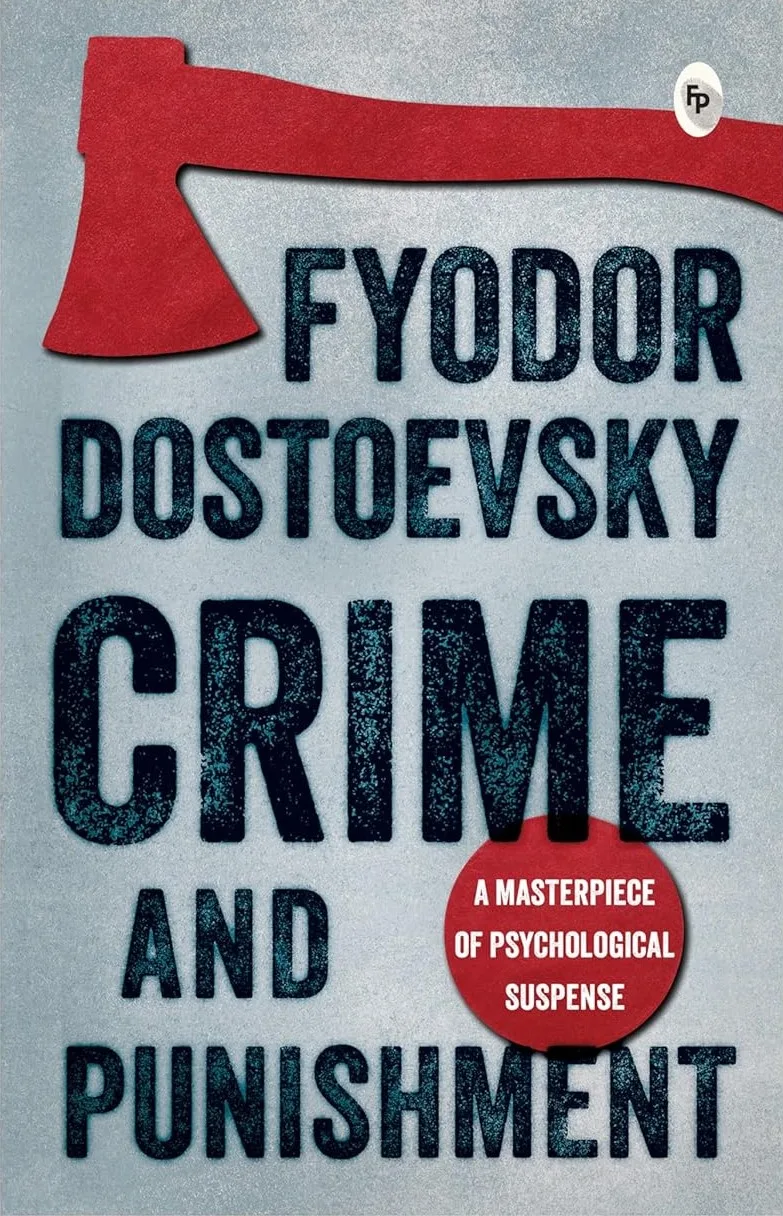
Download Cover Image
Do you want to download the full cover image for Crime and Punishment?