
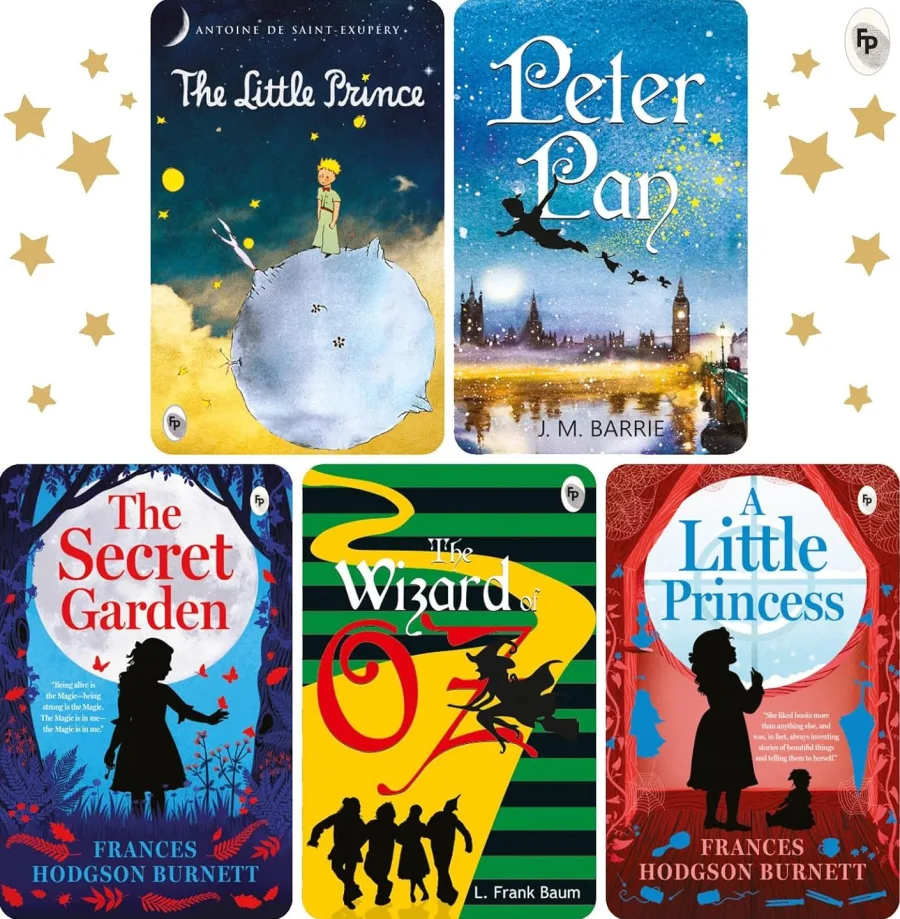
Best of Children's Classics : Perfect Gift Set for Kids (Set of 5 Books)
Antoine de Saint-Exupéry, J.M. Barrie
Paperback
• 936 Pages
• ₹ 549.00
• English
• 9789389432008
No ratings yet
| Publisher | Fingerprint! Publishing |
|---|---|
| ISBN13 | 9789389432008 |
| ASIN/SKU | 9389432006 |
| Book Format | Paperback |
| Language | English |
| Pages | 936 |
| List Price | ₹ 549.00 |
| Publishing Date | 01/08/2019 |
| Dimensions | 13.03 x 6.68 x 20.02 cm |
| Weight | 650 g |
| Book Code | BD00055037 |
Buy this Book
Amazon Stores
Ebook Stores
Other Stores
Discover Best of Children's Classics : Perfect Gift Set for Kids (Set of 5 Books) by Antoine de Saint-Exupéry. This book is published by Fingerprint! Publishing in Paperback format, ISBN 9789389432008, ASIN 9389432006, under Literature and Fiction, Action and Adventure for Young Adults, Fiction Classics for Young Adults.
Book Description
Discover a captivating collection of the five best works in children's literature, presented in a beautifully designed box set that is both a treasure for your library and an ideal gift. Join a young boy in a Sahara Desert crash landing, soar to Neverland with Peter Pan, explore the enchanting secret garden with Mary, journey to the magical city of Emeralds and encounter the Wizard of Oz, and befriend Sara, the imaginative little princess. These delightful and enthralling tales of adventure have stood the test of time, remaining beloved favorites that ignite the imagination and capture the hearts of readers of all ages.
Timeless tales. Endless wonder.
Timeless tales that ignite the imagination anew.
Beautifully designed box set, a collector's treasure.
Adventures that transport readers to magical worlds.
Beloved classics that captivate hearts across generations.
Perfect gift to spark a lifelong love for reading.
Timeless tales. Endless wonder.
Timeless tales that ignite the imagination anew.
Beautifully designed box set, a collector's treasure.
Adventures that transport readers to magical worlds.
Beloved classics that captivate hearts across generations.
Perfect gift to spark a lifelong love for reading.
Author Biography
Antoine de Saint-ExupÃ(c)ry, J.M. Barrie, Frances Hodgson Burnett & L. Frank Baum
Editorial Reviews
Editorial Reviews will be added soon…
Book Summary
Best of Children's Classics: Perfect Gift Set for Kids is a collection of five beloved children's classics gathered into a single set for young readers. Bringing together timeless stories by celebrated authors such as Antoine de Saint-Exupéry and J. M. Barrie, the collection introduces children to imaginative worlds, unforgettable characters, adventure, friendship, courage, and important lessons about growing up.
Rather than being a collection created around one particular genre or type of story, this five-book set brings together some of the most enduring traditions of children's literature. The stories encourage children to use their imagination while also introducing them to ideas about friendship, kindness, responsibility, love, courage, independence, and the meaning of childhood.
The appeal of a children's classics collection lies partly in its variety. Each story offers a different world and a different emotional experience, allowing young readers to move from fantasy and adventure to thoughtful reflections on life and human relationships.
A Collection of Timeless Children's Stories
Children's classics have survived across generations because their central ideas remain meaningful even as the world changes.
The stories included in this collection belong to that tradition.
They feature characters who experience wonder, adventure, danger, loneliness, friendship, discovery, and personal growth. Although many of these stories were written long ago, their emotional themes remain recognizable to today's children.
A child can still understand the excitement of discovering a magical world.
A young reader can still identify with a character who wants to explore beyond familiar surroundings.
The experience of friendship, fear, curiosity, and growing up remains universal.
This is what makes classic children's literature valuable: the setting may be unfamiliar, but the emotions are not.
Antoine de Saint-Exupéry and The Little Prince
One of the most famous authors associated with the collection is Antoine de Saint-Exupéry, best known for The Little Prince.
Although often categorized as a children's book, The Little Prince is unusual because its ideas can be appreciated at different levels.
Young readers can enjoy the fantastical journey of a little prince who travels between planets and meets a series of unusual characters.
Older readers can discover deeper reflections on friendship, loneliness, love, responsibility, imagination, and the difference between the way children and adults understand the world.
The Little Prince's journey introduces children to a world in which planets can contain unusual inhabitants and seemingly simple conversations can lead to profound questions.
One of the book's most important ideas is that relationships create responsibility.
When we form meaningful connections with others, we cannot treat those relationships as disposable.
This makes the story particularly valuable for introducing children to the emotional importance of friendship and caring for others.
J. M. Barrie and Peter Pan
Another major literary figure represented in this tradition is J. M. Barrie, the author of Peter Pan.
Peter Pan is one of the most recognizable characters in children's literature: a boy who refuses to grow up and lives in the magical world of Neverland.
The story combines pirates, fairies, adventure, flying, fantasy, danger, and childhood imagination.
Peter Pan's world is exciting because it represents a place where children can escape the ordinary rules of everyday life.
But beneath the adventure lies a more complicated idea.
Growing up means losing some of the freedom and innocence of childhood, but it also brings maturity, responsibility, and a deeper understanding of relationships.
This makes Peter Pan more than a simple adventure story.
It invites readers to think about childhood itself.
Why do we want to grow up?
Why do we sometimes wish we could remain children forever?
What do we gain and lose as we become adults?
These questions give the story an enduring quality.
Imagination as a Central Theme
One of the strongest connections among children's classics is their belief in imagination.
Young children naturally transform ordinary objects and situations into extraordinary adventures.
A bedroom can become a magical kingdom.
A journey can become a quest.
A conversation can become a life-changing experience.
Classic children's literature preserves this imaginative freedom.
The stories in a collection like Best of Children's Classics encourage children to imagine beyond what they see immediately.
This is important because reading fiction is not simply about following a plot.
It is also about learning to imagine the experiences of someone else.
Friendship and Companionship
Friendship is another recurring theme in children's classics.
Characters often begin their adventures alone or uncertain, but they discover companions along the way.
These friendships help them face difficulties.
They teach them about loyalty.
They give them courage.
They sometimes challenge their assumptions.
For young readers, such stories provide an accessible way to understand relationships.
A friend is not simply someone with whom you have fun. A good friend may also be someone who helps you become more courageous, honest, responsible, or compassionate.
This makes friendship one of the most valuable lessons that classic children's literature can offer.
Courage and Adventure
Children's classics rarely avoid adventure.
Their protagonists enter unfamiliar environments, confront frightening characters, solve problems, and face situations they do not fully understand.
This allows young readers to experience danger safely through fiction.
The child can feel the excitement of the adventure while remaining physically secure.
At the same time, these stories demonstrate that courage is not the absence of fear.
Characters may be frightened and still continue.
They may be uncertain and still make decisions.
They may be small or inexperienced and still find ways to overcome obstacles.
This can encourage young readers to think about their own challenges in a more positive way.
Lessons About Growing Up
Many classic children's stories are fundamentally about growing up.
Their young protagonists begin with limited knowledge of the world.
Through adventure, they learn about friendship, responsibility, independence, loss, and choice.
This process reflects the real experience of childhood.
Children gradually become more independent.
They encounter situations they have never experienced before.
They make mistakes.
They learn from other people.
They begin to understand that actions have consequences.
Classic literature can help children process these experiences through characters who face similar challenges in imaginative settings.
Kindness and Compassion
Children's classics often place kindness at the center of their moral worlds.
Characters may be separated by age, background, wealth, personality, or species, but meaningful relationships are often built through compassion.
Stories teach children that strength is not simply physical.
Being kind can be a form of courage.
Listening can be a form of friendship.
Helping another person can be more meaningful than winning.
These ideas can be particularly powerful when they are communicated through memorable characters rather than direct instruction.
Learning Through Stories
A collection of children's classics provides educational value without making reading feel like a lesson.
Children learn vocabulary naturally while reading.
They encounter different styles of storytelling.
They discover unfamiliar places and historical settings.
They develop the ability to follow longer narratives.
They learn to understand characters' motivations.
Most importantly, they develop empathy by experiencing the world through different perspectives.
A child who reads about a character who is lonely, frightened, curious, or misunderstood can begin to understand that other people may experience emotions differently.
This is one of the greatest strengths of literature.
Why Classic Books Still Matter
Modern children have access to countless forms of entertainment.
Animated films, games, videos, and digital content can provide immediate stimulation.
Classic books offer something different.
They require children to slow down and create images in their own minds.
When a book describes a magical island, a distant planet, or an extraordinary character, the child's imagination completes the picture.
This active participation is one reason classic children's literature remains valuable.
The reader is not simply watching a story.
The reader is helping to create it.
A Gift for Young Readers
The title itself positions the collection as a gift set for kids, making it particularly suitable for birthdays, holidays, school rewards, reading milestones, and family gifts.
A collection has another advantage over a single book: it gives a child multiple stories to explore.
A young reader may connect strongly with one book and then discover another that introduces a completely different style or theme.
This can encourage children to develop broader reading interests.
Instead of reading only one type of story, they can experience fantasy, adventure, friendship, imagination, and classic storytelling across several books.
Building a Child's Personal Library
A set of children's classics can also become an important part of a child's home library.
Some books are read once and forgotten.
Classic stories are different.
Children may return to them years later and understand them differently.
A young child may read The Little Prince primarily as a magical story.
A teenager may return to it and notice its reflections on love and responsibility.
An adult may discover entirely different meanings.
That ability to grow with the reader is one of the defining characteristics of classic literature.
Suitable for Family Reading
The stories in children's classics are also well suited to shared reading.
Parents can read aloud to younger children, while older children can read the books independently.
Family reading creates opportunities for conversation.
Parents can ask children about their favorite characters, discuss difficult decisions, or talk about the lessons they noticed in the story.
This makes classic books more than entertainment.
They can become a starting point for conversations about emotions, relationships, imagination, and growing up.
Who Is This Collection For?
Best of Children's Classics: Perfect Gift Set for Kids is particularly suitable for:
Young readers discovering classic literature
Children who enjoy fantasy and adventure
Fans of The Little Prince
Readers interested in Peter Pan
Children who love imaginative stories
Parents building a home library
Families looking for read-aloud books
Children interested in timeless stories
Birthday and holiday gifts for young readers
Young readers developing independent reading habits
Teachers and educators introducing children's classics
It can also appeal to adults who want to revisit stories they loved during childhood or introduce those stories to a new generation.
Final Thoughts
Best of Children's Classics: Perfect Gift Set for Kids offers young readers an opportunity to discover stories that have remained important across generations.
The collection brings together the magic of classic children's literature with themes that continue to matter: friendship, courage, imagination, kindness, adventure, responsibility, love, and the experience of growing up.
The presence of authors such as Antoine de Saint-Exupéry and J. M. Barrie connects the collection to two particularly influential traditions in children's literature. The Little Prince invites readers to think about friendship, love, responsibility, and the way we see the world, while Peter Pan opens the door to a world of adventure and explores the complicated relationship between childhood and growing up.
What makes such stories enduring is that they do not belong entirely to one generation.
A child can enjoy the adventure.
A parent can appreciate the emotional lesson.
An older reader can discover meanings that were invisible during childhood.
That is the special quality of children's classics.
For readers searching for Best of Children's Classics, children's classic books, classic books for kids, children's literature collections, children's books gift set, five-book children's collection, books for young readers, classic fantasy books for children, The Little Prince, Peter Pan, Antoine de Saint-Exupéry books, J. M. Barrie books, children's adventure stories, books about friendship for kids, children's books about courage, imaginative children's stories, bedtime classics, family reading books, or classic literature gift sets for children, this collection offers a convenient introduction to timeless storytelling.
Ultimately, a good children's classic does more than entertain a child for an afternoon.
It gives them characters to remember, worlds to imagine, questions to consider, and ideas that may remain with them for years.
A collection like Best of Children's Classics can therefore become more than a gift.
It can become the beginning of a child's lifelong relationship with books.
Rather than being a collection created around one particular genre or type of story, this five-book set brings together some of the most enduring traditions of children's literature. The stories encourage children to use their imagination while also introducing them to ideas about friendship, kindness, responsibility, love, courage, independence, and the meaning of childhood.
The appeal of a children's classics collection lies partly in its variety. Each story offers a different world and a different emotional experience, allowing young readers to move from fantasy and adventure to thoughtful reflections on life and human relationships.
A Collection of Timeless Children's Stories
Children's classics have survived across generations because their central ideas remain meaningful even as the world changes.
The stories included in this collection belong to that tradition.
They feature characters who experience wonder, adventure, danger, loneliness, friendship, discovery, and personal growth. Although many of these stories were written long ago, their emotional themes remain recognizable to today's children.
A child can still understand the excitement of discovering a magical world.
A young reader can still identify with a character who wants to explore beyond familiar surroundings.
The experience of friendship, fear, curiosity, and growing up remains universal.
This is what makes classic children's literature valuable: the setting may be unfamiliar, but the emotions are not.
Antoine de Saint-Exupéry and The Little Prince
One of the most famous authors associated with the collection is Antoine de Saint-Exupéry, best known for The Little Prince.
Although often categorized as a children's book, The Little Prince is unusual because its ideas can be appreciated at different levels.
Young readers can enjoy the fantastical journey of a little prince who travels between planets and meets a series of unusual characters.
Older readers can discover deeper reflections on friendship, loneliness, love, responsibility, imagination, and the difference between the way children and adults understand the world.
The Little Prince's journey introduces children to a world in which planets can contain unusual inhabitants and seemingly simple conversations can lead to profound questions.
One of the book's most important ideas is that relationships create responsibility.
When we form meaningful connections with others, we cannot treat those relationships as disposable.
This makes the story particularly valuable for introducing children to the emotional importance of friendship and caring for others.
J. M. Barrie and Peter Pan
Another major literary figure represented in this tradition is J. M. Barrie, the author of Peter Pan.
Peter Pan is one of the most recognizable characters in children's literature: a boy who refuses to grow up and lives in the magical world of Neverland.
The story combines pirates, fairies, adventure, flying, fantasy, danger, and childhood imagination.
Peter Pan's world is exciting because it represents a place where children can escape the ordinary rules of everyday life.
But beneath the adventure lies a more complicated idea.
Growing up means losing some of the freedom and innocence of childhood, but it also brings maturity, responsibility, and a deeper understanding of relationships.
This makes Peter Pan more than a simple adventure story.
It invites readers to think about childhood itself.
Why do we want to grow up?
Why do we sometimes wish we could remain children forever?
What do we gain and lose as we become adults?
These questions give the story an enduring quality.
Imagination as a Central Theme
One of the strongest connections among children's classics is their belief in imagination.
Young children naturally transform ordinary objects and situations into extraordinary adventures.
A bedroom can become a magical kingdom.
A journey can become a quest.
A conversation can become a life-changing experience.
Classic children's literature preserves this imaginative freedom.
The stories in a collection like Best of Children's Classics encourage children to imagine beyond what they see immediately.
This is important because reading fiction is not simply about following a plot.
It is also about learning to imagine the experiences of someone else.
Friendship and Companionship
Friendship is another recurring theme in children's classics.
Characters often begin their adventures alone or uncertain, but they discover companions along the way.
These friendships help them face difficulties.
They teach them about loyalty.
They give them courage.
They sometimes challenge their assumptions.
For young readers, such stories provide an accessible way to understand relationships.
A friend is not simply someone with whom you have fun. A good friend may also be someone who helps you become more courageous, honest, responsible, or compassionate.
This makes friendship one of the most valuable lessons that classic children's literature can offer.
Courage and Adventure
Children's classics rarely avoid adventure.
Their protagonists enter unfamiliar environments, confront frightening characters, solve problems, and face situations they do not fully understand.
This allows young readers to experience danger safely through fiction.
The child can feel the excitement of the adventure while remaining physically secure.
At the same time, these stories demonstrate that courage is not the absence of fear.
Characters may be frightened and still continue.
They may be uncertain and still make decisions.
They may be small or inexperienced and still find ways to overcome obstacles.
This can encourage young readers to think about their own challenges in a more positive way.
Lessons About Growing Up
Many classic children's stories are fundamentally about growing up.
Their young protagonists begin with limited knowledge of the world.
Through adventure, they learn about friendship, responsibility, independence, loss, and choice.
This process reflects the real experience of childhood.
Children gradually become more independent.
They encounter situations they have never experienced before.
They make mistakes.
They learn from other people.
They begin to understand that actions have consequences.
Classic literature can help children process these experiences through characters who face similar challenges in imaginative settings.
Kindness and Compassion
Children's classics often place kindness at the center of their moral worlds.
Characters may be separated by age, background, wealth, personality, or species, but meaningful relationships are often built through compassion.
Stories teach children that strength is not simply physical.
Being kind can be a form of courage.
Listening can be a form of friendship.
Helping another person can be more meaningful than winning.
These ideas can be particularly powerful when they are communicated through memorable characters rather than direct instruction.
Learning Through Stories
A collection of children's classics provides educational value without making reading feel like a lesson.
Children learn vocabulary naturally while reading.
They encounter different styles of storytelling.
They discover unfamiliar places and historical settings.
They develop the ability to follow longer narratives.
They learn to understand characters' motivations.
Most importantly, they develop empathy by experiencing the world through different perspectives.
A child who reads about a character who is lonely, frightened, curious, or misunderstood can begin to understand that other people may experience emotions differently.
This is one of the greatest strengths of literature.
Why Classic Books Still Matter
Modern children have access to countless forms of entertainment.
Animated films, games, videos, and digital content can provide immediate stimulation.
Classic books offer something different.
They require children to slow down and create images in their own minds.
When a book describes a magical island, a distant planet, or an extraordinary character, the child's imagination completes the picture.
This active participation is one reason classic children's literature remains valuable.
The reader is not simply watching a story.
The reader is helping to create it.
A Gift for Young Readers
The title itself positions the collection as a gift set for kids, making it particularly suitable for birthdays, holidays, school rewards, reading milestones, and family gifts.
A collection has another advantage over a single book: it gives a child multiple stories to explore.
A young reader may connect strongly with one book and then discover another that introduces a completely different style or theme.
This can encourage children to develop broader reading interests.
Instead of reading only one type of story, they can experience fantasy, adventure, friendship, imagination, and classic storytelling across several books.
Building a Child's Personal Library
A set of children's classics can also become an important part of a child's home library.
Some books are read once and forgotten.
Classic stories are different.
Children may return to them years later and understand them differently.
A young child may read The Little Prince primarily as a magical story.
A teenager may return to it and notice its reflections on love and responsibility.
An adult may discover entirely different meanings.
That ability to grow with the reader is one of the defining characteristics of classic literature.
Suitable for Family Reading
The stories in children's classics are also well suited to shared reading.
Parents can read aloud to younger children, while older children can read the books independently.
Family reading creates opportunities for conversation.
Parents can ask children about their favorite characters, discuss difficult decisions, or talk about the lessons they noticed in the story.
This makes classic books more than entertainment.
They can become a starting point for conversations about emotions, relationships, imagination, and growing up.
Who Is This Collection For?
Best of Children's Classics: Perfect Gift Set for Kids is particularly suitable for:
Young readers discovering classic literature
Children who enjoy fantasy and adventure
Fans of The Little Prince
Readers interested in Peter Pan
Children who love imaginative stories
Parents building a home library
Families looking for read-aloud books
Children interested in timeless stories
Birthday and holiday gifts for young readers
Young readers developing independent reading habits
Teachers and educators introducing children's classics
It can also appeal to adults who want to revisit stories they loved during childhood or introduce those stories to a new generation.
Final Thoughts
Best of Children's Classics: Perfect Gift Set for Kids offers young readers an opportunity to discover stories that have remained important across generations.
The collection brings together the magic of classic children's literature with themes that continue to matter: friendship, courage, imagination, kindness, adventure, responsibility, love, and the experience of growing up.
The presence of authors such as Antoine de Saint-Exupéry and J. M. Barrie connects the collection to two particularly influential traditions in children's literature. The Little Prince invites readers to think about friendship, love, responsibility, and the way we see the world, while Peter Pan opens the door to a world of adventure and explores the complicated relationship between childhood and growing up.
What makes such stories enduring is that they do not belong entirely to one generation.
A child can enjoy the adventure.
A parent can appreciate the emotional lesson.
An older reader can discover meanings that were invisible during childhood.
That is the special quality of children's classics.
For readers searching for Best of Children's Classics, children's classic books, classic books for kids, children's literature collections, children's books gift set, five-book children's collection, books for young readers, classic fantasy books for children, The Little Prince, Peter Pan, Antoine de Saint-Exupéry books, J. M. Barrie books, children's adventure stories, books about friendship for kids, children's books about courage, imaginative children's stories, bedtime classics, family reading books, or classic literature gift sets for children, this collection offers a convenient introduction to timeless storytelling.
Ultimately, a good children's classic does more than entertain a child for an afternoon.
It gives them characters to remember, worlds to imagine, questions to consider, and ideas that may remain with them for years.
A collection like Best of Children's Classics can therefore become more than a gift.
It can become the beginning of a child's lifelong relationship with books.
Sample Chapters
Sample Chapters will be added soon…
Reader Reviews
No reviews yet.
Best of Children's Classics : Perfect Gift Set for Kids (Set of 5 Books)
Download Cover Image
Do you want to download the full cover image for Best of Children's Classics : Perfect Gift Set for Kids (Set of 5 Books)?