
Harry Potter and the Chamber of Secrets
Paperback
• 384 Pages
• ₹ 599.00
• English
• 9781408855669
No ratings yet
Children's Books
Science Fiction & Fantasy for Children
Visionary & Metaphysical Fantasy Fiction for Children
| Publisher | Bloomsbury Children's Books |
|---|---|
| ISBN13 | 9781408855669 |
| ASIN/SKU | 1408855666 |
| Book Format | Paperback |
| Language | English |
| Pages | 384 |
| List Price | ₹ 599.00 |
| Publishing Date | 31/01/2014 |
| Dimensions | 19.8 x 2.5 x 12.9 cm |
| Weight | 1 kg 50 g |
| Book Code | BD00055036 |
Buy this Book
Amazon Stores
Ebook Stores
Other Stores
Discover Harry Potter and the Chamber of Secrets by J.K. Rowling. This book is published by Bloomsbury Children's Books in Paperback format, ISBN 9781408855669, ASIN 1408855666, under Children's Books, Science Fiction and Fantasy for Children, Visionary and Metaphysical Fantasy Fiction for Children.
Book Description
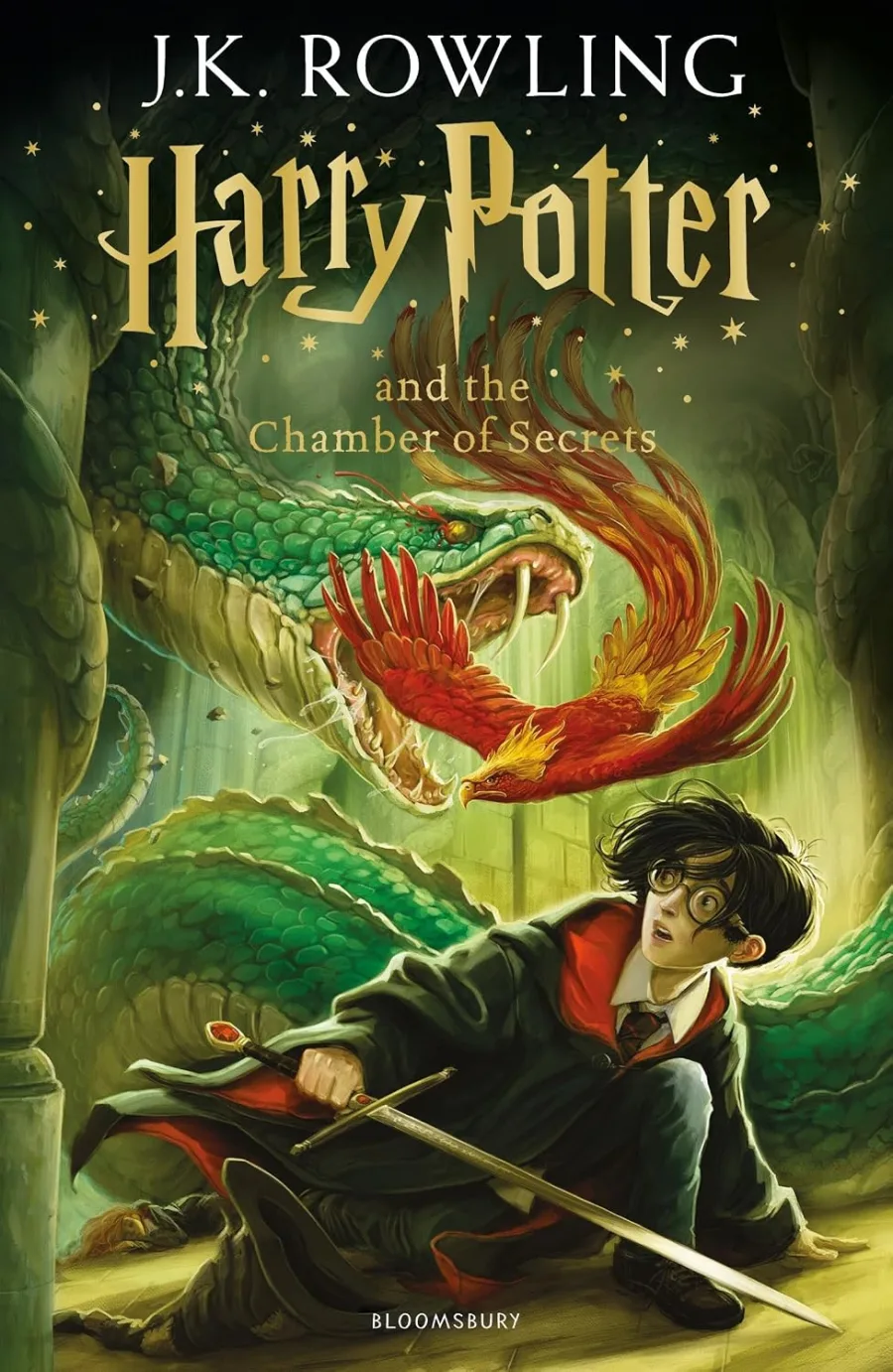
Harry Potter's summer has included the worst birthday ever, doomy warnings from a house-elf called Dobby, and rescue from the Dursleys by his friend Ron Weasley in a magical flying car! Back at Hogwarts School of Witchcraft and Wizardry for his second year, Harry hears strange whispers echo through empty corridors - and then the attacks start. Students are found as through turned to stone . Dobby's sinister predictions seem to be coming true.These new editions of the classic and internationally bestselling, multi-award-winning series feature instantly pick-up-able new jackets by Jonny Duddle, with huge child appeal, to bring Harry Potter to the next generation of readers. It's time to PASS THE MAGIC ON .
Author Biography
Harry Potter and the Philosopher's Stone was J.K. Rowling's first novel, followed by the subsequent six titles in the Harry Potter series, as well as three books written for charity: Fantastic Beasts and Where to Find Them, Quidditch Through the Ages and The Tales of Beedle the Bard. The Harry Potter novels have now sold over 450 million copies worldwide and been translated into 78 languages.
Editorial Reviews
Editorial Reviews will be added soon…
Book Summary
Harry Potter and the Chamber of Secrets is the second novel in J.K. Rowling's Harry Potter series. It continues Harry's adventures at Hogwarts School of Witchcraft and Wizardry, combining fantasy, mystery, friendship, humor, danger, and the struggle between courage and prejudice. The story begins with Harry's difficult summer at the Dursleys and develops into a terrifying mystery when students at Hogwarts are mysteriously attacked and an ancient chamber hidden beneath the school is apparently opened.
The novel begins during Harry's summer holiday with the Dursley family. Harry is living with his aunt Petunia, uncle Vernon, and cousin Dudley, who continue to treat him poorly because of his magical abilities. Harry desperately wants to return to Hogwarts, where he feels that he belongs and where he has friends who understand him.
But before the new school year begins, Harry receives an unexpected visitor.
A strange house-elf named Dobby appears in his bedroom and warns him not to return to Hogwarts. Dobby refuses to explain everything clearly, but he insists that terrible danger awaits Harry at the school. Harry naturally wants to know why, but Dobby's attempts to protect him ultimately create even more trouble.
When Dobby magically interferes with the Dursleys' dinner party, Harry is blamed for the disaster. Uncle Vernon locks him in his room and tries to prevent him from returning to school.
Harry is eventually rescued by Ron Weasley and his brothers, who arrive in a flying car. Harry escapes the Dursleys and spends the remainder of the summer at the warm and chaotic Weasley home, where he feels far more welcome than he ever has with his relatives.
The contrast between the Dursleys and the Weasleys is important to the novel. The Dursleys represent rejection and prejudice, while the Weasley family represents affection, loyalty, and belonging. Harry's friendship with Ron and his growing relationship with the Weasley family reinforce the idea that family can be defined by love rather than blood alone.
When Harry and Ron attempt to return to Hogwarts, they discover that their journey will not be as straightforward as expected. After missing the Hogwarts Express, they use Mr. Weasley's enchanted flying car to reach the school. Their arrival is spectacular but disastrous, and they are punished for violating school rules.
Yet their punishment soon becomes insignificant compared with what happens next.
Hogwarts is not the same as it was during Harry's first year.
Students begin hearing a mysterious voice within the walls. Then the caretaker's cat, Mrs. Norris, is found petrified near a threatening message announcing that the Chamber of Secrets has been opened.
The message creates immediate fear throughout the school.
According to Hogwarts legend, the Chamber of Secrets was created by Salazar Slytherin, one of the school's four founders. Slytherin supposedly built a hidden chamber containing a monster that only his true heir could release. The legend claims that the monster would eventually attack students whom Slytherin considered unworthy of attending Hogwarts.
The possibility that the Chamber has been opened terrifies the school because it suggests that an ancient threat has returned.
Harry, Ron, and Hermione Granger begin investigating the mystery.
Their friendship is central to the story. Harry is brave and instinctive, Ron is loyal and courageous, and Hermione brings intelligence, research skills, and determination. Their different strengths complement one another, allowing them to investigate mysteries that would be difficult for any one of them to solve alone.
Soon, students begin to be attacked.
They are not killed but petrified, left rigid and unconscious. The attacks make the school increasingly fearful. Teachers struggle to protect students, while rumors spread about who might be responsible.
Harry becomes particularly suspicious because he discovers that he can hear the mysterious voice moving through the walls. This ability frightens him because it is connected to one of the characteristics of Salazar Slytherin's heir: the ability to speak Parseltongue, the language of snakes.
Harry's ability to speak to snakes had already made other students suspicious of him during his first year. Now, with the Chamber of Secrets apparently open, his unusual ability makes him look like a possible suspect.
This creates one of the novel's major themes: prejudice based on fear and incomplete information.
Harry is innocent, but many students are willing to believe he is responsible simply because he possesses a rare ability associated with Slytherin. The story demonstrates how quickly fear can turn into suspicion and how easily people can judge someone without evidence.
The attacks also create tension between different groups at Hogwarts. Some students are particularly concerned about the idea of Muggle-born witches and wizards being targeted. Muggle-born students have magical abilities despite being born to non-magical parents, and the Chamber's legend suggests that Slytherin's heir intends to drive them from Hogwarts.
This introduces the series' broader conflict between prejudice and equality. The idea that magical ability should be determined by family background is presented as a dangerous form of discrimination.
Meanwhile, Hogwarts receives a new Defense Against the Dark Arts teacher: Gilderoy Lockhart.
Lockhart is charming, famous, and extremely confident. He constantly talks about his heroic adventures and displays an impressive collection of books about his supposed accomplishments. Yet his self-confidence is so exaggerated that it becomes clear he is more interested in his reputation than in teaching.
His presence provides much of the novel's comedy.
Harry and Ron quickly become skeptical of Lockhart, especially when his behavior contradicts his public image. Hermione, however, initially admires him. Eventually, the trio's experiences reveal that Lockhart's reputation is built on something very different from genuine courage.
The novel also introduces Lucius Malfoy, Draco Malfoy's father. Lucius is a powerful and influential wizard who represents the darker side of the magical elite. His attitude toward Muggle-born witches and wizards reveals the prejudices that Harry and his friends are beginning to understand more clearly.
Harry encounters Lucius at Flourish and Blotts, where an incident involving Ginny Weasley's books becomes an important clue. Lucius secretly places an old diary among Ginny's belongings, setting in motion one of the most important elements of the mystery.
The diary eventually falls into Ginny's hands.
It appears to be an ordinary blank diary, but it is actually magical. When Ginny writes in it, the diary responds. Gradually, she becomes emotionally connected to it and begins sharing her thoughts with the mysterious person inside.
The diary belongs to Tom Riddle, a former Hogwarts student.
Tom presents himself as charming and sympathetic. He listens to Ginny's worries and gains her trust. But his influence becomes increasingly dangerous.
Meanwhile, Harry discovers a mysterious object that allows him to see memories from the past. Through the diary, he witnesses Tom Riddle's version of events from fifty years earlier, when the Chamber of Secrets was supposedly opened for the first time.
Tom claims that he helped expose the person responsible for the earlier attacks.
But Harry eventually realizes that the diary is not merely a record of the past.
It is a living magical object connected to Tom Riddle himself.
As Harry investigates, he discovers a crucial connection between Tom Riddle and Lord Voldemort, the dark wizard who attempted to kill him as a baby. Tom Riddle is revealed to be Voldemort's younger identity.
This revelation expands Harry's understanding of his enemy. Voldemort is not simply a mysterious evil figure from the past. He was once a Hogwarts student, and his history is deeply connected to the school.
The connection between Voldemort and Slytherin also becomes important. Tom Riddle is descended from Salazar Slytherin and possesses the ability to speak Parseltongue. He is therefore the heir capable of controlling the monster inside the Chamber.
The mystery finally leads Harry and Ron to the Chamber itself.
Hermione has been unable to accompany them because she has been petrified, but she leaves behind an important clue. The boys discover that the creature responsible for the attacks is a Basilisk, an enormous serpent whose gaze can kill.
The students who were attacked survived because they never looked directly into the creature's eyes. Mrs. Norris saw the Basilisk's reflection in water. Colin Creevey was looking through a camera. Justin Finch-Fletchley saw it indirectly, and Hermione used a mirror.
This discovery explains the mysterious voice Harry has heard. The Basilisk has been moving through the school's pipes, allowing it to travel through Hogwarts unseen.
Harry and Ron eventually learn that Ginny has been taken into the Chamber.
Harry follows her.
Inside the Chamber, he encounters Tom Riddle's memory, which has been strengthened by Ginny's life force. Riddle explains that he manipulated Ginny into reopening the Chamber and controlling the Basilisk.
Ginny is therefore not the villain.
She is a victim.
Tom Riddle has exploited her loneliness and insecurity, using her trust to accomplish his own purposes.
This is another important theme of the novel: manipulation can disguise itself as friendship.
Harry confronts Riddle and refuses to surrender. He also learns that the diary is the object through which Riddle's consciousness is preserved.
During the confrontation, Harry receives unexpected help from Fawkes, Albus Dumbledore's phoenix. Fawkes brings Harry the Sorting Hat, from which Harry draws the sword of Godric Gryffindor.
Harry uses the sword to kill the Basilisk.
But the Basilisk's poisonous fang wounds Harry.
With time running out, Harry uses one of the Basilisk's fangs to destroy Tom Riddle's diary. The destruction of the diary destroys Riddle's presence and frees Ginny from his control.
Fawkes's tears then heal Harry's poisoned wound, allowing him to survive.
The conclusion resolves the mystery while revealing important truths about several characters.
Harry learns that Dobby had been trying to protect him all along. Dobby had warned him about Hogwarts because he knew that Lucius Malfoy had placed the diary in Ginny's possession and that something terrible was likely to happen.
Harry also discovers that Lucius Malfoy was responsible for giving Ginny the diary.
Using cleverness rather than direct confrontation, Harry manipulates Lucius into freeing Dobby from his service. This gives Dobby his freedom and demonstrates Harry's growing ability to solve problems through intelligence as well as courage.
The school eventually returns to normal.
The petrified students are restored, Hermione returns, and the threat of the Chamber is removed.
The novel ends on a hopeful note, but its themes remain significant.
One of the most important is the difference between identity and ancestry. Harry discovers that possessing Parseltongue does not make him the heir of Slytherin. What defines him is not his ability or bloodline but the choices he makes.
This idea becomes especially important when Harry worries that his similarities to Voldemort might mean that he is somehow like him. Dumbledore reassures him that it is our choices, rather than our abilities, that reveal who we truly are.
The novel therefore presents a powerful message about personal responsibility.
Harry and Voldemort share certain unusual abilities. Both are connected to Slytherin through Parseltongue. Both possess exceptional magical powers. But their moral choices are radically different.
Harry chooses friendship, courage, compassion, and self-sacrifice.
Voldemort chooses manipulation, domination, and cruelty.
The difference between them is not simply what they can do.
It is what they choose to do.
The story also explores prejudice and blood status. The attacks on Muggle-born students reveal the danger of believing that someone's worth is determined by their ancestry. The conflict is not merely a magical problem; it reflects a universal human tendency to divide people into groups and treat some as more deserving than others.
Friendship remains another major theme.
Harry could not solve the mystery alone. Ron provides loyalty and bravery, while Hermione contributes knowledge and careful reasoning. Even when Hermione is temporarily removed from the action, her earlier research helps Harry and Ron understand the mystery.
The novel also shows that courage is not the absence of fear. Hogwarts is genuinely dangerous, and Harry is frightened. Yet he continues because other people need his help.
This is particularly clear in the final confrontation. Harry enters the Chamber knowing that he may not survive, but he chooses to act because Ginny's life is at stake.
Ultimately, Harry Potter and the Chamber of Secrets is both a magical adventure and a story about identity, prejudice, friendship, and moral choice.
The mystery of the Chamber provides the suspense, while the characters' relationships give the story its emotional depth. Harry must confront not only a physical monster but also his fear that he might somehow resemble the person he hates most.
The novel's answer is reassuring: we are not defined solely by what we inherit. We are defined by what we choose.
Through the hidden Chamber, the terrifying Basilisk, Tom Riddle's diary, Ginny's manipulation, and the return of Voldemort's past, J.K. Rowling expands the magical world introduced in the first book while making the story darker and more complex.
Yet the heart of the novel remains simple. Friendship can overcome fear. Courage can exist alongside uncertainty. Prejudice can be challenged. Manipulation can be resisted. And even when the past seems to determine someone's identity, the power to choose differently remains.
Harry Potter and the Chamber of Secrets ultimately reminds readers that the most important magic is not the ability to cast spells. It is the ability to choose compassion, loyalty, and courage when fear would make the easier choice seem more attractive.
The novel begins during Harry's summer holiday with the Dursley family. Harry is living with his aunt Petunia, uncle Vernon, and cousin Dudley, who continue to treat him poorly because of his magical abilities. Harry desperately wants to return to Hogwarts, where he feels that he belongs and where he has friends who understand him.
But before the new school year begins, Harry receives an unexpected visitor.
A strange house-elf named Dobby appears in his bedroom and warns him not to return to Hogwarts. Dobby refuses to explain everything clearly, but he insists that terrible danger awaits Harry at the school. Harry naturally wants to know why, but Dobby's attempts to protect him ultimately create even more trouble.
When Dobby magically interferes with the Dursleys' dinner party, Harry is blamed for the disaster. Uncle Vernon locks him in his room and tries to prevent him from returning to school.
Harry is eventually rescued by Ron Weasley and his brothers, who arrive in a flying car. Harry escapes the Dursleys and spends the remainder of the summer at the warm and chaotic Weasley home, where he feels far more welcome than he ever has with his relatives.
The contrast between the Dursleys and the Weasleys is important to the novel. The Dursleys represent rejection and prejudice, while the Weasley family represents affection, loyalty, and belonging. Harry's friendship with Ron and his growing relationship with the Weasley family reinforce the idea that family can be defined by love rather than blood alone.
When Harry and Ron attempt to return to Hogwarts, they discover that their journey will not be as straightforward as expected. After missing the Hogwarts Express, they use Mr. Weasley's enchanted flying car to reach the school. Their arrival is spectacular but disastrous, and they are punished for violating school rules.
Yet their punishment soon becomes insignificant compared with what happens next.
Hogwarts is not the same as it was during Harry's first year.
Students begin hearing a mysterious voice within the walls. Then the caretaker's cat, Mrs. Norris, is found petrified near a threatening message announcing that the Chamber of Secrets has been opened.
The message creates immediate fear throughout the school.
According to Hogwarts legend, the Chamber of Secrets was created by Salazar Slytherin, one of the school's four founders. Slytherin supposedly built a hidden chamber containing a monster that only his true heir could release. The legend claims that the monster would eventually attack students whom Slytherin considered unworthy of attending Hogwarts.
The possibility that the Chamber has been opened terrifies the school because it suggests that an ancient threat has returned.
Harry, Ron, and Hermione Granger begin investigating the mystery.
Their friendship is central to the story. Harry is brave and instinctive, Ron is loyal and courageous, and Hermione brings intelligence, research skills, and determination. Their different strengths complement one another, allowing them to investigate mysteries that would be difficult for any one of them to solve alone.
Soon, students begin to be attacked.
They are not killed but petrified, left rigid and unconscious. The attacks make the school increasingly fearful. Teachers struggle to protect students, while rumors spread about who might be responsible.
Harry becomes particularly suspicious because he discovers that he can hear the mysterious voice moving through the walls. This ability frightens him because it is connected to one of the characteristics of Salazar Slytherin's heir: the ability to speak Parseltongue, the language of snakes.
Harry's ability to speak to snakes had already made other students suspicious of him during his first year. Now, with the Chamber of Secrets apparently open, his unusual ability makes him look like a possible suspect.
This creates one of the novel's major themes: prejudice based on fear and incomplete information.
Harry is innocent, but many students are willing to believe he is responsible simply because he possesses a rare ability associated with Slytherin. The story demonstrates how quickly fear can turn into suspicion and how easily people can judge someone without evidence.
The attacks also create tension between different groups at Hogwarts. Some students are particularly concerned about the idea of Muggle-born witches and wizards being targeted. Muggle-born students have magical abilities despite being born to non-magical parents, and the Chamber's legend suggests that Slytherin's heir intends to drive them from Hogwarts.
This introduces the series' broader conflict between prejudice and equality. The idea that magical ability should be determined by family background is presented as a dangerous form of discrimination.
Meanwhile, Hogwarts receives a new Defense Against the Dark Arts teacher: Gilderoy Lockhart.
Lockhart is charming, famous, and extremely confident. He constantly talks about his heroic adventures and displays an impressive collection of books about his supposed accomplishments. Yet his self-confidence is so exaggerated that it becomes clear he is more interested in his reputation than in teaching.
His presence provides much of the novel's comedy.
Harry and Ron quickly become skeptical of Lockhart, especially when his behavior contradicts his public image. Hermione, however, initially admires him. Eventually, the trio's experiences reveal that Lockhart's reputation is built on something very different from genuine courage.
The novel also introduces Lucius Malfoy, Draco Malfoy's father. Lucius is a powerful and influential wizard who represents the darker side of the magical elite. His attitude toward Muggle-born witches and wizards reveals the prejudices that Harry and his friends are beginning to understand more clearly.
Harry encounters Lucius at Flourish and Blotts, where an incident involving Ginny Weasley's books becomes an important clue. Lucius secretly places an old diary among Ginny's belongings, setting in motion one of the most important elements of the mystery.
The diary eventually falls into Ginny's hands.
It appears to be an ordinary blank diary, but it is actually magical. When Ginny writes in it, the diary responds. Gradually, she becomes emotionally connected to it and begins sharing her thoughts with the mysterious person inside.
The diary belongs to Tom Riddle, a former Hogwarts student.
Tom presents himself as charming and sympathetic. He listens to Ginny's worries and gains her trust. But his influence becomes increasingly dangerous.
Meanwhile, Harry discovers a mysterious object that allows him to see memories from the past. Through the diary, he witnesses Tom Riddle's version of events from fifty years earlier, when the Chamber of Secrets was supposedly opened for the first time.
Tom claims that he helped expose the person responsible for the earlier attacks.
But Harry eventually realizes that the diary is not merely a record of the past.
It is a living magical object connected to Tom Riddle himself.
As Harry investigates, he discovers a crucial connection between Tom Riddle and Lord Voldemort, the dark wizard who attempted to kill him as a baby. Tom Riddle is revealed to be Voldemort's younger identity.
This revelation expands Harry's understanding of his enemy. Voldemort is not simply a mysterious evil figure from the past. He was once a Hogwarts student, and his history is deeply connected to the school.
The connection between Voldemort and Slytherin also becomes important. Tom Riddle is descended from Salazar Slytherin and possesses the ability to speak Parseltongue. He is therefore the heir capable of controlling the monster inside the Chamber.
The mystery finally leads Harry and Ron to the Chamber itself.
Hermione has been unable to accompany them because she has been petrified, but she leaves behind an important clue. The boys discover that the creature responsible for the attacks is a Basilisk, an enormous serpent whose gaze can kill.
The students who were attacked survived because they never looked directly into the creature's eyes. Mrs. Norris saw the Basilisk's reflection in water. Colin Creevey was looking through a camera. Justin Finch-Fletchley saw it indirectly, and Hermione used a mirror.
This discovery explains the mysterious voice Harry has heard. The Basilisk has been moving through the school's pipes, allowing it to travel through Hogwarts unseen.
Harry and Ron eventually learn that Ginny has been taken into the Chamber.
Harry follows her.
Inside the Chamber, he encounters Tom Riddle's memory, which has been strengthened by Ginny's life force. Riddle explains that he manipulated Ginny into reopening the Chamber and controlling the Basilisk.
Ginny is therefore not the villain.
She is a victim.
Tom Riddle has exploited her loneliness and insecurity, using her trust to accomplish his own purposes.
This is another important theme of the novel: manipulation can disguise itself as friendship.
Harry confronts Riddle and refuses to surrender. He also learns that the diary is the object through which Riddle's consciousness is preserved.
During the confrontation, Harry receives unexpected help from Fawkes, Albus Dumbledore's phoenix. Fawkes brings Harry the Sorting Hat, from which Harry draws the sword of Godric Gryffindor.
Harry uses the sword to kill the Basilisk.
But the Basilisk's poisonous fang wounds Harry.
With time running out, Harry uses one of the Basilisk's fangs to destroy Tom Riddle's diary. The destruction of the diary destroys Riddle's presence and frees Ginny from his control.
Fawkes's tears then heal Harry's poisoned wound, allowing him to survive.
The conclusion resolves the mystery while revealing important truths about several characters.
Harry learns that Dobby had been trying to protect him all along. Dobby had warned him about Hogwarts because he knew that Lucius Malfoy had placed the diary in Ginny's possession and that something terrible was likely to happen.
Harry also discovers that Lucius Malfoy was responsible for giving Ginny the diary.
Using cleverness rather than direct confrontation, Harry manipulates Lucius into freeing Dobby from his service. This gives Dobby his freedom and demonstrates Harry's growing ability to solve problems through intelligence as well as courage.
The school eventually returns to normal.
The petrified students are restored, Hermione returns, and the threat of the Chamber is removed.
The novel ends on a hopeful note, but its themes remain significant.
One of the most important is the difference between identity and ancestry. Harry discovers that possessing Parseltongue does not make him the heir of Slytherin. What defines him is not his ability or bloodline but the choices he makes.
This idea becomes especially important when Harry worries that his similarities to Voldemort might mean that he is somehow like him. Dumbledore reassures him that it is our choices, rather than our abilities, that reveal who we truly are.
The novel therefore presents a powerful message about personal responsibility.
Harry and Voldemort share certain unusual abilities. Both are connected to Slytherin through Parseltongue. Both possess exceptional magical powers. But their moral choices are radically different.
Harry chooses friendship, courage, compassion, and self-sacrifice.
Voldemort chooses manipulation, domination, and cruelty.
The difference between them is not simply what they can do.
It is what they choose to do.
The story also explores prejudice and blood status. The attacks on Muggle-born students reveal the danger of believing that someone's worth is determined by their ancestry. The conflict is not merely a magical problem; it reflects a universal human tendency to divide people into groups and treat some as more deserving than others.
Friendship remains another major theme.
Harry could not solve the mystery alone. Ron provides loyalty and bravery, while Hermione contributes knowledge and careful reasoning. Even when Hermione is temporarily removed from the action, her earlier research helps Harry and Ron understand the mystery.
The novel also shows that courage is not the absence of fear. Hogwarts is genuinely dangerous, and Harry is frightened. Yet he continues because other people need his help.
This is particularly clear in the final confrontation. Harry enters the Chamber knowing that he may not survive, but he chooses to act because Ginny's life is at stake.
Ultimately, Harry Potter and the Chamber of Secrets is both a magical adventure and a story about identity, prejudice, friendship, and moral choice.
The mystery of the Chamber provides the suspense, while the characters' relationships give the story its emotional depth. Harry must confront not only a physical monster but also his fear that he might somehow resemble the person he hates most.
The novel's answer is reassuring: we are not defined solely by what we inherit. We are defined by what we choose.
Through the hidden Chamber, the terrifying Basilisk, Tom Riddle's diary, Ginny's manipulation, and the return of Voldemort's past, J.K. Rowling expands the magical world introduced in the first book while making the story darker and more complex.
Yet the heart of the novel remains simple. Friendship can overcome fear. Courage can exist alongside uncertainty. Prejudice can be challenged. Manipulation can be resisted. And even when the past seems to determine someone's identity, the power to choose differently remains.
Harry Potter and the Chamber of Secrets ultimately reminds readers that the most important magic is not the ability to cast spells. It is the ability to choose compassion, loyalty, and courage when fear would make the easier choice seem more attractive.
Sample Chapters
Sample Chapters will be added soon…
Reader Reviews
No reviews yet.
Harry Potter and the Chamber of Secrets
Download Cover Image
Do you want to download the full cover image for Harry Potter and the Chamber of Secrets?