
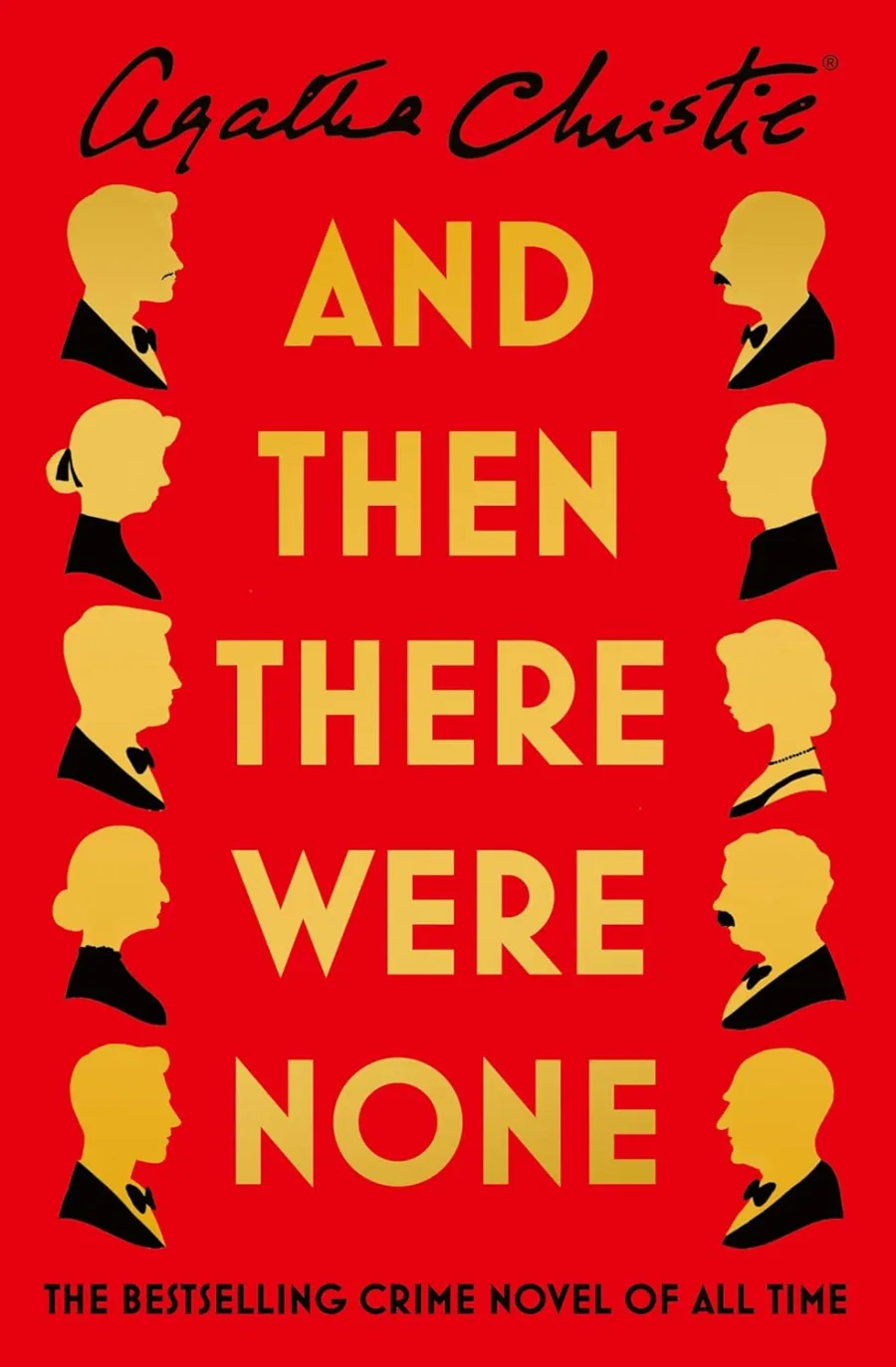
And Then There Were None: The World’s Favourite Agatha Christie Book
Paperback
• 256 Pages
• ₹ 399.00
• English
• 9780008123208
No ratings yet
| Publisher | Harper Collins |
|---|---|
| ISBN13 | 9780008123208 |
| ASIN/SKU | 0008123209 |
| Book Format | Paperback |
| Language | English |
| Pages | 256 |
| List Price | ₹ 399.00 |
| Publishing Date | 05/10/2017 |
| Dimensions | 12.9 x 1.63 x 19.8 cm |
| Weight | 294 g |
| Book Code | BD00055035 |
Buy this Book
Amazon Stores
Ebook Stores
Other Stores
Discover And Then There Were None: The World’s Favourite Agatha Christie Book by Agatha Christie. This book is published by Harper Collins in Paperback format, ISBN 9780008123208, ASIN 0008123209, under Literature and Fiction, Crime Fiction, Mysteries.
Book Description
The book that topped the international online poll held in Agatha Christies 125th birthday year to discover which of her 80 crime books was the worlds favourite.
1939. Europe teeters on the brink of war. Ten strangers are invited to Soldier Island, an isolated rock near the Devon coast. Cut off from the mainland, with their generous hosts Mr and Mrs U.N. Owen mysteriously absent, they are each accused of a terrible crime. When one of the party dies suddenly they realise they may be harbouring a murderer among their number.
The 10 strangers include a reckless playboy, a troubled Harley Street doctor, a formidable judge, an uncouth detective, an unscrupulous mercenary, a God-fearing spinster, two restless servants, a highly decorated general and an anxious secretary. One by one they are picked off. Who will survive? And who is the killer? Copies of an ominous nursery rhyme hang in each room, the murders mimicking the awful fates of its Ten Little Soldier Boys.
The clear winner in an international online poll held to discover the worlds favourite Agatha Christie book, this new paperback also coincides with a new 3-part BBC TV adaptation featuring a stellar ensemble cast: Douglas Booth, Charles Dance, Maeve Dermody, Burn Gorman, Anna Maxwell Martin, Sam Neill, Miranda Richardson, Toby Stephens, Noah Taylor and Aidan Turner.
1939. Europe teeters on the brink of war. Ten strangers are invited to Soldier Island, an isolated rock near the Devon coast. Cut off from the mainland, with their generous hosts Mr and Mrs U.N. Owen mysteriously absent, they are each accused of a terrible crime. When one of the party dies suddenly they realise they may be harbouring a murderer among their number.
The 10 strangers include a reckless playboy, a troubled Harley Street doctor, a formidable judge, an uncouth detective, an unscrupulous mercenary, a God-fearing spinster, two restless servants, a highly decorated general and an anxious secretary. One by one they are picked off. Who will survive? And who is the killer? Copies of an ominous nursery rhyme hang in each room, the murders mimicking the awful fates of its Ten Little Soldier Boys.
The clear winner in an international online poll held to discover the worlds favourite Agatha Christie book, this new paperback also coincides with a new 3-part BBC TV adaptation featuring a stellar ensemble cast: Douglas Booth, Charles Dance, Maeve Dermody, Burn Gorman, Anna Maxwell Martin, Sam Neill, Miranda Richardson, Toby Stephens, Noah Taylor and Aidan Turner.
Author Biography
Agatha Christie was born in Torquay in 1890 and became, quite simply, the bestselling novelist in history. Her first novel, The Mysterious Affair at Styles, written towards the end of the First World War, introduced us to Hercule Poirot, who was to become the most popular detective in crime fiction since Sherlock Holmes. She is known throughout the world as the Queen of Crime. Her books have sold over a billion copies in the English language and another billion in over 100 foreign countries. She is the author of 80 crime novels and short story collections, 19 plays and six novels under the name of Mary Westmacott.
Editorial Reviews
Select Guide Rating
Book Summary
And Then There Were None by Agatha Christie is one of the most famous mystery novels ever written and widely regarded as one of the author's finest works. First published in 1939, the novel combines murder mystery, psychological suspense, isolation, deception, guilt, and survival into a tightly constructed whodunit in which ten strangers are brought together on an isolated island—and one by one, they begin to die.
Unlike a traditional detective story, there is no obvious detective waiting to explain the crime. The suspects themselves must try to understand what is happening while the number of living people around them steadily decreases. The result is an atmosphere of mounting fear and uncertainty that has made the novel a lasting classic of crime fiction.
Agatha Christie described the book as one of the most difficult stories she had ever written, and its ingenious structure helped establish it as one of the best-known mystery novels in the world.
The Mysterious Invitation
The story begins when several seemingly unrelated people receive invitations to Indian Island, a secluded island off the coast of Devon.
Each person has been invited for a different reason.
Some believe they are going to visit an acquaintance.
Others expect employment.
One person has been invited to enjoy a holiday.
Another believes there is a social connection.
What none of them realize is that they have all been brought together for a very different purpose.
When the guests arrive, they discover that their mysterious host, U. N. Owen, is nowhere to be found.
The house is beautifully prepared.
There is food.
There is accommodation.
There are servants.
But something feels wrong.
The guests gradually realize that they have been brought together under circumstances that none of them fully understands.
Ten Strangers
The characters come from different backgrounds and social positions.
Among them are Justice Wargrave, a retired judge; Vera Claythorne, a young woman employed as a secretary; Philip Lombard, a former military officer; Dr. Armstrong, a physician; Emily Brent, a strict and religious woman; General Macarthur, an elderly former military officer; Anthony Marston, a wealthy and reckless young man; William Blore, a former police officer; Thomas Rogers, the butler; and Ethel Rogers, his wife.
At first, they appear to have little in common.
But a strange recording soon changes everything.
A voice accuses each person of having been responsible for the death of another human being.
The guests are stunned.
They insist that they are innocent—or attempt to justify what happened.
But the accusation creates immediate suspicion.
If everyone on the island has a secret, then anyone could potentially be involved in what is about to happen.
The First Death
The tension becomes terrifying when one of the guests suddenly dies.
At first, the death may appear accidental.
But the circumstances suggest otherwise.
The guests begin to realize that the accusations were not simply a bizarre prank.
Someone has deliberately brought them together.
And someone appears to be killing them according to a carefully planned pattern.
The group looks at one another differently.
Trust disappears.
Fear takes its place.
The Nursery Rhyme
One of the novel's most memorable devices is the children's rhyme placed in the rooms of the house.
The rhyme describes ten soldiers who gradually disappear one after another.
As each death occurs, the guests notice a disturbing connection between the victim and the next part of the rhyme.
This creates a countdown.
The characters know what is coming.
The reader knows what is coming.
But neither knows exactly how it will happen or who will be next.
This structure gives the novel an extraordinary sense of inevitability.
Every death moves the story closer to its terrifying conclusion.
The Isolated Island
The island setting is essential to the novel's suspense.
The characters are cut off from the mainland.
There is no easy escape.
The sea surrounds them.
Communication is limited.
The weather and geography make outside assistance difficult.
This isolation transforms the house into a closed environment.
The murderer does not need to worry about strangers arriving and interfering.
The suspects are trapped together.
The island therefore functions almost like a second antagonist.
It prevents escape and forces the characters to remain in the presence of one another.
No Obvious Detective
One of the most unusual aspects of And Then There Were None is the absence of a conventional detective.
There is no Hercule Poirot arriving to inspect the crime scene.
There is no Miss Marple calmly observing the suspects.
Instead, the people trapped on the island have to investigate the murders themselves.
This makes the reader's experience different from a typical Christie mystery.
There is no reliable investigator to guide us toward the truth.
Everyone is a suspect.
Everyone is afraid.
Everyone has something to hide.
And even the person who appears most trustworthy may have a reason to lie.
Suspicion and Paranoia
As the deaths continue, suspicion spreads.
The characters begin examining one another's behavior.
A strange movement becomes suspicious.
A missing object becomes evidence.
A contradiction in someone's story becomes potentially significant.
Even innocent behavior can appear threatening.
This is where Christie demonstrates her skill at psychological suspense.
The mystery is not simply about identifying the killer.
It is also about watching fear change the behavior of the people who are trapped together.
The more frightened they become, the more difficult it is to think rationally.
The Question of Guilt
The accusations at the beginning of the story introduce an important moral dimension.
The ten people have been accused of causing the deaths of others.
Their actions may not all have been legally defined as murder.
Some may have involved negligence.
Some may have involved choices that indirectly led to death.
Some characters believe they did nothing wrong.
Others are forced to confront uncomfortable memories.
This creates a central question:
Can someone be morally guilty even when they have escaped legal punishment?
The novel does not offer an easy answer.
Instead, it places characters with different attitudes toward guilt and responsibility in the same isolated environment.
Justice and Revenge
The murders also raise questions about the difference between justice and revenge.
If someone believes that ten people have escaped punishment for causing deaths, is it justice to punish them?
Or is such punishment simply revenge?
Who has the authority to decide?
Can one individual appoint themselves judge, jury, and executioner?
These questions give the mystery a deeper philosophical dimension.
The novel is entertaining as a whodunit, but it is also interested in the darker psychology of punishment.
Fear Changes Everything
At the beginning, the guests behave according to familiar social rules.
They introduce themselves.
They eat together.
They have conversations.
They maintain polite appearances.
As the deaths continue, that social structure begins to collapse.
Fear changes their behavior.
People become defensive.
They begin watching one another.
They question motives.
They become desperate.
The transformation demonstrates how quickly social order can weaken when people believe they are in danger.
The Importance of the Setting
The house itself contributes to the atmosphere.
It is elegant but isolated.
It should be a place of comfort.
Instead, it becomes a place of fear.
Every room can become a potential crime scene.
Every object can become significant.
Every unexplained sound can cause alarm.
This transformation of a comfortable home into a threatening environment is one of Christie's most effective techniques.
The Mystery Structure
And Then There Were None is particularly impressive from a structural perspective.
Christie has to manage a large cast of characters while ensuring that the mystery remains coherent.
Each person needs a motive.
Each person needs secrets.
Each person needs to appear potentially guilty.
At the same time, the reader needs enough information to remain engaged without being given an easy answer.
The result is a tightly controlled mystery in which the possibilities constantly shift.
Red Herrings and Misleading Clues
Christie is famous for her use of red herrings, and this novel provides many opportunities for readers to draw the wrong conclusions.
A character may behave suspiciously for completely different reasons.
An apparently innocent detail may turn out to be important.
A seemingly obvious theory may collapse after another death.
This constant uncertainty keeps the reader actively involved.
You are not simply waiting for the solution.
You are trying to construct one yourself.
The Psychology of the Suspects
Each character responds differently to the crisis.
Some attempt to remain rational.
Some become frightened.
Some become aggressive.
Some attempt to take control.
Others retreat into themselves.
These reactions reveal their personalities more clearly than their initial introductions.
The island strips away social appearances.
As the situation becomes more dangerous, the characters reveal what they are really like.
This psychological element makes the book more than a mechanical puzzle.
Vera Claythorne
Vera Claythorne becomes one of the most important characters as the story develops.
She is intelligent, observant, and increasingly frightened by the events around her.
Her psychological state becomes particularly important as the murders continue.
Vera's memories and emotional reactions add another layer to the mystery.
She is not simply trying to survive physically.
She is also forced to confront her own past.
Justice Wargrave
Justice Wargrave is another fascinating figure.
As a retired judge, he represents law, judgment, and authority.
His professional background makes him particularly interesting in a story centered on guilt and punishment.
He is observant and analytical.
His presence naturally influences the other characters because they associate him with the legal system.
But in a mystery filled with deception, appearances cannot automatically be trusted.
The Island as a Closed-Box Mystery
The novel is a classic example of a closed-circle mystery.
A limited number of people are trapped in one location.
The murderer must be one of them.
Because no outsiders can easily enter or leave, the possibilities are restricted.
This makes every character important.
The reader can examine the entire group and attempt to determine which person is responsible.
The closed-circle structure is one of the reasons the novel remains so satisfying to mystery enthusiasts.
The Meaning of the Title
The title “And Then There Were None” captures the central structure of the story.
The number of living people continues to decrease.
Ten becomes nine.
Nine becomes eight.
And so on.
The title therefore creates an immediate sense of inevitability.
The reader knows the destination.
The suspense comes from discovering how the story will get there.
That is a difficult trick for a mystery writer to accomplish.
Christie manages to create tension even though the basic trajectory is known.
Why the Novel Remains So Popular
The enduring popularity of And Then There Were None comes from several factors.
It has a memorable setting.
It has a large cast of suspects.
It has a clever structural device.
It combines mystery with psychological tension.
It raises questions about guilt and justice.
And most importantly, it makes the reader participate.
You are constantly encouraged to ask:
Who is doing this?
Why were these people chosen?
Can anyone be trusted?
Who will die next?
Is the obvious suspect really guilty?
The novel's structure makes those questions almost impossible to ignore.
A Classic of Mystery Fiction
The novel is often regarded as one of Christie's most important works and one of the most famous mystery novels ever published.
Its influence can be seen in countless later stories involving isolated groups, hidden killers, escalating deaths, and closed-circle investigations.
The premise has also inspired numerous adaptations for stage, television, and film.
The story's basic structure is so powerful that it continues to work even when the setting and medium change.
Who Should Read And Then There Were None?
The novel is especially suitable for readers who enjoy:
Classic mystery fiction
Murder mysteries
Psychological suspense
Whodunit novels
Closed-circle mysteries
Crime fiction
Detective literature
Suspenseful classics
Stories about hidden identities
Psychological thrillers
Books about guilt and justice
Agatha Christie novels
Twist-filled mysteries
Isolated-setting thrillers
It is particularly rewarding for readers who enjoy trying to solve the mystery before reaching the final explanation.
Final Thoughts
And Then There Were None by Agatha Christie is an extraordinary example of how a simple premise can become an unforgettable mystery.
Ten strangers arrive on an isolated island.
They discover that they have been accused of causing deaths in their past.
Then one of them dies.
Then another.
As the number of survivors decreases, suspicion and fear increase.
There is no obvious detective.
There is no easy escape.
And there is no guarantee that the person standing beside you is innocent.
The novel's brilliance lies in its combination of plot structure, psychological tension, atmosphere, deception, and moral ambiguity.
It is not simply a question of finding the murderer.
The characters must also confront their own histories.
The reader must constantly reconsider assumptions.
And the isolated setting creates the terrifying possibility that the murderer is already inside the house.
For readers searching for And Then There Were None by Agatha Christie, And Then There Were None summary, And Then There Were None review, Agatha Christie books, best Agatha Christie mysteries, classic murder mysteries, psychological suspense novels, closed-circle mysteries, whodunit books, mystery novels with twists, books about guilt and justice, isolated-setting mystery novels, detective fiction classics, or famous mystery books, this novel remains an essential choice.
Ultimately, And Then There Were None succeeds because it turns uncertainty itself into the source of terror.
Every character could be guilty.
Every clue could mislead.
Every moment could be the beginning of another murder.
And as the number of survivors approaches zero, the reader is left with the most important question of all:
Who will be left when there is no one left to trust?
Unlike a traditional detective story, there is no obvious detective waiting to explain the crime. The suspects themselves must try to understand what is happening while the number of living people around them steadily decreases. The result is an atmosphere of mounting fear and uncertainty that has made the novel a lasting classic of crime fiction.
Agatha Christie described the book as one of the most difficult stories she had ever written, and its ingenious structure helped establish it as one of the best-known mystery novels in the world.
The Mysterious Invitation
The story begins when several seemingly unrelated people receive invitations to Indian Island, a secluded island off the coast of Devon.
Each person has been invited for a different reason.
Some believe they are going to visit an acquaintance.
Others expect employment.
One person has been invited to enjoy a holiday.
Another believes there is a social connection.
What none of them realize is that they have all been brought together for a very different purpose.
When the guests arrive, they discover that their mysterious host, U. N. Owen, is nowhere to be found.
The house is beautifully prepared.
There is food.
There is accommodation.
There are servants.
But something feels wrong.
The guests gradually realize that they have been brought together under circumstances that none of them fully understands.
Ten Strangers
The characters come from different backgrounds and social positions.
Among them are Justice Wargrave, a retired judge; Vera Claythorne, a young woman employed as a secretary; Philip Lombard, a former military officer; Dr. Armstrong, a physician; Emily Brent, a strict and religious woman; General Macarthur, an elderly former military officer; Anthony Marston, a wealthy and reckless young man; William Blore, a former police officer; Thomas Rogers, the butler; and Ethel Rogers, his wife.
At first, they appear to have little in common.
But a strange recording soon changes everything.
A voice accuses each person of having been responsible for the death of another human being.
The guests are stunned.
They insist that they are innocent—or attempt to justify what happened.
But the accusation creates immediate suspicion.
If everyone on the island has a secret, then anyone could potentially be involved in what is about to happen.
The First Death
The tension becomes terrifying when one of the guests suddenly dies.
At first, the death may appear accidental.
But the circumstances suggest otherwise.
The guests begin to realize that the accusations were not simply a bizarre prank.
Someone has deliberately brought them together.
And someone appears to be killing them according to a carefully planned pattern.
The group looks at one another differently.
Trust disappears.
Fear takes its place.
The Nursery Rhyme
One of the novel's most memorable devices is the children's rhyme placed in the rooms of the house.
The rhyme describes ten soldiers who gradually disappear one after another.
As each death occurs, the guests notice a disturbing connection between the victim and the next part of the rhyme.
This creates a countdown.
The characters know what is coming.
The reader knows what is coming.
But neither knows exactly how it will happen or who will be next.
This structure gives the novel an extraordinary sense of inevitability.
Every death moves the story closer to its terrifying conclusion.
The Isolated Island
The island setting is essential to the novel's suspense.
The characters are cut off from the mainland.
There is no easy escape.
The sea surrounds them.
Communication is limited.
The weather and geography make outside assistance difficult.
This isolation transforms the house into a closed environment.
The murderer does not need to worry about strangers arriving and interfering.
The suspects are trapped together.
The island therefore functions almost like a second antagonist.
It prevents escape and forces the characters to remain in the presence of one another.
No Obvious Detective
One of the most unusual aspects of And Then There Were None is the absence of a conventional detective.
There is no Hercule Poirot arriving to inspect the crime scene.
There is no Miss Marple calmly observing the suspects.
Instead, the people trapped on the island have to investigate the murders themselves.
This makes the reader's experience different from a typical Christie mystery.
There is no reliable investigator to guide us toward the truth.
Everyone is a suspect.
Everyone is afraid.
Everyone has something to hide.
And even the person who appears most trustworthy may have a reason to lie.
Suspicion and Paranoia
As the deaths continue, suspicion spreads.
The characters begin examining one another's behavior.
A strange movement becomes suspicious.
A missing object becomes evidence.
A contradiction in someone's story becomes potentially significant.
Even innocent behavior can appear threatening.
This is where Christie demonstrates her skill at psychological suspense.
The mystery is not simply about identifying the killer.
It is also about watching fear change the behavior of the people who are trapped together.
The more frightened they become, the more difficult it is to think rationally.
The Question of Guilt
The accusations at the beginning of the story introduce an important moral dimension.
The ten people have been accused of causing the deaths of others.
Their actions may not all have been legally defined as murder.
Some may have involved negligence.
Some may have involved choices that indirectly led to death.
Some characters believe they did nothing wrong.
Others are forced to confront uncomfortable memories.
This creates a central question:
Can someone be morally guilty even when they have escaped legal punishment?
The novel does not offer an easy answer.
Instead, it places characters with different attitudes toward guilt and responsibility in the same isolated environment.
Justice and Revenge
The murders also raise questions about the difference between justice and revenge.
If someone believes that ten people have escaped punishment for causing deaths, is it justice to punish them?
Or is such punishment simply revenge?
Who has the authority to decide?
Can one individual appoint themselves judge, jury, and executioner?
These questions give the mystery a deeper philosophical dimension.
The novel is entertaining as a whodunit, but it is also interested in the darker psychology of punishment.
Fear Changes Everything
At the beginning, the guests behave according to familiar social rules.
They introduce themselves.
They eat together.
They have conversations.
They maintain polite appearances.
As the deaths continue, that social structure begins to collapse.
Fear changes their behavior.
People become defensive.
They begin watching one another.
They question motives.
They become desperate.
The transformation demonstrates how quickly social order can weaken when people believe they are in danger.
The Importance of the Setting
The house itself contributes to the atmosphere.
It is elegant but isolated.
It should be a place of comfort.
Instead, it becomes a place of fear.
Every room can become a potential crime scene.
Every object can become significant.
Every unexplained sound can cause alarm.
This transformation of a comfortable home into a threatening environment is one of Christie's most effective techniques.
The Mystery Structure
And Then There Were None is particularly impressive from a structural perspective.
Christie has to manage a large cast of characters while ensuring that the mystery remains coherent.
Each person needs a motive.
Each person needs secrets.
Each person needs to appear potentially guilty.
At the same time, the reader needs enough information to remain engaged without being given an easy answer.
The result is a tightly controlled mystery in which the possibilities constantly shift.
Red Herrings and Misleading Clues
Christie is famous for her use of red herrings, and this novel provides many opportunities for readers to draw the wrong conclusions.
A character may behave suspiciously for completely different reasons.
An apparently innocent detail may turn out to be important.
A seemingly obvious theory may collapse after another death.
This constant uncertainty keeps the reader actively involved.
You are not simply waiting for the solution.
You are trying to construct one yourself.
The Psychology of the Suspects
Each character responds differently to the crisis.
Some attempt to remain rational.
Some become frightened.
Some become aggressive.
Some attempt to take control.
Others retreat into themselves.
These reactions reveal their personalities more clearly than their initial introductions.
The island strips away social appearances.
As the situation becomes more dangerous, the characters reveal what they are really like.
This psychological element makes the book more than a mechanical puzzle.
Vera Claythorne
Vera Claythorne becomes one of the most important characters as the story develops.
She is intelligent, observant, and increasingly frightened by the events around her.
Her psychological state becomes particularly important as the murders continue.
Vera's memories and emotional reactions add another layer to the mystery.
She is not simply trying to survive physically.
She is also forced to confront her own past.
Justice Wargrave
Justice Wargrave is another fascinating figure.
As a retired judge, he represents law, judgment, and authority.
His professional background makes him particularly interesting in a story centered on guilt and punishment.
He is observant and analytical.
His presence naturally influences the other characters because they associate him with the legal system.
But in a mystery filled with deception, appearances cannot automatically be trusted.
The Island as a Closed-Box Mystery
The novel is a classic example of a closed-circle mystery.
A limited number of people are trapped in one location.
The murderer must be one of them.
Because no outsiders can easily enter or leave, the possibilities are restricted.
This makes every character important.
The reader can examine the entire group and attempt to determine which person is responsible.
The closed-circle structure is one of the reasons the novel remains so satisfying to mystery enthusiasts.
The Meaning of the Title
The title “And Then There Were None” captures the central structure of the story.
The number of living people continues to decrease.
Ten becomes nine.
Nine becomes eight.
And so on.
The title therefore creates an immediate sense of inevitability.
The reader knows the destination.
The suspense comes from discovering how the story will get there.
That is a difficult trick for a mystery writer to accomplish.
Christie manages to create tension even though the basic trajectory is known.
Why the Novel Remains So Popular
The enduring popularity of And Then There Were None comes from several factors.
It has a memorable setting.
It has a large cast of suspects.
It has a clever structural device.
It combines mystery with psychological tension.
It raises questions about guilt and justice.
And most importantly, it makes the reader participate.
You are constantly encouraged to ask:
Who is doing this?
Why were these people chosen?
Can anyone be trusted?
Who will die next?
Is the obvious suspect really guilty?
The novel's structure makes those questions almost impossible to ignore.
A Classic of Mystery Fiction
The novel is often regarded as one of Christie's most important works and one of the most famous mystery novels ever published.
Its influence can be seen in countless later stories involving isolated groups, hidden killers, escalating deaths, and closed-circle investigations.
The premise has also inspired numerous adaptations for stage, television, and film.
The story's basic structure is so powerful that it continues to work even when the setting and medium change.
Who Should Read And Then There Were None?
The novel is especially suitable for readers who enjoy:
Classic mystery fiction
Murder mysteries
Psychological suspense
Whodunit novels
Closed-circle mysteries
Crime fiction
Detective literature
Suspenseful classics
Stories about hidden identities
Psychological thrillers
Books about guilt and justice
Agatha Christie novels
Twist-filled mysteries
Isolated-setting thrillers
It is particularly rewarding for readers who enjoy trying to solve the mystery before reaching the final explanation.
Final Thoughts
And Then There Were None by Agatha Christie is an extraordinary example of how a simple premise can become an unforgettable mystery.
Ten strangers arrive on an isolated island.
They discover that they have been accused of causing deaths in their past.
Then one of them dies.
Then another.
As the number of survivors decreases, suspicion and fear increase.
There is no obvious detective.
There is no easy escape.
And there is no guarantee that the person standing beside you is innocent.
The novel's brilliance lies in its combination of plot structure, psychological tension, atmosphere, deception, and moral ambiguity.
It is not simply a question of finding the murderer.
The characters must also confront their own histories.
The reader must constantly reconsider assumptions.
And the isolated setting creates the terrifying possibility that the murderer is already inside the house.
For readers searching for And Then There Were None by Agatha Christie, And Then There Were None summary, And Then There Were None review, Agatha Christie books, best Agatha Christie mysteries, classic murder mysteries, psychological suspense novels, closed-circle mysteries, whodunit books, mystery novels with twists, books about guilt and justice, isolated-setting mystery novels, detective fiction classics, or famous mystery books, this novel remains an essential choice.
Ultimately, And Then There Were None succeeds because it turns uncertainty itself into the source of terror.
Every character could be guilty.
Every clue could mislead.
Every moment could be the beginning of another murder.
And as the number of survivors approaches zero, the reader is left with the most important question of all:
Who will be left when there is no one left to trust?
Sample Chapters
Sample Chapters will be added soon…
Reader Reviews
No reviews yet.
And Then There Were None: The World’s Favourite Agatha Christie Book
Download Cover Image
Do you want to download the full cover image for And Then There Were None: The World’s Favourite Agatha Christie Book?