
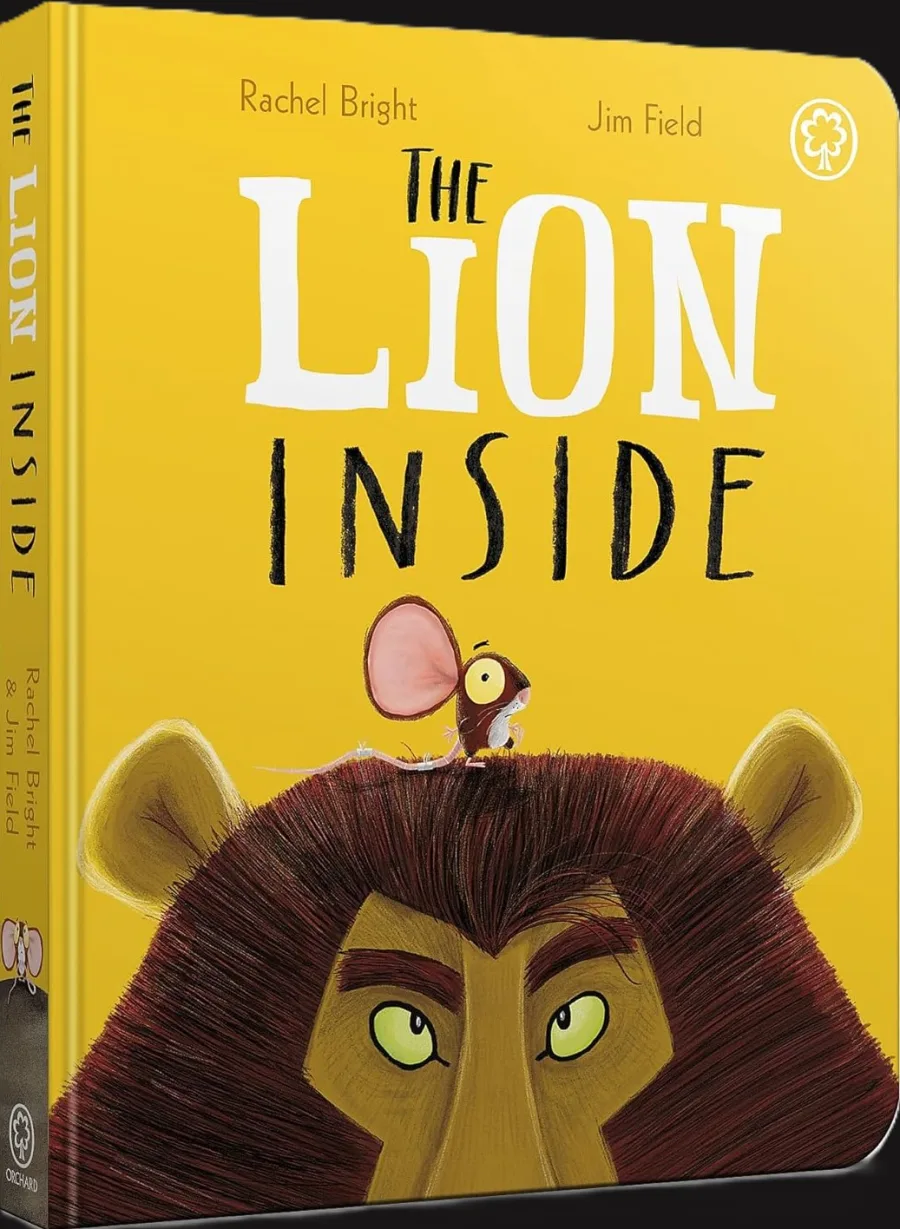
The Lion Inside
Board Book
• 30 Pages
• ₹ 399.00
• English
• 9781408349045
No ratings yet
| Publisher | Orchard Books |
|---|---|
| ISBN13 | 9781408349045 |
| ASIN/SKU | 1408349043 |
| Book Format | Board Book |
| Language | English |
| Pages | 30 |
| List Price | ₹ 399.00 |
| Publishing Date | 09/02/2017 |
| Dimensions | 15 x 2 x 18.2 cm |
| Weight | 500 g |
| Book Code | BD00055034 |
Buy this Book
Amazon Stores
Ebook Stores
Other Stores
Discover The Lion Inside by Rachel Bright. This book is published by Orchard Books in Board Book format, ISBN 9781408349045, ASIN 1408349043, under Children's Books on Self-Esteem and Self-Respect, Stories in Verse for Children.
Book Description
Board book edition of this bestselling story about confidence, self-esteem, and a shy little mouse who sets out on a journey to find his roar.In a dry dusty place where the sand sparkled gold, stood a mighty flat rock, all craggy and old. And under that rock in a tinyful house, lived the littlest, quietest, meekest brown mouse.Fed up of being ignored by the other animals, Mouse wishes he could roar like Lion. But, as he discovers, even the biggest, bossiest people are scared sometimes ... and even the smallest creatures can have the heart of a lion! A modern classic, The Lion Inside has sold over 200,000 copies in the UK alone and been translated into over 30 languages worldwide."A heartfelt message, delightfully conveyed." Parents in Touch"Captivating." Books for Keeps"A delight to read over and over again." WRD
Author Biography
Rachel Bright is a wordsmith, illustrator and professional thinker of happy thoughts. She has written several books for children, including Love Monster, The Lion Inside and The Koala Who Could - winner of the Evening Standard Oscar's Book Prize and the Sainsbury's Book Award. Her books have been translated into 40 languages and have sold over 2 million copies worldwide. She is also the creator of award-winning stationery and homewares range, The Brightside. Rachel lives on a farm near the seaside, with her partner and their two young daughters.
Editorial Reviews
A heartfelt message, delightfully conveyed ― Parents in Touch
A delight to read over and over again ― WRD
Charming... Older children will appreciate the moral of the story....Meanwhile, younger children will love looking at the fun, vibrant illustrations of all the animals ― Mumfidential
[This] adorable, big-eared mouse will easily win over readers. ― The Book List
Rachel Bright's rhyming story reads aloud well, and Jim Field's illustrations are a delight ... A book to treasure that has already been shared many times with grandchildren ― School Librarian
Book Description
Board book edition of this bestselling story about confidence, self-esteem, and a shy little mouse who sets out on a journey to find his roar.
A delight to read over and over again ― WRD
Charming... Older children will appreciate the moral of the story....Meanwhile, younger children will love looking at the fun, vibrant illustrations of all the animals ― Mumfidential
[This] adorable, big-eared mouse will easily win over readers. ― The Book List
Rachel Bright's rhyming story reads aloud well, and Jim Field's illustrations are a delight ... A book to treasure that has already been shared many times with grandchildren ― School Librarian
Book Description
Board book edition of this bestselling story about confidence, self-esteem, and a shy little mouse who sets out on a journey to find his roar.
Book Summary
The Lion Inside by Rachel Bright, illustrated by Jim Field, is a warm, funny, and uplifting children's picture book about confidence, self-esteem, courage, friendship, and discovering your own inner strength. At the heart of the story is a tiny, shy mouse who feels unnoticed and insignificant. He believes that if only he could become more like the confident lion around him, he would finally be heard and respected.
But his journey teaches him—and the lion—a much more meaningful lesson: you do not have to be big, loud, or powerful to be brave, important, or capable.
The book combines Rachel Bright's lively rhyming storytelling with Jim Field's expressive illustrations, creating a story that is entertaining for young children while also carrying a valuable message about believing in yourself. The publishers describe it as a bestselling story about confidence and self-esteem, and it has been translated into numerous languages and sold widely around the world.
A Little Mouse With a Big Problem
The story begins in a dry, dusty landscape where a tiny brown mouse lives beneath a large rock.
The mouse is described as the smallest, quietest, and meekest creature around. His life is difficult because other animals often overlook him. He feels invisible.
He watches the lion who lives above him and sees exactly the qualities he wishes he possessed.
The lion is big.
The lion is loud.
The lion is confident.
Most importantly, the lion can roar.
The mouse believes that the lion's roar is the secret to being noticed. If he could roar just as loudly, perhaps the other animals would listen to him, respect him, and include him.
This simple desire becomes the starting point for the mouse's journey.
The Mouse Wants to Find His Roar
The mouse decides that he needs to learn how to roar.
But there is an obvious problem: the only creature who can teach him is the lion.
Approaching a lion is frightening enough for any small mouse, especially one who believes he might become the lion's dinner.
Nevertheless, the mouse realizes that if he wants his life to change, he must take a risk.
This is an important lesson in the story.
Confidence does not necessarily arrive before action.
Sometimes we become more confident by doing something that scares us.
The mouse is frightened, but he does not allow his fear to stop him completely. He takes the first step toward the lion.
That step becomes the beginning of his transformation.
The Lion Is Not as Fearless as He Looks
One of the story's most delightful surprises is that the lion, despite his enormous size and powerful roar, is not completely fearless.
The mouse discovers that the lion is actually afraid of mice.
This creates a humorous reversal.
The tiny creature who believes the lion has everything he lacks discovers that the lion has insecurities of his own.
The lion may look powerful from the outside, but inside he has fears just like the mouse.
The story therefore challenges the assumption that outward confidence means someone has no worries or weaknesses.
Even the biggest and most impressive person can feel vulnerable.
A Friendship Is Born
The relationship between the mouse and the lion changes once they discover each other's fears.
Instead of remaining enemies, they become friends.
The mouse realizes that the lion is not simply a powerful creature to imitate.
The lion realizes that the mouse is not simply a tiny and insignificant animal.
They begin to understand one another.
This is one of the book's most important emotional lessons: everyone has strengths and weaknesses.
A person who appears confident may secretly be frightened.
Someone who seems quiet may possess tremendous courage.
Someone who looks small may have a very big heart.
The friendship between Mouse and Lion allows both characters to see themselves differently.
The Lion Inside Us
The central metaphor of the book is contained in its title.
The Lion Inside suggests that courage and confidence do not have to come from physical strength or outward appearance.
A person can be small and still be brave.
A person can be quiet and still have a strong voice.
A person can be nervous and still do something courageous.
The story teaches children that they already possess qualities they may not recognize in themselves.
The “lion” is therefore a symbol of inner confidence, courage, determination, and self-belief.
At the same time, the story suggests that everyone also has a “mouse” inside—a part that can feel uncertain, nervous, shy, or vulnerable. The publisher's description captures this idea by emphasizing that, regardless of size, everyone contains both a mouse and a lion within.
Confidence Is Not About Being the Loudest
One of the most valuable lessons in The Lion Inside is that confidence does not mean being the loudest person in the room.
Children can easily believe that confident people are always outgoing, outspoken, fearless, or dominant.
The story offers a gentler definition.
Confidence can mean trying something new.
It can mean speaking when you are usually quiet.
It can mean asking for help.
It can mean facing something frightening.
It can mean accepting that you are different from someone else.
The mouse does not need to become physically larger or turn into a lion.
He simply needs to recognize that he already possesses courage.
Overcoming Fear
Fear is an important part of the mouse's journey.
He is afraid of approaching the lion, and that fear is understandable.
But instead of waiting until he feels completely fearless, he decides to act despite being scared.
This makes the story particularly useful for conversations with children about difficult experiences.
A child might be nervous about starting school, meeting new people, speaking in front of others, making friends, trying something unfamiliar, or standing up for themselves.
The book offers a reassuring message: being afraid does not mean you are weak.
Courage can exist alongside fear.
Self-Esteem and Self-Belief
At the beginning of the story, the mouse's biggest problem is not actually his size.
It is the way he sees himself.
He believes that being small makes him less important.
He compares himself with the lion and concludes that he lacks the qualities necessary to be noticed.
This is a familiar experience for many children.
They may compare themselves with classmates, siblings, friends, or other children and decide that they are not clever enough, athletic enough, outgoing enough, or talented enough.
The Lion Inside gently challenges this kind of comparison.
The mouse does not become valuable because he becomes more like the lion.
He discovers value in himself.
The Importance of Being Yourself
The story does not ultimately tell the mouse to become louder, bigger, or more aggressive.
Instead, it helps him understand that he does not need to become somebody else.
This is an important distinction.
Self-confidence is not the same as changing your personality to impress others.
A naturally quiet child does not have to become loud.
A shy child does not have to become extremely outgoing.
A gentle child does not have to become aggressive.
The important thing is to develop enough confidence to participate in the world while remaining true to who you are.
The Lion's Lesson Too
The story's message applies to the lion as much as it applies to the mouse.
The lion initially appears to have everything.
He has strength.
He has size.
He has a powerful voice.
He receives attention.
But his fear of mice reveals that external power does not eliminate vulnerability.
This makes the story more balanced than a simple “small mouse becomes brave” narrative.
Both characters learn something.
The mouse learns that he has courage.
The lion learns that he has fears.
Together, they discover that neither size nor appearance tells the whole story about a person.
Friendship and Empathy
The friendship between the two characters also introduces children to the idea of empathy.
Once the mouse realizes that the lion is afraid, he does not laugh at him or use the fear against him.
Instead, he comforts him.
This is a beautiful reversal of their original relationship.
The mouse had approached the lion because he wanted something from him. Eventually, their interaction becomes a genuine friendship based on understanding.
Children can therefore learn that recognizing another person's fear can create connection rather than distance.
Sometimes the person who seems strongest may need kindness too.
Rachel Bright's Rhyming Style
Rachel Bright tells the story in lively rhyming verse.
The rhythm makes the book particularly suitable for reading aloud. Children can listen to the sounds and patterns of the language while following the story through the illustrations.
The publisher specifically highlights the book's rhyming quality, and reviews have praised its rhythm and read-aloud appeal.
The rhyme also helps make the story memorable.
Children can anticipate sounds, repeat phrases, and become involved in the storytelling.
For parents and teachers, this makes The Lion Inside a useful choice for shared reading.
Jim Field's Illustrations
Jim Field's illustrations play an important role in bringing the story to life.
The mouse and lion have distinct visual personalities.
The mouse appears small and vulnerable, while the lion is presented as large, expressive, and imposing.
The contrast helps children immediately understand the central relationship.
The illustrations also add humor and emotional detail to the story. Reviews have particularly praised Field's lively and imaginative visual storytelling.
The visual difference between Mouse and Lion reinforces the book's message while making the pages engaging for young readers.
A Story About Dreams and Possibilities
The book also encourages children to believe in their own possibilities.
The mouse initially thinks his small size prevents him from doing certain things.
But his journey shows that limitations are not always as fixed as they seem.
Sometimes the biggest barrier is the belief that we cannot succeed.
The story encourages young readers to take small steps toward their goals rather than allowing fear or self-doubt to make decisions for them.
This makes The Lion Inside a useful book for conversations about aspiration, perseverance, confidence, and personal growth. Educational resources around the book similarly identify dreams, aspiration, and believing in oneself as important themes.
A Gentle Lesson About Differences
Another important message is that differences do not have to separate people.
Mouse and Lion are almost complete opposites.
One is tiny.
The other is enormous.
One is quiet.
The other is loud.
One is nervous.
The other appears confident.
Yet these differences eventually become part of their friendship.
The story therefore encourages children to appreciate differences rather than automatically viewing them as weaknesses.
Being different from someone else does not mean being less valuable.
Why Children Enjoy The Lion Inside
The book works particularly well because its lessons are presented through humor and character rather than through a heavy moral lecture.
Children can enjoy the funny situation of a mouse trying to learn how to roar.
They can laugh when the powerful lion turns out to be afraid of mice.
They can enjoy the expressive illustrations.
At the same time, they absorb a deeper message about courage and self-confidence.
This balance between entertainment and emotional learning is one of the book's greatest strengths.
Who Should Read The Lion Inside?
The Lion Inside is particularly suitable for:
Young children and preschool readers
Children beginning school
Parents looking for confidence-building stories
Teachers and early-years educators
Children who are shy or hesitant
Children dealing with self-esteem issues
Bedtime story sessions
Read-aloud activities
Stories about friendship
Books about courage and overcoming fear
Picture books about emotions
Stories that encourage children to believe in themselves
The book is generally aimed at young children, with publisher listings placing it around the early-years age range and recommending it from approximately age three.
Why Parents and Teachers May Find It Valuable
The story creates many opportunities for discussion.
Parents can ask children:
What makes the mouse feel small?
Why does he want to be like the lion?
Was the mouse brave even though he was scared?
Why was the lion afraid?
What does it mean to have a lion inside you?
These questions can help children connect the story with their own experiences.
Teachers can also use the book to introduce lessons about emotions, confidence, friendship, self-esteem, and overcoming fear.
Because the message is simple but flexible, different children can take different lessons from it.
A Modern Classic for Young Readers
Since its publication, The Lion Inside has become one of Rachel Bright's best-known children's stories. Hachette India describes it as a bestselling story that has sold more than five million copies worldwide and been translated into 42 languages in connection with its tenth-anniversary edition.
Its continued popularity comes from the timeless nature of its central message.
Children may grow up in different countries and cultures, but the feeling of being small, overlooked, nervous, or uncertain is universal.
So is the desire to be heard.
And so is the discovery that courage can come from within.
Final Thoughts
The Lion Inside by Rachel Bright is a charming picture book about a tiny mouse who believes he needs to become bigger and louder before he can be confident.
His journey to find his roar teaches him something far more important.
He does not need to become a lion.
He needs to discover the courage that already exists inside him.
The story also teaches the lion that appearing strong does not mean being free from fear. Both characters have vulnerabilities, and both discover something valuable about themselves through their unexpected friendship.
At its heart, The Lion Inside is a celebration of self-confidence, courage, empathy, friendship, individuality, and believing in your own abilities.
For parents and educators searching for The Lion Inside by Rachel Bright, The Lion Inside story, The Lion Inside summary, Rachel Bright children's books, books about confidence for kids, children's books about self-esteem, books about courage for children, shy child confidence books, picture books about friendship, books about overcoming fear, preschool storybooks, rhyming children's books, books about believing in yourself, or bedtime stories for young children, this book offers an engaging and reassuring reading experience.
Its central message is simple enough for a young child to understand but meaningful enough to stay with them as they grow:
You do not have to be the biggest, loudest, or strongest person to have courage.
Sometimes the bravest thing you can do is simply believe that there is a little lion inside you too.
But his journey teaches him—and the lion—a much more meaningful lesson: you do not have to be big, loud, or powerful to be brave, important, or capable.
The book combines Rachel Bright's lively rhyming storytelling with Jim Field's expressive illustrations, creating a story that is entertaining for young children while also carrying a valuable message about believing in yourself. The publishers describe it as a bestselling story about confidence and self-esteem, and it has been translated into numerous languages and sold widely around the world.
A Little Mouse With a Big Problem
The story begins in a dry, dusty landscape where a tiny brown mouse lives beneath a large rock.
The mouse is described as the smallest, quietest, and meekest creature around. His life is difficult because other animals often overlook him. He feels invisible.
He watches the lion who lives above him and sees exactly the qualities he wishes he possessed.
The lion is big.
The lion is loud.
The lion is confident.
Most importantly, the lion can roar.
The mouse believes that the lion's roar is the secret to being noticed. If he could roar just as loudly, perhaps the other animals would listen to him, respect him, and include him.
This simple desire becomes the starting point for the mouse's journey.
The Mouse Wants to Find His Roar
The mouse decides that he needs to learn how to roar.
But there is an obvious problem: the only creature who can teach him is the lion.
Approaching a lion is frightening enough for any small mouse, especially one who believes he might become the lion's dinner.
Nevertheless, the mouse realizes that if he wants his life to change, he must take a risk.
This is an important lesson in the story.
Confidence does not necessarily arrive before action.
Sometimes we become more confident by doing something that scares us.
The mouse is frightened, but he does not allow his fear to stop him completely. He takes the first step toward the lion.
That step becomes the beginning of his transformation.
The Lion Is Not as Fearless as He Looks
One of the story's most delightful surprises is that the lion, despite his enormous size and powerful roar, is not completely fearless.
The mouse discovers that the lion is actually afraid of mice.
This creates a humorous reversal.
The tiny creature who believes the lion has everything he lacks discovers that the lion has insecurities of his own.
The lion may look powerful from the outside, but inside he has fears just like the mouse.
The story therefore challenges the assumption that outward confidence means someone has no worries or weaknesses.
Even the biggest and most impressive person can feel vulnerable.
A Friendship Is Born
The relationship between the mouse and the lion changes once they discover each other's fears.
Instead of remaining enemies, they become friends.
The mouse realizes that the lion is not simply a powerful creature to imitate.
The lion realizes that the mouse is not simply a tiny and insignificant animal.
They begin to understand one another.
This is one of the book's most important emotional lessons: everyone has strengths and weaknesses.
A person who appears confident may secretly be frightened.
Someone who seems quiet may possess tremendous courage.
Someone who looks small may have a very big heart.
The friendship between Mouse and Lion allows both characters to see themselves differently.
The Lion Inside Us
The central metaphor of the book is contained in its title.
The Lion Inside suggests that courage and confidence do not have to come from physical strength or outward appearance.
A person can be small and still be brave.
A person can be quiet and still have a strong voice.
A person can be nervous and still do something courageous.
The story teaches children that they already possess qualities they may not recognize in themselves.
The “lion” is therefore a symbol of inner confidence, courage, determination, and self-belief.
At the same time, the story suggests that everyone also has a “mouse” inside—a part that can feel uncertain, nervous, shy, or vulnerable. The publisher's description captures this idea by emphasizing that, regardless of size, everyone contains both a mouse and a lion within.
Confidence Is Not About Being the Loudest
One of the most valuable lessons in The Lion Inside is that confidence does not mean being the loudest person in the room.
Children can easily believe that confident people are always outgoing, outspoken, fearless, or dominant.
The story offers a gentler definition.
Confidence can mean trying something new.
It can mean speaking when you are usually quiet.
It can mean asking for help.
It can mean facing something frightening.
It can mean accepting that you are different from someone else.
The mouse does not need to become physically larger or turn into a lion.
He simply needs to recognize that he already possesses courage.
Overcoming Fear
Fear is an important part of the mouse's journey.
He is afraid of approaching the lion, and that fear is understandable.
But instead of waiting until he feels completely fearless, he decides to act despite being scared.
This makes the story particularly useful for conversations with children about difficult experiences.
A child might be nervous about starting school, meeting new people, speaking in front of others, making friends, trying something unfamiliar, or standing up for themselves.
The book offers a reassuring message: being afraid does not mean you are weak.
Courage can exist alongside fear.
Self-Esteem and Self-Belief
At the beginning of the story, the mouse's biggest problem is not actually his size.
It is the way he sees himself.
He believes that being small makes him less important.
He compares himself with the lion and concludes that he lacks the qualities necessary to be noticed.
This is a familiar experience for many children.
They may compare themselves with classmates, siblings, friends, or other children and decide that they are not clever enough, athletic enough, outgoing enough, or talented enough.
The Lion Inside gently challenges this kind of comparison.
The mouse does not become valuable because he becomes more like the lion.
He discovers value in himself.
The Importance of Being Yourself
The story does not ultimately tell the mouse to become louder, bigger, or more aggressive.
Instead, it helps him understand that he does not need to become somebody else.
This is an important distinction.
Self-confidence is not the same as changing your personality to impress others.
A naturally quiet child does not have to become loud.
A shy child does not have to become extremely outgoing.
A gentle child does not have to become aggressive.
The important thing is to develop enough confidence to participate in the world while remaining true to who you are.
The Lion's Lesson Too
The story's message applies to the lion as much as it applies to the mouse.
The lion initially appears to have everything.
He has strength.
He has size.
He has a powerful voice.
He receives attention.
But his fear of mice reveals that external power does not eliminate vulnerability.
This makes the story more balanced than a simple “small mouse becomes brave” narrative.
Both characters learn something.
The mouse learns that he has courage.
The lion learns that he has fears.
Together, they discover that neither size nor appearance tells the whole story about a person.
Friendship and Empathy
The friendship between the two characters also introduces children to the idea of empathy.
Once the mouse realizes that the lion is afraid, he does not laugh at him or use the fear against him.
Instead, he comforts him.
This is a beautiful reversal of their original relationship.
The mouse had approached the lion because he wanted something from him. Eventually, their interaction becomes a genuine friendship based on understanding.
Children can therefore learn that recognizing another person's fear can create connection rather than distance.
Sometimes the person who seems strongest may need kindness too.
Rachel Bright's Rhyming Style
Rachel Bright tells the story in lively rhyming verse.
The rhythm makes the book particularly suitable for reading aloud. Children can listen to the sounds and patterns of the language while following the story through the illustrations.
The publisher specifically highlights the book's rhyming quality, and reviews have praised its rhythm and read-aloud appeal.
The rhyme also helps make the story memorable.
Children can anticipate sounds, repeat phrases, and become involved in the storytelling.
For parents and teachers, this makes The Lion Inside a useful choice for shared reading.
Jim Field's Illustrations
Jim Field's illustrations play an important role in bringing the story to life.
The mouse and lion have distinct visual personalities.
The mouse appears small and vulnerable, while the lion is presented as large, expressive, and imposing.
The contrast helps children immediately understand the central relationship.
The illustrations also add humor and emotional detail to the story. Reviews have particularly praised Field's lively and imaginative visual storytelling.
The visual difference between Mouse and Lion reinforces the book's message while making the pages engaging for young readers.
A Story About Dreams and Possibilities
The book also encourages children to believe in their own possibilities.
The mouse initially thinks his small size prevents him from doing certain things.
But his journey shows that limitations are not always as fixed as they seem.
Sometimes the biggest barrier is the belief that we cannot succeed.
The story encourages young readers to take small steps toward their goals rather than allowing fear or self-doubt to make decisions for them.
This makes The Lion Inside a useful book for conversations about aspiration, perseverance, confidence, and personal growth. Educational resources around the book similarly identify dreams, aspiration, and believing in oneself as important themes.
A Gentle Lesson About Differences
Another important message is that differences do not have to separate people.
Mouse and Lion are almost complete opposites.
One is tiny.
The other is enormous.
One is quiet.
The other is loud.
One is nervous.
The other appears confident.
Yet these differences eventually become part of their friendship.
The story therefore encourages children to appreciate differences rather than automatically viewing them as weaknesses.
Being different from someone else does not mean being less valuable.
Why Children Enjoy The Lion Inside
The book works particularly well because its lessons are presented through humor and character rather than through a heavy moral lecture.
Children can enjoy the funny situation of a mouse trying to learn how to roar.
They can laugh when the powerful lion turns out to be afraid of mice.
They can enjoy the expressive illustrations.
At the same time, they absorb a deeper message about courage and self-confidence.
This balance between entertainment and emotional learning is one of the book's greatest strengths.
Who Should Read The Lion Inside?
The Lion Inside is particularly suitable for:
Young children and preschool readers
Children beginning school
Parents looking for confidence-building stories
Teachers and early-years educators
Children who are shy or hesitant
Children dealing with self-esteem issues
Bedtime story sessions
Read-aloud activities
Stories about friendship
Books about courage and overcoming fear
Picture books about emotions
Stories that encourage children to believe in themselves
The book is generally aimed at young children, with publisher listings placing it around the early-years age range and recommending it from approximately age three.
Why Parents and Teachers May Find It Valuable
The story creates many opportunities for discussion.
Parents can ask children:
What makes the mouse feel small?
Why does he want to be like the lion?
Was the mouse brave even though he was scared?
Why was the lion afraid?
What does it mean to have a lion inside you?
These questions can help children connect the story with their own experiences.
Teachers can also use the book to introduce lessons about emotions, confidence, friendship, self-esteem, and overcoming fear.
Because the message is simple but flexible, different children can take different lessons from it.
A Modern Classic for Young Readers
Since its publication, The Lion Inside has become one of Rachel Bright's best-known children's stories. Hachette India describes it as a bestselling story that has sold more than five million copies worldwide and been translated into 42 languages in connection with its tenth-anniversary edition.
Its continued popularity comes from the timeless nature of its central message.
Children may grow up in different countries and cultures, but the feeling of being small, overlooked, nervous, or uncertain is universal.
So is the desire to be heard.
And so is the discovery that courage can come from within.
Final Thoughts
The Lion Inside by Rachel Bright is a charming picture book about a tiny mouse who believes he needs to become bigger and louder before he can be confident.
His journey to find his roar teaches him something far more important.
He does not need to become a lion.
He needs to discover the courage that already exists inside him.
The story also teaches the lion that appearing strong does not mean being free from fear. Both characters have vulnerabilities, and both discover something valuable about themselves through their unexpected friendship.
At its heart, The Lion Inside is a celebration of self-confidence, courage, empathy, friendship, individuality, and believing in your own abilities.
For parents and educators searching for The Lion Inside by Rachel Bright, The Lion Inside story, The Lion Inside summary, Rachel Bright children's books, books about confidence for kids, children's books about self-esteem, books about courage for children, shy child confidence books, picture books about friendship, books about overcoming fear, preschool storybooks, rhyming children's books, books about believing in yourself, or bedtime stories for young children, this book offers an engaging and reassuring reading experience.
Its central message is simple enough for a young child to understand but meaningful enough to stay with them as they grow:
You do not have to be the biggest, loudest, or strongest person to have courage.
Sometimes the bravest thing you can do is simply believe that there is a little lion inside you too.
Sample Chapters
Sample Chapters will be added soon…
Reader Reviews
No reviews yet.
The Lion Inside
Download Cover Image
Do you want to download the full cover image for The Lion Inside?