
The Psychology of Money
Paperback
• 252 Pages
• ₹ 399.00
• English
• 9789395970334
No ratings yet
| Publisher | Jaico Publishing House |
|---|---|
| ISBN13 | 9789395970334 |
| ASIN/SKU | 9390166268 |
| Book Format | Paperback |
| Language | English |
| Pages | 252 |
| List Price | ₹ 399.00 |
| Publishing Date | 01/11/2020 |
| Dimensions | 14.2 x 0.9 x 21.7 cm |
| Weight | 224 g |
| Book Code | BD00055006 |
Buy this Book
Amazon Stores
Ebook Stores
Other Stores
Discover The Psychology of Money by Morgan Housel. This book is published by Jaico Publishing House in Paperback format, ISBN 9789395970334, ASIN 9390166268, under Business and Money, Analysis and Strategy, Personal Transformation.
Book Description
Timeless lessons on wealth, greed, and happiness doing well with money isn?t necessarily about what you know. It?s about how you behave. And behavior is hard to teach, even to really smart people. How to manage money, invest it, and make business decisions are typically considered to involve a lot of mathematical calculations, where data and formulae tell us exactly what to do. But in the real world, people don?t make financial decisions on a spreadsheet. They make them at the dinner table, or in a meeting room, where personal history, your unique view of the world, ego, pride, marketing, and odd incentives are scrambled together. In the psychology of money, the author shares 19 short stories exploring the strange ways people think about money and teaches you how to make better sense of one of life?s most important matters.
Author Biography
Morgan Housel is a partner at The Collaborative Fund. He is a two-time winner of the Best in Business Award from the Society of American Business Editors and Writers, winner of the New York Times Sidney Award, and a two-time finalist for the Gerald Loeb Award for Distinguished Business and Financial Journalism. He lives in Seattle with his wife and two kids.
Editorial Reviews
Editorial Reviews will be added soon…
Book Summary
The Psychology of Money, Morgan Housel masterfully shifts the focus of personal finance from the cold, clinical world of spreadsheets, interest rates, and market analysis to the messy, emotional, and often irrational world of human behavior. The book is built on the premise that doing well with money has very little to do with how smart you are and everything to do with how you behave. Housel argues that our financial decisions are rarely made in a vacuum; instead, they are shaped by our personal history, our unique view of the world, and the specific era in which we were raised. Because our experiences are so wildly different, no single set of "correct" financial rules works for everyone.
A central theme throughout the book is that financial success is not a hard science; it is a "soft skill." Housel emphasizes that the most important factor in building wealth is not the size of your investment return, but the consistency of your behavior over time. He highlights the power of compounding, illustrating that while it sounds mathematically simple, it is psychologically difficult to grasp. The human brain is wired to think linearly, not exponentially. As a result, we often underestimate how small, consistent actions over a long period can lead to life-altering outcomes. He uses the example of Warren Buffett to show that his true wealth isn’t just due to being a good investor, but because he has been investing consistently for over three-quarters of a century.
Housel also delves into the critical difference between "getting rich" and "staying rich." While getting rich often requires optimism, risk-taking, and confidence, staying rich requires the exact opposite: a deep sense of humility and a constant fear that what you have built can be taken away. He argues that survival is the most important skill in investing. To stay in the game long enough for compounding to work its magic, one must be financially "unsinkable." This means avoiding leverage, having a significant margin of safety, and being comfortable with the idea that you can be wrong and still be okay. He points out that the greatest returns in history were often achieved by people who didn't let one bad year or one market crash force them to abandon their long-term plans.
The book challenges the common cultural narrative that money is primarily a tool for showing off. Housel introduces the concept of "wealth" versus "richness." Being rich means having a high current income, often signaled by expensive cars, houses, and clothes. Wealth, however, is what you don't see—it is the financial assets that haven't yet been converted into the things you can buy. Wealth is the option to buy your freedom, your time, and your flexibility. He argues that the ultimate value of money is the ability to control your time, which is the most valuable dividend money can pay. When you have enough wealth to live life on your own terms, you are truly successful, regardless of the size of your bank account.
Another insightful aspect of the book is the discussion on the "seduction of pessimism." Housel explains that, for evolutionary reasons, humans are wired to pay more attention to danger than to progress. Bad news is sensational and immediate, while good news is often a slow, boring grind. This is why financial pundits who predict doom always seem more credible than those who suggest that things are gradually getting better. To be a successful investor, Housel suggests we must accept that while the world will always have problems, it also possesses a remarkable capacity for adaptation and growth. Recognizing that the future won't be like the past is essential for maintaining a long-term perspective.
Housel also tackles the "room for error" or "margin of safety." He suggests that the most important part of any plan is having a plan for when things don't go according to plan. Whether it is an unexpected medical bill, a market crash, or a career setback, things will inevitably go wrong. If your finances are so tightly wound that you have no room for error, even a minor hurdle can become a catastrophe. By intentionally keeping our expectations grounded and maintaining a buffer—whether in cash savings or time—we protect ourselves from the volatility that is an inherent part of both life and the stock market.
Ultimately, The Psychology of Money is a guide to developing a healthier, more grounded relationship with wealth. Housel urges readers to stop comparing themselves to others, as the goalposts are always moving. He encourages us to define "enough" for ourselves rather than letting society dictate what success looks like. The book concludes with the idea that the best financial plan is one that allows you to sleep soundly at night. If your strategy keeps you up worrying, it doesn't matter how high the potential returns are; it is a bad strategy for you. By understanding our own biases, embracing the power of patience, and valuing freedom over status, we can move toward a life where money serves our happiness rather than controlling our anxiety.
What is one specific financial habit or belief you’ve held that this perspective makes you want to rethink?
A central theme throughout the book is that financial success is not a hard science; it is a "soft skill." Housel emphasizes that the most important factor in building wealth is not the size of your investment return, but the consistency of your behavior over time. He highlights the power of compounding, illustrating that while it sounds mathematically simple, it is psychologically difficult to grasp. The human brain is wired to think linearly, not exponentially. As a result, we often underestimate how small, consistent actions over a long period can lead to life-altering outcomes. He uses the example of Warren Buffett to show that his true wealth isn’t just due to being a good investor, but because he has been investing consistently for over three-quarters of a century.
Housel also delves into the critical difference between "getting rich" and "staying rich." While getting rich often requires optimism, risk-taking, and confidence, staying rich requires the exact opposite: a deep sense of humility and a constant fear that what you have built can be taken away. He argues that survival is the most important skill in investing. To stay in the game long enough for compounding to work its magic, one must be financially "unsinkable." This means avoiding leverage, having a significant margin of safety, and being comfortable with the idea that you can be wrong and still be okay. He points out that the greatest returns in history were often achieved by people who didn't let one bad year or one market crash force them to abandon their long-term plans.
The book challenges the common cultural narrative that money is primarily a tool for showing off. Housel introduces the concept of "wealth" versus "richness." Being rich means having a high current income, often signaled by expensive cars, houses, and clothes. Wealth, however, is what you don't see—it is the financial assets that haven't yet been converted into the things you can buy. Wealth is the option to buy your freedom, your time, and your flexibility. He argues that the ultimate value of money is the ability to control your time, which is the most valuable dividend money can pay. When you have enough wealth to live life on your own terms, you are truly successful, regardless of the size of your bank account.
Another insightful aspect of the book is the discussion on the "seduction of pessimism." Housel explains that, for evolutionary reasons, humans are wired to pay more attention to danger than to progress. Bad news is sensational and immediate, while good news is often a slow, boring grind. This is why financial pundits who predict doom always seem more credible than those who suggest that things are gradually getting better. To be a successful investor, Housel suggests we must accept that while the world will always have problems, it also possesses a remarkable capacity for adaptation and growth. Recognizing that the future won't be like the past is essential for maintaining a long-term perspective.
Housel also tackles the "room for error" or "margin of safety." He suggests that the most important part of any plan is having a plan for when things don't go according to plan. Whether it is an unexpected medical bill, a market crash, or a career setback, things will inevitably go wrong. If your finances are so tightly wound that you have no room for error, even a minor hurdle can become a catastrophe. By intentionally keeping our expectations grounded and maintaining a buffer—whether in cash savings or time—we protect ourselves from the volatility that is an inherent part of both life and the stock market.
Ultimately, The Psychology of Money is a guide to developing a healthier, more grounded relationship with wealth. Housel urges readers to stop comparing themselves to others, as the goalposts are always moving. He encourages us to define "enough" for ourselves rather than letting society dictate what success looks like. The book concludes with the idea that the best financial plan is one that allows you to sleep soundly at night. If your strategy keeps you up worrying, it doesn't matter how high the potential returns are; it is a bad strategy for you. By understanding our own biases, embracing the power of patience, and valuing freedom over status, we can move toward a life where money serves our happiness rather than controlling our anxiety.
What is one specific financial habit or belief you’ve held that this perspective makes you want to rethink?
Sample Chapters
Sample Chapters will be added soon…
Reader Reviews
No reviews yet.
The Psychology of Money
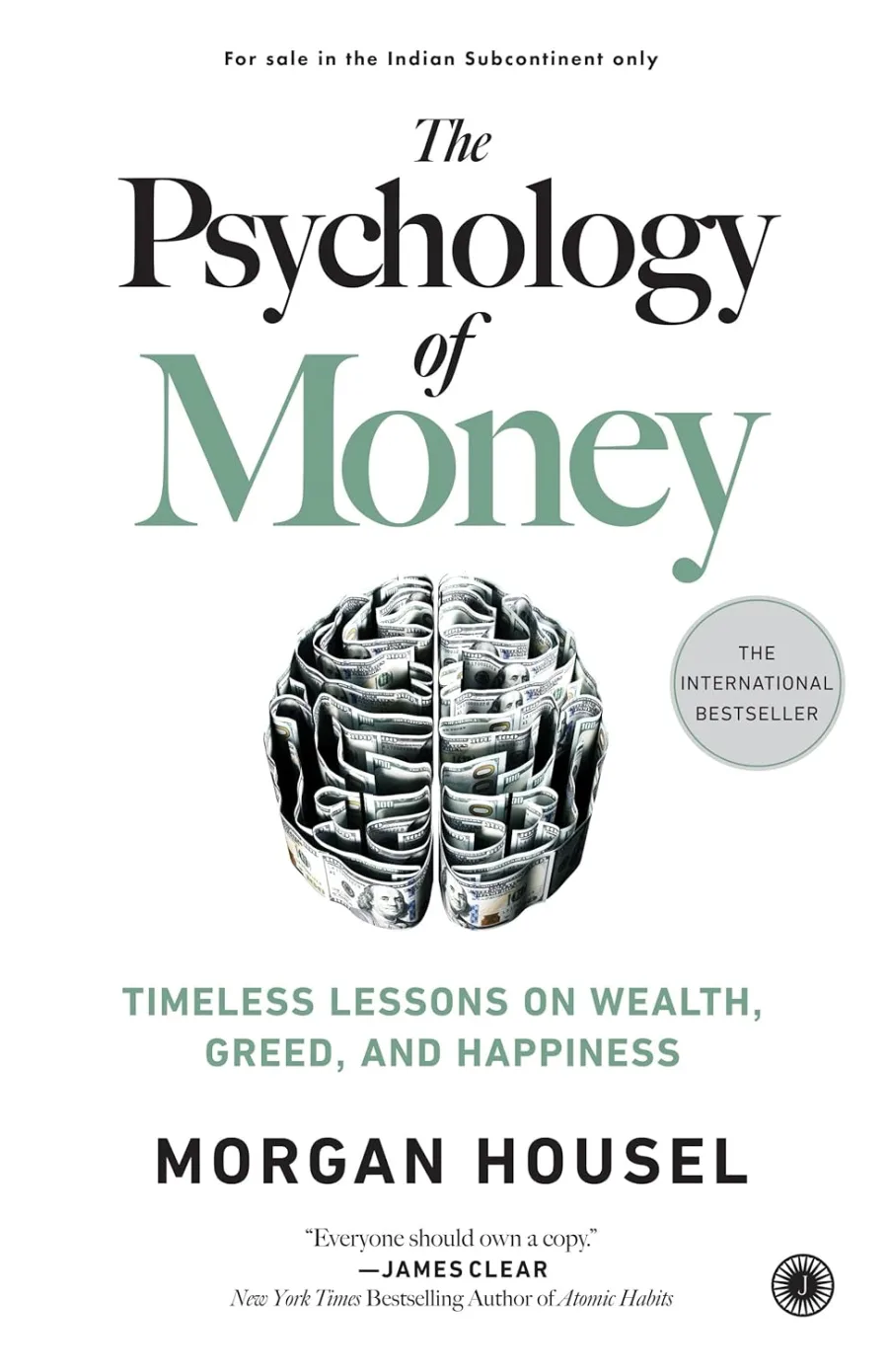
Download Cover Image
Do you want to download the full cover image for The Psychology of Money?