
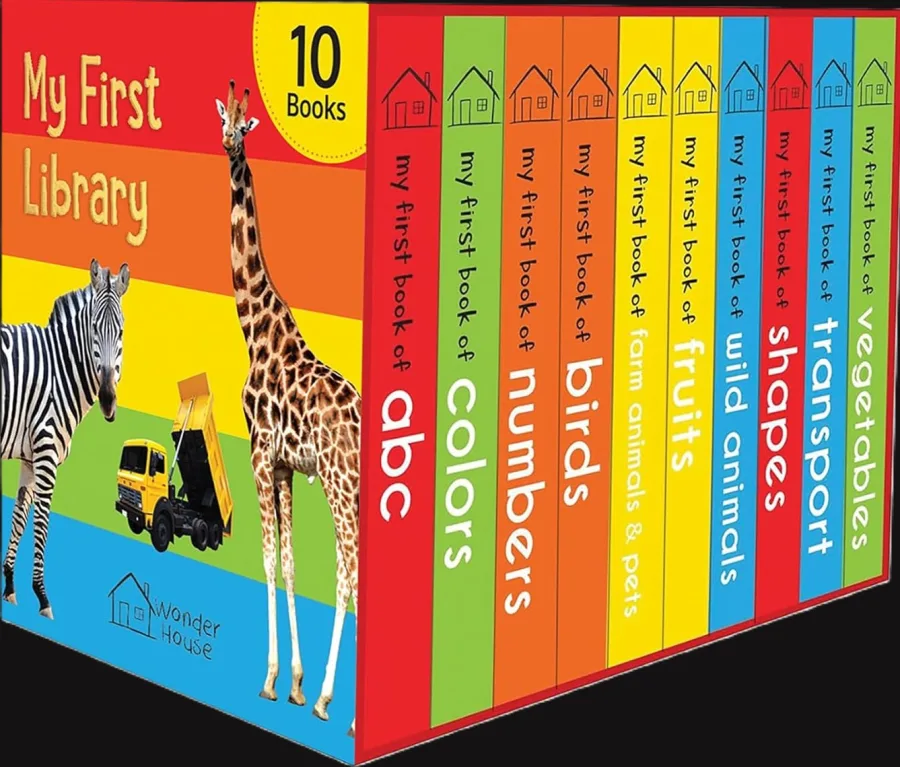
My First Library: Boxset of 10 Board Books for Kids (Pack 1) | Includes ABC, Numbers, Shapes
Hardcover
• 220 Pages
• ₹ 375.00
• English
• 9789387779266
No ratings yet
| Publisher | Wonder House Books |
|---|---|
| ISBN13 | 9789387779266 |
| ASIN/SKU | 9387779262 |
| Book Format | Hardcover |
| Language | English |
| Pages | 220 |
| List Price | ₹ 375.00 |
| Publishing Date | 01/01/2018 |
| Dimensions | 13.5 x 10.4 x 9.2 cm |
| Weight | 820 g |
| Book Code | BD00055004 |
Buy this Book
Amazon Stores
Ebook Stores
Other Stores
Discover My First Library: Boxset of 10 Board Books for Kids (Pack 1) | Includes ABC, Numbers, Shapes by Wonder House Books. This book is published by Wonder House Books in Hardcover format, ISBN 9789387779266, ASIN 9387779262, under Children's Books, Language Study for Children, Books and Libraries for Children.
Book Description
A collection of 10 well-researched Board books to introduce a wide range of learning topics and everyday objects to the little scholars. The topics included in the set are - ABC, numbers, shapes, colours, wild animals, farm animals and pets, birds, fruits, vegetables and transport. These beautiful picture books develops reading skills helps the child to build a vocabulary improves listening and observational skill have well-researched bright pictures covers comprehensive set of topics suited for a toddler.
Author Biography
Wonder House has a dedicated team of editors and designers involved in the development of magnificent and enriching children books. The team pays special attention to develop age appropriate content and does extensive research on every topic included in the book. Our mission is to develop highly informative content which will help the children to master different skills. At Wonder House, we strive to make learning a joy.
Editorial Reviews
Select Guide Rating
Book Summary
My First Library: Boxset of 10 Board Books for Kids (Pack 1) by Wonder House Books is a colorful and child-friendly collection created to introduce young children to the basic ideas, words, objects, and concepts they encounter in their early years. Instead of being one continuous story, the book set works as a small first library, with ten sturdy board books that encourage children to learn through pictures, simple words, repetition, and everyday examples. The collection is designed especially for very young learners who are beginning to recognize familiar objects, understand simple ideas, and develop their first vocabulary.
One of the most useful features of the set is its focus on early learning through familiar concepts. Young children often learn best when they can connect a new word or idea with something they already see around them. The books therefore introduce basic subjects in a straightforward way, using bright illustrations and short pieces of information. Topics such as the alphabet, numbers, shapes, colors, animals, fruits, vehicles, and other familiar themes can help children build a foundation for later learning. Rather than giving long explanations, the books present information in a form that is easy for a young child to look at, hear, repeat, and remember.
The ABC content is especially important because recognizing letters is one of the first steps toward reading. Children are introduced to the alphabet in a simple and attractive format, generally connecting letters with familiar words and pictures. A child can see a letter, hear its name, and associate it with an object. This kind of repeated connection can gradually make letters more recognizable. The approach is not meant to teach advanced reading but to make the alphabet familiar and enjoyable.
The numbers section introduces children to early counting and number recognition. Numbers become easier for children to understand when they are connected with visible objects. Instead of treating numbers as abstract symbols, the books can help children see the relationship between a number and a quantity. Looking at pictures and counting objects gives children an opportunity to practice simple observation and counting skills. This creates an early foundation for mathematics without making learning feel like formal study.
Shapes are another important part of early childhood education. Children begin to notice differences in the forms of objects around them long before they understand geometric terminology. By introducing basic shapes through clear pictures and familiar examples, the set encourages children to observe the world more carefully. They can begin to recognize that objects may be round, square, rectangular, triangular, or shaped in other simple ways. This supports both visual recognition and early logical thinking.
The books also make learning more engaging by introducing subjects through pictures. For young children, illustrations are not merely decoration. They help hold attention and make unfamiliar words easier to understand. A picture of an animal, fruit, toy, vehicle, or household object can immediately give meaning to a word. Children can point at pictures, name what they see, repeat words after an adult, and gradually develop their own vocabulary. This makes the books useful not only for independent looking but also for shared reading between children and parents, grandparents, or teachers.
Another strength of the collection is repetition. Young children often need to encounter the same information many times before it becomes familiar. Because these books concentrate on basic concepts, children can return to them repeatedly without feeling that they have to move quickly from one subject to another. A child may first enjoy simply looking at the pictures, later begin naming objects, and eventually start recognizing letters, numbers, colors, and shapes. In this way, the same books can support different stages of early learning.
The board-book format is particularly suitable for small children. Very young readers may not yet know how to handle thin paper pages carefully, so sturdy board pages make the books easier to hold and turn. They are designed for hands-on use and repeated reading. The compact format also makes the collection convenient for parents to keep together as a small learning library.
The set is valuable because it combines learning and play. At this age, children learn naturally through curiosity. They ask questions, point at pictures, imitate sounds, repeat words, and make connections between what they see in books and what they experience in daily life. These books provide parents with simple opportunities to encourage that curiosity. An adult can ask a child to find a particular letter, count objects, identify a shape, name an animal, or describe a picture. Such small conversations can make reading an interactive experience rather than a passive activity.
Overall, My First Library: Boxset of 10 Board Books for Kids (Pack 1) is best understood as an introductory learning collection rather than a traditional storybook. Its purpose is to make important early concepts familiar through simple language, attractive pictures, repetition, and hands-on reading. The inclusion of subjects such as ABC, numbers, and shapes gives children a useful starting point for literacy, numeracy, observation, and vocabulary development. Most importantly, the set encourages children to associate books with discovery and enjoyment. As a first library, it can become a gentle bridge between a child's everyday experiences and the more structured learning that comes later.
One of the most useful features of the set is its focus on early learning through familiar concepts. Young children often learn best when they can connect a new word or idea with something they already see around them. The books therefore introduce basic subjects in a straightforward way, using bright illustrations and short pieces of information. Topics such as the alphabet, numbers, shapes, colors, animals, fruits, vehicles, and other familiar themes can help children build a foundation for later learning. Rather than giving long explanations, the books present information in a form that is easy for a young child to look at, hear, repeat, and remember.
The ABC content is especially important because recognizing letters is one of the first steps toward reading. Children are introduced to the alphabet in a simple and attractive format, generally connecting letters with familiar words and pictures. A child can see a letter, hear its name, and associate it with an object. This kind of repeated connection can gradually make letters more recognizable. The approach is not meant to teach advanced reading but to make the alphabet familiar and enjoyable.
The numbers section introduces children to early counting and number recognition. Numbers become easier for children to understand when they are connected with visible objects. Instead of treating numbers as abstract symbols, the books can help children see the relationship between a number and a quantity. Looking at pictures and counting objects gives children an opportunity to practice simple observation and counting skills. This creates an early foundation for mathematics without making learning feel like formal study.
Shapes are another important part of early childhood education. Children begin to notice differences in the forms of objects around them long before they understand geometric terminology. By introducing basic shapes through clear pictures and familiar examples, the set encourages children to observe the world more carefully. They can begin to recognize that objects may be round, square, rectangular, triangular, or shaped in other simple ways. This supports both visual recognition and early logical thinking.
The books also make learning more engaging by introducing subjects through pictures. For young children, illustrations are not merely decoration. They help hold attention and make unfamiliar words easier to understand. A picture of an animal, fruit, toy, vehicle, or household object can immediately give meaning to a word. Children can point at pictures, name what they see, repeat words after an adult, and gradually develop their own vocabulary. This makes the books useful not only for independent looking but also for shared reading between children and parents, grandparents, or teachers.
Another strength of the collection is repetition. Young children often need to encounter the same information many times before it becomes familiar. Because these books concentrate on basic concepts, children can return to them repeatedly without feeling that they have to move quickly from one subject to another. A child may first enjoy simply looking at the pictures, later begin naming objects, and eventually start recognizing letters, numbers, colors, and shapes. In this way, the same books can support different stages of early learning.
The board-book format is particularly suitable for small children. Very young readers may not yet know how to handle thin paper pages carefully, so sturdy board pages make the books easier to hold and turn. They are designed for hands-on use and repeated reading. The compact format also makes the collection convenient for parents to keep together as a small learning library.
The set is valuable because it combines learning and play. At this age, children learn naturally through curiosity. They ask questions, point at pictures, imitate sounds, repeat words, and make connections between what they see in books and what they experience in daily life. These books provide parents with simple opportunities to encourage that curiosity. An adult can ask a child to find a particular letter, count objects, identify a shape, name an animal, or describe a picture. Such small conversations can make reading an interactive experience rather than a passive activity.
Overall, My First Library: Boxset of 10 Board Books for Kids (Pack 1) is best understood as an introductory learning collection rather than a traditional storybook. Its purpose is to make important early concepts familiar through simple language, attractive pictures, repetition, and hands-on reading. The inclusion of subjects such as ABC, numbers, and shapes gives children a useful starting point for literacy, numeracy, observation, and vocabulary development. Most importantly, the set encourages children to associate books with discovery and enjoyment. As a first library, it can become a gentle bridge between a child's everyday experiences and the more structured learning that comes later.
Sample Chapters
Sample Chapters will be added soon…
Reader Reviews
No reviews yet.
My First Library: Boxset of 10 Board Books for Kids (Pack 1) | Includes ABC, Numbers, Shapes
Download Cover Image
Do you want to download the full cover image for My First Library: Boxset of 10 Board Books for Kids (Pack 1) | Includes ABC, Numbers, Shapes?