
MTG International Mathematics Olympiad (IMO) Workbook Class 3 - Chapter-wise MCQs with Achievers
Paperback
• 80 Pages
• ₹ 100.00
• English
• 9789369574490
No ratings yet
| Publisher | MTG Learning Media Pvt. Ltd. |
|---|---|
| ISBN13 | 9789369574490 |
| ASIN/SKU | 9369574492 |
| Book Format | Paperback |
| Language | English |
| Pages | 80 |
| List Price | ₹ 100.00 |
| Publishing Date | 31/03/2026 |
| Dimensions | 24 x 17 x 0.5 cm |
| Weight | 120 g |
| Book Code | BD00054882 |
Buy this Book
Amazon Stores
Ebook Stores
Other Stores
Discover MTG International Mathematics Olympiad (IMO) Workbook Class 3 - Chapter-wise MCQs with Achievers by Mahabir Singh. This book is published by MTG Learning Media Pvt. Ltd. in Paperback format, ISBN 9789369574490, ASIN 9369574492, under School Books, Schools and Teaching.
Book Description
MTG presents the fully revised & updated “InternationalMathematics Olympiad Workbook” - the perfect companion to ace the SOF International MathematicsOlympiad (IMO) 2026-27 exam.
Who Can Benefit?
SOF IMO participants
For classes 1-12
School teachers
BOOK DESCRIPTION
MTG’s fully revised & updated IMO workbook is the perfect tool to help students prepare for their upcoming SOF IMO (2026-27) exam. Packed with an interactive question bank, this workbook is designed to keep students engaged and motivated throughout their learning process. With a focus on developing important Math skills and knowledge needed for success, this workbook is a must-have for any student looking to excel in their Olympiad exams.
Chapter-wise quick recap for thorough preparation.
Chapter-wise MCQs for extensive practice.
The MCQs are divided into general questions and the achiever’s section
Includes hints and explanations for better understanding.
HOTS section to challenge students and enhance critical thinking skills.
What Sets This Book Apart?
2025 IMO exam paper to familiarize students with the exam pattern.
OMR sheets are provided after each chapter to practice filling them out.
What Will You Learn?
Aids in better comprehension and proficiency in Math concepts.
Extensive practice will help in becoming ready for the Olympiad.
Helps students refine their Math skills and deepen their understanding.
Boosts students' ability in reasoning, analytical, and problem-solving skills.
Who Can Benefit?
SOF IMO participants
For classes 1-12
School teachers
BOOK DESCRIPTION
MTG’s fully revised & updated IMO workbook is the perfect tool to help students prepare for their upcoming SOF IMO (2026-27) exam. Packed with an interactive question bank, this workbook is designed to keep students engaged and motivated throughout their learning process. With a focus on developing important Math skills and knowledge needed for success, this workbook is a must-have for any student looking to excel in their Olympiad exams.
Chapter-wise quick recap for thorough preparation.
Chapter-wise MCQs for extensive practice.
The MCQs are divided into general questions and the achiever’s section
Includes hints and explanations for better understanding.
HOTS section to challenge students and enhance critical thinking skills.
What Sets This Book Apart?
2025 IMO exam paper to familiarize students with the exam pattern.
OMR sheets are provided after each chapter to practice filling them out.
What Will You Learn?
Aids in better comprehension and proficiency in Math concepts.
Extensive practice will help in becoming ready for the Olympiad.
Helps students refine their Math skills and deepen their understanding.
Boosts students' ability in reasoning, analytical, and problem-solving skills.
Author Biography
Author Biography will be added soon…
Editorial Reviews
Editorial Reviews will be added soon…
Book Summary
MTG International Mathematics Olympiad (IMO) Workbook Class 3 – Chapter-wise MCQs with Achievers Section by Mahabir Singh is a focused practice workbook designed for young students preparing for the SOF International Mathematics Olympiad (IMO) 2026–27. The book is intended to strengthen mathematical concepts while developing reasoning, analytical thinking, problem-solving ability, and confidence with Olympiad-style questions. The current edition is listed as 2026–27, with ISBN 9789369574490 and Mahabir Singh as the author.
The workbook is different from an ordinary Class 3 mathematics practice book because its purpose is not simply to help children complete their school syllabus. Olympiad examinations generally require students to think carefully, recognize patterns, apply concepts in unfamiliar situations, and solve questions efficiently. The book therefore combines regular chapterwise MCQs with a more challenging Achievers' Section and HOTS-style questions.
One of the most useful features is its chapterwise organization. The book covers Number Sense, Computation Operations, Fractions, Money, Length, Weight, Capacity, Time and Temperature, Geometry, Data Handling, and Logical Reasoning. This structure allows children to study one mathematical area at a time instead of being presented with a large mixture of unrelated questions.
The first area, Number Sense, develops the child's understanding of numbers and their relationships. At Class 3 level, this includes recognizing numbers, comparing quantities, understanding place value, and working with numbers in different forms. These skills are fundamental because almost every later mathematical topic depends on a strong understanding of numbers.
The book's MCQs can help children move beyond simply reading numbers and performing routine exercises. They have to examine the options, identify patterns, and decide which mathematical idea applies. This gradually develops the habit of thinking before calculating.
Computation Operations forms another important section. Addition, subtraction, multiplication, and division are fundamental skills for young learners. However, Olympiad questions can present these operations in less direct ways. A child may need to identify a missing number, choose the correct operation, compare results, or solve a short problem.
Such practice encourages children to understand what an operation actually does instead of treating mathematics as a collection of mechanical procedures.
The section on Fractions introduces children to another important mathematical concept. Fractions can initially be difficult because children have to understand that a whole can be divided into equal parts and that different fractions can represent different quantities.
Olympiad-style questions can make this learning more interesting by presenting fractions through comparisons, visual situations, or logical problems. Repeated practice can help children become comfortable with the idea of parts and wholes.
The Money chapter connects mathematics with everyday life. Children encounter money while shopping, saving, comparing prices, or calculating change. Questions based on money can therefore make mathematical operations more practical.
Instead of viewing addition and subtraction as abstract exercises, children can understand how those operations are used in real situations. This also develops early financial awareness while strengthening mathematical reasoning.
The book also covers Length, Weight, Capacity, Time and Temperature, a group of measurement concepts that children encounter regularly. Understanding units and comparing quantities requires more than memorizing names. Children need to understand relationships between units and interpret measurements correctly.
Time-related questions can be particularly useful because they require children to think about sequences, durations, and intervals. Temperature and measurement questions similarly encourage careful reading and comparison.
The Geometry section introduces children to shapes, lines, spatial relationships, and other basic geometric concepts. Geometry is important because it develops visual thinking in addition to numerical ability.
Children learn to recognize shapes and their properties and gradually develop an understanding of how objects relate to one another in space. Olympiad questions can challenge them to identify patterns, count shapes, recognize relationships, or reason about geometric figures.
Another important section is Data Handling. Children learn to interpret information presented in organized forms such as tables, charts, or graphs. This is an increasingly important skill because students encounter visual data in school subjects and everyday life.
Data-handling questions teach children to extract relevant information rather than becoming overwhelmed by a collection of numbers. They need to read carefully, compare values, identify patterns, and answer questions based on the information provided.
The final chapter, Logical Reasoning, is particularly important for Olympiad preparation. Mathematical Olympiads are not limited to straightforward arithmetic. Students are often expected to recognize patterns, make deductions, identify relationships, and think logically.
Reasoning questions can also be enjoyable for children because they often resemble puzzles. Instead of simply calculating an answer, the child may need to discover a hidden pattern or determine what comes next in a sequence.
One of the defining features of the workbook is the division of its MCQs into general questions and the Achievers' Section. The general questions help children strengthen their basic understanding and become familiar with Olympiad-style formats. The Achievers' Section provides more challenging problems for students who are ready to go beyond routine practice.
This graded approach is useful because not every child begins with the same level of mathematical confidence. A student can start with simpler questions and gradually attempt more challenging ones.
The HOTS section, or Higher Order Thinking Skills section, is intended to develop deeper reasoning and critical-thinking abilities. These questions encourage students to look for relationships and apply concepts rather than simply recall a formula or procedure.
For parents, this is an important distinction. Olympiad preparation should not become an exercise in memorizing answers. Children benefit more when they are encouraged to explain how they reached an answer.
The book also includes hints and explanations, allowing students to understand the reasoning behind the answers. This makes the workbook useful for self-study as well as guided practice.
Parents should encourage children to attempt a problem independently before looking at the hint. If a child immediately checks the explanation, they may miss the opportunity to develop problem-solving skills. After making an attempt, however, the explanation can help them understand where their reasoning went wrong.
The workbook also includes the 2025 SOF International Mathematics Olympiad paper at the end, giving students exposure to a recent examination format. This is valuable because actual examination questions provide a clearer idea of how concepts may be combined and presented.
Children can first solve chapterwise questions to strengthen individual concepts and later attempt the previous-year paper as a complete exercise. This creates a natural progression from learning to examination practice.
The workbook is also useful for becoming familiar with the MCQ format. Young students may know the mathematics but make mistakes because they do not read the options carefully. Regular practice teaches them to compare alternatives and eliminate obviously incorrect choices.
This is a valuable examination skill. Children should learn that an MCQ is not simply a question followed by a quick guess. They need to read the question, understand exactly what is being asked, solve or reason through it, and then select the best answer.
The book can also help develop mathematical confidence. Some children begin to believe that mathematics is difficult when they encounter unfamiliar problems. Olympiad practice can teach them that a difficult question does not necessarily require advanced mathematics; sometimes it simply requires careful thinking.
This is an important lesson for young learners. They should be encouraged to spend time understanding a challenging problem rather than immediately concluding that they cannot solve it.
Parents can make the practice more effective by asking questions such as, “What do you know from the question?” “What are the possible choices?” or “Can you find a pattern?” Such prompts encourage children to think independently without giving away the answer.
The workbook is different from an ordinary Class 3 mathematics practice book because its purpose is not simply to help children complete their school syllabus. Olympiad examinations generally require students to think carefully, recognize patterns, apply concepts in unfamiliar situations, and solve questions efficiently. The book therefore combines regular chapterwise MCQs with a more challenging Achievers' Section and HOTS-style questions.
One of the most useful features is its chapterwise organization. The book covers Number Sense, Computation Operations, Fractions, Money, Length, Weight, Capacity, Time and Temperature, Geometry, Data Handling, and Logical Reasoning. This structure allows children to study one mathematical area at a time instead of being presented with a large mixture of unrelated questions.
The first area, Number Sense, develops the child's understanding of numbers and their relationships. At Class 3 level, this includes recognizing numbers, comparing quantities, understanding place value, and working with numbers in different forms. These skills are fundamental because almost every later mathematical topic depends on a strong understanding of numbers.
The book's MCQs can help children move beyond simply reading numbers and performing routine exercises. They have to examine the options, identify patterns, and decide which mathematical idea applies. This gradually develops the habit of thinking before calculating.
Computation Operations forms another important section. Addition, subtraction, multiplication, and division are fundamental skills for young learners. However, Olympiad questions can present these operations in less direct ways. A child may need to identify a missing number, choose the correct operation, compare results, or solve a short problem.
Such practice encourages children to understand what an operation actually does instead of treating mathematics as a collection of mechanical procedures.
The section on Fractions introduces children to another important mathematical concept. Fractions can initially be difficult because children have to understand that a whole can be divided into equal parts and that different fractions can represent different quantities.
Olympiad-style questions can make this learning more interesting by presenting fractions through comparisons, visual situations, or logical problems. Repeated practice can help children become comfortable with the idea of parts and wholes.
The Money chapter connects mathematics with everyday life. Children encounter money while shopping, saving, comparing prices, or calculating change. Questions based on money can therefore make mathematical operations more practical.
Instead of viewing addition and subtraction as abstract exercises, children can understand how those operations are used in real situations. This also develops early financial awareness while strengthening mathematical reasoning.
The book also covers Length, Weight, Capacity, Time and Temperature, a group of measurement concepts that children encounter regularly. Understanding units and comparing quantities requires more than memorizing names. Children need to understand relationships between units and interpret measurements correctly.
Time-related questions can be particularly useful because they require children to think about sequences, durations, and intervals. Temperature and measurement questions similarly encourage careful reading and comparison.
The Geometry section introduces children to shapes, lines, spatial relationships, and other basic geometric concepts. Geometry is important because it develops visual thinking in addition to numerical ability.
Children learn to recognize shapes and their properties and gradually develop an understanding of how objects relate to one another in space. Olympiad questions can challenge them to identify patterns, count shapes, recognize relationships, or reason about geometric figures.
Another important section is Data Handling. Children learn to interpret information presented in organized forms such as tables, charts, or graphs. This is an increasingly important skill because students encounter visual data in school subjects and everyday life.
Data-handling questions teach children to extract relevant information rather than becoming overwhelmed by a collection of numbers. They need to read carefully, compare values, identify patterns, and answer questions based on the information provided.
The final chapter, Logical Reasoning, is particularly important for Olympiad preparation. Mathematical Olympiads are not limited to straightforward arithmetic. Students are often expected to recognize patterns, make deductions, identify relationships, and think logically.
Reasoning questions can also be enjoyable for children because they often resemble puzzles. Instead of simply calculating an answer, the child may need to discover a hidden pattern or determine what comes next in a sequence.
One of the defining features of the workbook is the division of its MCQs into general questions and the Achievers' Section. The general questions help children strengthen their basic understanding and become familiar with Olympiad-style formats. The Achievers' Section provides more challenging problems for students who are ready to go beyond routine practice.
This graded approach is useful because not every child begins with the same level of mathematical confidence. A student can start with simpler questions and gradually attempt more challenging ones.
The HOTS section, or Higher Order Thinking Skills section, is intended to develop deeper reasoning and critical-thinking abilities. These questions encourage students to look for relationships and apply concepts rather than simply recall a formula or procedure.
For parents, this is an important distinction. Olympiad preparation should not become an exercise in memorizing answers. Children benefit more when they are encouraged to explain how they reached an answer.
The book also includes hints and explanations, allowing students to understand the reasoning behind the answers. This makes the workbook useful for self-study as well as guided practice.
Parents should encourage children to attempt a problem independently before looking at the hint. If a child immediately checks the explanation, they may miss the opportunity to develop problem-solving skills. After making an attempt, however, the explanation can help them understand where their reasoning went wrong.
The workbook also includes the 2025 SOF International Mathematics Olympiad paper at the end, giving students exposure to a recent examination format. This is valuable because actual examination questions provide a clearer idea of how concepts may be combined and presented.
Children can first solve chapterwise questions to strengthen individual concepts and later attempt the previous-year paper as a complete exercise. This creates a natural progression from learning to examination practice.
The workbook is also useful for becoming familiar with the MCQ format. Young students may know the mathematics but make mistakes because they do not read the options carefully. Regular practice teaches them to compare alternatives and eliminate obviously incorrect choices.
This is a valuable examination skill. Children should learn that an MCQ is not simply a question followed by a quick guess. They need to read the question, understand exactly what is being asked, solve or reason through it, and then select the best answer.
The book can also help develop mathematical confidence. Some children begin to believe that mathematics is difficult when they encounter unfamiliar problems. Olympiad practice can teach them that a difficult question does not necessarily require advanced mathematics; sometimes it simply requires careful thinking.
This is an important lesson for young learners. They should be encouraged to spend time understanding a challenging problem rather than immediately concluding that they cannot solve it.
Parents can make the practice more effective by asking questions such as, “What do you know from the question?” “What are the possible choices?” or “Can you find a pattern?” Such prompts encourage children to think independently without giving away the answer.
Sample Chapters
Sample Chapters will be added soon…
Reader Reviews
No reviews yet.
MTG International Mathematics Olympiad (IMO) Workbook Class 3 - Chapter-wise MCQs with Achievers
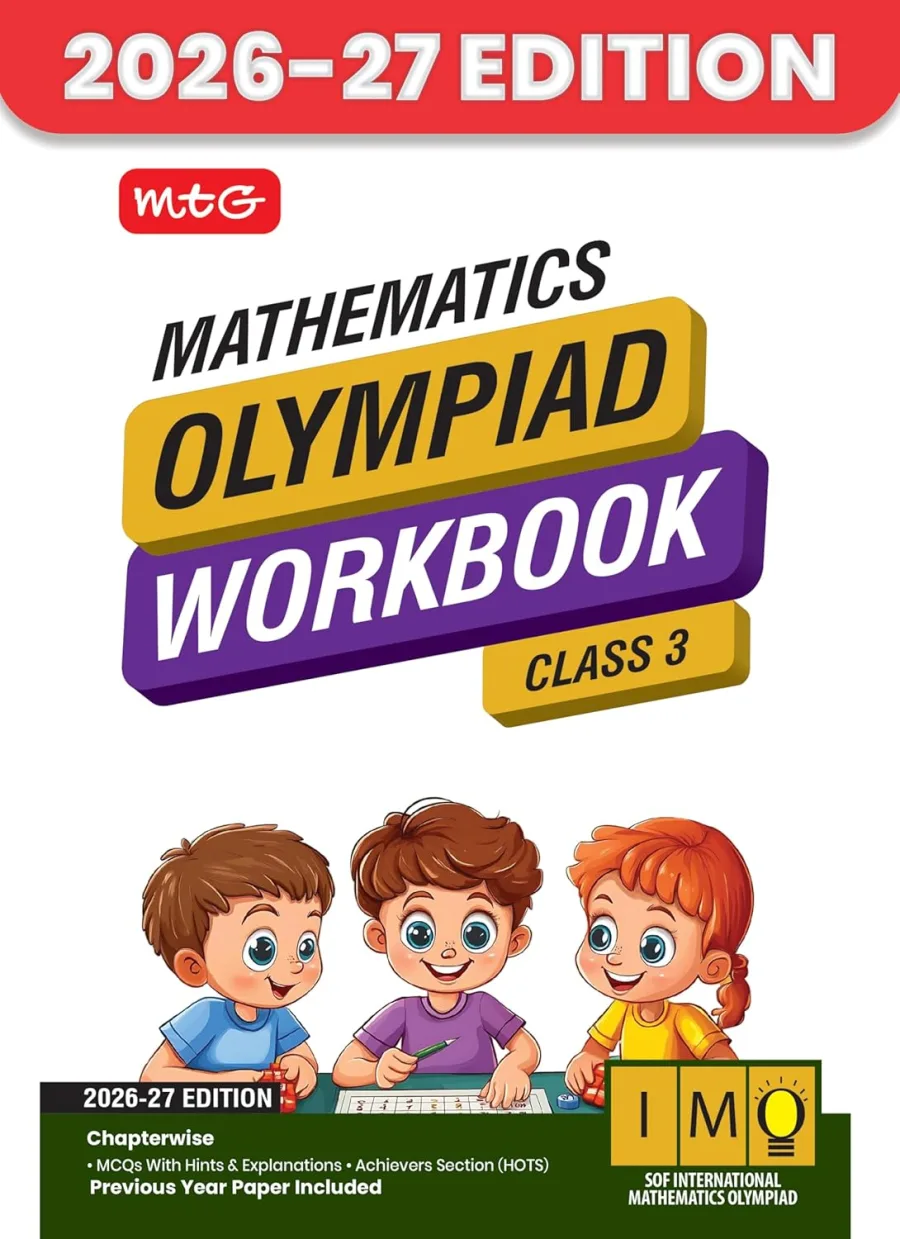
Download Cover Image
Do you want to download the full cover image for MTG International Mathematics Olympiad (IMO) Workbook Class 3 - Chapter-wise MCQs with Achievers?