
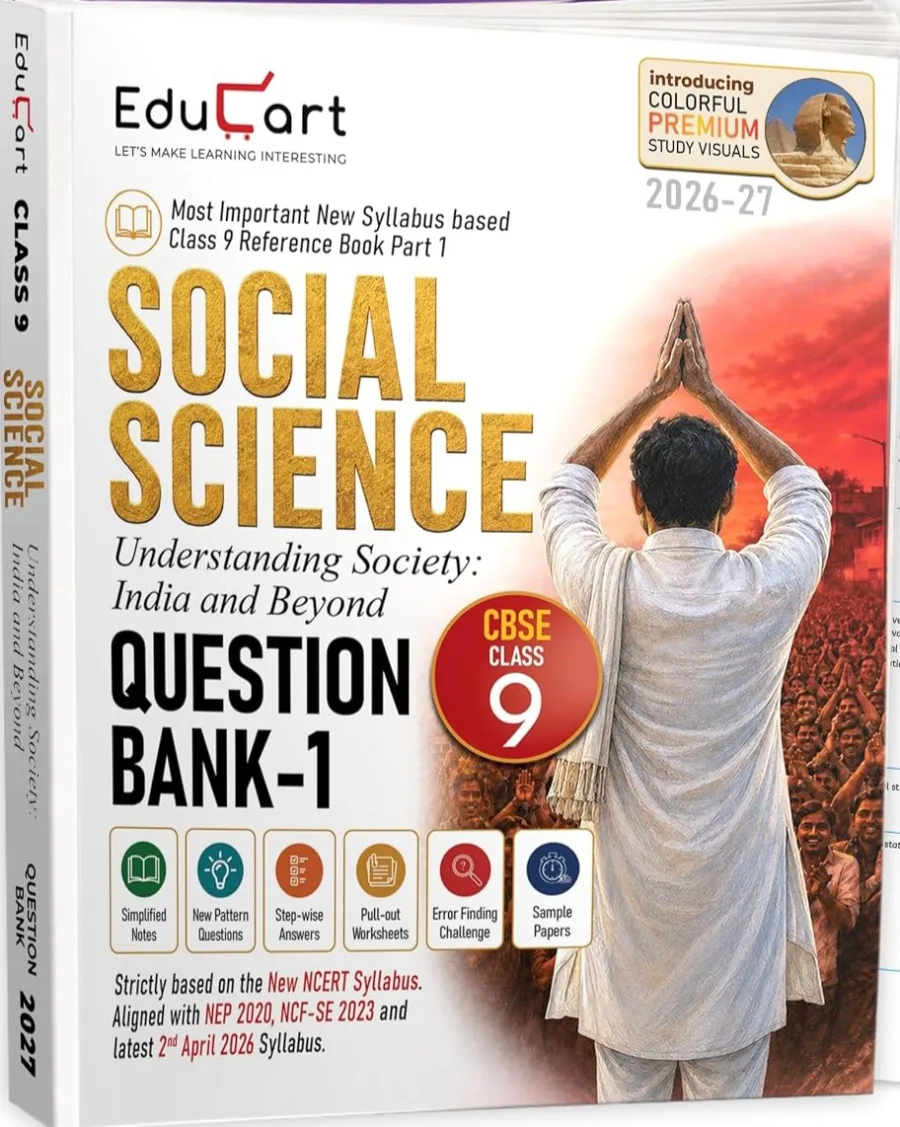
Educart CBSE Class 9 Social Science Question Bank 2026-27 | Understanding Society
Paperback
• 356 Pages
• ₹ 449.00
• English
• 9789375160694
No ratings yet
| Publisher | Educart (Agrawal Group Of Publications) |
|---|---|
| ISBN13 | 9789375160694 |
| ASIN/SKU | 9375160696 |
| Book Format | Paperback |
| Language | English |
| Pages | 356 |
| List Price | ₹ 449.00 |
| Publishing Date | 27/05/2026 |
| Dimensions | 21 x 1 x 27 cm |
| Weight | 498 g |
| Book Code | BD00054757 |
Buy this Book
Amazon Stores
Ebook Stores
Other Stores
Discover Educart CBSE Class 9 Social Science Question Bank 2026-27 | Understanding Society by Digraj Singh Rajput. This book is published by Educart (Agrawal Group Of Publications) in Paperback format, ISBN 9789375160694, ASIN 9375160696, under School Books, Test Preparation.
Book Description
The Educart Social Science Question Bank Class 9–Understanding Society: India and Beyond (Part 1)–is curated entirely on the basis of the latest NCERT SST textbook, making it the most recommended class 9 Social Science Question Bank 2027 already.
Genre: Education/School Books/CBSE/Question Papers
Who is this Book For?
This SST Question Bank is for Class 9 students willing to go beyond rote learning; acquiring in-depth concept understanding and confidence in the CBSE's new assessment pattern.
These New Class 9 Reference Books are made for teachers too with tools to help build lesson plans, interactive examples, class activities, and unit tests.
Why Choose Educart Class 9 SST Question Bank 2027?
★ Strictly aligned with latest CBSE Class 9 syllabus: NEP 2020, NCF-SE 2023, and the 2nd April 2026 syllabus update
★ Premium colorful study visuals — Supporting material such as maps, timelines, infographics, and simplified notes makes subjects like History, Geography, Political Science, and Economics interesting.
★ Find the latest questions across MCQs, source-based, VSAs, SAs, and LAs — each marked with a difficulty level, helping students plan their preparation smartly
★ Step-wise detailed answers teaching students structure scoring answers for Social Science, where presentation is as crucial as content
★ Pull-out worksheets for quick chapter revision and self-assessment before half-yearlies and unit exams
★ Chapter-wise Error Finding Challenge to identify gaps in factual and conceptual understanding
★ Sample Papers of the 2026-27 Board Pattern have been added to help students improve their answer-writing and time management skills, which are essential for subjects like social science.
The Educart SST question bank for Class 9 ensures that it covers every strand of the latest Social Science curriculum—making students confident to face any question that comes in the exam.
Genre: Education/School Books/CBSE/Question Papers
Who is this Book For?
This SST Question Bank is for Class 9 students willing to go beyond rote learning; acquiring in-depth concept understanding and confidence in the CBSE's new assessment pattern.
These New Class 9 Reference Books are made for teachers too with tools to help build lesson plans, interactive examples, class activities, and unit tests.
Why Choose Educart Class 9 SST Question Bank 2027?
★ Strictly aligned with latest CBSE Class 9 syllabus: NEP 2020, NCF-SE 2023, and the 2nd April 2026 syllabus update
★ Premium colorful study visuals — Supporting material such as maps, timelines, infographics, and simplified notes makes subjects like History, Geography, Political Science, and Economics interesting.
★ Find the latest questions across MCQs, source-based, VSAs, SAs, and LAs — each marked with a difficulty level, helping students plan their preparation smartly
★ Step-wise detailed answers teaching students structure scoring answers for Social Science, where presentation is as crucial as content
★ Pull-out worksheets for quick chapter revision and self-assessment before half-yearlies and unit exams
★ Chapter-wise Error Finding Challenge to identify gaps in factual and conceptual understanding
★ Sample Papers of the 2026-27 Board Pattern have been added to help students improve their answer-writing and time management skills, which are essential for subjects like social science.
The Educart SST question bank for Class 9 ensures that it covers every strand of the latest Social Science curriculum—making students confident to face any question that comes in the exam.
Author Biography
Author Biography will be added soon…
Editorial Reviews
Editorial Reviews will be added soon…
Book Summary
Educart CBSE Class 9 Social Science Question Bank 2026–27 | Understanding Society by Digraj Singh Rajput and Educart is an exam-oriented practice resource designed for students preparing for the CBSE Class 9 Social Science curriculum for the 2026–27 academic session. The book is intended to help students understand the new NCERT-based Social Science content while developing the ability to answer different kinds of questions. Rather than functioning only as a traditional textbook, it focuses on practice, application, revision, and examination preparation.
Class 9 Social Science is an important stage because students begin to study society, history, geography, political systems, economics, and related ideas in greater depth. The subject contains a mixture of factual information and conceptual understanding. Students have to remember important events, places, terms, definitions, processes, and examples, but they must also understand relationships between ideas and apply what they have learned to unfamiliar questions.
The question bank is particularly useful because modern CBSE examinations increasingly move beyond simple recall. Students may be asked to interpret information, analyze a situation, compare concepts, identify relationships, or apply their knowledge to a new context. A preparation book therefore needs to provide more than straightforward questions.
The resource is based around Understanding Society: India and Beyond, the newer NCERT Social Science curriculum for Class 9. The subject brings different areas of Social Science together and encourages students to understand India and the wider world through multiple perspectives. This makes conceptual clarity especially important.
One of the main advantages of a question bank is that it allows students to test their understanding immediately after studying a chapter. Instead of reading a chapter repeatedly and assuming that they know it, students can attempt questions without looking at the answers. Their performance then shows which parts they have understood and which areas require additional revision.
The book's question-oriented approach can also make Social Science preparation less monotonous. Reading several pages of theory can sometimes feel overwhelming, especially when a chapter contains many names, dates, concepts, and descriptions. Questions break the material into smaller learning units and encourage students to actively recall what they have studied.
A major focus is likely to be competency-based preparation. Competency-based questions require students to use information rather than simply reproduce it. For example, instead of asking for a definition directly, a question may describe a situation and ask students to identify the relevant concept.
This style of questioning encourages deeper learning. Students need to understand why something happens, how different factors are connected, and what conclusions can be drawn from information provided in the question.
The book can also help students practise case-based questions. These questions generally provide a short passage, situation, data set, map, illustration, or other source material followed by multiple questions. Students need to read the material carefully and use it to arrive at the correct answers.
Case-based practice is valuable because it develops both reading and reasoning skills. Students learn not to depend entirely on memorized answers but to use evidence provided in the question.
Another useful area is source-based learning. Social Science frequently involves interpreting historical accounts, maps, charts, tables, political information, or economic situations. Learning how to extract relevant information from a source can help students answer questions more accurately.
The book can also support multiple-choice question practice. MCQs test whether students can recognize the correct answer quickly while distinguishing it from plausible alternatives. Good MCQ practice requires students to understand why the correct option is correct and why the other options are wrong.
This is particularly important because some questions may contain options that are partially correct or closely related. Careful reading is therefore as important as factual knowledge.
For History-related portions of the syllabus, students need to understand events, developments, people, institutions, and historical processes. Instead of memorizing isolated dates, students should understand the sequence and causes of events. A question bank can help them test whether they can connect one development with another.
History becomes easier when students think in terms of cause and effect. They can ask what led to an event, what happened afterward, who was affected, and why the development was significant. Such questions encourage a more meaningful understanding of the past.
Geography requires a somewhat different approach. Students need to understand physical features, climate, resources, locations, human-environment relationships, and spatial patterns. Maps and diagrams can be especially important.
Question practice helps students apply geographical concepts rather than simply memorize descriptions. A question might provide a map or a particular situation and ask students to identify a feature or explain why a phenomenon occurs in a particular region.
The book can therefore help students develop map-reading and interpretation skills where these are relevant to the prescribed curriculum.
Political and social topics require students to understand concepts related to government, society, institutions, rights, responsibilities, and citizenship. These topics are often better understood through examples than through memorized definitions.
Students should learn to connect political concepts with everyday situations. Understanding the purpose of an institution, for example, is more useful than simply remembering its name. Question-based practice can help students make these connections.
The economic and social portions of the curriculum similarly require students to understand how individuals, communities, resources, work, and institutions interact. Students should be able to explain concepts clearly and apply them to real-life situations.
The involvement of Digraj Singh Rajput is notable because he is widely associated with teaching Social Science to school and competitive-exam learners. His involvement gives the resource an explicitly student-oriented and examination-focused character.
Another important feature of a question bank is answer practice. Students may understand a topic but struggle to express their ideas in the format expected by the examination. Regular writing practice can help them become more precise and organized.
For descriptive questions, students should learn to identify the exact demand of the question. If a question asks for reasons, they should provide reasons. If it asks for comparison, they should clearly discuss both sides. If it asks for an explanation, they should develop the idea rather than simply list keywords.
The question bank can help students practise these differences.
Students can also use the book to improve answer presentation. Social Science answers become easier to evaluate when they are organized clearly. Appropriate headings, numbered points, short paragraphs, keywords, and relevant examples can make an answer more readable.
However, students should avoid unnecessarily decorating their answers. The main goal should be clarity, relevance, and accuracy.
The book is also useful for revision before school examinations. After completing a chapter, students can attempt a selection of questions. Before a test, they can return to the questions they previously answered incorrectly and try them again.
This creates a cycle of learning and correction. Mistakes should not simply be marked and forgotten. Students should determine why they made the mistake and revise the relevant concept.
A useful strategy is to maintain a mistake notebook. Students can record difficult concepts, confusing terms, frequently forgotten facts, and questions they answered incorrectly. Revisiting this notebook before examinations can make revision more targeted.
The question bank can also help students identify weak chapters. A student may feel confident after reading a chapter but discover that they cannot answer application-based questions. This is valuable information because it shows that the chapter needs deeper understanding.
Rather than rereading the entire syllabus repeatedly, students can then concentrate on their weaker areas.
Another important benefit is self-assessment. Students can periodically attempt questions without referring to their books and calculate their approximate accuracy. Over time, they can see whether their performance is improving.
Class 9 Social Science is an important stage because students begin to study society, history, geography, political systems, economics, and related ideas in greater depth. The subject contains a mixture of factual information and conceptual understanding. Students have to remember important events, places, terms, definitions, processes, and examples, but they must also understand relationships between ideas and apply what they have learned to unfamiliar questions.
The question bank is particularly useful because modern CBSE examinations increasingly move beyond simple recall. Students may be asked to interpret information, analyze a situation, compare concepts, identify relationships, or apply their knowledge to a new context. A preparation book therefore needs to provide more than straightforward questions.
The resource is based around Understanding Society: India and Beyond, the newer NCERT Social Science curriculum for Class 9. The subject brings different areas of Social Science together and encourages students to understand India and the wider world through multiple perspectives. This makes conceptual clarity especially important.
One of the main advantages of a question bank is that it allows students to test their understanding immediately after studying a chapter. Instead of reading a chapter repeatedly and assuming that they know it, students can attempt questions without looking at the answers. Their performance then shows which parts they have understood and which areas require additional revision.
The book's question-oriented approach can also make Social Science preparation less monotonous. Reading several pages of theory can sometimes feel overwhelming, especially when a chapter contains many names, dates, concepts, and descriptions. Questions break the material into smaller learning units and encourage students to actively recall what they have studied.
A major focus is likely to be competency-based preparation. Competency-based questions require students to use information rather than simply reproduce it. For example, instead of asking for a definition directly, a question may describe a situation and ask students to identify the relevant concept.
This style of questioning encourages deeper learning. Students need to understand why something happens, how different factors are connected, and what conclusions can be drawn from information provided in the question.
The book can also help students practise case-based questions. These questions generally provide a short passage, situation, data set, map, illustration, or other source material followed by multiple questions. Students need to read the material carefully and use it to arrive at the correct answers.
Case-based practice is valuable because it develops both reading and reasoning skills. Students learn not to depend entirely on memorized answers but to use evidence provided in the question.
Another useful area is source-based learning. Social Science frequently involves interpreting historical accounts, maps, charts, tables, political information, or economic situations. Learning how to extract relevant information from a source can help students answer questions more accurately.
The book can also support multiple-choice question practice. MCQs test whether students can recognize the correct answer quickly while distinguishing it from plausible alternatives. Good MCQ practice requires students to understand why the correct option is correct and why the other options are wrong.
This is particularly important because some questions may contain options that are partially correct or closely related. Careful reading is therefore as important as factual knowledge.
For History-related portions of the syllabus, students need to understand events, developments, people, institutions, and historical processes. Instead of memorizing isolated dates, students should understand the sequence and causes of events. A question bank can help them test whether they can connect one development with another.
History becomes easier when students think in terms of cause and effect. They can ask what led to an event, what happened afterward, who was affected, and why the development was significant. Such questions encourage a more meaningful understanding of the past.
Geography requires a somewhat different approach. Students need to understand physical features, climate, resources, locations, human-environment relationships, and spatial patterns. Maps and diagrams can be especially important.
Question practice helps students apply geographical concepts rather than simply memorize descriptions. A question might provide a map or a particular situation and ask students to identify a feature or explain why a phenomenon occurs in a particular region.
The book can therefore help students develop map-reading and interpretation skills where these are relevant to the prescribed curriculum.
Political and social topics require students to understand concepts related to government, society, institutions, rights, responsibilities, and citizenship. These topics are often better understood through examples than through memorized definitions.
Students should learn to connect political concepts with everyday situations. Understanding the purpose of an institution, for example, is more useful than simply remembering its name. Question-based practice can help students make these connections.
The economic and social portions of the curriculum similarly require students to understand how individuals, communities, resources, work, and institutions interact. Students should be able to explain concepts clearly and apply them to real-life situations.
The involvement of Digraj Singh Rajput is notable because he is widely associated with teaching Social Science to school and competitive-exam learners. His involvement gives the resource an explicitly student-oriented and examination-focused character.
Another important feature of a question bank is answer practice. Students may understand a topic but struggle to express their ideas in the format expected by the examination. Regular writing practice can help them become more precise and organized.
For descriptive questions, students should learn to identify the exact demand of the question. If a question asks for reasons, they should provide reasons. If it asks for comparison, they should clearly discuss both sides. If it asks for an explanation, they should develop the idea rather than simply list keywords.
The question bank can help students practise these differences.
Students can also use the book to improve answer presentation. Social Science answers become easier to evaluate when they are organized clearly. Appropriate headings, numbered points, short paragraphs, keywords, and relevant examples can make an answer more readable.
However, students should avoid unnecessarily decorating their answers. The main goal should be clarity, relevance, and accuracy.
The book is also useful for revision before school examinations. After completing a chapter, students can attempt a selection of questions. Before a test, they can return to the questions they previously answered incorrectly and try them again.
This creates a cycle of learning and correction. Mistakes should not simply be marked and forgotten. Students should determine why they made the mistake and revise the relevant concept.
A useful strategy is to maintain a mistake notebook. Students can record difficult concepts, confusing terms, frequently forgotten facts, and questions they answered incorrectly. Revisiting this notebook before examinations can make revision more targeted.
The question bank can also help students identify weak chapters. A student may feel confident after reading a chapter but discover that they cannot answer application-based questions. This is valuable information because it shows that the chapter needs deeper understanding.
Rather than rereading the entire syllabus repeatedly, students can then concentrate on their weaker areas.
Another important benefit is self-assessment. Students can periodically attempt questions without referring to their books and calculate their approximate accuracy. Over time, they can see whether their performance is improving.
Sample Chapters
Sample Chapters will be added soon…
Reader Reviews
No reviews yet.
Educart CBSE Class 9 Social Science Question Bank 2026-27 | Understanding Society
Download Cover Image
Do you want to download the full cover image for Educart CBSE Class 9 Social Science Question Bank 2026-27 | Understanding Society?