
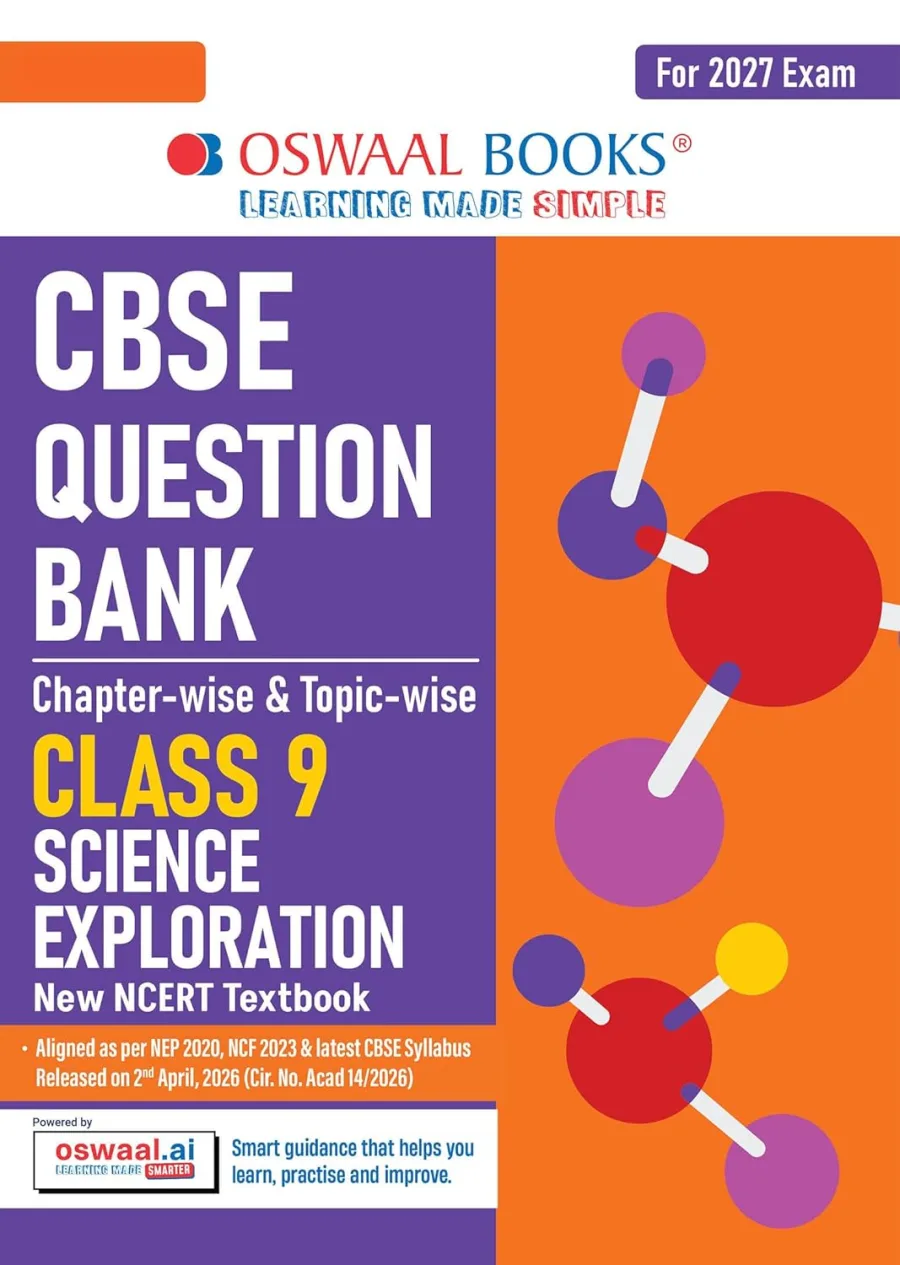
Oswaal CBSE Science Question Bank Chapter-wise & Topic-wise Class 9
Paperback
• 328 Pages
• ₹ 599.00
• English
• 9789377130336
No ratings yet
| Publisher | Oswaal Books And Learning Private Limited |
|---|---|
| ISBN13 | 9789377130336 |
| ASIN/SKU | 9377130336 |
| Book Format | Paperback |
| Language | English |
| Pages | 328 |
| List Price | ₹ 599.00 |
| Publishing Date | 14/05/2026 |
| Dimensions | 28 x 19.5 x 1.3 cm |
| Weight | 525 g |
| Book Code | BD00054694 |
Buy this Book
Amazon Stores
Ebook Stores
Other Stores
Discover Oswaal CBSE Science Question Bank Chapter-wise and Topic-wise Class 9 by Oswaal Editorial Board. This book is published by Oswaal Books And Learning Private Limited in Paperback format, ISBN 9789377130336, ASIN 9377130336, under School Books.
Book Description
Why Oswaal CBSE Question Bank?
Oswaal CBSE Question Banks offer exam-relevant questions based on NCERT and current CBSE trends. It helps you practise smart, revise effectively, and perform better in the exam.
What does this book offer?
Chapter-wise and Topic-wise Coverage strictly aligned with the latest CBSE syllabus and new NCERT Textbook, with exam-ready and competency-based questions along with complete NCERT Coverage.
700+ NCERT and Exam Practice Questions, fully solved, including fully-solved NCERT in-text questions, exercise questions, NCERT activities & NCERT Exemplar (applicable only for Science and Maths).
Competency-Focused Practice covering application-based and higher-order thinking questions as per CBSE assessment guidelines, mapped as per the syllabus-prescribed curricular goals and competency.
Smart Revision Support through Mind Maps, revision notes, mnemonics, concept videos and audio transcripts for faster recall and better retention.
AI-powered Personalised Practice by oswaal.ai that identifies learning gaps and helps improve performance through targeted support.
Practice Papers and Self-Assessment Tools to simulate real exam conditions and track preparation progress.
How does Oswaal CBSE Question Bank Help You Excel?
Structured Coverage: Chapter-wise and topic-wise questions aligned with the latest CBSE syllabus, including NCERT Corner & NCERT Exemplar.
Exam-Focused Practice: Competency-based and application-oriented questions reflecting CBSE assessment patterns, critical thinking, experiential and interactive learning.
Smart Revision Support: Mind Maps, revision notes, mnemonics, and concept videos for quick recall.
Answer-Writing Clarity: Fully solved questions tagged with curricular goals.
Smarter Learning with AI: Exclusive Advantage of oswaal.ai with instant answers, smart quizzes, detailed explanations & fun games.
Oswaal CBSE Question Banks offer exam-relevant questions based on NCERT and current CBSE trends. It helps you practise smart, revise effectively, and perform better in the exam.
What does this book offer?
Chapter-wise and Topic-wise Coverage strictly aligned with the latest CBSE syllabus and new NCERT Textbook, with exam-ready and competency-based questions along with complete NCERT Coverage.
700+ NCERT and Exam Practice Questions, fully solved, including fully-solved NCERT in-text questions, exercise questions, NCERT activities & NCERT Exemplar (applicable only for Science and Maths).
Competency-Focused Practice covering application-based and higher-order thinking questions as per CBSE assessment guidelines, mapped as per the syllabus-prescribed curricular goals and competency.
Smart Revision Support through Mind Maps, revision notes, mnemonics, concept videos and audio transcripts for faster recall and better retention.
AI-powered Personalised Practice by oswaal.ai that identifies learning gaps and helps improve performance through targeted support.
Practice Papers and Self-Assessment Tools to simulate real exam conditions and track preparation progress.
How does Oswaal CBSE Question Bank Help You Excel?
Structured Coverage: Chapter-wise and topic-wise questions aligned with the latest CBSE syllabus, including NCERT Corner & NCERT Exemplar.
Exam-Focused Practice: Competency-based and application-oriented questions reflecting CBSE assessment patterns, critical thinking, experiential and interactive learning.
Smart Revision Support: Mind Maps, revision notes, mnemonics, and concept videos for quick recall.
Answer-Writing Clarity: Fully solved questions tagged with curricular goals.
Smarter Learning with AI: Exclusive Advantage of oswaal.ai with instant answers, smart quizzes, detailed explanations & fun games.
Author Biography
Author Biography will be added soon…
Editorial Reviews
Editorial Reviews will be added soon…
Book Summary
Oswaal CBSE Science Question Bank Chapter-wise & Topic-wise Class 9 by the Oswaal Editorial Board is a comprehensive practice and revision resource designed for students studying CBSE Class 9 Science under the latest NCERT curriculum. The current edition is based on the new NCERT Science textbook Exploration and is structured around chapter-wise and topic-wise preparation. It combines NCERT coverage with examination-style questions, competency-based practice, revision tools, self-assessment, and practice papers. The publisher lists more than 700 fully solved NCERT and exam-pattern questions in the book.
The main purpose of the question bank is to help students move beyond simply reading their textbook. Science requires students to understand concepts, remember important information, apply principles to unfamiliar situations, interpret diagrams and data, and explain answers clearly. A question bank gives students an opportunity to test whether they can actually use what they have studied.
The book follows a chapter-wise and topic-wise structure, which makes preparation more organized. Students can study a topic from the NCERT textbook and then immediately practise questions based on it. This creates a useful learning cycle: understand the concept, attempt questions, identify mistakes, revise the weak area, and then practise again.
The current edition is aligned with the latest CBSE syllabus and new NCERT textbook. It also includes NCERT in-text questions, exercise questions, activities, and NCERT Exemplar material applicable to Science. This is important because the NCERT textbook remains the foundation of CBSE preparation.
Class 9 Science brings together concepts from Physics, Chemistry, and Biology, so students need to develop different kinds of thinking. Physics often involves relationships, measurements, calculations, and applications. Chemistry requires an understanding of matter, chemical processes, properties, and reactions. Biology requires students to understand structures, processes, organisms, and relationships within living systems.
A good question bank helps connect these areas with actual practice.
The Physics-related portions of Class 9 Science require students to understand concepts rather than memorize formulas mechanically. Questions can ask students to interpret motion, forces, energy, measurements, or other physical phenomena. A student who only memorizes definitions may struggle when the same concept is presented through a real-life situation.
Application-based questions therefore have an important role. The book specifically emphasizes competency-based and application-oriented questions aligned with CBSE assessment expectations.
For example, instead of asking students simply to reproduce a definition, a question may describe an everyday situation and ask them to identify the relevant scientific principle. This encourages students to connect classroom learning with the world around them.
Chemistry requires a similar approach. Students encounter concepts involving matter, particles, properties, changes, chemical behavior, and related ideas. It is easy to memorize definitions without really understanding them. Question practice helps reveal whether students can distinguish between similar concepts and apply the correct idea to a new example.
The question bank's chapter-wise organization makes it easier to practise these concepts systematically. Students can complete one topic before moving to another rather than attempting a large mixed question set immediately.
Biology introduces students to the organization and functioning of living systems. Students need to understand structures, processes, functions, and relationships. Questions can test whether they can identify structures from diagrams, explain processes, compare concepts, or apply biological ideas to situations.
Visual learning is therefore particularly important. The book includes mind maps and revision notes, which can help students organize information visually and recall relationships between different concepts.
Mind maps are especially useful when a chapter contains several interconnected concepts. Instead of remembering each point independently, students can see how the ideas fit together. This can make revision faster and reduce the feeling that Science consists of hundreds of disconnected facts.
Another feature is the use of mnemonics. Mnemonics are memory aids that connect difficult information with easier words or patterns. They can be helpful when students need to remember classifications, sequences, terminology, or lists of scientific facts.
However, mnemonics should support understanding rather than replace it. A student should first understand the scientific concept and then use a memory aid for information that is particularly difficult to retain.
The book also provides concept videos and audio transcripts as part of its smart revision support. These additional resources are intended to give students alternative ways of reviewing difficult concepts and improving recall.
This can be particularly useful for students who struggle with long written explanations. A short conceptual explanation followed by practice may sometimes be easier to absorb than repeatedly rereading a chapter.
One of the strongest features of the book is its large collection of fully solved questions. The publisher describes the book as containing 700+ NCERT and exam-practice questions.
Solved questions are useful because they show students not only what the answer is but also how it should be approached. This is important for descriptive Science questions, where students need to present their reasoning clearly.
Students should nevertheless attempt each question independently before checking the solution. Looking at an answer first can create the illusion of understanding. Genuine learning occurs when students try to retrieve the information and solve the problem themselves.
The book also focuses on higher-order and competency-based thinking. These questions can be more challenging because they require students to combine information or apply a concept rather than simply recall a textbook statement.
For Class 9 students, this is an important transition. Earlier classes may rely more heavily on direct questions, whereas secondary-school Science increasingly requires interpretation and application. Developing these skills early can make later CBSE preparation easier.
Another useful feature is self-assessment. The book includes self-assessment and practice papers that allow students to check their preparation under more examination-like conditions.
Self-assessment is important because students often overestimate how well they know a chapter. After reading a chapter several times, the material may feel familiar, but familiarity is not the same as the ability to recall and apply information.
A test can reveal the difference.
Students can use the self-assessment sections after completing several chapters. They should attempt them without referring to notes and then analyze their performance. Incorrect answers should be treated as learning opportunities rather than simply deducted marks.
The book can also help students develop exam-writing skills. Science answers need to be accurate, relevant, and sufficiently explained. A one-word answer may be inadequate for a question that asks for an explanation, while a long answer may waste time when a short response is sufficient.
Students can learn to identify command words such as “define,” “explain,” “differentiate,” “give reasons,” “describe,” and “compare.” Each of these words indicates a different type of response.
For example, a “differentiate” question generally requires two concepts to be compared clearly, while an “explain” question requires a connected description rather than a simple definition.
The question bank can help students practise these distinctions repeatedly.
Another important aspect is NCERT coverage. The publisher specifically states that the book includes NCERT in-text questions, exercise questions, and activities, along with additional exam-oriented practice.
This is valuable because students should not ignore questions and activities embedded inside the textbook. Such material often reinforces concepts and can provide useful preparation for school assessments.
The book can therefore be used immediately after studying the NCERT chapter. Students can first complete the textbook's examples and exercises, then use the question bank to expand their practice.
The NCERT Exemplar component, where applicable, provides additional challenge. Exemplar-style questions can encourage deeper reasoning and help students move beyond routine exercises.
For students who want to score highly, this additional practice can be useful because it exposes them to questions that require more careful thinking.
The main purpose of the question bank is to help students move beyond simply reading their textbook. Science requires students to understand concepts, remember important information, apply principles to unfamiliar situations, interpret diagrams and data, and explain answers clearly. A question bank gives students an opportunity to test whether they can actually use what they have studied.
The book follows a chapter-wise and topic-wise structure, which makes preparation more organized. Students can study a topic from the NCERT textbook and then immediately practise questions based on it. This creates a useful learning cycle: understand the concept, attempt questions, identify mistakes, revise the weak area, and then practise again.
The current edition is aligned with the latest CBSE syllabus and new NCERT textbook. It also includes NCERT in-text questions, exercise questions, activities, and NCERT Exemplar material applicable to Science. This is important because the NCERT textbook remains the foundation of CBSE preparation.
Class 9 Science brings together concepts from Physics, Chemistry, and Biology, so students need to develop different kinds of thinking. Physics often involves relationships, measurements, calculations, and applications. Chemistry requires an understanding of matter, chemical processes, properties, and reactions. Biology requires students to understand structures, processes, organisms, and relationships within living systems.
A good question bank helps connect these areas with actual practice.
The Physics-related portions of Class 9 Science require students to understand concepts rather than memorize formulas mechanically. Questions can ask students to interpret motion, forces, energy, measurements, or other physical phenomena. A student who only memorizes definitions may struggle when the same concept is presented through a real-life situation.
Application-based questions therefore have an important role. The book specifically emphasizes competency-based and application-oriented questions aligned with CBSE assessment expectations.
For example, instead of asking students simply to reproduce a definition, a question may describe an everyday situation and ask them to identify the relevant scientific principle. This encourages students to connect classroom learning with the world around them.
Chemistry requires a similar approach. Students encounter concepts involving matter, particles, properties, changes, chemical behavior, and related ideas. It is easy to memorize definitions without really understanding them. Question practice helps reveal whether students can distinguish between similar concepts and apply the correct idea to a new example.
The question bank's chapter-wise organization makes it easier to practise these concepts systematically. Students can complete one topic before moving to another rather than attempting a large mixed question set immediately.
Biology introduces students to the organization and functioning of living systems. Students need to understand structures, processes, functions, and relationships. Questions can test whether they can identify structures from diagrams, explain processes, compare concepts, or apply biological ideas to situations.
Visual learning is therefore particularly important. The book includes mind maps and revision notes, which can help students organize information visually and recall relationships between different concepts.
Mind maps are especially useful when a chapter contains several interconnected concepts. Instead of remembering each point independently, students can see how the ideas fit together. This can make revision faster and reduce the feeling that Science consists of hundreds of disconnected facts.
Another feature is the use of mnemonics. Mnemonics are memory aids that connect difficult information with easier words or patterns. They can be helpful when students need to remember classifications, sequences, terminology, or lists of scientific facts.
However, mnemonics should support understanding rather than replace it. A student should first understand the scientific concept and then use a memory aid for information that is particularly difficult to retain.
The book also provides concept videos and audio transcripts as part of its smart revision support. These additional resources are intended to give students alternative ways of reviewing difficult concepts and improving recall.
This can be particularly useful for students who struggle with long written explanations. A short conceptual explanation followed by practice may sometimes be easier to absorb than repeatedly rereading a chapter.
One of the strongest features of the book is its large collection of fully solved questions. The publisher describes the book as containing 700+ NCERT and exam-practice questions.
Solved questions are useful because they show students not only what the answer is but also how it should be approached. This is important for descriptive Science questions, where students need to present their reasoning clearly.
Students should nevertheless attempt each question independently before checking the solution. Looking at an answer first can create the illusion of understanding. Genuine learning occurs when students try to retrieve the information and solve the problem themselves.
The book also focuses on higher-order and competency-based thinking. These questions can be more challenging because they require students to combine information or apply a concept rather than simply recall a textbook statement.
For Class 9 students, this is an important transition. Earlier classes may rely more heavily on direct questions, whereas secondary-school Science increasingly requires interpretation and application. Developing these skills early can make later CBSE preparation easier.
Another useful feature is self-assessment. The book includes self-assessment and practice papers that allow students to check their preparation under more examination-like conditions.
Self-assessment is important because students often overestimate how well they know a chapter. After reading a chapter several times, the material may feel familiar, but familiarity is not the same as the ability to recall and apply information.
A test can reveal the difference.
Students can use the self-assessment sections after completing several chapters. They should attempt them without referring to notes and then analyze their performance. Incorrect answers should be treated as learning opportunities rather than simply deducted marks.
The book can also help students develop exam-writing skills. Science answers need to be accurate, relevant, and sufficiently explained. A one-word answer may be inadequate for a question that asks for an explanation, while a long answer may waste time when a short response is sufficient.
Students can learn to identify command words such as “define,” “explain,” “differentiate,” “give reasons,” “describe,” and “compare.” Each of these words indicates a different type of response.
For example, a “differentiate” question generally requires two concepts to be compared clearly, while an “explain” question requires a connected description rather than a simple definition.
The question bank can help students practise these distinctions repeatedly.
Another important aspect is NCERT coverage. The publisher specifically states that the book includes NCERT in-text questions, exercise questions, and activities, along with additional exam-oriented practice.
This is valuable because students should not ignore questions and activities embedded inside the textbook. Such material often reinforces concepts and can provide useful preparation for school assessments.
The book can therefore be used immediately after studying the NCERT chapter. Students can first complete the textbook's examples and exercises, then use the question bank to expand their practice.
The NCERT Exemplar component, where applicable, provides additional challenge. Exemplar-style questions can encourage deeper reasoning and help students move beyond routine exercises.
For students who want to score highly, this additional practice can be useful because it exposes them to questions that require more careful thinking.
Sample Chapters
Sample Chapters will be added soon…
Reader Reviews
No reviews yet.
Oswaal CBSE Science Question Bank Chapter-wise & Topic-wise Class 9
Download Cover Image
Do you want to download the full cover image for Oswaal CBSE Science Question Bank Chapter-wise & Topic-wise Class 9?