
I Died Too Early: Written for the Ones Who Kept Loving Even When It Hurt
Paperback
• 224 Pages
• ₹ 299.00
• English
• 9780143479734
No ratings yet
| Publisher | Ebury Press |
|---|---|
| ISBN13 | 9780143479734 |
| ASIN/SKU | 0143479733 |
| Book Format | Paperback |
| Language | English |
| Pages | 224 |
| List Price | ₹ 299.00 |
| Publishing Date | 18/05/2026 |
| Dimensions | 12.9 x 1.15 x 19.8 cm |
| Weight | 150 g |
| Book Code | BD00054685 |
Buy this Book
Amazon Stores
Ebook Stores
Other Stores
Discover I Died Too Early: Written for the Ones Who Kept Loving Even When It Hurt by Sumitra Manda. This book is published by Ebury Press in Paperback format, ISBN 9780143479734, ASIN 0143479733, under Self-Help, Poetry, Family Relationships.
Book Description
‘I died in pieces. But the day I started loving myself,
the broken parts began blooming again.’
I Died Too Early is a collection for those who learnt pain too young and kept loving long after it hurt.
These poems and quiet reflections trace heartbreak, childhood wounds, womanhood and the slow return
to yourself after being broken.
The pages hold the voices of those who grew up too fast and carried more than they ever said out loud.
For anyone who has ever felt lost or unseen, this book is a reminder that healing happens gently,
in small, blooming pieces.
May these pages remind you that you lived through what tried to end you.
the broken parts began blooming again.’
I Died Too Early is a collection for those who learnt pain too young and kept loving long after it hurt.
These poems and quiet reflections trace heartbreak, childhood wounds, womanhood and the slow return
to yourself after being broken.
The pages hold the voices of those who grew up too fast and carried more than they ever said out loud.
For anyone who has ever felt lost or unseen, this book is a reminder that healing happens gently,
in small, blooming pieces.
May these pages remind you that you lived through what tried to end you.
Author Biography
Sumitra Manda is a LinkedIn content creator with a passion for writing about self-help, business, and personal growth. But beyond strategies and success, she believes in the power of emotions―the quiet struggles we all carry. In the Silence You Left Behind was born from a place of longing, a book she once needed herself. It’s her second book, following Dreams in Dormitories, which, while not her best work, was a steppingstone that gave her the confidence to write this one. Sumitra writes with heart, hoping her words reach those who need them most.
Editorial Reviews
Editorial Reviews will be added soon…
Book Summary
I Died Too Early by Sumitra Manda is a deeply emotional collection of poetry and quiet reflections about heartbreak, childhood wounds, womanhood, loneliness, grief, and the slow, often painful journey back to oneself. Published by Ebury Press in 2026, the book is written for people who learned pain too early, loved deeply even when love became painful, and carried emotional burdens they rarely knew how to express. Rather than telling one continuous story, the collection gives voice to many stages of emotional hurt and healing.
The central idea of the book is captured in its opening sentiment: the speaker has felt herself “die in pieces,” yet discovers that when she begins loving herself, those broken pieces can slowly begin to bloom again. This image provides the emotional foundation for the entire collection. The book is not ultimately about destruction. It is about survival, reconstruction, and discovering that a person can become whole again after experiences that once seemed capable of destroying everything.
Manda writes particularly for people who have grown up too quickly. Childhood is often imagined as a period of safety and innocence, but these poems recognize that not everyone experiences it that way. Some children learn fear, silence, disappointment, rejection, or emotional responsibility much earlier than they should. They learn to understand other people's pain while having little space to express their own.
The collection gives those experiences a language.
The poems and reflections explore what happens when early wounds continue into adulthood. A childhood experience may end years ago, but its emotional consequences can remain. It can influence how a person understands love, trust, boundaries, family, intimacy, and even their own worth.
This is one reason the book's treatment of memory is so important. The past is not presented as something neatly finished. Memories can remain inside the body and mind, resurfacing through particular words, places, relationships, silences, or moments of vulnerability. Healing therefore requires more than simply forgetting what happened.
The book also explores heartbreak in a way that extends beyond romantic relationships. Love can hurt in many forms. A person can be wounded by a partner, a parent, a family member, a friend, or even by the expectations they place upon themselves. Manda's writing recognizes the complicated emotions that follow such experiences: longing, anger, grief, guilt, disappointment, and the temptation to blame oneself.
One of the collection's most significant themes is the tendency to keep loving even when love has become painful. The subtitle—“Written for the ones who kept loving even when it hurt”—captures this emotional paradox. People sometimes remain attached to relationships long after those relationships have stopped being healthy or reciprocal. They continue hoping, forgiving, waiting, and making excuses because letting go can feel more frightening than continuing to suffer.
The poems explore the emotional cost of that pattern without reducing it to a simple lesson. Loving someone does not automatically make a relationship good. Forgiving someone does not require forgetting what they did. And leaving someone does not necessarily mean that love has disappeared.
This distinction between love and self-abandonment is central to the collection's movement toward healing.
The book gradually shifts from describing pain toward reclaiming the self. This transition is not sudden. Healing is presented as quiet and gradual rather than dramatic. A person does not wake up one morning completely free of the past. Instead, recovery can happen through small realizations: recognizing one's worth, setting a boundary, allowing oneself to grieve, refusing to return to a harmful situation, or simply accepting that one's feelings are valid.
This is why the image of blooming is so effective. Flowers do not appear instantly. They grow slowly, often invisibly at first. In the same way, emotional recovery may be happening even when a person cannot yet see obvious evidence of change.
Womanhood is another major concern. The collection reflects on the pressures placed upon women to endure, accommodate, forgive, remain emotionally available, and keep families and relationships together. Women can become so accustomed to carrying other people's needs that they forget to ask what they themselves need.
Manda's reflections challenge this pattern by turning attention inward. A woman is allowed to be tired. She is allowed to say no. She is allowed to leave. She is allowed to grieve. She is allowed to want more from life. Most importantly, she is allowed to choose herself without treating that choice as selfishness.
This emphasis on self-worth gives the collection a strong connection with personal growth and emotional self-help. The book is classified across areas including poetry, love and relationships, emotions, personal growth, and motivational writing.
Yet I Died Too Early is not presented as a conventional self-help manual. Its lessons emerge through feeling rather than instruction. Instead of offering a numbered list of rules for healing, Manda creates a space in which readers can recognize their own experiences.
The collection can therefore feel intimate. A reader who has experienced rejection may recognize themselves in a poem about being unwanted. Someone who has remained in a painful relationship may recognize the conflict between love and self-preservation. Someone who grew up feeling unseen may find comfort in the book's insistence that their experience mattered.
The idea of being unseen is especially important. Emotional pain can be difficult to communicate because there may be no visible injury. Someone can appear successful, cheerful, or composed while privately struggling. The book gives attention to those invisible wounds.
This makes silence another recurring emotional theme. People often learn to keep painful experiences private because they fear judgment, rejection, or disbelief. They become skilled at saying “I'm fine” even when they are not. Over time, silence can become a habit.
Manda's writing attempts to break that silence.
The book also recognizes the complicated relationship between grief and healing. Grief is not limited to death. People can grieve relationships that ended, childhoods they did not have, versions of themselves they lost, futures that never happened, or people who are still alive but no longer part of their lives.
Such grief can be difficult to explain because there is often no socially recognized ceremony for it. A person may have to continue with ordinary life while privately mourning something nobody else realizes they have lost.
The collection creates space for that kind of grief.
At the same time, it refuses to make pain the permanent identity of the reader. The title may sound final—I Died Too Early—but the book's emotional trajectory moves in the opposite direction. The speaker may have felt emotionally destroyed, but she ultimately discovers that destruction was not the end.
There is a return.
There is still a self underneath the hurt.
There is still the possibility of tenderness.
And there is still life.
This idea gives the collection its strongest sense of hope. Healing does not require pretending that the past never happened. Instead, the past can become something that is acknowledged without being allowed to control the future.
The book's language is intentionally accessible and emotionally direct. Its poems and reflections are designed less as intellectual exercises than as moments of recognition. The simplicity allows the emotional ideas to remain close to everyday experience.
This is particularly important for readers who do not usually read poetry. The collection does not depend on complicated literary analysis to communicate its message. Its emotional vocabulary—love, hurt, fear, loneliness, grief, healing, trust, and self-worth—is immediately recognizable.
The collection also carries an important message about boundaries. Loving someone does not mean tolerating everything they do. Caring for another person does not require sacrificing one's dignity indefinitely. Sometimes healing begins when a person recognizes that protecting their own emotional well-being is an act of love too.
That realization can be difficult for people who have spent years defining themselves through what they give to others. The book therefore encourages a movement from external validation toward internal understanding.
A particularly meaningful aspect of the collection is its recognition that people can be both wounded and strong. Strength does not mean never crying, never struggling, or never feeling afraid. Sometimes strength means admitting that something hurt. Sometimes it means asking for help. Sometimes it means walking away. Sometimes it simply means surviving another day.
This makes the book's message compassionate rather than judgmental.
The poems also explore the complicated process of learning to trust oneself again. After repeated disappointment, people may begin to doubt their own judgment. They wonder whether they were too sensitive, too trusting, too demanding, or somehow responsible for the way others treated them.
Healing requires reclaiming that inner voice.
A person begins to understand that having loved sincerely was not a weakness. Caring deeply was not a mistake. The fact that someone misused their trust does not make their capacity for trust foolish.
This distinction allows the collection to celebrate tenderness without romanticizing suffering.
Ultimately, I Died Too Early is about the journey from self-erasure to self-recognition. The speaker's emotional world begins in places of hurt and fragmentation, but gradually moves toward the possibility of becoming visible to herself again.
She learns that she is more than what happened to her.
She is more than the relationship that broke her.
She is more than the childhood wounds she carries.
She is more than the people who failed to see her.
This is perhaps the book's most empowering message.
The collection's final emotional direction is therefore not revenge or bitterness. It is self-love. The goal is not to make the people who caused pain regret what they did. The goal is to stop allowing their actions to determine one's sense of worth.
Self-love becomes an act of reclamation.
The book's intended audience is broad: anyone who has felt lost, unseen, emotionally exhausted, or trapped in the memory of something painful. Penguin Random House India describes it specifically as a collection for those who learned pain too young and continued loving long after it hurt.
For such readers, the book can function almost like a quiet companion. It does not promise that healing will be immediate. Instead, it offers reassurance that healing can happen slowly and imperfectly.
There will be difficult days.
There may be memories that return.
There may be moments when the old pain feels close again.
But returning to pain does not necessarily mean returning to the beginning.
The reader can continue moving forward.
In this sense, I Died Too Early is ultimately a book about survival disguised as a collection of poems about heartbreak. Its deepest message is that people can survive experiences that once convinced them they would not. They can learn to love again without abandoning themselves. They can remember without remaining trapped. They can mourn what they lost while still becoming someone new.
The collection's title is therefore deliberately paradoxical. To say “I died too early” is to describe the feeling of losing one's emotional self before life was truly over. But the book gradually challenges that feeling. The broken self is not necessarily the final self.
There can be another beginning.
There can be softness after hardness.
There can be trust after betrayal.
There can be joy after grief.
And there can be self-love after years of giving love away.
Ultimately, Sumitra Manda's I Died Too Early is a tender collection for readers who have carried invisible wounds and wondered whether they would ever feel whole again. Through poems and reflections on heartbreak, childhood, womanhood, loneliness, grief, and healing, the book turns private pain into shared recognition.
Its most hopeful insight is simple: surviving what hurt you is only the beginning; learning to love yourself afterward is where the real healing begins.
The central idea of the book is captured in its opening sentiment: the speaker has felt herself “die in pieces,” yet discovers that when she begins loving herself, those broken pieces can slowly begin to bloom again. This image provides the emotional foundation for the entire collection. The book is not ultimately about destruction. It is about survival, reconstruction, and discovering that a person can become whole again after experiences that once seemed capable of destroying everything.
Manda writes particularly for people who have grown up too quickly. Childhood is often imagined as a period of safety and innocence, but these poems recognize that not everyone experiences it that way. Some children learn fear, silence, disappointment, rejection, or emotional responsibility much earlier than they should. They learn to understand other people's pain while having little space to express their own.
The collection gives those experiences a language.
The poems and reflections explore what happens when early wounds continue into adulthood. A childhood experience may end years ago, but its emotional consequences can remain. It can influence how a person understands love, trust, boundaries, family, intimacy, and even their own worth.
This is one reason the book's treatment of memory is so important. The past is not presented as something neatly finished. Memories can remain inside the body and mind, resurfacing through particular words, places, relationships, silences, or moments of vulnerability. Healing therefore requires more than simply forgetting what happened.
The book also explores heartbreak in a way that extends beyond romantic relationships. Love can hurt in many forms. A person can be wounded by a partner, a parent, a family member, a friend, or even by the expectations they place upon themselves. Manda's writing recognizes the complicated emotions that follow such experiences: longing, anger, grief, guilt, disappointment, and the temptation to blame oneself.
One of the collection's most significant themes is the tendency to keep loving even when love has become painful. The subtitle—“Written for the ones who kept loving even when it hurt”—captures this emotional paradox. People sometimes remain attached to relationships long after those relationships have stopped being healthy or reciprocal. They continue hoping, forgiving, waiting, and making excuses because letting go can feel more frightening than continuing to suffer.
The poems explore the emotional cost of that pattern without reducing it to a simple lesson. Loving someone does not automatically make a relationship good. Forgiving someone does not require forgetting what they did. And leaving someone does not necessarily mean that love has disappeared.
This distinction between love and self-abandonment is central to the collection's movement toward healing.
The book gradually shifts from describing pain toward reclaiming the self. This transition is not sudden. Healing is presented as quiet and gradual rather than dramatic. A person does not wake up one morning completely free of the past. Instead, recovery can happen through small realizations: recognizing one's worth, setting a boundary, allowing oneself to grieve, refusing to return to a harmful situation, or simply accepting that one's feelings are valid.
This is why the image of blooming is so effective. Flowers do not appear instantly. They grow slowly, often invisibly at first. In the same way, emotional recovery may be happening even when a person cannot yet see obvious evidence of change.
Womanhood is another major concern. The collection reflects on the pressures placed upon women to endure, accommodate, forgive, remain emotionally available, and keep families and relationships together. Women can become so accustomed to carrying other people's needs that they forget to ask what they themselves need.
Manda's reflections challenge this pattern by turning attention inward. A woman is allowed to be tired. She is allowed to say no. She is allowed to leave. She is allowed to grieve. She is allowed to want more from life. Most importantly, she is allowed to choose herself without treating that choice as selfishness.
This emphasis on self-worth gives the collection a strong connection with personal growth and emotional self-help. The book is classified across areas including poetry, love and relationships, emotions, personal growth, and motivational writing.
Yet I Died Too Early is not presented as a conventional self-help manual. Its lessons emerge through feeling rather than instruction. Instead of offering a numbered list of rules for healing, Manda creates a space in which readers can recognize their own experiences.
The collection can therefore feel intimate. A reader who has experienced rejection may recognize themselves in a poem about being unwanted. Someone who has remained in a painful relationship may recognize the conflict between love and self-preservation. Someone who grew up feeling unseen may find comfort in the book's insistence that their experience mattered.
The idea of being unseen is especially important. Emotional pain can be difficult to communicate because there may be no visible injury. Someone can appear successful, cheerful, or composed while privately struggling. The book gives attention to those invisible wounds.
This makes silence another recurring emotional theme. People often learn to keep painful experiences private because they fear judgment, rejection, or disbelief. They become skilled at saying “I'm fine” even when they are not. Over time, silence can become a habit.
Manda's writing attempts to break that silence.
The book also recognizes the complicated relationship between grief and healing. Grief is not limited to death. People can grieve relationships that ended, childhoods they did not have, versions of themselves they lost, futures that never happened, or people who are still alive but no longer part of their lives.
Such grief can be difficult to explain because there is often no socially recognized ceremony for it. A person may have to continue with ordinary life while privately mourning something nobody else realizes they have lost.
The collection creates space for that kind of grief.
At the same time, it refuses to make pain the permanent identity of the reader. The title may sound final—I Died Too Early—but the book's emotional trajectory moves in the opposite direction. The speaker may have felt emotionally destroyed, but she ultimately discovers that destruction was not the end.
There is a return.
There is still a self underneath the hurt.
There is still the possibility of tenderness.
And there is still life.
This idea gives the collection its strongest sense of hope. Healing does not require pretending that the past never happened. Instead, the past can become something that is acknowledged without being allowed to control the future.
The book's language is intentionally accessible and emotionally direct. Its poems and reflections are designed less as intellectual exercises than as moments of recognition. The simplicity allows the emotional ideas to remain close to everyday experience.
This is particularly important for readers who do not usually read poetry. The collection does not depend on complicated literary analysis to communicate its message. Its emotional vocabulary—love, hurt, fear, loneliness, grief, healing, trust, and self-worth—is immediately recognizable.
The collection also carries an important message about boundaries. Loving someone does not mean tolerating everything they do. Caring for another person does not require sacrificing one's dignity indefinitely. Sometimes healing begins when a person recognizes that protecting their own emotional well-being is an act of love too.
That realization can be difficult for people who have spent years defining themselves through what they give to others. The book therefore encourages a movement from external validation toward internal understanding.
A particularly meaningful aspect of the collection is its recognition that people can be both wounded and strong. Strength does not mean never crying, never struggling, or never feeling afraid. Sometimes strength means admitting that something hurt. Sometimes it means asking for help. Sometimes it means walking away. Sometimes it simply means surviving another day.
This makes the book's message compassionate rather than judgmental.
The poems also explore the complicated process of learning to trust oneself again. After repeated disappointment, people may begin to doubt their own judgment. They wonder whether they were too sensitive, too trusting, too demanding, or somehow responsible for the way others treated them.
Healing requires reclaiming that inner voice.
A person begins to understand that having loved sincerely was not a weakness. Caring deeply was not a mistake. The fact that someone misused their trust does not make their capacity for trust foolish.
This distinction allows the collection to celebrate tenderness without romanticizing suffering.
Ultimately, I Died Too Early is about the journey from self-erasure to self-recognition. The speaker's emotional world begins in places of hurt and fragmentation, but gradually moves toward the possibility of becoming visible to herself again.
She learns that she is more than what happened to her.
She is more than the relationship that broke her.
She is more than the childhood wounds she carries.
She is more than the people who failed to see her.
This is perhaps the book's most empowering message.
The collection's final emotional direction is therefore not revenge or bitterness. It is self-love. The goal is not to make the people who caused pain regret what they did. The goal is to stop allowing their actions to determine one's sense of worth.
Self-love becomes an act of reclamation.
The book's intended audience is broad: anyone who has felt lost, unseen, emotionally exhausted, or trapped in the memory of something painful. Penguin Random House India describes it specifically as a collection for those who learned pain too young and continued loving long after it hurt.
For such readers, the book can function almost like a quiet companion. It does not promise that healing will be immediate. Instead, it offers reassurance that healing can happen slowly and imperfectly.
There will be difficult days.
There may be memories that return.
There may be moments when the old pain feels close again.
But returning to pain does not necessarily mean returning to the beginning.
The reader can continue moving forward.
In this sense, I Died Too Early is ultimately a book about survival disguised as a collection of poems about heartbreak. Its deepest message is that people can survive experiences that once convinced them they would not. They can learn to love again without abandoning themselves. They can remember without remaining trapped. They can mourn what they lost while still becoming someone new.
The collection's title is therefore deliberately paradoxical. To say “I died too early” is to describe the feeling of losing one's emotional self before life was truly over. But the book gradually challenges that feeling. The broken self is not necessarily the final self.
There can be another beginning.
There can be softness after hardness.
There can be trust after betrayal.
There can be joy after grief.
And there can be self-love after years of giving love away.
Ultimately, Sumitra Manda's I Died Too Early is a tender collection for readers who have carried invisible wounds and wondered whether they would ever feel whole again. Through poems and reflections on heartbreak, childhood, womanhood, loneliness, grief, and healing, the book turns private pain into shared recognition.
Its most hopeful insight is simple: surviving what hurt you is only the beginning; learning to love yourself afterward is where the real healing begins.
Sample Chapters
Sample Chapters will be added soon…
Reader Reviews
No reviews yet.
I Died Too Early: Written for the Ones Who Kept Loving Even When It Hurt
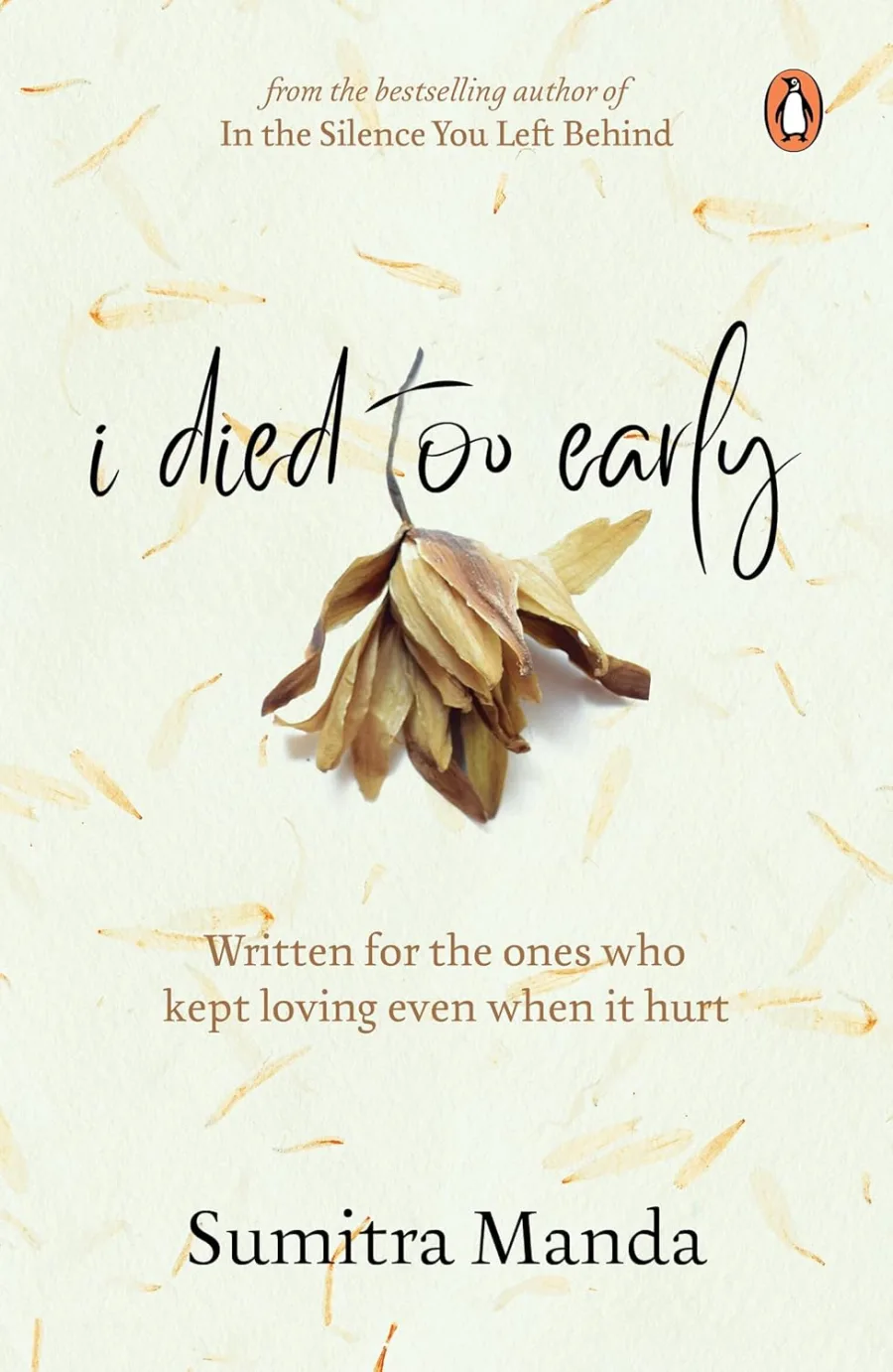
Download Cover Image
Do you want to download the full cover image for I Died Too Early: Written for the Ones Who Kept Loving Even When It Hurt?