
Educart CBSE Class 10 Science Question Bank 2026-27 | Chapterwise, Case-Based & Competency-Based Qs
Paperback
• 455 Pages
• ₹ 749.00
• English
• 9789375162209
No ratings yet
| Publisher | Educart (Agrawal Group Of Publications) |
|---|---|
| ISBN13 | 9789375162209 |
| ASIN/SKU | 9375162206 |
| Book Format | Paperback |
| Language | English |
| Pages | 455 |
| List Price | ₹ 749.00 |
| Publishing Date | 21/04/2026 |
| Dimensions | 21.5 x 2 x 27.5 cm |
| Weight | 875 g |
| Book Code | BD00054681 |
Buy this Book
Amazon Stores
Ebook Stores
Other Stores
Discover Educart CBSE Class 10 Science Question Bank 2026-27 | Chapterwise, Case-Based and Competency-Based Qs by Prashant Kirad. This book is published by Educart (Agrawal Group Of Publications) in Paperback format, ISBN 9789375162209, ASIN 9375162206, under School Books, Test Preparation.
Book Description
The objective of Educart CBSE Class 10 Science Question Bank 2026-27 (with premium colored study visuals for 2027 boards) is to help students understand concepts more easily through simplified notes and visuals. With our latest addition of a 30-minute error-finding challenge, we aim to enhance accuracy and build confidence in students.
What's Unique?
Premium Coloured Study Visuals (for better understanding)
30-Minute Error-Finding Challenge
Unit-wise worksheets (for structured revision)
Key Features
Based on the latest CBSE blueprint and question typology (suitable for 2026-27)
Simplified theory for concept clarity
Ch-wise notes and solved examples
Includes Qs from the DIKSHA platform
Detailed explanations for every answer
Marks breakdown of every example as per the CBSE marking scheme for improved answer writing
Subject Specific Features
Mnemonics for fast revision & easy exam recall
Related theory + caution points to avoid common mistakes
One-Shot Videos available online for chapter-wise revision
What's Unique?
Premium Coloured Study Visuals (for better understanding)
30-Minute Error-Finding Challenge
Unit-wise worksheets (for structured revision)
Key Features
Based on the latest CBSE blueprint and question typology (suitable for 2026-27)
Simplified theory for concept clarity
Ch-wise notes and solved examples
Includes Qs from the DIKSHA platform
Detailed explanations for every answer
Marks breakdown of every example as per the CBSE marking scheme for improved answer writing
Subject Specific Features
Mnemonics for fast revision & easy exam recall
Related theory + caution points to avoid common mistakes
One-Shot Videos available online for chapter-wise revision
Author Biography
Author Biography will be added soon…
Editorial Reviews
Editorial Reviews will be added soon…
Book Summary
Educart CBSE Class 10 Science Question Bank 2026–27 | Chapterwise, Case-Based & Competency-Based Questions by Prashant Kirad and Educart is an exam-oriented practice resource designed for students preparing for the CBSE Class 10 Science examination in the 2026–27 academic session. The book is built around the NCERT curriculum and focuses on helping students move from basic understanding to application, reasoning, and examination practice. Its chapterwise structure makes it possible to study the syllabus systematically while its case-based and competency-based questions prepare students for different styles of CBSE assessment.
Class 10 Science is an important subject because it combines several branches of science and requires different kinds of learning. Students need to understand concepts from Physics, Chemistry, and Biology, remember important scientific facts, interpret diagrams and situations, solve numerical problems, and write explanations accurately. Simply reading the textbook repeatedly is often not enough. Students need to test whether they can actually use what they have learned.
The main strength of a question bank is that it turns passive study into active practice. After completing a chapter from NCERT, students can attempt questions without looking at the answers. Their performance immediately reveals whether the chapter is genuinely understood or only familiar because it has been read several times.
The chapterwise organization is especially useful for Class 10 students. Instead of attempting questions from the entire syllabus at once, they can complete one chapter, practise it, analyze their mistakes, and then move to the next. This creates a manageable study routine and makes it easier to track progress.
The book's emphasis on case-based and competency-based questions is particularly relevant to modern CBSE examinations. Such questions do not always ask students to reproduce textbook sentences. Instead, they may present a situation, observation, diagram, experiment, data set, or real-life example and ask students to apply scientific concepts.
This requires a deeper level of understanding. A student may know the definition of a scientific principle but still struggle to use it in an unfamiliar situation. Competency-based practice helps bridge this gap.
The Chemistry portion of Class 10 Science includes important concepts involving chemical reactions, acids and bases, metals and non-metals, carbon compounds, and periodic classification, along with related topics prescribed in the curriculum. These chapters require a mixture of conceptual understanding, chemical equations, properties, reactions, and application.
Question practice can help students recognize patterns in chemical reactions. Instead of simply memorizing an equation, they can learn to identify the type of reaction and understand what happens to the substances involved.
For example, when studying chemical reactions, students should understand concepts such as combination, decomposition, displacement, double displacement, oxidation, and reduction. A good question bank can present these concepts through different examples so that students learn to identify them rather than memorize one example for each category.
Acids, bases, and salts similarly require students to understand properties, indicators, reactions, pH, and everyday applications. Practice questions can connect textbook concepts with practical situations, making the subject more meaningful.
The chapter on metals and non-metals involves physical and chemical properties, reactivity, reactions, extraction-related ideas, and applications. Students often find it difficult to remember numerous properties. A question-based approach helps them organize information through comparison and application.
Carbon compounds introduce another important area of Chemistry. Students need to understand carbon's bonding behavior, hydrocarbons, functional groups, chemical reactions, and related compounds. These concepts become easier when students understand the underlying patterns rather than trying to memorize every reaction separately.
The Physics section of Class 10 Science requires students to combine concepts with numerical and diagram-based practice. Topics such as light, electricity, magnetic effects, and related phenomena require students to understand principles and apply formulas correctly.
For numerical questions, simply memorizing formulas is not sufficient. Students need to understand what each quantity represents, select the correct formula, substitute values carefully, maintain appropriate units, and interpret the result.
A question bank provides repeated opportunities to practise this process.
Diagram-based questions are also important in Science. Students may need to interpret or draw diagrams related to optical phenomena, electric circuits, magnetic fields, or biological structures. Regular practice helps them become familiar with the expected presentation.
In Physics, students should also learn to check whether their final answer is physically reasonable. Unit errors and calculation mistakes are common, particularly when students rush. Practising step by step can improve accuracy.
The Biology portion requires a different style of preparation. Students need to understand life processes, control and coordination, reproduction, heredity, evolution, environment, and other prescribed concepts. Biology contains a large amount of terminology and factual information, but understanding relationships between concepts is equally important.
For example, students should not merely memorize the names of organs involved in a life process. They should understand how the organs work together and why each step is necessary. Case-based questions can help students apply biological concepts to real-world situations.
Heredity and evolution can similarly become easier when students understand the logic behind inheritance rather than memorizing isolated definitions. Questions can help students practise concepts such as traits, genes, variation, and inheritance patterns.
The book's chapterwise practice also makes revision more efficient. Students can return to a chapter whenever their test performance shows that they need improvement. Rather than rereading the entire syllabus repeatedly, they can focus on specific weak areas.
Another important feature of a question bank is the exposure to different question formats. Students may encounter multiple-choice questions, assertion-based questions, case-based questions, competency-based questions, short-answer questions, and longer explanatory questions.
Practising these different formats helps students understand that the same concept can be tested in several ways.
A student who has memorized one standard answer may struggle when the question is rephrased. A student who understands the concept can adapt the answer to different formats. This is why competency-based practice is particularly valuable.
The book can also help students improve answer-writing skills. Science answers should be clear and precise. Students need to use appropriate scientific terminology, explain processes logically, include equations where required, and label diagrams correctly.
For example, if a question asks for reasons, students should clearly state the reason rather than simply providing a related fact. If a question asks for a comparison, both concepts should be discussed. If a numerical problem requires a calculation, the working should be shown clearly.
Students can use model answers as guides but should avoid memorizing them word for word. The goal is to understand how a strong answer is constructed and then express the idea independently.
Another major benefit is mistake analysis. Students should not simply check whether an answer is right or wrong. They should ask why they made the mistake.
Was the concept misunderstood? Was a formula forgotten? Was a chemical equation written incorrectly? Was a diagram mislabeled? Was the question misread? Was the calculation wrong?
Identifying the cause of the error is often more useful than simply seeing the correct answer.
A dedicated mistake notebook can be particularly helpful. Students can record important errors and revise them regularly. Before the final examination, this notebook can become a highly personalized revision resource.
The book can also be used for self-assessment. After completing several chapters, students can attempt a mixed set without referring to their notes. This provides a more realistic measure of their preparation.
Initially, chapterwise practice is useful because it strengthens individual topics. Later, mixed practice becomes important because the actual examination requires students to switch between Chemistry, Physics, and Biology without knowing which topic will appear next.
Class 10 Science is an important subject because it combines several branches of science and requires different kinds of learning. Students need to understand concepts from Physics, Chemistry, and Biology, remember important scientific facts, interpret diagrams and situations, solve numerical problems, and write explanations accurately. Simply reading the textbook repeatedly is often not enough. Students need to test whether they can actually use what they have learned.
The main strength of a question bank is that it turns passive study into active practice. After completing a chapter from NCERT, students can attempt questions without looking at the answers. Their performance immediately reveals whether the chapter is genuinely understood or only familiar because it has been read several times.
The chapterwise organization is especially useful for Class 10 students. Instead of attempting questions from the entire syllabus at once, they can complete one chapter, practise it, analyze their mistakes, and then move to the next. This creates a manageable study routine and makes it easier to track progress.
The book's emphasis on case-based and competency-based questions is particularly relevant to modern CBSE examinations. Such questions do not always ask students to reproduce textbook sentences. Instead, they may present a situation, observation, diagram, experiment, data set, or real-life example and ask students to apply scientific concepts.
This requires a deeper level of understanding. A student may know the definition of a scientific principle but still struggle to use it in an unfamiliar situation. Competency-based practice helps bridge this gap.
The Chemistry portion of Class 10 Science includes important concepts involving chemical reactions, acids and bases, metals and non-metals, carbon compounds, and periodic classification, along with related topics prescribed in the curriculum. These chapters require a mixture of conceptual understanding, chemical equations, properties, reactions, and application.
Question practice can help students recognize patterns in chemical reactions. Instead of simply memorizing an equation, they can learn to identify the type of reaction and understand what happens to the substances involved.
For example, when studying chemical reactions, students should understand concepts such as combination, decomposition, displacement, double displacement, oxidation, and reduction. A good question bank can present these concepts through different examples so that students learn to identify them rather than memorize one example for each category.
Acids, bases, and salts similarly require students to understand properties, indicators, reactions, pH, and everyday applications. Practice questions can connect textbook concepts with practical situations, making the subject more meaningful.
The chapter on metals and non-metals involves physical and chemical properties, reactivity, reactions, extraction-related ideas, and applications. Students often find it difficult to remember numerous properties. A question-based approach helps them organize information through comparison and application.
Carbon compounds introduce another important area of Chemistry. Students need to understand carbon's bonding behavior, hydrocarbons, functional groups, chemical reactions, and related compounds. These concepts become easier when students understand the underlying patterns rather than trying to memorize every reaction separately.
The Physics section of Class 10 Science requires students to combine concepts with numerical and diagram-based practice. Topics such as light, electricity, magnetic effects, and related phenomena require students to understand principles and apply formulas correctly.
For numerical questions, simply memorizing formulas is not sufficient. Students need to understand what each quantity represents, select the correct formula, substitute values carefully, maintain appropriate units, and interpret the result.
A question bank provides repeated opportunities to practise this process.
Diagram-based questions are also important in Science. Students may need to interpret or draw diagrams related to optical phenomena, electric circuits, magnetic fields, or biological structures. Regular practice helps them become familiar with the expected presentation.
In Physics, students should also learn to check whether their final answer is physically reasonable. Unit errors and calculation mistakes are common, particularly when students rush. Practising step by step can improve accuracy.
The Biology portion requires a different style of preparation. Students need to understand life processes, control and coordination, reproduction, heredity, evolution, environment, and other prescribed concepts. Biology contains a large amount of terminology and factual information, but understanding relationships between concepts is equally important.
For example, students should not merely memorize the names of organs involved in a life process. They should understand how the organs work together and why each step is necessary. Case-based questions can help students apply biological concepts to real-world situations.
Heredity and evolution can similarly become easier when students understand the logic behind inheritance rather than memorizing isolated definitions. Questions can help students practise concepts such as traits, genes, variation, and inheritance patterns.
The book's chapterwise practice also makes revision more efficient. Students can return to a chapter whenever their test performance shows that they need improvement. Rather than rereading the entire syllabus repeatedly, they can focus on specific weak areas.
Another important feature of a question bank is the exposure to different question formats. Students may encounter multiple-choice questions, assertion-based questions, case-based questions, competency-based questions, short-answer questions, and longer explanatory questions.
Practising these different formats helps students understand that the same concept can be tested in several ways.
A student who has memorized one standard answer may struggle when the question is rephrased. A student who understands the concept can adapt the answer to different formats. This is why competency-based practice is particularly valuable.
The book can also help students improve answer-writing skills. Science answers should be clear and precise. Students need to use appropriate scientific terminology, explain processes logically, include equations where required, and label diagrams correctly.
For example, if a question asks for reasons, students should clearly state the reason rather than simply providing a related fact. If a question asks for a comparison, both concepts should be discussed. If a numerical problem requires a calculation, the working should be shown clearly.
Students can use model answers as guides but should avoid memorizing them word for word. The goal is to understand how a strong answer is constructed and then express the idea independently.
Another major benefit is mistake analysis. Students should not simply check whether an answer is right or wrong. They should ask why they made the mistake.
Was the concept misunderstood? Was a formula forgotten? Was a chemical equation written incorrectly? Was a diagram mislabeled? Was the question misread? Was the calculation wrong?
Identifying the cause of the error is often more useful than simply seeing the correct answer.
A dedicated mistake notebook can be particularly helpful. Students can record important errors and revise them regularly. Before the final examination, this notebook can become a highly personalized revision resource.
The book can also be used for self-assessment. After completing several chapters, students can attempt a mixed set without referring to their notes. This provides a more realistic measure of their preparation.
Initially, chapterwise practice is useful because it strengthens individual topics. Later, mixed practice becomes important because the actual examination requires students to switch between Chemistry, Physics, and Biology without knowing which topic will appear next.
Sample Chapters
Sample Chapters will be added soon…
Reader Reviews
No reviews yet.
Educart CBSE Class 10 Science Question Bank 2026-27 | Chapterwise, Case-Based & Competency-Based Qs
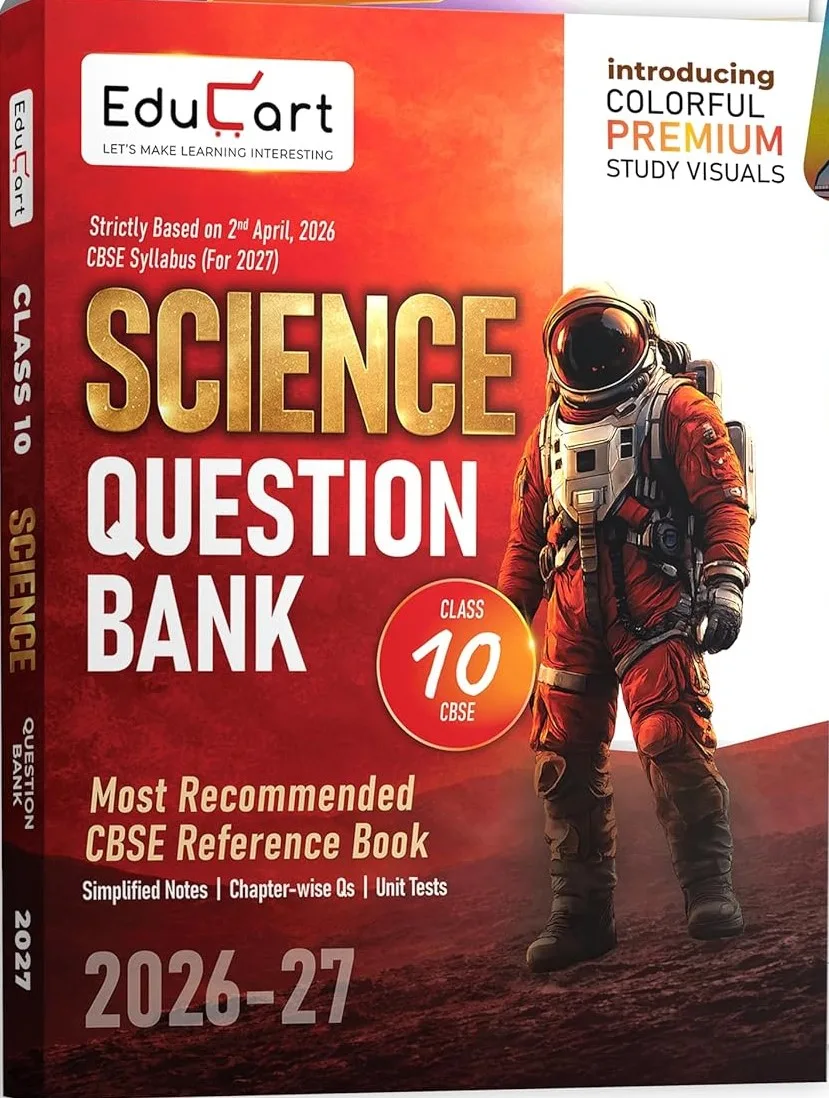
Download Cover Image
Do you want to download the full cover image for Educart CBSE Class 10 Science Question Bank 2026-27 | Chapterwise, Case-Based & Competency-Based Qs?