
Arihant All in One English Language & Literature Class 10 for CBSE Exam 2026-27
Abhishek Singh Tomar, Sanskriti Sinha
Paperback
• 559 Pages
• ₹ 650.00
• English
• 9789373941127
No ratings yet
| Publisher | Arihant Publications India Limited |
|---|---|
| ISBN13 | 9789373941127 |
| ASIN/SKU | 9373941127 |
| Book Format | Paperback |
| Language | English |
| Pages | 559 |
| List Price | ₹ 650.00 |
| Publishing Date | 07/04/2026 |
| Dimensions | 27 x 21 x 2 cm |
| Weight | 559 |
| Book Code | BD00054662 |
Buy this Book
Amazon Stores
Ebook Stores
Other Stores
Discover Arihant All in One English Language and Literature Class 10 for CBSE Exam 2026-27 by Abhishek Singh Tomar. This book is published by Arihant Publications India Limited in Paperback format, ISBN 9789373941127, ASIN 9373941127, under School Books, Test Preparation.
Book Description
All-in-One English Language and Literature for CBSE Class 10 (2026–27) by Arihant is a comprehensive study guide designed to build strong conceptual understanding while ensuring effective exam preparation. It integrates focused theory, extensive practice exercises, and competency-based questions (CBQs) to help students master the subject with confidence. Structured as per the latest CBSE syllabus and exam pattern, the book supports both learning and self-assessment in a clear and organised manner.
Genre: Education/Academic/School Books/CBSE
Audience: CBSE Class 10 students studying English Language and Literature, especially those aiming for strong conceptual clarity and exam readiness.
Key Features:
Based on the latest CBSE syllabus (2026–27 edition)
Well-structured theory with clear explanations
Extensive practice exercises and CBQs
Chapter-wise self-assessment and evaluation tools
Sample papers aligned with the latest exam pattern
Interactive mind maps for quick revision
Focus on conceptual clarity and application-based learning
Includes previous years’ questions and exam-oriented content
Why Choose This Book?
This book is an all-in-one solution for Class 10 English Language and Literature preparation, eliminating the need for multiple resources. Its well-structured content, combined with extensive practice and exam-focused questions, ensures that students not only understand concepts but also gain the confidence to excel in exams. The inclusion of the latest CBSE pattern and teacher-reviewed material makes it a reliable and effective study companion.
Genre: Education/Academic/School Books/CBSE
Audience: CBSE Class 10 students studying English Language and Literature, especially those aiming for strong conceptual clarity and exam readiness.
Key Features:
Based on the latest CBSE syllabus (2026–27 edition)
Well-structured theory with clear explanations
Extensive practice exercises and CBQs
Chapter-wise self-assessment and evaluation tools
Sample papers aligned with the latest exam pattern
Interactive mind maps for quick revision
Focus on conceptual clarity and application-based learning
Includes previous years’ questions and exam-oriented content
Why Choose This Book?
This book is an all-in-one solution for Class 10 English Language and Literature preparation, eliminating the need for multiple resources. Its well-structured content, combined with extensive practice and exam-focused questions, ensures that students not only understand concepts but also gain the confidence to excel in exams. The inclusion of the latest CBSE pattern and teacher-reviewed material makes it a reliable and effective study companion.
Author Biography
Author Biography will be added soon…
Editorial Reviews
Editorial Reviews will be added soon…
Book Summary
Arihant All in One English Language & Literature Class 10 for CBSE Exam 2026–27 by Abhishek Singh Tomar and Sanskriti Sinha is a comprehensive study and examination-preparation book designed for students of CBSE Class 10 English Language and Literature. The book is based on the prescribed CBSE and NCERT curriculum and aims to bring together conceptual explanations, textbook coverage, question practice, revision material, and examination-oriented preparation in one resource.
English in Class 10 is not limited to reading stories and poems. Students are expected to understand literary texts, interpret characters and themes, answer questions in an organized manner, develop writing skills, and apply grammar correctly. Because the subject combines literature, language, and writing, students need a balanced preparation strategy. This book is designed to provide that structure and help students prepare systematically throughout the academic year.
One of the main advantages of an All in One guide is that it brings different parts of the syllabus together. Instead of using separate resources for literature, grammar, writing, and examination practice, students can use one organized book for most of their revision needs. This can make preparation easier, particularly for students who find it difficult to manage several books at the same time.
The book follows the CBSE Class 10 curriculum for the 2026–27 examination session, making it relevant for students preparing for the current academic cycle. However, students should always compare their copy with the latest official CBSE syllabus and examination guidelines because prescribed content and assessment patterns can change.
The literature section is an important part of the book. Class 10 English Language and Literature includes prose, poetry, and supplementary reading. Students need to understand not only what happens in a chapter or poem but also why the characters behave in particular ways, what themes the author explores, and what message or idea the text communicates.
A strong literature answer requires more than simply retelling the story. Students need to identify the central idea, understand character development, recognize important incidents, and explain how those incidents contribute to the overall meaning of the text. The book's explanatory approach can help students develop this kind of understanding.
For prose chapters, students need to become familiar with the plot, characters, setting, themes, important events, and key ideas. Understanding the sequence of events is important, but students should also think about the reasons behind the characters' actions and the changes they experience during the story.
Character-based questions are common in school examinations. A student may be asked to describe a character, explain a particular decision, or discuss how the character changes during the story. The best answers combine evidence from the text with clear explanation. Simply listing adjectives such as “kind,” “brave,” or “honest” is usually less effective than explaining how the character demonstrates those qualities.
The poetry section requires a somewhat different approach. Students need to understand theme, poetic devices, tone, imagery, symbolism, and the poet's message. Poems often communicate ideas through comparisons, metaphors, repetition, sound patterns, and images. Recognizing these techniques can help students write stronger answers.
Poetry can initially seem difficult because the meaning is not always stated directly. Students need to interpret the poet's language and understand the emotions or ideas behind it. A good study guide can make this easier by explaining difficult expressions and identifying important literary features.
The book also supports literary analysis. Instead of simply memorizing prepared answers, students can learn how to approach questions from different perspectives. This is important because examination questions may use different wording even when they are based on the same chapter or poem.
Another major component is grammar. Grammar questions test the student's ability to use English accurately. Topics generally involve areas such as tenses, subject-verb agreement, reported speech, modals, determiners, and other language structures included in the prescribed syllabus.
Grammar becomes easier when students understand the rule and then practise applying it. Memorizing a definition is not enough. A student must be able to identify the correct structure in an unfamiliar sentence. Regular exercises therefore play an important role.
The book's practice-oriented format can help students identify common grammatical mistakes. For example, students may understand a tense concept but confuse it when several time expressions appear in the same question. Repeated practice can gradually improve accuracy.
The writing section is equally important for Class 10 students. Writing tasks require students to communicate ideas clearly within a specified format and word limit. Students need to understand the purpose of the task, organize their ideas logically, use appropriate language, and follow the required format.
Writing practice is particularly useful because students cannot improve simply by reading model answers. They need to write their own responses and then compare them with appropriate standards. Regular writing can improve sentence construction, vocabulary, organization, and confidence.
The book can help students understand the basic structure of different writing tasks. Knowing how to begin, organize the main content, and conclude appropriately can prevent students from wasting time during examinations.
Another important skill is reading comprehension. Students need to read passages carefully, identify the central idea, interpret information, understand vocabulary from context, and answer questions accurately. Reading comprehension is less about memorizing information and more about understanding what the passage actually says.
Practice is therefore essential. Students who regularly solve unseen passages can become more comfortable with unfamiliar topics and different styles of writing. They also learn how to locate relevant information quickly.
The book can also help students improve vocabulary. A strong vocabulary makes both reading and writing easier. While studying literature, students encounter words and expressions that may not be part of their everyday language. Understanding these words helps students interpret the texts more accurately.
Students can maintain a personal vocabulary list while using the book. They can note unfamiliar words, meanings, synonyms, antonyms, and examples. Revising these words periodically can gradually improve their command of English.
One of the strongest benefits of an All in One guide is exam-oriented practice. Students need to know the content of the syllabus, but they also need to understand how questions are framed. Practice questions allow them to become familiar with different types of literature, grammar, writing, and comprehension questions.
Question practice also helps students develop answer-writing skills. Knowing an answer mentally is different from expressing it clearly in an examination. Students need to learn how to identify the key point, provide an explanation, and remain within the expected length.
For literature questions, students should avoid writing unnecessarily long answers. A good answer should directly address the question and support the point with relevant details from the text. Clear structure and precise language are generally more effective than excessive repetition.
The book can also be useful for revision before school tests. Students can study a chapter from the NCERT textbook, use the All in One explanation to clarify difficult points, and then attempt the related questions. This makes it possible to identify weak areas before the final examination.
Regular revision is particularly important in literature because students have to remember details from multiple chapters and poems. Instead of waiting until the end of the year, students should revise completed chapters at intervals.
One useful method is to create a short summary of each chapter in one's own words. Students can then write down the central theme, major characters, important events, and possible questions. For poems, they can note the theme, tone, imagery, and major poetic devices.
The book can also help students prepare for competency-based questions. Modern CBSE examinations increasingly emphasize understanding and application rather than simple recall. A question may present a situation, quotation, inference, or interpretation and ask the student to connect it with a literary text.
This means students should understand the text deeply rather than memorize a fixed set of answers.
English in Class 10 is not limited to reading stories and poems. Students are expected to understand literary texts, interpret characters and themes, answer questions in an organized manner, develop writing skills, and apply grammar correctly. Because the subject combines literature, language, and writing, students need a balanced preparation strategy. This book is designed to provide that structure and help students prepare systematically throughout the academic year.
One of the main advantages of an All in One guide is that it brings different parts of the syllabus together. Instead of using separate resources for literature, grammar, writing, and examination practice, students can use one organized book for most of their revision needs. This can make preparation easier, particularly for students who find it difficult to manage several books at the same time.
The book follows the CBSE Class 10 curriculum for the 2026–27 examination session, making it relevant for students preparing for the current academic cycle. However, students should always compare their copy with the latest official CBSE syllabus and examination guidelines because prescribed content and assessment patterns can change.
The literature section is an important part of the book. Class 10 English Language and Literature includes prose, poetry, and supplementary reading. Students need to understand not only what happens in a chapter or poem but also why the characters behave in particular ways, what themes the author explores, and what message or idea the text communicates.
A strong literature answer requires more than simply retelling the story. Students need to identify the central idea, understand character development, recognize important incidents, and explain how those incidents contribute to the overall meaning of the text. The book's explanatory approach can help students develop this kind of understanding.
For prose chapters, students need to become familiar with the plot, characters, setting, themes, important events, and key ideas. Understanding the sequence of events is important, but students should also think about the reasons behind the characters' actions and the changes they experience during the story.
Character-based questions are common in school examinations. A student may be asked to describe a character, explain a particular decision, or discuss how the character changes during the story. The best answers combine evidence from the text with clear explanation. Simply listing adjectives such as “kind,” “brave,” or “honest” is usually less effective than explaining how the character demonstrates those qualities.
The poetry section requires a somewhat different approach. Students need to understand theme, poetic devices, tone, imagery, symbolism, and the poet's message. Poems often communicate ideas through comparisons, metaphors, repetition, sound patterns, and images. Recognizing these techniques can help students write stronger answers.
Poetry can initially seem difficult because the meaning is not always stated directly. Students need to interpret the poet's language and understand the emotions or ideas behind it. A good study guide can make this easier by explaining difficult expressions and identifying important literary features.
The book also supports literary analysis. Instead of simply memorizing prepared answers, students can learn how to approach questions from different perspectives. This is important because examination questions may use different wording even when they are based on the same chapter or poem.
Another major component is grammar. Grammar questions test the student's ability to use English accurately. Topics generally involve areas such as tenses, subject-verb agreement, reported speech, modals, determiners, and other language structures included in the prescribed syllabus.
Grammar becomes easier when students understand the rule and then practise applying it. Memorizing a definition is not enough. A student must be able to identify the correct structure in an unfamiliar sentence. Regular exercises therefore play an important role.
The book's practice-oriented format can help students identify common grammatical mistakes. For example, students may understand a tense concept but confuse it when several time expressions appear in the same question. Repeated practice can gradually improve accuracy.
The writing section is equally important for Class 10 students. Writing tasks require students to communicate ideas clearly within a specified format and word limit. Students need to understand the purpose of the task, organize their ideas logically, use appropriate language, and follow the required format.
Writing practice is particularly useful because students cannot improve simply by reading model answers. They need to write their own responses and then compare them with appropriate standards. Regular writing can improve sentence construction, vocabulary, organization, and confidence.
The book can help students understand the basic structure of different writing tasks. Knowing how to begin, organize the main content, and conclude appropriately can prevent students from wasting time during examinations.
Another important skill is reading comprehension. Students need to read passages carefully, identify the central idea, interpret information, understand vocabulary from context, and answer questions accurately. Reading comprehension is less about memorizing information and more about understanding what the passage actually says.
Practice is therefore essential. Students who regularly solve unseen passages can become more comfortable with unfamiliar topics and different styles of writing. They also learn how to locate relevant information quickly.
The book can also help students improve vocabulary. A strong vocabulary makes both reading and writing easier. While studying literature, students encounter words and expressions that may not be part of their everyday language. Understanding these words helps students interpret the texts more accurately.
Students can maintain a personal vocabulary list while using the book. They can note unfamiliar words, meanings, synonyms, antonyms, and examples. Revising these words periodically can gradually improve their command of English.
One of the strongest benefits of an All in One guide is exam-oriented practice. Students need to know the content of the syllabus, but they also need to understand how questions are framed. Practice questions allow them to become familiar with different types of literature, grammar, writing, and comprehension questions.
Question practice also helps students develop answer-writing skills. Knowing an answer mentally is different from expressing it clearly in an examination. Students need to learn how to identify the key point, provide an explanation, and remain within the expected length.
For literature questions, students should avoid writing unnecessarily long answers. A good answer should directly address the question and support the point with relevant details from the text. Clear structure and precise language are generally more effective than excessive repetition.
The book can also be useful for revision before school tests. Students can study a chapter from the NCERT textbook, use the All in One explanation to clarify difficult points, and then attempt the related questions. This makes it possible to identify weak areas before the final examination.
Regular revision is particularly important in literature because students have to remember details from multiple chapters and poems. Instead of waiting until the end of the year, students should revise completed chapters at intervals.
One useful method is to create a short summary of each chapter in one's own words. Students can then write down the central theme, major characters, important events, and possible questions. For poems, they can note the theme, tone, imagery, and major poetic devices.
The book can also help students prepare for competency-based questions. Modern CBSE examinations increasingly emphasize understanding and application rather than simple recall. A question may present a situation, quotation, inference, or interpretation and ask the student to connect it with a literary text.
This means students should understand the text deeply rather than memorize a fixed set of answers.
Sample Chapters
Sample Chapters will be added soon…
Reader Reviews
No reviews yet.
Arihant All in One English Language & Literature Class 10 for CBSE Exam 2026-27
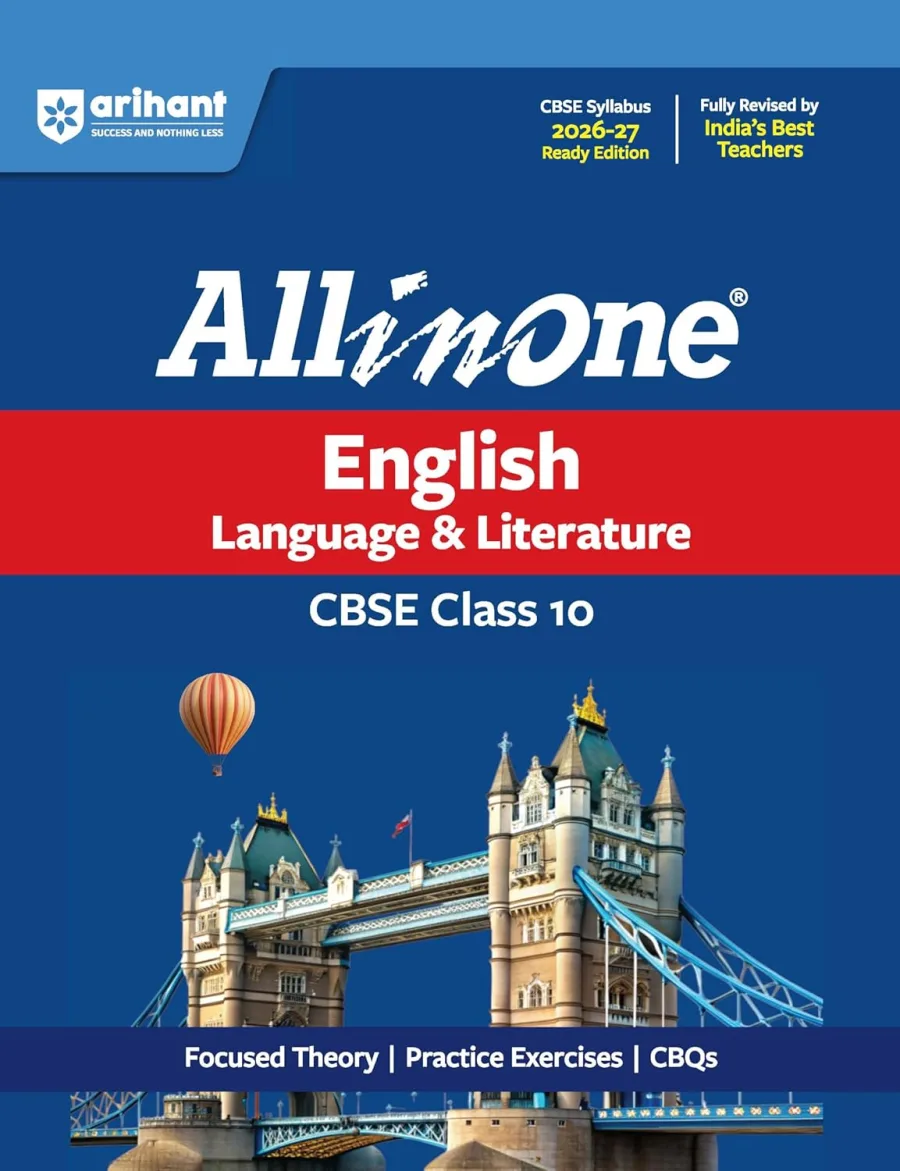
Download Cover Image
Do you want to download the full cover image for Arihant All in One English Language & Literature Class 10 for CBSE Exam 2026-27?