
Arihant All in One Science Class 10 for CBSE Exam 2026-27 | NCERT Based Complete Theory
Paperback
• 580 Pages
• ₹ 650.00
• English
• 9789373941400
No ratings yet
| Publisher | Arihant Publications India Limited |
|---|---|
| ISBN13 | 9789373941400 |
| ASIN/SKU | 9373941402 |
| Book Format | Paperback |
| Language | English |
| Pages | 580 |
| List Price | ₹ 650.00 |
| Publishing Date | 11/04/2026 |
| Dimensions | 27 x 21 x 2 cm |
| Weight | 928 g |
| Book Code | BD00054658 |
Buy this Book
Amazon Stores
Ebook Stores
Other Stores
Discover Arihant All in One Science Class 10 for CBSE Exam 2026-27 | NCERT Based Complete Theory by Alpesh Kumar. This book is published by Arihant Publications India Limited in Paperback format, ISBN 9789373941400, ASIN 9373941402, under School Books, Science.
Book Description
All-in-One Science for CBSE Class 10 (2026–27 Edition) by Arihant is a comprehensive study guide designed to build strong concepts, provide ample practice, and ensure effective assessment. Structured with focused theory, practice exercises, and CBQs in the English medium, this book supports confident learning aligned with the latest CBSE syllabus.
Genre: Education/Academic/School Books/CBSE
Audience: CBSE Class 10 students studying Science, especially those aiming for strong conceptual clarity and exam readiness.
Key Features:
Focused and well-structured theory with clear explanations
Extensive practice exercises and CBQs for exam readiness
Designed to strengthen conceptual clarity
Helps boost exam preparation through targeted practice
Enhances problem-solving skills with graded questions and real exam patterns
Encourages self-learning and continuous assessment
Based on the latest CBSE syllabus and exam pattern (2026–27)
Includes interactive mind maps for quick revision
Provides self-evaluation and assessment exercises in every chapter
Contains sample papers based on the latest exam pattern
Recommended by teachers and trusted by toppers
Why Choose This Book?
This book stands out as a complete learning resource for CBSE Class 10 Science. It not only builds a strong foundation with clear and structured theory but also reinforces learning through extensive practice and self-assessment. With features like mind maps, CBQs, and sample papers aligned to the latest syllabus, it ensures students are fully prepared for exams while improving their problem-solving abilities and confidence.
Genre: Education/Academic/School Books/CBSE
Audience: CBSE Class 10 students studying Science, especially those aiming for strong conceptual clarity and exam readiness.
Key Features:
Focused and well-structured theory with clear explanations
Extensive practice exercises and CBQs for exam readiness
Designed to strengthen conceptual clarity
Helps boost exam preparation through targeted practice
Enhances problem-solving skills with graded questions and real exam patterns
Encourages self-learning and continuous assessment
Based on the latest CBSE syllabus and exam pattern (2026–27)
Includes interactive mind maps for quick revision
Provides self-evaluation and assessment exercises in every chapter
Contains sample papers based on the latest exam pattern
Recommended by teachers and trusted by toppers
Why Choose This Book?
This book stands out as a complete learning resource for CBSE Class 10 Science. It not only builds a strong foundation with clear and structured theory but also reinforces learning through extensive practice and self-assessment. With features like mind maps, CBQs, and sample papers aligned to the latest syllabus, it ensures students are fully prepared for exams while improving their problem-solving abilities and confidence.
Author Biography
Author Biography will be added soon…
Editorial Reviews
Editorial Reviews will be added soon…
Book Summary
Arihant All in One Science Class 10 for CBSE Exam 2026–27 by Alpesh Kumar and Tamanna Sharma is a comprehensive, NCERT-based study and examination guide designed for students preparing for the CBSE Class 10 Science board examination. The revised 2026–27 edition is structured around the latest syllabus and brings together theory, practice, competency-based questions, assertion-reason questions, sample papers, and mind maps in a single volume. Arihant describes the book as a resource for building conceptual clarity as well as improving examination readiness.
The book is designed to solve a common problem faced by Class 10 students: Science requires both understanding and regular practice. Simply memorizing definitions and formulas is not enough because examination questions can ask students to explain concepts, apply principles to unfamiliar situations, interpret information, perform calculations, and give logical reasons. The book therefore combines explanatory material with different types of questions so that students can move from learning a concept to applying it.
The content is based on the NCERT Science curriculum, which makes the book particularly useful for CBSE students. Its theory is organized chapter by chapter and presented in a focused manner so that students can revise important ideas without having to search through several different resources. Arihant describes the theory as clear and well structured, with an emphasis on making concepts easier to understand.
The Science syllabus at this level brings together three major areas: Physics, Chemistry, and Biology. The book helps students study these different branches within one organized framework. Chemistry requires understanding reactions, properties, equations, acids, bases, salts, metals, carbon compounds, and related concepts. Physics involves topics such as light, electricity, magnetic effects, and numerical applications. Biology introduces students to life processes, control and coordination, reproduction, heredity, evolution, and environmental concepts. The combination means that students need different methods of learning, and the book attempts to provide support for each.
The Chemistry portion encourages students to understand scientific reactions rather than merely memorize equations. Chemical reactions and equations, for example, require students to recognize changes in substances, understand different types of reactions, balance equations, and identify the practical significance of chemical processes. Similarly, the chapters dealing with acids, bases, salts, metals, and carbon compounds require students to connect properties with examples and applications.
Another important aspect of Chemistry is the relationship between concepts and everyday life. Materials such as acids, bases, salts, metals, and carbon compounds are not simply laboratory topics; they are connected with food, medicines, cleaning products, fuels, household materials, and industrial processes. Understanding these connections can make the subject easier to remember and can also help students answer application-based questions.
The Physics section requires a somewhat different approach because students need both conceptual understanding and numerical practice. Topics such as electricity involve quantities, relationships, formulas, circuits, and calculations. Students must understand what different physical quantities represent and learn how to apply the appropriate formula in a given situation. The book's combination of theory and practice allows students to review the concept and then test their ability to use it.
Light and its related concepts also require careful understanding of diagrams, terminology, and applications. Students may need to interpret situations involving reflection or refraction, understand image formation, and work with relevant diagrams. Practice is particularly important here because knowing a definition is not enough to answer every type of examination question.
The Biology section focuses more heavily on processes, relationships, diagrams, and explanations. Life processes require students to understand how organisms obtain nutrition, exchange gases, transport substances, and remove waste. These processes involve interconnected systems, so students need to understand how different parts work together rather than memorizing isolated statements.
Chapters related to control and coordination, reproduction, and heredity introduce students to biological mechanisms and the ways organisms respond, reproduce, and pass characteristics from one generation to another. These topics can contain many terms and processes, making organized revision especially useful. The book provides structured explanations intended to help students remember the sequence and relationship between important concepts.
Environmental topics further broaden the subject by connecting Science with everyday human activity. Students learn about ecosystems, energy flow, environmental problems, and the effects of human actions. These chapters encourage students to understand scientific concepts in the context of the world around them.
A major feature of this edition is its practice exercises. After learning theory, students need to test whether they can actually recall and apply the information. Practice questions help identify weak areas and show whether a student understands a concept sufficiently to answer it in written form. The official description specifically identifies practice exercises as one of the central components of the book.
The inclusion of competency-based questions, or CBQs, is especially relevant to modern examination preparation. Such questions require students to apply knowledge rather than simply reproduce memorized lines. A question may present a situation, experiment, data set, observation, or case and ask students to use their scientific understanding to reach an answer. Regular practice with this format can make students more comfortable with unfamiliar questions.
The book also contains assertion-reason questions. These questions test whether students can distinguish between a correct statement and the explanation supporting it. They require careful reading and logical thinking. Students who practice this format can become more attentive to the difference between knowing that something is true and understanding why it is true.
Mind maps provide another method of revision. Science chapters can contain many connected terms, processes, formulas, and relationships. A mind map condenses these ideas into a visual structure, allowing students to review an entire topic more quickly. This can be especially useful before school tests, pre-board examinations, or the final board examination. The current edition explicitly includes mind maps among its features.
The book also includes sample papers, which allow students to move from chapter-wise preparation to complete examination practice. Solving a full paper is different from answering individual chapter questions because students have to manage time, decide which questions to attempt first, and maintain concentration throughout the examination. Sample papers can therefore help students develop both knowledge and exam technique.
Another useful feature is the presence of examples and illustrations. Science becomes easier to understand when abstract ideas are connected with diagrams, situations, observations, and practical applications. Visual explanations can also help students remember processes and structures more effectively than text alone.
The revised edition is specifically designed for the 2026–27 CBSE examination cycle and is described by the publisher as being aligned with the latest syllabus. The edition carries ISBN 9789373941400 and was published in 2026. This makes it more appropriate for students preparing for the current academic session than relying on an older edition without checking syllabus changes.
For effective preparation, the book works best when used alongside the original NCERT textbook rather than as a complete replacement for it. Students should first understand the NCERT material carefully, including diagrams, examples, activities, and important explanations. The Arihant guide can then be used to reinforce those concepts, simplify revision, and provide additional examination practice.
A sensible approach is to study one chapter carefully, revise its important concepts, solve the practice questions, and then attempt competency-based and assertion-reason questions. Difficult questions can be marked for later revision. Once several chapters are complete, students can use the mind maps to refresh their memory and eventually move on to sample papers.
The book is particularly useful for students who want a single resource combining learning, practice, and assessment.
The book is designed to solve a common problem faced by Class 10 students: Science requires both understanding and regular practice. Simply memorizing definitions and formulas is not enough because examination questions can ask students to explain concepts, apply principles to unfamiliar situations, interpret information, perform calculations, and give logical reasons. The book therefore combines explanatory material with different types of questions so that students can move from learning a concept to applying it.
The content is based on the NCERT Science curriculum, which makes the book particularly useful for CBSE students. Its theory is organized chapter by chapter and presented in a focused manner so that students can revise important ideas without having to search through several different resources. Arihant describes the theory as clear and well structured, with an emphasis on making concepts easier to understand.
The Science syllabus at this level brings together three major areas: Physics, Chemistry, and Biology. The book helps students study these different branches within one organized framework. Chemistry requires understanding reactions, properties, equations, acids, bases, salts, metals, carbon compounds, and related concepts. Physics involves topics such as light, electricity, magnetic effects, and numerical applications. Biology introduces students to life processes, control and coordination, reproduction, heredity, evolution, and environmental concepts. The combination means that students need different methods of learning, and the book attempts to provide support for each.
The Chemistry portion encourages students to understand scientific reactions rather than merely memorize equations. Chemical reactions and equations, for example, require students to recognize changes in substances, understand different types of reactions, balance equations, and identify the practical significance of chemical processes. Similarly, the chapters dealing with acids, bases, salts, metals, and carbon compounds require students to connect properties with examples and applications.
Another important aspect of Chemistry is the relationship between concepts and everyday life. Materials such as acids, bases, salts, metals, and carbon compounds are not simply laboratory topics; they are connected with food, medicines, cleaning products, fuels, household materials, and industrial processes. Understanding these connections can make the subject easier to remember and can also help students answer application-based questions.
The Physics section requires a somewhat different approach because students need both conceptual understanding and numerical practice. Topics such as electricity involve quantities, relationships, formulas, circuits, and calculations. Students must understand what different physical quantities represent and learn how to apply the appropriate formula in a given situation. The book's combination of theory and practice allows students to review the concept and then test their ability to use it.
Light and its related concepts also require careful understanding of diagrams, terminology, and applications. Students may need to interpret situations involving reflection or refraction, understand image formation, and work with relevant diagrams. Practice is particularly important here because knowing a definition is not enough to answer every type of examination question.
The Biology section focuses more heavily on processes, relationships, diagrams, and explanations. Life processes require students to understand how organisms obtain nutrition, exchange gases, transport substances, and remove waste. These processes involve interconnected systems, so students need to understand how different parts work together rather than memorizing isolated statements.
Chapters related to control and coordination, reproduction, and heredity introduce students to biological mechanisms and the ways organisms respond, reproduce, and pass characteristics from one generation to another. These topics can contain many terms and processes, making organized revision especially useful. The book provides structured explanations intended to help students remember the sequence and relationship between important concepts.
Environmental topics further broaden the subject by connecting Science with everyday human activity. Students learn about ecosystems, energy flow, environmental problems, and the effects of human actions. These chapters encourage students to understand scientific concepts in the context of the world around them.
A major feature of this edition is its practice exercises. After learning theory, students need to test whether they can actually recall and apply the information. Practice questions help identify weak areas and show whether a student understands a concept sufficiently to answer it in written form. The official description specifically identifies practice exercises as one of the central components of the book.
The inclusion of competency-based questions, or CBQs, is especially relevant to modern examination preparation. Such questions require students to apply knowledge rather than simply reproduce memorized lines. A question may present a situation, experiment, data set, observation, or case and ask students to use their scientific understanding to reach an answer. Regular practice with this format can make students more comfortable with unfamiliar questions.
The book also contains assertion-reason questions. These questions test whether students can distinguish between a correct statement and the explanation supporting it. They require careful reading and logical thinking. Students who practice this format can become more attentive to the difference between knowing that something is true and understanding why it is true.
Mind maps provide another method of revision. Science chapters can contain many connected terms, processes, formulas, and relationships. A mind map condenses these ideas into a visual structure, allowing students to review an entire topic more quickly. This can be especially useful before school tests, pre-board examinations, or the final board examination. The current edition explicitly includes mind maps among its features.
The book also includes sample papers, which allow students to move from chapter-wise preparation to complete examination practice. Solving a full paper is different from answering individual chapter questions because students have to manage time, decide which questions to attempt first, and maintain concentration throughout the examination. Sample papers can therefore help students develop both knowledge and exam technique.
Another useful feature is the presence of examples and illustrations. Science becomes easier to understand when abstract ideas are connected with diagrams, situations, observations, and practical applications. Visual explanations can also help students remember processes and structures more effectively than text alone.
The revised edition is specifically designed for the 2026–27 CBSE examination cycle and is described by the publisher as being aligned with the latest syllabus. The edition carries ISBN 9789373941400 and was published in 2026. This makes it more appropriate for students preparing for the current academic session than relying on an older edition without checking syllabus changes.
For effective preparation, the book works best when used alongside the original NCERT textbook rather than as a complete replacement for it. Students should first understand the NCERT material carefully, including diagrams, examples, activities, and important explanations. The Arihant guide can then be used to reinforce those concepts, simplify revision, and provide additional examination practice.
A sensible approach is to study one chapter carefully, revise its important concepts, solve the practice questions, and then attempt competency-based and assertion-reason questions. Difficult questions can be marked for later revision. Once several chapters are complete, students can use the mind maps to refresh their memory and eventually move on to sample papers.
The book is particularly useful for students who want a single resource combining learning, practice, and assessment.
Sample Chapters
Sample Chapters will be added soon…
Reader Reviews
No reviews yet.
Arihant All in One Science Class 10 for CBSE Exam 2026-27 | NCERT Based Complete Theory
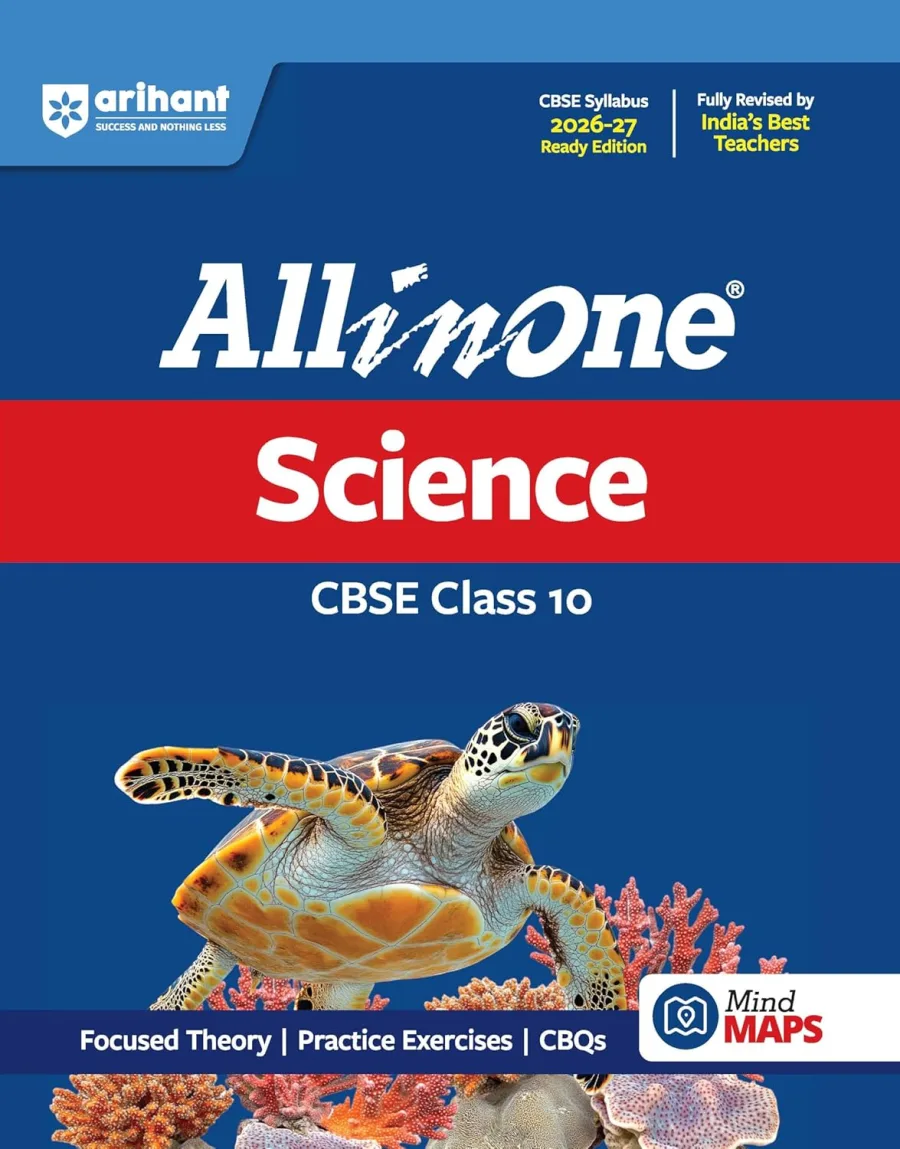
Download Cover Image
Do you want to download the full cover image for Arihant All in One Science Class 10 for CBSE Exam 2026-27 | NCERT Based Complete Theory?