
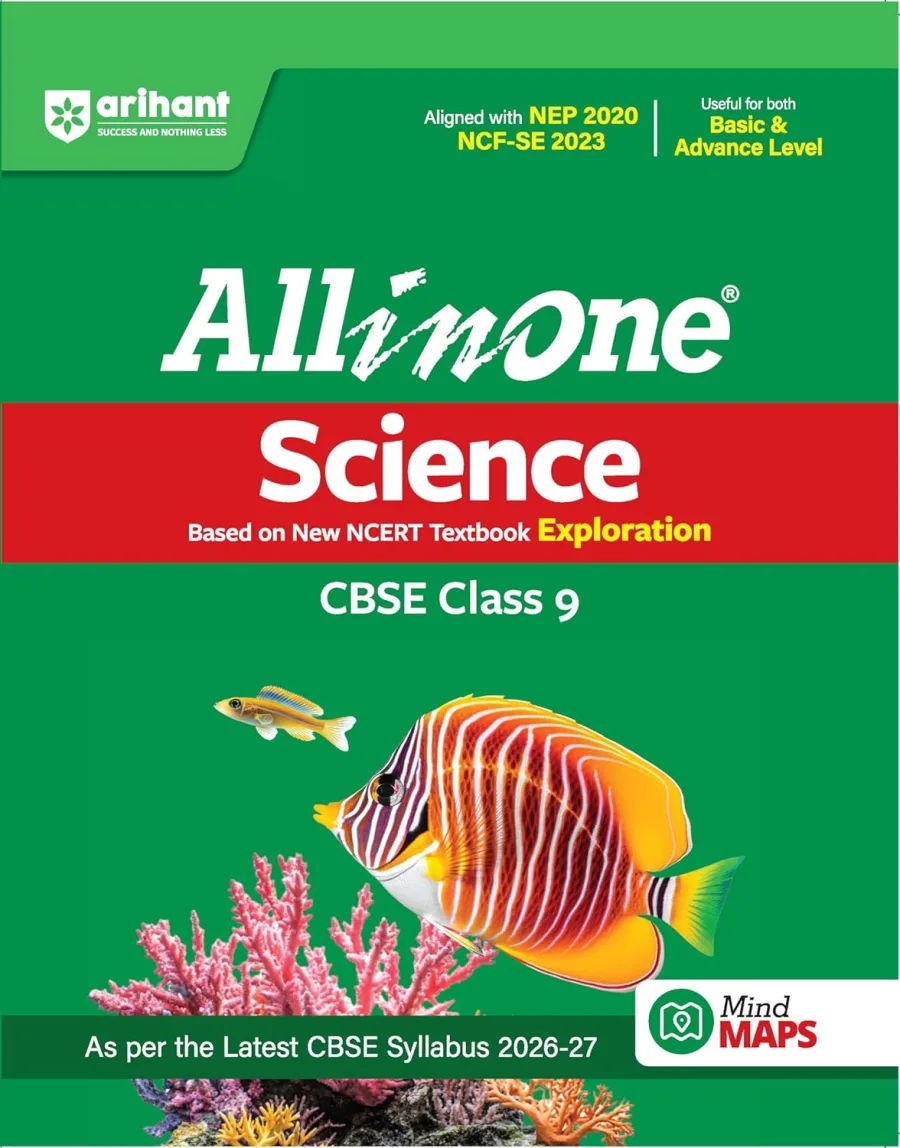
Arihant All in One Science (Exploration) Class 9 for CBSE Exam 2026-27 | NCERT Based Complete Theory
Paperback
• 540 Pages
• ₹ 650.00
• English
• 9789378162640
No ratings yet
| Publisher | Arihant Publications India Limited |
|---|---|
| ISBN13 | 9789378162640 |
| ASIN/SKU | 9378162649 |
| Book Format | Paperback |
| Language | English |
| Pages | 540 |
| List Price | ₹ 650.00 |
| Publishing Date | 25/04/2026 |
| Dimensions | 27 x 21 x 4 cm |
| Weight | 864 g |
| Book Code | BD00054657 |
Buy this Book
Amazon Stores
Ebook Stores
Other Stores
Discover Arihant All in One Science (Exploration) Class 9 for CBSE Exam 2026-27 | NCERT Based Complete Theory by Siddhartha Shankar. This book is published by Arihant Publications India Limited in Paperback format, ISBN 9789378162640, ASIN 9378162649, under School Books, Science.
Book Description
All-in-One Science for CBSE Class 9 (2026–27 Edition) by Arihant is a comprehensive study guide designed to build strong concepts, provide ample practice, and ensure effective assessment. Structured with focused theory, practice exercises, and CBQs in the English medium, this book supports confident learning aligned with the latest CBSE syllabus.
Genre: Education/Academic/School Books/CBSE
Audience: CBSE Class 9 students studying Science, especially those aiming for strong conceptual clarity and exam readiness.
Key Features:
Complete coverage of the latest CBSE Class 9 Science syllabus
Chapter-wise structured theory aligned with NCERT
Extensive practice questions, including CBQs
Graded questions based on real exam patterns
Mind maps for quick revision and concept clarity
In-chapter and end-of-chapter assessment exercises
Sample papers based on the latest exam pattern
Focus on conceptual clarity, problem-solving, and self-assessment
Why Choose This Book?
This book is an all-in-one resource that combines clear explanations, systematic practice, and exam-oriented preparation in a single volume. It helps students strengthen fundamentals, improve analytical skills, and gain confidence through continuous assessment and revision tools, making it highly reliable for consistent academic performance.
Genre: Education/Academic/School Books/CBSE
Audience: CBSE Class 9 students studying Science, especially those aiming for strong conceptual clarity and exam readiness.
Key Features:
Complete coverage of the latest CBSE Class 9 Science syllabus
Chapter-wise structured theory aligned with NCERT
Extensive practice questions, including CBQs
Graded questions based on real exam patterns
Mind maps for quick revision and concept clarity
In-chapter and end-of-chapter assessment exercises
Sample papers based on the latest exam pattern
Focus on conceptual clarity, problem-solving, and self-assessment
Why Choose This Book?
This book is an all-in-one resource that combines clear explanations, systematic practice, and exam-oriented preparation in a single volume. It helps students strengthen fundamentals, improve analytical skills, and gain confidence through continuous assessment and revision tools, making it highly reliable for consistent academic performance.
Author Biography
Author Biography will be added soon…
Editorial Reviews
Editorial Reviews will be added soon…
Book Summary
Arihant All in One Science (Exploration) Class 9 for CBSE Exam 2026–27 by Siddhartha Shankar is a comprehensive study and revision guide designed for students preparing for the Class 9 CBSE Science examination. Based on the NCERT curriculum, the book aims to bring together the essential theory, explanations, examples, practice questions, and examination-oriented preparation that a student needs in one place. Rather than functioning only as a supplementary question bank, it is designed to support students throughout their academic preparation, from understanding fundamental concepts to revising important material before examinations.
The main purpose of the book is to make Class 9 Science easier to study in a structured manner. Science at this level introduces students to concepts from Physics, Chemistry, and Biology that form the foundation for higher classes. Students are expected not only to remember definitions but also to understand processes, relationships, diagrams, formulas, and applications. The book therefore follows the NCERT-based syllabus while presenting concepts in a more examination-friendly format.
The Chemistry portion introduces students to the basic nature and structure of matter. One of the foundational ideas is that matter is made up of particles and that these particles have specific characteristics. Students explore the different states of matter—solid, liquid, and gas—and learn how changes in temperature and pressure can affect these states. Concepts such as melting, freezing, evaporation, condensation, and sublimation help students understand how matter changes from one form to another.
The book also develops an understanding of the physical nature of matter through concepts such as diffusion, density, and the movement of particles. These ideas are important because they provide a foundation for understanding more advanced chemistry later. Instead of treating matter as something static, students learn to see it as a system of particles that are continuously interacting and changing.
Another major area is the classification of matter. Students learn about mixtures and pure substances and the difference between homogeneous and heterogeneous mixtures. The study of solutions, suspensions, and colloids helps learners understand how substances can be combined and separated. Methods of separation, such as filtration, evaporation, centrifugation, distillation, and chromatography, demonstrate how scientific principles can be applied to everyday situations.
The Chemistry section then moves toward atoms and molecules. Students are introduced to the basic laws of chemical combination and the ideas behind atomic and molecular structure. Understanding atoms is essential because it provides the foundation for chemistry as a whole. Students learn about symbols, atomic mass, molecular mass, and the representation of substances through chemical formulae. These concepts can initially seem abstract, so a structured explanation and repeated practice are particularly useful at this stage.
The Physics section introduces students to the language and concepts used to describe the physical world. Motion is one of the major starting points. Students learn about distance, displacement, speed, velocity, acceleration, and graphical representation of motion. These concepts help students understand how objects move and how their motion can be measured and represented mathematically.
The book also introduces Newton's laws of motion and the concept of force. Students learn that forces can change the state of motion of an object and that motion depends on the interaction between objects. Newton's laws are particularly important because they form the basis for understanding many everyday phenomena. Examples involving pushing, pulling, acceleration, and changes in motion help connect abstract principles with familiar experiences.
Gravitation is another significant area. Students learn about the universal nature of gravitational attraction and its role in phenomena such as falling objects, planetary motion, and weight. The distinction between mass and weight is particularly important for students because these terms are often confused in everyday language. The book provides the theoretical foundation and numerical practice needed to understand the topic more confidently.
Work and energy introduce students to another major part of Physics. Learners explore the meaning of work in the scientific sense and study forms of energy such as kinetic and potential energy. The relationship between work and energy helps students understand how energy is transferred and transformed. Numerical problems and formula-based exercises can help students learn how to apply these concepts rather than merely memorize definitions.
The Biology portion focuses on the structure and organization of living organisms. Students learn about cells as the fundamental units of life and study the differences between plant and animal cells. Cell organelles and their functions are explained so that students can understand how different parts of a cell contribute to its functioning. This topic provides a foundation for later study of tissues, organs, and biological systems.
Tissues form another important part of the Biology curriculum. Students learn how groups of similar cells work together to perform specific functions. Plant tissues and animal tissues are studied separately, allowing students to understand how organisms are organized at different levels. Diagrams and comparisons are particularly useful in this area because many examination questions require students to identify structures and distinguish between different types of tissues.
The book also covers diversity in living organisms. Students are introduced to the need for classification and the ways scientists organize living organisms into groups. Classification helps learners understand the enormous variety of life and the similarities and differences among organisms. The topic connects biology with evolutionary relationships and provides a systematic way of studying living forms.
Why Do We Fall Ill? introduces students to health and disease. The chapter helps learners distinguish between health and the absence of disease and introduces infectious and non-infectious diseases, their causes, modes of transmission, prevention, and treatment. Students also learn about the role of microorganisms and the importance of public health measures. The subject connects scientific knowledge with everyday life and encourages students to think about health in a broader social context.
Natural resources and improvement in food resources bring science into the areas of environment and agriculture. Students learn about air, water, soil, and other natural resources and examine the importance of maintaining ecological balance. The improvement of food resources introduces agricultural practices, crop production, animal husbandry, and related methods used to increase the availability and quality of food.
A major advantage of an All in One guide is that it combines explanation with examination practice. Students can study a concept, review key points, and then test their understanding through questions. This helps identify areas that require additional revision. Regular practice is especially important in Science because understanding a chapter once does not guarantee that a student will be able to answer examination questions correctly.
The book is also designed to make revision more efficient. Class 9 students often have to manage several subjects simultaneously, so having a single comprehensive Science resource can help organize preparation. Important definitions, concepts, diagrams, formulae, and questions can be reviewed systematically rather than being scattered across different sources.
However, because the guide is NCERT-based, the NCERT textbook remains an important foundation. Students should read the original NCERT material carefully, especially for conceptual explanations, diagrams, activities, and questions. The Arihant guide is most useful when used alongside NCERT rather than as a complete replacement for it.
Overall, Arihant All in One Science (Exploration) Class 9 for CBSE Exam 2026–27 by Siddhartha Shankar is designed to provide students with a structured and examination-focused approach to Class 9 Science. It brings together Physics, Chemistry, and Biology concepts in a single resource and supports learning through theory, explanations, examples, diagrams, and practice. Its NCERT-based structure makes it particularly suitable for students who want additional guidance while following the CBSE curriculum.
The deeper value of the book is that it encourages students to approach Science as a subject that requires both understanding and application.
The main purpose of the book is to make Class 9 Science easier to study in a structured manner. Science at this level introduces students to concepts from Physics, Chemistry, and Biology that form the foundation for higher classes. Students are expected not only to remember definitions but also to understand processes, relationships, diagrams, formulas, and applications. The book therefore follows the NCERT-based syllabus while presenting concepts in a more examination-friendly format.
The Chemistry portion introduces students to the basic nature and structure of matter. One of the foundational ideas is that matter is made up of particles and that these particles have specific characteristics. Students explore the different states of matter—solid, liquid, and gas—and learn how changes in temperature and pressure can affect these states. Concepts such as melting, freezing, evaporation, condensation, and sublimation help students understand how matter changes from one form to another.
The book also develops an understanding of the physical nature of matter through concepts such as diffusion, density, and the movement of particles. These ideas are important because they provide a foundation for understanding more advanced chemistry later. Instead of treating matter as something static, students learn to see it as a system of particles that are continuously interacting and changing.
Another major area is the classification of matter. Students learn about mixtures and pure substances and the difference between homogeneous and heterogeneous mixtures. The study of solutions, suspensions, and colloids helps learners understand how substances can be combined and separated. Methods of separation, such as filtration, evaporation, centrifugation, distillation, and chromatography, demonstrate how scientific principles can be applied to everyday situations.
The Chemistry section then moves toward atoms and molecules. Students are introduced to the basic laws of chemical combination and the ideas behind atomic and molecular structure. Understanding atoms is essential because it provides the foundation for chemistry as a whole. Students learn about symbols, atomic mass, molecular mass, and the representation of substances through chemical formulae. These concepts can initially seem abstract, so a structured explanation and repeated practice are particularly useful at this stage.
The Physics section introduces students to the language and concepts used to describe the physical world. Motion is one of the major starting points. Students learn about distance, displacement, speed, velocity, acceleration, and graphical representation of motion. These concepts help students understand how objects move and how their motion can be measured and represented mathematically.
The book also introduces Newton's laws of motion and the concept of force. Students learn that forces can change the state of motion of an object and that motion depends on the interaction between objects. Newton's laws are particularly important because they form the basis for understanding many everyday phenomena. Examples involving pushing, pulling, acceleration, and changes in motion help connect abstract principles with familiar experiences.
Gravitation is another significant area. Students learn about the universal nature of gravitational attraction and its role in phenomena such as falling objects, planetary motion, and weight. The distinction between mass and weight is particularly important for students because these terms are often confused in everyday language. The book provides the theoretical foundation and numerical practice needed to understand the topic more confidently.
Work and energy introduce students to another major part of Physics. Learners explore the meaning of work in the scientific sense and study forms of energy such as kinetic and potential energy. The relationship between work and energy helps students understand how energy is transferred and transformed. Numerical problems and formula-based exercises can help students learn how to apply these concepts rather than merely memorize definitions.
The Biology portion focuses on the structure and organization of living organisms. Students learn about cells as the fundamental units of life and study the differences between plant and animal cells. Cell organelles and their functions are explained so that students can understand how different parts of a cell contribute to its functioning. This topic provides a foundation for later study of tissues, organs, and biological systems.
Tissues form another important part of the Biology curriculum. Students learn how groups of similar cells work together to perform specific functions. Plant tissues and animal tissues are studied separately, allowing students to understand how organisms are organized at different levels. Diagrams and comparisons are particularly useful in this area because many examination questions require students to identify structures and distinguish between different types of tissues.
The book also covers diversity in living organisms. Students are introduced to the need for classification and the ways scientists organize living organisms into groups. Classification helps learners understand the enormous variety of life and the similarities and differences among organisms. The topic connects biology with evolutionary relationships and provides a systematic way of studying living forms.
Why Do We Fall Ill? introduces students to health and disease. The chapter helps learners distinguish between health and the absence of disease and introduces infectious and non-infectious diseases, their causes, modes of transmission, prevention, and treatment. Students also learn about the role of microorganisms and the importance of public health measures. The subject connects scientific knowledge with everyday life and encourages students to think about health in a broader social context.
Natural resources and improvement in food resources bring science into the areas of environment and agriculture. Students learn about air, water, soil, and other natural resources and examine the importance of maintaining ecological balance. The improvement of food resources introduces agricultural practices, crop production, animal husbandry, and related methods used to increase the availability and quality of food.
A major advantage of an All in One guide is that it combines explanation with examination practice. Students can study a concept, review key points, and then test their understanding through questions. This helps identify areas that require additional revision. Regular practice is especially important in Science because understanding a chapter once does not guarantee that a student will be able to answer examination questions correctly.
The book is also designed to make revision more efficient. Class 9 students often have to manage several subjects simultaneously, so having a single comprehensive Science resource can help organize preparation. Important definitions, concepts, diagrams, formulae, and questions can be reviewed systematically rather than being scattered across different sources.
However, because the guide is NCERT-based, the NCERT textbook remains an important foundation. Students should read the original NCERT material carefully, especially for conceptual explanations, diagrams, activities, and questions. The Arihant guide is most useful when used alongside NCERT rather than as a complete replacement for it.
Overall, Arihant All in One Science (Exploration) Class 9 for CBSE Exam 2026–27 by Siddhartha Shankar is designed to provide students with a structured and examination-focused approach to Class 9 Science. It brings together Physics, Chemistry, and Biology concepts in a single resource and supports learning through theory, explanations, examples, diagrams, and practice. Its NCERT-based structure makes it particularly suitable for students who want additional guidance while following the CBSE curriculum.
The deeper value of the book is that it encourages students to approach Science as a subject that requires both understanding and application.
Sample Chapters
Sample Chapters will be added soon…
Reader Reviews
No reviews yet.
Arihant All in One Science (Exploration) Class 9 for CBSE Exam 2026-27 | NCERT Based Complete Theory
Download Cover Image
Do you want to download the full cover image for Arihant All in One Science (Exploration) Class 9 for CBSE Exam 2026-27 | NCERT Based Complete Theory?