
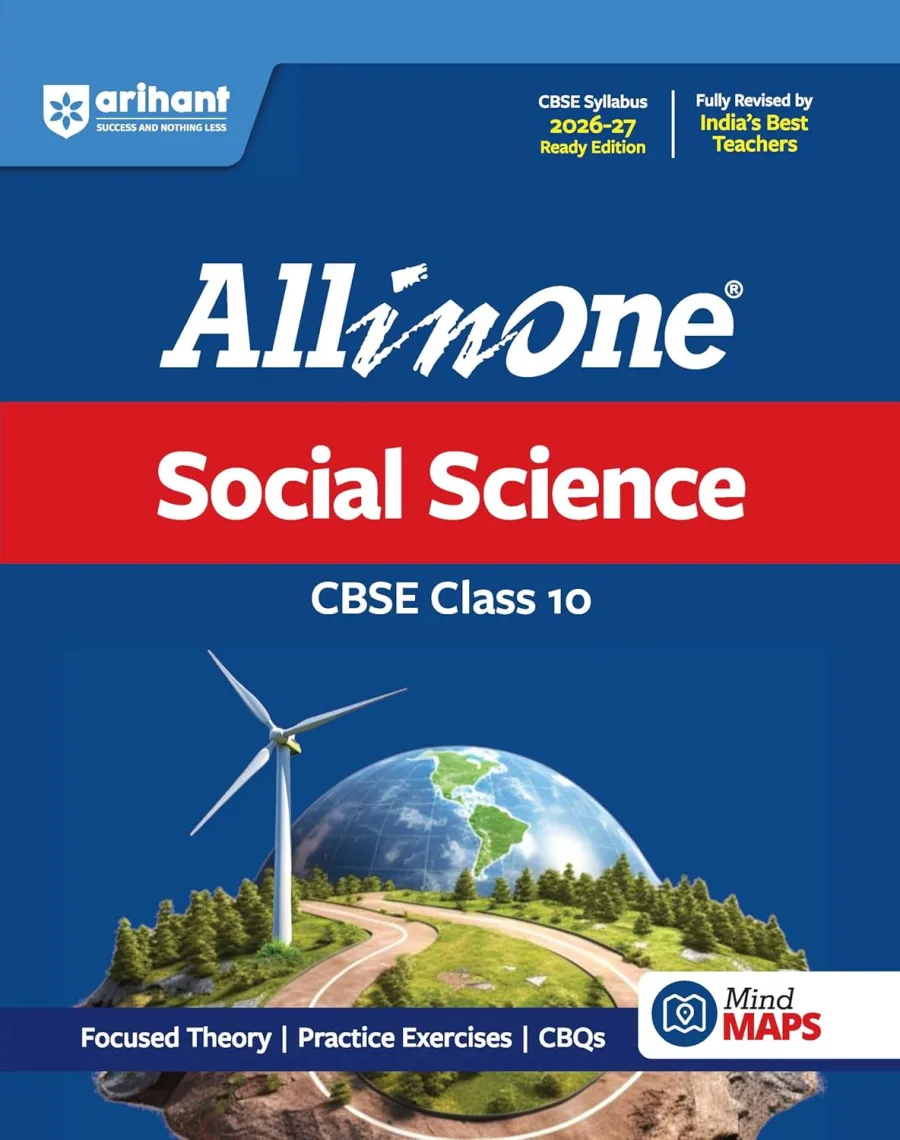
Arihant All in One Social Science Class 10 for CBSE Exam 2026-27 | NCERT Based Complete Theory
Paperback
• 560 Pages
• ₹ 650.00
• English
• 9789373949581
No ratings yet
| Publisher | Arihant Publications India Limited |
|---|---|
| ISBN13 | 9789373949581 |
| ASIN/SKU | 9373949586 |
| Book Format | Paperback |
| Language | English |
| Pages | 560 |
| List Price | ₹ 650.00 |
| Publishing Date | 07/04/2026 |
| Dimensions | 27 x 21 x 2 cm |
| Weight | 896 g |
| Book Code | BD00054655 |
Buy this Book
Amazon Stores
Ebook Stores
Other Stores
Discover Arihant All in One Social Science Class 10 for CBSE Exam 2026-27 | NCERT Based Complete Theory by Jyoti Arora. This book is published by Arihant Publications India Limited in Paperback format, ISBN 9789373949581, ASIN 9373949586, under School Books, Social Sciences.
Book Description
Arihant All-in-One Social Science for CBSE Class 10 is a comprehensive study guide designed to build strong conceptual understanding while ensuring effective exam preparation. It combines well-structured theory with extensive practice exercises and competency-based questions (CBQs), aligned with the latest CBSE syllabus (2026–27) in the English medium. The book emphasises clarity, application, and continuous assessment to help students perform confidently in exams.
Genre: Education/Academic/School Books/CBSE
Audience: CBSE Class 10 students studying Social Science, especially those aiming for strong conceptual clarity and exam readiness.
Key Features:
Complete coverage based on the latest CBSE syllabus and exam pattern
Well-structured and easy-to-understand theory in each chapter
Extensive practice exercises, including CBQs
Chapter-wise assessment and self-evaluation tools
Inclusion of sample papers based on the latest exam pattern
Mind maps for quick and effective revision
Focus on conceptual clarity and real exam-level questions
Encourages self-learning and continuous performance improvement
Designed and reviewed by experienced educators
Why Choose This Book?
This book is an ideal all-in-one resource for Class 10 students seeking a balance between theory and practice. It not only strengthens conceptual understanding but also enhances problem-solving skills through exam-oriented questions. With updated content, structured revision tools, and comprehensive practice material, it ensures students are fully prepared and confident to excel in their Social Science exams.
Genre: Education/Academic/School Books/CBSE
Audience: CBSE Class 10 students studying Social Science, especially those aiming for strong conceptual clarity and exam readiness.
Key Features:
Complete coverage based on the latest CBSE syllabus and exam pattern
Well-structured and easy-to-understand theory in each chapter
Extensive practice exercises, including CBQs
Chapter-wise assessment and self-evaluation tools
Inclusion of sample papers based on the latest exam pattern
Mind maps for quick and effective revision
Focus on conceptual clarity and real exam-level questions
Encourages self-learning and continuous performance improvement
Designed and reviewed by experienced educators
Why Choose This Book?
This book is an ideal all-in-one resource for Class 10 students seeking a balance between theory and practice. It not only strengthens conceptual understanding but also enhances problem-solving skills through exam-oriented questions. With updated content, structured revision tools, and comprehensive practice material, it ensures students are fully prepared and confident to excel in their Social Science exams.
Author Biography
Author Biography will be added soon…
Editorial Reviews
Editorial Reviews will be added soon…
Book Summary
Arihant All in One Social Science Class 10 for CBSE Exam 2026–27 by Jyoti Arora and Nauseen Nigar is a comprehensive NCERT-based study and examination guide designed for students preparing for the CBSE Class 10 Social Science examination. The revised edition is aligned with the latest syllabus and combines complete theory with practice exercises, competency-based questions, assertion-reason questions, mind maps, and sample papers. Arihant presents it as a resource that brings conceptual learning and examination preparation together in one book.
The book covers the major areas of Class 10 Social Science, including History, Geography, Political Science, and Economics. Because Social Science contains a large amount of information, students often find it difficult to decide what to study, how deeply to study it, and how to prepare for different question formats. This book attempts to solve that problem by organizing the NCERT-based material chapter by chapter and following it with examination-oriented practice.
The History section is based on India and the Contemporary World–II. It helps students understand important developments that shaped the modern world and India. Rather than treating history simply as a list of dates and events, the book explains political, economic, social, and cultural changes and shows how different historical developments influenced one another. This approach is particularly useful because CBSE questions increasingly require students to understand causes, consequences, comparisons, and historical relationships.
One important theme in the History portion is the development of nationalism. Students study the growth of national identities, political movements, conflicts, and the forces that contributed to the formation of modern nation-states. The Indian national movement receives particular attention, allowing students to understand how different groups participated in the struggle against colonial rule and how ideas of nationalism developed in India.
The History section also introduces students to industrialization and its consequences. Industrial growth transformed production, employment, trade, cities, and social relationships. Students learn how new technologies and production systems affected workers and consumers and how industrialization contributed to broader economic and social changes. The book connects these developments with global trade and the changing world economy.
The Geography portion follows the NCERT framework of Contemporary India–II. It focuses on India's resources, agriculture, industries, manufacturing, transportation, communication, and related economic activities. Geography is presented not merely as the study of places but as a subject that explains how natural resources and human activities interact.
Resource management is an important starting point. Students learn about different types of resources and the importance of planning and conservation. Land, soil, water, forests, minerals, and energy resources are essential for development, but excessive exploitation can create environmental and economic problems. The book encourages students to understand why sustainable resource use is necessary.
Agriculture is another major area. Students study different types of farming, cropping patterns, major crops, technological developments, and the role of agriculture in the Indian economy. Understanding agriculture also requires students to connect physical conditions such as climate and soil with human factors such as irrigation, technology, markets, and government policies.
Manufacturing industries form another important part of Geography. The book explains how industries depend on raw materials, energy, labour, transportation, markets, and infrastructure. Different industries are associated with different locations because their requirements vary. Students therefore learn to analyze why certain industries develop in particular regions rather than simply memorizing their names and locations.
The Geography section also discusses transport and communication. Roads, railways, waterways, airways, ports, and communication networks connect producers, consumers, markets, and regions. These systems are essential for economic development because goods and people need to move efficiently. Students can therefore understand infrastructure as a major factor connecting different parts of the Indian economy.
Political Science, or Democratic Politics–II, introduces students to the functioning of democracy. The book examines power-sharing, federalism, gender and social differences, political parties, outcomes of democracy, and challenges faced by democratic systems. These chapters encourage students to understand democracy not merely as a system of elections but as a method of organizing political power and managing differences.
Power-sharing is presented as an important feature of democratic government. When power is concentrated in one person or group, conflicts can become more severe. Sharing power among institutions, levels of government, and social groups can create greater stability and representation. Students learn why power-sharing is valuable and how different democratic systems implement it.
Federalism is another major concept. India has different levels of government, including the Union, state, and local levels. Each level has its own responsibilities and powers. Understanding federalism helps students see how a large and diverse country can distribute authority while maintaining national unity. The book also explains how linguistic and regional diversity can coexist within a federal political structure.
Social differences are examined in the context of democracy. Differences based on gender, religion, caste, language, region, and other identities can influence political and social life. The important question is not whether differences exist but how democratic institutions and citizens respond to them. The book encourages students to understand the difference between diversity that enriches society and divisions that can become sources of conflict.
Political parties receive considerable attention because they are essential to representative democracy. Political parties contest elections, present policies and programmes, form governments, organize opposition, and connect citizens with political institutions. Students also learn about challenges faced by political parties, such as lack of internal democracy, dynastic succession, money and muscle power, and limited meaningful choices in some situations.
The book then examines the outcomes of democracy. Democracy is expected to provide accountable, responsive, and legitimate government, but democratic systems also have limitations. Decision-making may take time, inequalities may continue, and political institutions may not always perform perfectly. Students are encouraged to understand democracy realistically rather than treating it as a system without problems.
Economics forms the fourth major component of the book. The section helps students understand development, sectors of the economy, money and credit, globalization, and consumer rights. These topics introduce students to economic concepts that are directly connected with everyday life.
Development is presented as a concept that cannot be measured only through income. Different people can have different goals, and development can involve education, health, security, equality, freedom, and access to opportunities. Students therefore learn that economic progress must be examined from several perspectives.
The discussion of sectors of the economy introduces primary, secondary, and tertiary activities. Agriculture and related activities belong largely to the primary sector, manufacturing is associated with the secondary sector, and services form the tertiary sector. Students learn how these sectors depend on one another and how their relative importance changes as an economy develops.
Money and credit explain how economic transactions take place and how people and businesses obtain funds. Students learn about formal and informal sources of credit and the importance of financial institutions. The chapter helps explain why access to affordable credit can influence economic opportunities and why borrowing from unregulated sources can sometimes create serious problems.
Globalization introduces students to the increasing connections among countries, markets, companies, producers, and consumers. Advances in technology, transportation, communication, and trade have made economies more interconnected. The book explains how multinational companies participate in production and investment and how globalization can create both opportunities and challenges for different groups.
Consumer rights complete an important part of the Economics section. Consumers need information and protection when purchasing goods and services.
The book covers the major areas of Class 10 Social Science, including History, Geography, Political Science, and Economics. Because Social Science contains a large amount of information, students often find it difficult to decide what to study, how deeply to study it, and how to prepare for different question formats. This book attempts to solve that problem by organizing the NCERT-based material chapter by chapter and following it with examination-oriented practice.
The History section is based on India and the Contemporary World–II. It helps students understand important developments that shaped the modern world and India. Rather than treating history simply as a list of dates and events, the book explains political, economic, social, and cultural changes and shows how different historical developments influenced one another. This approach is particularly useful because CBSE questions increasingly require students to understand causes, consequences, comparisons, and historical relationships.
One important theme in the History portion is the development of nationalism. Students study the growth of national identities, political movements, conflicts, and the forces that contributed to the formation of modern nation-states. The Indian national movement receives particular attention, allowing students to understand how different groups participated in the struggle against colonial rule and how ideas of nationalism developed in India.
The History section also introduces students to industrialization and its consequences. Industrial growth transformed production, employment, trade, cities, and social relationships. Students learn how new technologies and production systems affected workers and consumers and how industrialization contributed to broader economic and social changes. The book connects these developments with global trade and the changing world economy.
The Geography portion follows the NCERT framework of Contemporary India–II. It focuses on India's resources, agriculture, industries, manufacturing, transportation, communication, and related economic activities. Geography is presented not merely as the study of places but as a subject that explains how natural resources and human activities interact.
Resource management is an important starting point. Students learn about different types of resources and the importance of planning and conservation. Land, soil, water, forests, minerals, and energy resources are essential for development, but excessive exploitation can create environmental and economic problems. The book encourages students to understand why sustainable resource use is necessary.
Agriculture is another major area. Students study different types of farming, cropping patterns, major crops, technological developments, and the role of agriculture in the Indian economy. Understanding agriculture also requires students to connect physical conditions such as climate and soil with human factors such as irrigation, technology, markets, and government policies.
Manufacturing industries form another important part of Geography. The book explains how industries depend on raw materials, energy, labour, transportation, markets, and infrastructure. Different industries are associated with different locations because their requirements vary. Students therefore learn to analyze why certain industries develop in particular regions rather than simply memorizing their names and locations.
The Geography section also discusses transport and communication. Roads, railways, waterways, airways, ports, and communication networks connect producers, consumers, markets, and regions. These systems are essential for economic development because goods and people need to move efficiently. Students can therefore understand infrastructure as a major factor connecting different parts of the Indian economy.
Political Science, or Democratic Politics–II, introduces students to the functioning of democracy. The book examines power-sharing, federalism, gender and social differences, political parties, outcomes of democracy, and challenges faced by democratic systems. These chapters encourage students to understand democracy not merely as a system of elections but as a method of organizing political power and managing differences.
Power-sharing is presented as an important feature of democratic government. When power is concentrated in one person or group, conflicts can become more severe. Sharing power among institutions, levels of government, and social groups can create greater stability and representation. Students learn why power-sharing is valuable and how different democratic systems implement it.
Federalism is another major concept. India has different levels of government, including the Union, state, and local levels. Each level has its own responsibilities and powers. Understanding federalism helps students see how a large and diverse country can distribute authority while maintaining national unity. The book also explains how linguistic and regional diversity can coexist within a federal political structure.
Social differences are examined in the context of democracy. Differences based on gender, religion, caste, language, region, and other identities can influence political and social life. The important question is not whether differences exist but how democratic institutions and citizens respond to them. The book encourages students to understand the difference between diversity that enriches society and divisions that can become sources of conflict.
Political parties receive considerable attention because they are essential to representative democracy. Political parties contest elections, present policies and programmes, form governments, organize opposition, and connect citizens with political institutions. Students also learn about challenges faced by political parties, such as lack of internal democracy, dynastic succession, money and muscle power, and limited meaningful choices in some situations.
The book then examines the outcomes of democracy. Democracy is expected to provide accountable, responsive, and legitimate government, but democratic systems also have limitations. Decision-making may take time, inequalities may continue, and political institutions may not always perform perfectly. Students are encouraged to understand democracy realistically rather than treating it as a system without problems.
Economics forms the fourth major component of the book. The section helps students understand development, sectors of the economy, money and credit, globalization, and consumer rights. These topics introduce students to economic concepts that are directly connected with everyday life.
Development is presented as a concept that cannot be measured only through income. Different people can have different goals, and development can involve education, health, security, equality, freedom, and access to opportunities. Students therefore learn that economic progress must be examined from several perspectives.
The discussion of sectors of the economy introduces primary, secondary, and tertiary activities. Agriculture and related activities belong largely to the primary sector, manufacturing is associated with the secondary sector, and services form the tertiary sector. Students learn how these sectors depend on one another and how their relative importance changes as an economy develops.
Money and credit explain how economic transactions take place and how people and businesses obtain funds. Students learn about formal and informal sources of credit and the importance of financial institutions. The chapter helps explain why access to affordable credit can influence economic opportunities and why borrowing from unregulated sources can sometimes create serious problems.
Globalization introduces students to the increasing connections among countries, markets, companies, producers, and consumers. Advances in technology, transportation, communication, and trade have made economies more interconnected. The book explains how multinational companies participate in production and investment and how globalization can create both opportunities and challenges for different groups.
Consumer rights complete an important part of the Economics section. Consumers need information and protection when purchasing goods and services.
Sample Chapters
Sample Chapters will be added soon…
Reader Reviews
No reviews yet.
Arihant All in One Social Science Class 10 for CBSE Exam 2026-27 | NCERT Based Complete Theory
Download Cover Image
Do you want to download the full cover image for Arihant All in One Social Science Class 10 for CBSE Exam 2026-27 | NCERT Based Complete Theory?