
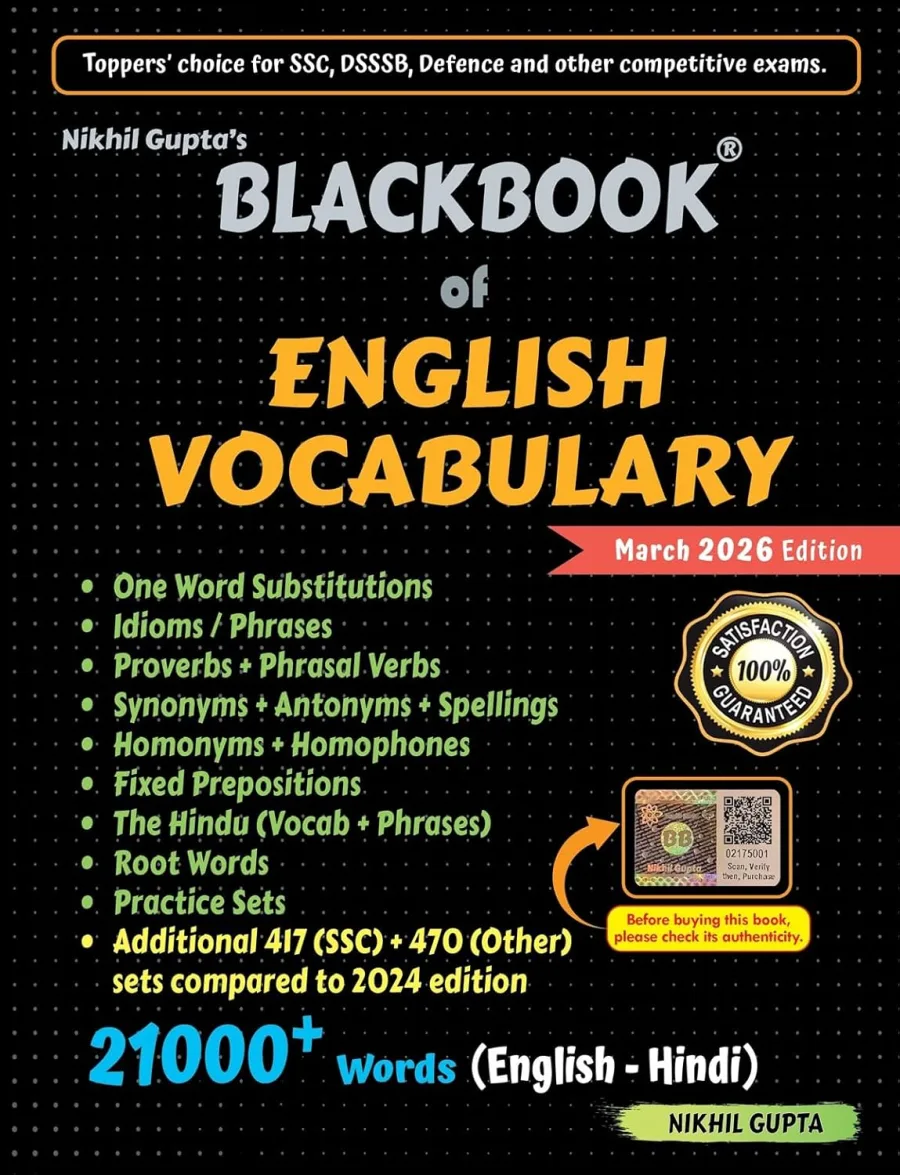
Blackbook of English vocabulary 2026 Edition (English - Hindi : Bilingual)
Paperback
• 720 Pages
• ₹ 449.00
• English
• 9788195645794
No ratings yet
| Publisher | Gupta Edutech |
|---|---|
| ISBN13 | 9788195645794 |
| ASIN/SKU | 8195645798 |
| Book Format | Paperback |
| Language | English |
| Pages | 720 |
| List Price | ₹ 449.00 |
| Publishing Date | 26/03/2026 |
| Dimensions | 24.1 x 18.4 x 3.2 cm |
| Weight | 1 kg 50 g |
| Book Code | BD00054647 |
Buy this Book
Amazon Stores
Ebook Stores
Other Stores
Discover Blackbook of English vocabulary 2026 Edition (English - Hindi : Bilingual) by Nikhil Gupta. This book is published by Gupta Edutech in Paperback format, ISBN 9788195645794, ASIN 8195645798, under Exam Preparation, Exercise and Fitness.
Book Description
The Blackbook of English Vocabulary (2026 Edition), 4th Edition | Bilingual: English-Hindi The most comprehensive vocabulary resource for competitive exam aspirants, trusted by toppers including AIR 1. Now in its 4th edition, the Blackbook brings thoroughly verified vocabulary compiled from SSC exam papers since 1997, updated with the latest papers through February 2026. Over 21,000 words with clear Hindi meanings, all in one place. Why Toppers Recommend This Book Vocabulary from actual exam papers, not textbooks No duplicates, no filler #R frequency indicator shows how often each word appeared in exams Study what matters, skip what doesn't What's Inside Synonyms, Antonyms, One Word Substitutions, Idioms and Phrases Phrasal Verbs, Spelling Corrections, Homonyms, Fixed Prepositions The Hindu editorial vocabulary Roots, Prefixes and Suffixes 24 specialised wordlists Practice sets in every chapter English definitions with Hindi meanings Star (*) and tilde (~) symbols for quick word relevance What's New in the 4th Edition 887 new exam papers added (417 SSC shifts + 470 other exams) New chapters on Fixed Prepositions, Homonyms, Additional Vocabulary English definitions added throughout Improved frequency marking system Covers: SSC CGL, CHSL, MTS, CPO, Steno, DSSSB, IBPS, SBI, RRB, NDA, CDS, AFCAT, MBA entrance, TET and all government competitive examinations
Author Biography
Nikhil Gupta, a distinguished name in the realm of competitive exam preparation, has earned acclaim for his insightful and meticulously crafted resources that have guided lakhs of aspirants to success. With a deep understanding of the challenges faced by students, he has dedicated his career to creating comprehensive study materials that cater to various competitive exams such as SSC, Railways, Banking, and other government examinations.
Author of the celebrated "Blackbook of English Vocabulary" and the "Blackbook of General Awareness", Nikhil Gupta's books are hailed for their precision, relevance, and ability to demystify complex concepts. His work is characterized by an innovative approach that blends thorough research with practical insights, making daunting subjects accessible to all levels of learners.
Nikhil Gupta's background in education and his passion for teaching shines through in his writing, which is both informative and engaging. His commitment to excellence and continuous improvement has made his publications indispensable for candidates aiming for top scores in competitive exams.
Beyond his books, Nikhil Gupta is an active contributor to the educational community, offering mentorship and guidance through various platforms. His dedication to empowering students extends to his presence on social media and educational forums, where he shares updates, study tips, and motivational advice.
As an author, educator, and mentor, Nikhil Gupta remains a beacon of hope and inspiration for countless competitive exam aspirants, continually striving to enrich their learning experience and maximize their potential.
Author of the celebrated "Blackbook of English Vocabulary" and the "Blackbook of General Awareness", Nikhil Gupta's books are hailed for their precision, relevance, and ability to demystify complex concepts. His work is characterized by an innovative approach that blends thorough research with practical insights, making daunting subjects accessible to all levels of learners.
Nikhil Gupta's background in education and his passion for teaching shines through in his writing, which is both informative and engaging. His commitment to excellence and continuous improvement has made his publications indispensable for candidates aiming for top scores in competitive exams.
Beyond his books, Nikhil Gupta is an active contributor to the educational community, offering mentorship and guidance through various platforms. His dedication to empowering students extends to his presence on social media and educational forums, where he shares updates, study tips, and motivational advice.
As an author, educator, and mentor, Nikhil Gupta remains a beacon of hope and inspiration for countless competitive exam aspirants, continually striving to enrich their learning experience and maximize their potential.
Editorial Reviews
Editorial Reviews will be added soon…
Book Summary
Blackbook of English Vocabulary 2026 Edition (English–Hindi: Bilingual) by Nikhil Gupta is a competitive-examination vocabulary book designed to help students and aspirants improve their English word power. The bilingual format makes the book especially useful for Hindi-speaking learners because English words and their meanings can be understood through Hindi explanations. The book is intended primarily for students preparing for examinations such as SSC, Banking, Railway, Defence, and other competitive tests in which English vocabulary plays an important role.
The main purpose of the book is to make vocabulary building systematic rather than random. Many students know basic English but struggle when examinations include difficult words, synonyms, antonyms, idioms, phrases, or vocabulary-based questions. Learning a few words occasionally is usually not enough. A strong vocabulary requires regular exposure, repetition, revision, and practice. A structured book like Blackbook of English Vocabulary provides learners with a large collection of words that can be studied gradually.
The English–Hindi bilingual approach is particularly useful for students who understand concepts more quickly when they have a familiar-language explanation. Instead of forcing learners to understand every unfamiliar English definition through another difficult English sentence, Hindi meanings can provide an immediate connection. Once the basic meaning is clear, the learner can focus on understanding how the English word is actually used.
Vocabulary is important because it affects several areas of English simultaneously. A student with a strong vocabulary can understand reading passages more easily, identify the meaning of unfamiliar words from context, recognize synonyms and antonyms, and communicate more confidently. Competitive examinations often test these abilities directly or indirectly.
One of the most important areas covered by a vocabulary resource is word meanings. Students encounter words that may not appear frequently in everyday conversation but are common in newspapers, academic writing, competitive examinations, and formal communication. Learning such words gradually expands a student's active and passive vocabulary.
The book is particularly useful for learners preparing for SSC examinations, where vocabulary-based questions can form an important part of the English section. Similar vocabulary knowledge can also help in Banking, Railway, Defence, and other government examinations. Students may encounter questions involving synonyms, antonyms, one-word substitutions, idioms, phrases, spelling, or contextual usage.
A major challenge in vocabulary preparation is retention. A student may learn fifty words in one day and forget most of them a few weeks later. The solution is not simply to learn even more words. It is to revise previously learned vocabulary repeatedly. A book with a large, organized vocabulary bank can serve as a reference that students return to during their preparation.
The bilingual presentation can also make revision faster. When students see an English word alongside a familiar Hindi meaning, they can quickly test whether they remember it. They can cover the meaning, recall it independently, and then check their answer. This simple process can turn reading into active revision.
Another important benefit is synonym and antonym development. Knowing one meaning of a word is useful, but competitive examinations often test whether students understand words with similar or opposite meanings. Learning vocabulary in groups can therefore be more effective than learning isolated words.
For example, if a student learns a word meaning “brief,” it is useful to connect it with related words such as “short,” “concise,” or “succinct.” Similarly, understanding its opposite can strengthen the overall concept. Such relationships help create a network of vocabulary in the learner's mind.
The book can also help with one-word substitutions. These questions require students to identify a single English word that represents a longer description or idea. They can be difficult because the correct word may not be used frequently in everyday conversation. Regular exposure to such vocabulary improves recognition and recall.
Idioms and phrases form another important part of English examination preparation. The meaning of an idiom cannot always be understood by translating each word separately. A bilingual explanation can make such expressions easier to understand because students can connect the complete expression with its Hindi meaning.
Spelling is another area where vocabulary preparation can help. English contains many words whose pronunciation does not make their spelling immediately obvious. Repeated visual exposure to difficult words can help students recognize correct spellings during examinations.
The book can also contribute to reading comprehension. When students encounter difficult vocabulary in a passage, they may lose track of the overall meaning. A larger vocabulary reduces this problem. Even when a student does not know every word, familiarity with related words can make it easier to understand the context.
Context is especially important because many English words can have slightly different meanings depending on how they are used. A good vocabulary learner therefore needs more than a Hindi translation. The learner should also understand the word's general sense, grammatical role, and typical usage. Students can strengthen this skill by encountering learned words in sentences, passages, newspapers, and practice questions.
The book can be used effectively as part of a daily vocabulary routine. Instead of trying to finish hundreds of pages quickly, students can study a manageable number of words every day. They can read the English word, recall its Hindi meaning, pronounce it, note related words, and then revise previously learned vocabulary.
A useful approach is spaced revision. Students can review new words after one day, again after several days, and again after a longer interval. This repeated exposure helps transfer vocabulary from short-term memory into longer-term memory.
Students can also maintain a separate list of difficult or frequently forgotten words. Not every word will be equally difficult. Some may become familiar after one or two readings, while others may require repeated revision. Identifying weak areas makes study time more efficient.
The book is also useful for learners who feel that their English vocabulary is limited because they studied primarily through Hindi. The bilingual format can reduce the psychological barrier created by unfamiliar English definitions. Once learners understand the basic meaning in Hindi, they can gradually begin thinking about the English word directly.
However, students should avoid becoming completely dependent on translation. Hindi meanings are helpful for understanding, but the ultimate goal is to recognize and use the English word without needing to translate it mentally every time. Students should therefore gradually move from “English word → Hindi meaning” toward “English word → direct understanding.”
Pronunciation is another useful area to practice. Learning a word only visually can create problems when students hear it in conversation. Saying the word aloud several times can improve familiarity and confidence. Students can also pay attention to stress and pronunciation while learning new vocabulary.
Vocabulary development also supports writing skills. A larger vocabulary gives students more choices when expressing an idea. Instead of repeatedly using simple words such as “good,” “bad,” “big,” or “important,” they can select more precise alternatives when appropriate. This can improve formal writing and communication.
The book can also help students become more comfortable with newspaper and editorial language. Competitive-exam aspirants often read newspapers to improve English and stay informed. Difficult vocabulary can make this habit frustrating at first. A strong vocabulary base makes formal articles and opinion pieces easier to understand.
Another advantage is exam-oriented familiarity. Students who repeatedly encounter commonly tested vocabulary are less likely to be surprised by difficult words during an examination. Familiarity can improve both speed and confidence because the student does not have to spend excessive time trying to interpret a word.
The book should nevertheless be used alongside practice questions. Memorizing vocabulary lists is useful, but students also need to see how words appear in actual examination contexts. Practice tests can reveal whether the learner can distinguish between similar words, understand contextual meanings, and identify correct synonyms or antonyms under time pressure.
The main purpose of the book is to make vocabulary building systematic rather than random. Many students know basic English but struggle when examinations include difficult words, synonyms, antonyms, idioms, phrases, or vocabulary-based questions. Learning a few words occasionally is usually not enough. A strong vocabulary requires regular exposure, repetition, revision, and practice. A structured book like Blackbook of English Vocabulary provides learners with a large collection of words that can be studied gradually.
The English–Hindi bilingual approach is particularly useful for students who understand concepts more quickly when they have a familiar-language explanation. Instead of forcing learners to understand every unfamiliar English definition through another difficult English sentence, Hindi meanings can provide an immediate connection. Once the basic meaning is clear, the learner can focus on understanding how the English word is actually used.
Vocabulary is important because it affects several areas of English simultaneously. A student with a strong vocabulary can understand reading passages more easily, identify the meaning of unfamiliar words from context, recognize synonyms and antonyms, and communicate more confidently. Competitive examinations often test these abilities directly or indirectly.
One of the most important areas covered by a vocabulary resource is word meanings. Students encounter words that may not appear frequently in everyday conversation but are common in newspapers, academic writing, competitive examinations, and formal communication. Learning such words gradually expands a student's active and passive vocabulary.
The book is particularly useful for learners preparing for SSC examinations, where vocabulary-based questions can form an important part of the English section. Similar vocabulary knowledge can also help in Banking, Railway, Defence, and other government examinations. Students may encounter questions involving synonyms, antonyms, one-word substitutions, idioms, phrases, spelling, or contextual usage.
A major challenge in vocabulary preparation is retention. A student may learn fifty words in one day and forget most of them a few weeks later. The solution is not simply to learn even more words. It is to revise previously learned vocabulary repeatedly. A book with a large, organized vocabulary bank can serve as a reference that students return to during their preparation.
The bilingual presentation can also make revision faster. When students see an English word alongside a familiar Hindi meaning, they can quickly test whether they remember it. They can cover the meaning, recall it independently, and then check their answer. This simple process can turn reading into active revision.
Another important benefit is synonym and antonym development. Knowing one meaning of a word is useful, but competitive examinations often test whether students understand words with similar or opposite meanings. Learning vocabulary in groups can therefore be more effective than learning isolated words.
For example, if a student learns a word meaning “brief,” it is useful to connect it with related words such as “short,” “concise,” or “succinct.” Similarly, understanding its opposite can strengthen the overall concept. Such relationships help create a network of vocabulary in the learner's mind.
The book can also help with one-word substitutions. These questions require students to identify a single English word that represents a longer description or idea. They can be difficult because the correct word may not be used frequently in everyday conversation. Regular exposure to such vocabulary improves recognition and recall.
Idioms and phrases form another important part of English examination preparation. The meaning of an idiom cannot always be understood by translating each word separately. A bilingual explanation can make such expressions easier to understand because students can connect the complete expression with its Hindi meaning.
Spelling is another area where vocabulary preparation can help. English contains many words whose pronunciation does not make their spelling immediately obvious. Repeated visual exposure to difficult words can help students recognize correct spellings during examinations.
The book can also contribute to reading comprehension. When students encounter difficult vocabulary in a passage, they may lose track of the overall meaning. A larger vocabulary reduces this problem. Even when a student does not know every word, familiarity with related words can make it easier to understand the context.
Context is especially important because many English words can have slightly different meanings depending on how they are used. A good vocabulary learner therefore needs more than a Hindi translation. The learner should also understand the word's general sense, grammatical role, and typical usage. Students can strengthen this skill by encountering learned words in sentences, passages, newspapers, and practice questions.
The book can be used effectively as part of a daily vocabulary routine. Instead of trying to finish hundreds of pages quickly, students can study a manageable number of words every day. They can read the English word, recall its Hindi meaning, pronounce it, note related words, and then revise previously learned vocabulary.
A useful approach is spaced revision. Students can review new words after one day, again after several days, and again after a longer interval. This repeated exposure helps transfer vocabulary from short-term memory into longer-term memory.
Students can also maintain a separate list of difficult or frequently forgotten words. Not every word will be equally difficult. Some may become familiar after one or two readings, while others may require repeated revision. Identifying weak areas makes study time more efficient.
The book is also useful for learners who feel that their English vocabulary is limited because they studied primarily through Hindi. The bilingual format can reduce the psychological barrier created by unfamiliar English definitions. Once learners understand the basic meaning in Hindi, they can gradually begin thinking about the English word directly.
However, students should avoid becoming completely dependent on translation. Hindi meanings are helpful for understanding, but the ultimate goal is to recognize and use the English word without needing to translate it mentally every time. Students should therefore gradually move from “English word → Hindi meaning” toward “English word → direct understanding.”
Pronunciation is another useful area to practice. Learning a word only visually can create problems when students hear it in conversation. Saying the word aloud several times can improve familiarity and confidence. Students can also pay attention to stress and pronunciation while learning new vocabulary.
Vocabulary development also supports writing skills. A larger vocabulary gives students more choices when expressing an idea. Instead of repeatedly using simple words such as “good,” “bad,” “big,” or “important,” they can select more precise alternatives when appropriate. This can improve formal writing and communication.
The book can also help students become more comfortable with newspaper and editorial language. Competitive-exam aspirants often read newspapers to improve English and stay informed. Difficult vocabulary can make this habit frustrating at first. A strong vocabulary base makes formal articles and opinion pieces easier to understand.
Another advantage is exam-oriented familiarity. Students who repeatedly encounter commonly tested vocabulary are less likely to be surprised by difficult words during an examination. Familiarity can improve both speed and confidence because the student does not have to spend excessive time trying to interpret a word.
The book should nevertheless be used alongside practice questions. Memorizing vocabulary lists is useful, but students also need to see how words appear in actual examination contexts. Practice tests can reveal whether the learner can distinguish between similar words, understand contextual meanings, and identify correct synonyms or antonyms under time pressure.
Sample Chapters
Sample Chapters will be added soon…
Reader Reviews
No reviews yet.
Blackbook of English vocabulary 2026 Edition (English - Hindi : Bilingual)
Download Cover Image
Do you want to download the full cover image for Blackbook of English vocabulary 2026 Edition (English - Hindi : Bilingual)?