
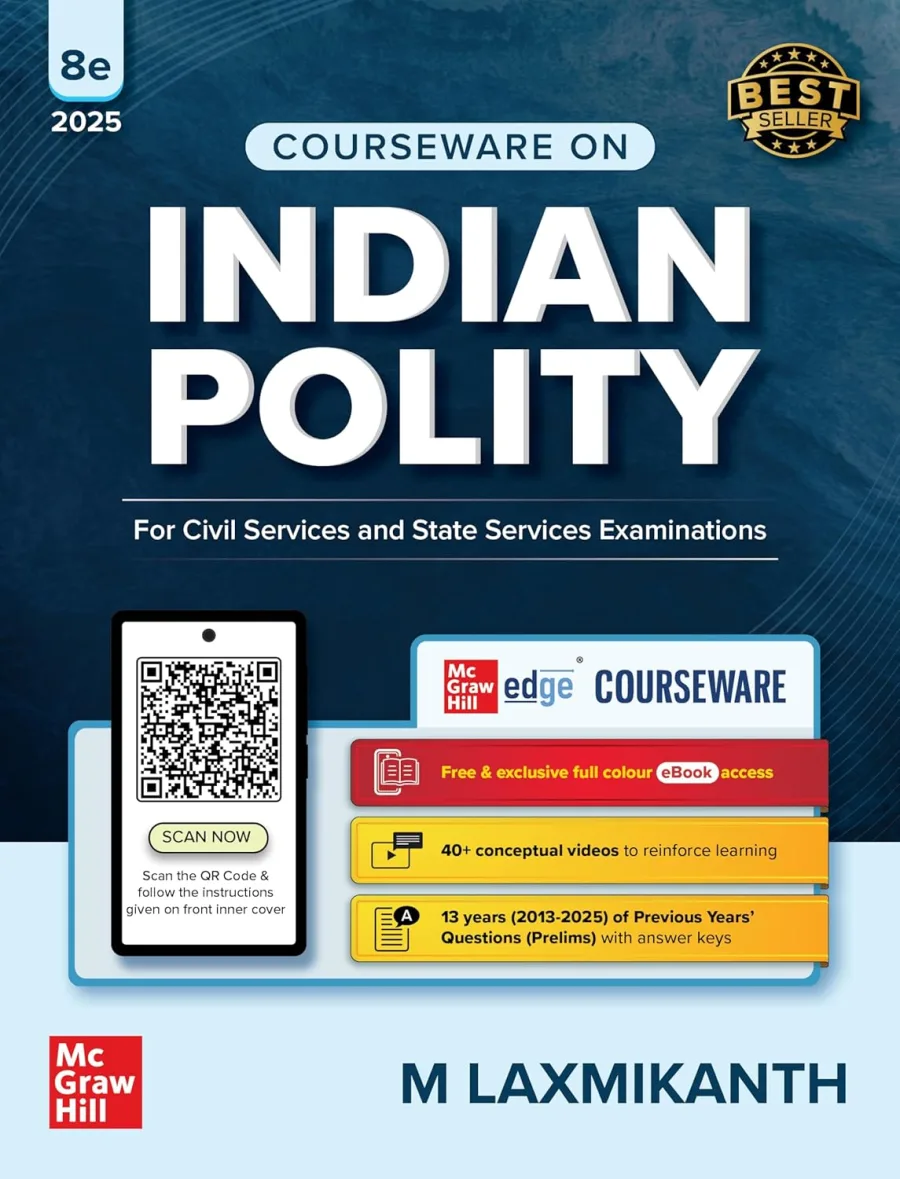
Indian Polity Courseware (English), 8e by M Laxmikanth for UPSC 2026
Paperback
• 856 Pages
• ₹ 1130.00
• English
• 9789364447676
No ratings yet
| Publisher | McGraw Hill |
|---|---|
| ISBN13 | 9789364447676 |
| ASIN/SKU | 9364447670 |
| Book Format | Paperback |
| Language | English |
| Pages | 856 |
| List Price | ₹ 1130.00 |
| Publishing Date | 01/08/2025 |
| Dimensions | 24.1 x 18.4 x 3.5 cm |
| Weight | 1 kg 140 g |
| Book Code | BD00054634 |
Buy this Book
Amazon Stores
Ebook Stores
Other Stores
Discover Indian Polity Courseware (English), 8e by M Laxmikanth for UPSC 2026 by M Laxmikanth. This book is published by McGraw Hill in Paperback format, ISBN 9789364447676, ASIN 9364447670, under Exam Preparation.
Book Description
Indian Polity Courseware – M. Laxmikanth (8th Edition)
✅ 95 chapters covering the entire Indian political and constitutional spectrum
📱 Free & exclusive access to the full-colour eBook with advanced features on McGraw Hill Edge
🎥 40+ conceptual videos to reinforce learning on complex constitutional and governance topics
📜 Solved 13 Previous Years' UPSC Prelims Polity Questions (including 2025)
📝 Previous 12 years of UPSC Mains Polity Questions included
🎯 High-quality practice questions to build exam readiness
⭐️ 18 Insightful Appendices (9 in book + 9 online) to support learning
📖 About this Courseware
McGraw Hill is delighted to present the 8th Edition of its flagship title, Indian Polity by M Laxmikanth now designed as a Courseware. This Courseware marks a significant evolution, from a widely trusted print volume into a dynamic learning experience.
In addition to its comprehensive textual content, it now offers 3 new chapters, 40+ meticulously crafted conceptual videos simplifying complex concepts, 18 insightful appendices, Previous 13 years of UPSC Preliminary Polity Questions (including 2025) with Answer Keys, Previous 12 years of UPSC Main Polity Questions and a full colour eBook.
An all-time bestseller and one of the most trusted titles continue to be an essential read for aspirants of the Civil Services and other State Services examinations. Designed to meet the needs of not just competitive exam candidates but also postgraduates, research scholars, academicians, and general readers, the eighth edition offers a deeper and more interactive learning experience on India's political and constitutional framework.
💡 What is McGraw Hill Edge Courseware?
McGraw Hill Courseware is an end-to-end learning solution designed to make learning holistic and adaptive to changing examination trends. It goes beyond traditional exam preparation, breaking the mould to give our learners a better chance at success. It seamlessly blends the traditional strengths of static resources like books with cutting-edge digital learning solutions, including, but not limited to:
🎥 Conceptual videos
🧠 Study aids like flashcards and infographics
🔍 Knowledge enrichment content
📜 Previous Years’ Questions with explanations
📝 Mock tests
📊 Performance analytics
🎤 Author webinars & doubt-clearing sessions
📚 Full colour eBook
✅ 95 chapters covering the entire Indian political and constitutional spectrum
📱 Free & exclusive access to the full-colour eBook with advanced features on McGraw Hill Edge
🎥 40+ conceptual videos to reinforce learning on complex constitutional and governance topics
📜 Solved 13 Previous Years' UPSC Prelims Polity Questions (including 2025)
📝 Previous 12 years of UPSC Mains Polity Questions included
🎯 High-quality practice questions to build exam readiness
⭐️ 18 Insightful Appendices (9 in book + 9 online) to support learning
📖 About this Courseware
McGraw Hill is delighted to present the 8th Edition of its flagship title, Indian Polity by M Laxmikanth now designed as a Courseware. This Courseware marks a significant evolution, from a widely trusted print volume into a dynamic learning experience.
In addition to its comprehensive textual content, it now offers 3 new chapters, 40+ meticulously crafted conceptual videos simplifying complex concepts, 18 insightful appendices, Previous 13 years of UPSC Preliminary Polity Questions (including 2025) with Answer Keys, Previous 12 years of UPSC Main Polity Questions and a full colour eBook.
An all-time bestseller and one of the most trusted titles continue to be an essential read for aspirants of the Civil Services and other State Services examinations. Designed to meet the needs of not just competitive exam candidates but also postgraduates, research scholars, academicians, and general readers, the eighth edition offers a deeper and more interactive learning experience on India's political and constitutional framework.
💡 What is McGraw Hill Edge Courseware?
McGraw Hill Courseware is an end-to-end learning solution designed to make learning holistic and adaptive to changing examination trends. It goes beyond traditional exam preparation, breaking the mould to give our learners a better chance at success. It seamlessly blends the traditional strengths of static resources like books with cutting-edge digital learning solutions, including, but not limited to:
🎥 Conceptual videos
🧠 Study aids like flashcards and infographics
🔍 Knowledge enrichment content
📜 Previous Years’ Questions with explanations
📝 Mock tests
📊 Performance analytics
🎤 Author webinars & doubt-clearing sessions
📚 Full colour eBook
Author Biography
M. Laxmikanth is a highly respected Indian academician, author, and educator whose name has become practically synonymous with India’s civil services preparation. Widely celebrated for his ability to demystify complex constitutional machinery, he is best known for authoring Indian Polity. This monumental text is universally regarded as the definitive guide—often dubbed the "bible"—for aspirants of the UPSC Civil Services Examination (CSE) and various State Public Service Commissions.
Academic Foundations and Early Career
Laxmikanth’s journey into the realm of public administration and political science began with a rigorous academic grounding in Hyderabad. He earned his Master’s degree in Political Science from Osmania University in 1989. Recognizing a significant gap in structured, accessible guidance for competitive exams, he founded Laxmikanth’s IAS Academy in Hyderabad. Serving as its director and lead mentor, he dedicated years to coaching civil service hopefuls. This direct interaction in the classroom allowed him to understand precisely where students struggled—particularly with the dense legalese of the Indian Constitution—and ultimately shaped his signature pedagogical approach.
The ‘Indian Polity’ Phenomenon
His hands-on teaching experience culminated in the creation of Indian Polity, a book designed to bridge the gap between heavy academic law texts and the pragmatic, objective needs of competitive exams. The book revolutionized UPSC preparation by offering a meticulously structured, point-wise breakdown of India's governance, constitutional bodies, and parliamentary procedures. Laxmikanth’s writing stands out for its extreme clarity, logical flow, and extensive use of comparative tables, making the retention of vast amounts of factual data significantly easier for students. Over the years, the text has continuously evolved to reflect new constitutional amendments, landmark Supreme Court judgments, and shifting examination trends.
Transition to Modern Learning: The 8th Edition
As the landscape of education shifts toward digital integration, Laxmikanth’s methodology has adapted accordingly. The latest iteration, Indian Polity Courseware (English), 8e specifically tailored for UPSC 2026, represents a leap from a traditional textbook to a comprehensive, hybrid learning ecosystem. Designed to meet the demands of the modern aspirant, this edition integrates the foundational printed text with digital tools, including conceptual video lectures, topic-wise previous year question mapping, and interactive performance analytics.
Beyond his magnum opus, Laxmikanth has authored other cornerstone texts that build upon his expertise, including Public Administration, Governance in India, and Objective Indian Polity. Today, M. Laxmikanth is viewed as more than just an author; his work has empowered millions of students, researchers, and everyday citizens with a lucid, accessible understanding of how the world's largest democracy functions.
Academic Foundations and Early Career
Laxmikanth’s journey into the realm of public administration and political science began with a rigorous academic grounding in Hyderabad. He earned his Master’s degree in Political Science from Osmania University in 1989. Recognizing a significant gap in structured, accessible guidance for competitive exams, he founded Laxmikanth’s IAS Academy in Hyderabad. Serving as its director and lead mentor, he dedicated years to coaching civil service hopefuls. This direct interaction in the classroom allowed him to understand precisely where students struggled—particularly with the dense legalese of the Indian Constitution—and ultimately shaped his signature pedagogical approach.
The ‘Indian Polity’ Phenomenon
His hands-on teaching experience culminated in the creation of Indian Polity, a book designed to bridge the gap between heavy academic law texts and the pragmatic, objective needs of competitive exams. The book revolutionized UPSC preparation by offering a meticulously structured, point-wise breakdown of India's governance, constitutional bodies, and parliamentary procedures. Laxmikanth’s writing stands out for its extreme clarity, logical flow, and extensive use of comparative tables, making the retention of vast amounts of factual data significantly easier for students. Over the years, the text has continuously evolved to reflect new constitutional amendments, landmark Supreme Court judgments, and shifting examination trends.
Transition to Modern Learning: The 8th Edition
As the landscape of education shifts toward digital integration, Laxmikanth’s methodology has adapted accordingly. The latest iteration, Indian Polity Courseware (English), 8e specifically tailored for UPSC 2026, represents a leap from a traditional textbook to a comprehensive, hybrid learning ecosystem. Designed to meet the demands of the modern aspirant, this edition integrates the foundational printed text with digital tools, including conceptual video lectures, topic-wise previous year question mapping, and interactive performance analytics.
Beyond his magnum opus, Laxmikanth has authored other cornerstone texts that build upon his expertise, including Public Administration, Governance in India, and Objective Indian Polity. Today, M. Laxmikanth is viewed as more than just an author; his work has empowered millions of students, researchers, and everyday citizens with a lucid, accessible understanding of how the world's largest democracy functions.
Editorial Reviews
Editorial Reviews will be added soon…
Book Summary
Indian Polity Courseware, 8th Edition by M. Laxmikanth, is a comprehensive study resource designed for students preparing for the UPSC Civil Services Examination and other competitive examinations that test knowledge of the Indian Constitution and political system. The book presents Indian polity in a systematic and examination-oriented manner, helping learners understand how the Constitution works, how different institutions function, how powers are distributed, and how democratic government operates in India. It is particularly valuable because Indian Polity is an important part of both the UPSC Preliminary and Main examinations.
The book begins with the foundations of the Indian Constitution. Students are introduced to the historical background that eventually led to the framing of the Constitution. Understanding this background is important because many constitutional provisions were influenced by developments during British rule and by the experiences of India's freedom movement. The book explains important constitutional developments, legislative acts, reforms, and events that shaped India's constitutional system.
The Constituent Assembly receives particular attention. Students learn about its formation, composition, committees, working, and role in preparing the Constitution. The discussions and decisions of the Assembly help explain why the Indian Constitution contains its particular combination of democratic, federal, parliamentary, and welfare-oriented features. The book presents the Constitution not merely as a document of rules but as the foundation of India's political and administrative system.
A major portion of the book deals with the salient features of the Constitution. India has a written and detailed Constitution with a combination of federal and unitary characteristics. It establishes a parliamentary form of government, an independent judiciary, fundamental rights, directive principles, universal adult franchise, and a system of constitutional government. Understanding these features provides the foundation for studying the individual institutions and provisions discussed in later chapters.
The Preamble is another important topic. It expresses the basic ideals and objectives of the Constitution through concepts such as justice, liberty, equality, and fraternity. The book helps students understand the significance of the Preamble and its relationship with the broader constitutional philosophy. For UPSC preparation, such conceptual understanding is important because questions may test both the wording and interpretation of constitutional principles.
Fundamental Rights form one of the most important areas of Indian Polity. The book explains the rights guaranteed to citizens, including equality, freedom, protection against exploitation, freedom of religion, cultural and educational rights, and constitutional remedies. Students also learn about reasonable restrictions, the role of the Supreme Court, and the significance of judicial protection of rights.
The discussion of Fundamental Rights naturally leads to Fundamental Duties and the Directive Principles of State Policy. Fundamental Duties describe responsibilities expected from citizens, while the Directive Principles provide broad goals for the state in areas such as social justice, economic welfare, public health, education, and equitable distribution of resources. The book helps students understand how these constitutional elements complement one another.
The Union Executive is another major section. Students study the President, Vice-President, Prime Minister, Council of Ministers, and the role of the executive in India's parliamentary system. The distinction between the constitutional position of the President and the practical role of the Prime Minister and Council of Ministers is particularly important. The book explains how constitutional authority and political responsibility operate within the parliamentary framework.
Parliament receives detailed treatment because it is central to India's democratic system. Students learn about the Lok Sabha and Rajya Sabha, their composition, powers, functions, privileges, procedures, legislative processes, financial powers, and various parliamentary committees. The book also explains important parliamentary devices and procedures that allow the legislature to examine government actions and participate in law-making.
The chapter on the Supreme Court and the judicial system is equally important. Students learn about the structure, jurisdiction, powers, independence, and role of the Supreme Court. Concepts such as judicial review, judicial activism, writ jurisdiction, and public interest litigation help explain how the judiciary interacts with the Constitution and protects legal and constitutional rights.
High Courts and subordinate courts are also discussed, giving students a broader understanding of India's judicial structure. Judicial independence is examined as an important feature of constitutional democracy. The judiciary is not simply responsible for deciding disputes; it also plays an important role in interpreting the Constitution and maintaining the balance between different organs of government.
The book also provides extensive coverage of federalism and Centre-State relations. India has a federal structure, but the Constitution gives the Union significant powers. Students examine legislative, administrative, and financial relations between the Centre and the states. This section is particularly important for UPSC because questions may require an understanding of how constitutional powers are divided and how disputes between different levels of government are handled.
Inter-State relations and mechanisms for resolving disputes are also important parts of this broader discussion. Students learn about constitutional and institutional arrangements designed to promote cooperation among states and maintain coordination within the Union. These concepts become especially relevant when studying subjects such as water disputes, regional development, and cooperative federalism.
Local government is another major area covered by the book. Students study Panchayati Raj institutions and urban local bodies, including the constitutional amendments that strengthened local self-government. The discussion explains the importance of decentralization and people's participation in governance. Local government allows students to understand how constitutional democracy extends beyond Parliament and state legislatures into villages, towns, and cities.
Constitutional and statutory bodies receive substantial attention. These include institutions such as the Election Commission, Union Public Service Commission, Finance Commission, Comptroller and Auditor General, and other bodies created to support constitutional governance. Understanding their composition, powers, functions, and independence is particularly important for objective examinations.
The Election Commission and electoral system are especially relevant because elections form the foundation of representative democracy. The book discusses electoral procedures, political representation, election-related provisions, and reforms. Students learn how citizens choose their representatives and how constitutional institutions help maintain the integrity of the electoral process.
Emergency provisions constitute another significant topic. The Constitution provides for national, state, and financial emergencies under specific circumstances. The book explains the constitutional mechanisms associated with these provisions and their implications for the distribution of power. These provisions are historically and constitutionally important because they demonstrate how India's federal structure can become more centralized during extraordinary circumstances.
Political parties, pressure groups, public opinion, and other elements of the political process are also important for understanding Indian democracy. Formal constitutional institutions alone cannot explain how politics actually works. Political parties connect citizens with government, pressure groups attempt to influence public policy, and public opinion can shape political decisions. The book therefore provides students with a broader understanding of the political system.
The book also examines important constitutional amendments and major developments in Indian polity. Constitutional amendments demonstrate that the Constitution is capable of adapting to changing circumstances while maintaining its fundamental framework. Students preparing for UPSC need to understand not only the original constitutional provisions but also important changes introduced over time.
For UPSC aspirants, the greatest strength of Indian Polity is its systematic organization. Indian constitutional topics are interconnected, and studying them separately can sometimes create confusion.
The book begins with the foundations of the Indian Constitution. Students are introduced to the historical background that eventually led to the framing of the Constitution. Understanding this background is important because many constitutional provisions were influenced by developments during British rule and by the experiences of India's freedom movement. The book explains important constitutional developments, legislative acts, reforms, and events that shaped India's constitutional system.
The Constituent Assembly receives particular attention. Students learn about its formation, composition, committees, working, and role in preparing the Constitution. The discussions and decisions of the Assembly help explain why the Indian Constitution contains its particular combination of democratic, federal, parliamentary, and welfare-oriented features. The book presents the Constitution not merely as a document of rules but as the foundation of India's political and administrative system.
A major portion of the book deals with the salient features of the Constitution. India has a written and detailed Constitution with a combination of federal and unitary characteristics. It establishes a parliamentary form of government, an independent judiciary, fundamental rights, directive principles, universal adult franchise, and a system of constitutional government. Understanding these features provides the foundation for studying the individual institutions and provisions discussed in later chapters.
The Preamble is another important topic. It expresses the basic ideals and objectives of the Constitution through concepts such as justice, liberty, equality, and fraternity. The book helps students understand the significance of the Preamble and its relationship with the broader constitutional philosophy. For UPSC preparation, such conceptual understanding is important because questions may test both the wording and interpretation of constitutional principles.
Fundamental Rights form one of the most important areas of Indian Polity. The book explains the rights guaranteed to citizens, including equality, freedom, protection against exploitation, freedom of religion, cultural and educational rights, and constitutional remedies. Students also learn about reasonable restrictions, the role of the Supreme Court, and the significance of judicial protection of rights.
The discussion of Fundamental Rights naturally leads to Fundamental Duties and the Directive Principles of State Policy. Fundamental Duties describe responsibilities expected from citizens, while the Directive Principles provide broad goals for the state in areas such as social justice, economic welfare, public health, education, and equitable distribution of resources. The book helps students understand how these constitutional elements complement one another.
The Union Executive is another major section. Students study the President, Vice-President, Prime Minister, Council of Ministers, and the role of the executive in India's parliamentary system. The distinction between the constitutional position of the President and the practical role of the Prime Minister and Council of Ministers is particularly important. The book explains how constitutional authority and political responsibility operate within the parliamentary framework.
Parliament receives detailed treatment because it is central to India's democratic system. Students learn about the Lok Sabha and Rajya Sabha, their composition, powers, functions, privileges, procedures, legislative processes, financial powers, and various parliamentary committees. The book also explains important parliamentary devices and procedures that allow the legislature to examine government actions and participate in law-making.
The chapter on the Supreme Court and the judicial system is equally important. Students learn about the structure, jurisdiction, powers, independence, and role of the Supreme Court. Concepts such as judicial review, judicial activism, writ jurisdiction, and public interest litigation help explain how the judiciary interacts with the Constitution and protects legal and constitutional rights.
High Courts and subordinate courts are also discussed, giving students a broader understanding of India's judicial structure. Judicial independence is examined as an important feature of constitutional democracy. The judiciary is not simply responsible for deciding disputes; it also plays an important role in interpreting the Constitution and maintaining the balance between different organs of government.
The book also provides extensive coverage of federalism and Centre-State relations. India has a federal structure, but the Constitution gives the Union significant powers. Students examine legislative, administrative, and financial relations between the Centre and the states. This section is particularly important for UPSC because questions may require an understanding of how constitutional powers are divided and how disputes between different levels of government are handled.
Inter-State relations and mechanisms for resolving disputes are also important parts of this broader discussion. Students learn about constitutional and institutional arrangements designed to promote cooperation among states and maintain coordination within the Union. These concepts become especially relevant when studying subjects such as water disputes, regional development, and cooperative federalism.
Local government is another major area covered by the book. Students study Panchayati Raj institutions and urban local bodies, including the constitutional amendments that strengthened local self-government. The discussion explains the importance of decentralization and people's participation in governance. Local government allows students to understand how constitutional democracy extends beyond Parliament and state legislatures into villages, towns, and cities.
Constitutional and statutory bodies receive substantial attention. These include institutions such as the Election Commission, Union Public Service Commission, Finance Commission, Comptroller and Auditor General, and other bodies created to support constitutional governance. Understanding their composition, powers, functions, and independence is particularly important for objective examinations.
The Election Commission and electoral system are especially relevant because elections form the foundation of representative democracy. The book discusses electoral procedures, political representation, election-related provisions, and reforms. Students learn how citizens choose their representatives and how constitutional institutions help maintain the integrity of the electoral process.
Emergency provisions constitute another significant topic. The Constitution provides for national, state, and financial emergencies under specific circumstances. The book explains the constitutional mechanisms associated with these provisions and their implications for the distribution of power. These provisions are historically and constitutionally important because they demonstrate how India's federal structure can become more centralized during extraordinary circumstances.
Political parties, pressure groups, public opinion, and other elements of the political process are also important for understanding Indian democracy. Formal constitutional institutions alone cannot explain how politics actually works. Political parties connect citizens with government, pressure groups attempt to influence public policy, and public opinion can shape political decisions. The book therefore provides students with a broader understanding of the political system.
The book also examines important constitutional amendments and major developments in Indian polity. Constitutional amendments demonstrate that the Constitution is capable of adapting to changing circumstances while maintaining its fundamental framework. Students preparing for UPSC need to understand not only the original constitutional provisions but also important changes introduced over time.
For UPSC aspirants, the greatest strength of Indian Polity is its systematic organization. Indian constitutional topics are interconnected, and studying them separately can sometimes create confusion.
Sample Chapters
Table of Contents
Preface to the Eighth Edition
Preface to the First Edition
1. Historical Background
2. Making of the Constitution
3. Concept of Constitution
4. Salient Features of the Constitution
5. Preamble of the Constitution
6. Union and its Territory
7. Citizenship
8. Fundamental Rights
9. Directive Principles of State Policy
10. Fundamental Duties
11. Amendment of the Constitution
12. Basic Structure of the Constitution
13. Parliamentary System
14. Federal System
15. Centre–State Relations
16. Inter-State Relations
17. Emergency Provisions
18. President
19. Vice-President
20. Prime Minister
21. Central Council of Ministers
22. Cabinet Committees
23. Parliament
24. Parliamentary Committees
25. Parliamentary Group
26. Supreme Court
27. Judicial Review
28. Judicial Activism
29. Public Interest Litigation
30. Governor
31. Chief Minister
32. State Council of Ministers
33. State Legislature
34. High Court
35. Subordinate Courts
36. Tribunals
37. National Consumer Disputes Redressal Commission
38. Lok Adalat and other courts
39. Panchayati Raj
40. Municipalities
41. Union Territories
42. Scheduled and Tribal Areas
43. Election Commission
44. Union Public Service Commission
45. State Public Service Commission
46. Finance Commission
47. Goods and Services Tax Council
48. National Commission for SCs
49. National Commission for STs
50. National Commission for BCs
51. Special Officer for Linguistic Minorities
52. Comptroller and Auditor General of India
53. Attorney General of India
54. Advocate General of the State
55. Constitutional Prescriptions
56. NITI Aayog
57. National Human Rights Commission
58. State Human Rights Commission
59. National Commission for Women
60. National Commission for Protection of Child Rights
61. National Commission for Minorities
62. Central Information Commission
63. State Information Commission
64. Central Vigilance Commission
65. Central Bureau of Investigation
66. Lokpal and Lokayuktas
67. National Investigation Agency
68. National Disaster Management Authority
69. Bar Council of India
70. Law Commission of India
71. Delimitation Commission of India
72. North Eastern Council
73. Co-operative Societies
74. Official Language
75. Public Services
76. Rights and Liabilities of the Government
77. Special Provisions Relating to Certain Classes
78. Special Provisions for Some States
79. Political Parties
80. Role of Regional Parties
81. Elections
82. Election Laws
83. Electoral Reforms
84. Voting Behaviour
85. Coalition Government
86. Anti-Defection Law
87. Pressure Groups
88. National Integration
89. Foreign Policy
90. National Commission to Review the Working of the Constitution
91. Landmark Judgements and their Impact
92. Judgements expanding the scope of Article 21
93. Judgements Relating to The Amendments
94. Judgements Relating to The Amendments
95. World Constitutions
Appendix I: Articles of the Constitution
Appendix II: Subjects of Union, State and Concurrent Lists
Appendix III: Table of Precedence
Appendix IV: Constitutional Amendments at a Glance
Appendix V: Constitutional Amendments with Reference to Articles
Appendix VI: Model Code of Conduct Relating to Elections
Appendix VII: Flag Code of India
Appendix VIII: Presidents, Vice-Presidents, Prime Ministers, etc.
Appendix IX: Chairpersons of the National Commissions
Question Set I: UPSC Questions on Indian Polity General Studies Prelims (2013-25)
Question Set II: Practice Questions on Indian Polity General Studies Prelims
Question Set III: UPSC Questions on Indian Polity General Studies Mains (2013-24)
Question Set IV: Practice Questions on Indian Polity General Studies Mains
Preface to the Eighth Edition
Preface to the First Edition
1. Historical Background
2. Making of the Constitution
3. Concept of Constitution
4. Salient Features of the Constitution
5. Preamble of the Constitution
6. Union and its Territory
7. Citizenship
8. Fundamental Rights
9. Directive Principles of State Policy
10. Fundamental Duties
11. Amendment of the Constitution
12. Basic Structure of the Constitution
13. Parliamentary System
14. Federal System
15. Centre–State Relations
16. Inter-State Relations
17. Emergency Provisions
18. President
19. Vice-President
20. Prime Minister
21. Central Council of Ministers
22. Cabinet Committees
23. Parliament
24. Parliamentary Committees
25. Parliamentary Group
26. Supreme Court
27. Judicial Review
28. Judicial Activism
29. Public Interest Litigation
30. Governor
31. Chief Minister
32. State Council of Ministers
33. State Legislature
34. High Court
35. Subordinate Courts
36. Tribunals
37. National Consumer Disputes Redressal Commission
38. Lok Adalat and other courts
39. Panchayati Raj
40. Municipalities
41. Union Territories
42. Scheduled and Tribal Areas
43. Election Commission
44. Union Public Service Commission
45. State Public Service Commission
46. Finance Commission
47. Goods and Services Tax Council
48. National Commission for SCs
49. National Commission for STs
50. National Commission for BCs
51. Special Officer for Linguistic Minorities
52. Comptroller and Auditor General of India
53. Attorney General of India
54. Advocate General of the State
55. Constitutional Prescriptions
56. NITI Aayog
57. National Human Rights Commission
58. State Human Rights Commission
59. National Commission for Women
60. National Commission for Protection of Child Rights
61. National Commission for Minorities
62. Central Information Commission
63. State Information Commission
64. Central Vigilance Commission
65. Central Bureau of Investigation
66. Lokpal and Lokayuktas
67. National Investigation Agency
68. National Disaster Management Authority
69. Bar Council of India
70. Law Commission of India
71. Delimitation Commission of India
72. North Eastern Council
73. Co-operative Societies
74. Official Language
75. Public Services
76. Rights and Liabilities of the Government
77. Special Provisions Relating to Certain Classes
78. Special Provisions for Some States
79. Political Parties
80. Role of Regional Parties
81. Elections
82. Election Laws
83. Electoral Reforms
84. Voting Behaviour
85. Coalition Government
86. Anti-Defection Law
87. Pressure Groups
88. National Integration
89. Foreign Policy
90. National Commission to Review the Working of the Constitution
91. Landmark Judgements and their Impact
92. Judgements expanding the scope of Article 21
93. Judgements Relating to The Amendments
94. Judgements Relating to The Amendments
95. World Constitutions
Appendix I: Articles of the Constitution
Appendix II: Subjects of Union, State and Concurrent Lists
Appendix III: Table of Precedence
Appendix IV: Constitutional Amendments at a Glance
Appendix V: Constitutional Amendments with Reference to Articles
Appendix VI: Model Code of Conduct Relating to Elections
Appendix VII: Flag Code of India
Appendix VIII: Presidents, Vice-Presidents, Prime Ministers, etc.
Appendix IX: Chairpersons of the National Commissions
Question Set I: UPSC Questions on Indian Polity General Studies Prelims (2013-25)
Question Set II: Practice Questions on Indian Polity General Studies Prelims
Question Set III: UPSC Questions on Indian Polity General Studies Mains (2013-24)
Question Set IV: Practice Questions on Indian Polity General Studies Mains
Reader Reviews
No reviews yet.
Indian Polity Courseware (English), 8e by M Laxmikanth for UPSC 2026
Download Cover Image
Do you want to download the full cover image for Indian Polity Courseware (English), 8e by M Laxmikanth for UPSC 2026?