
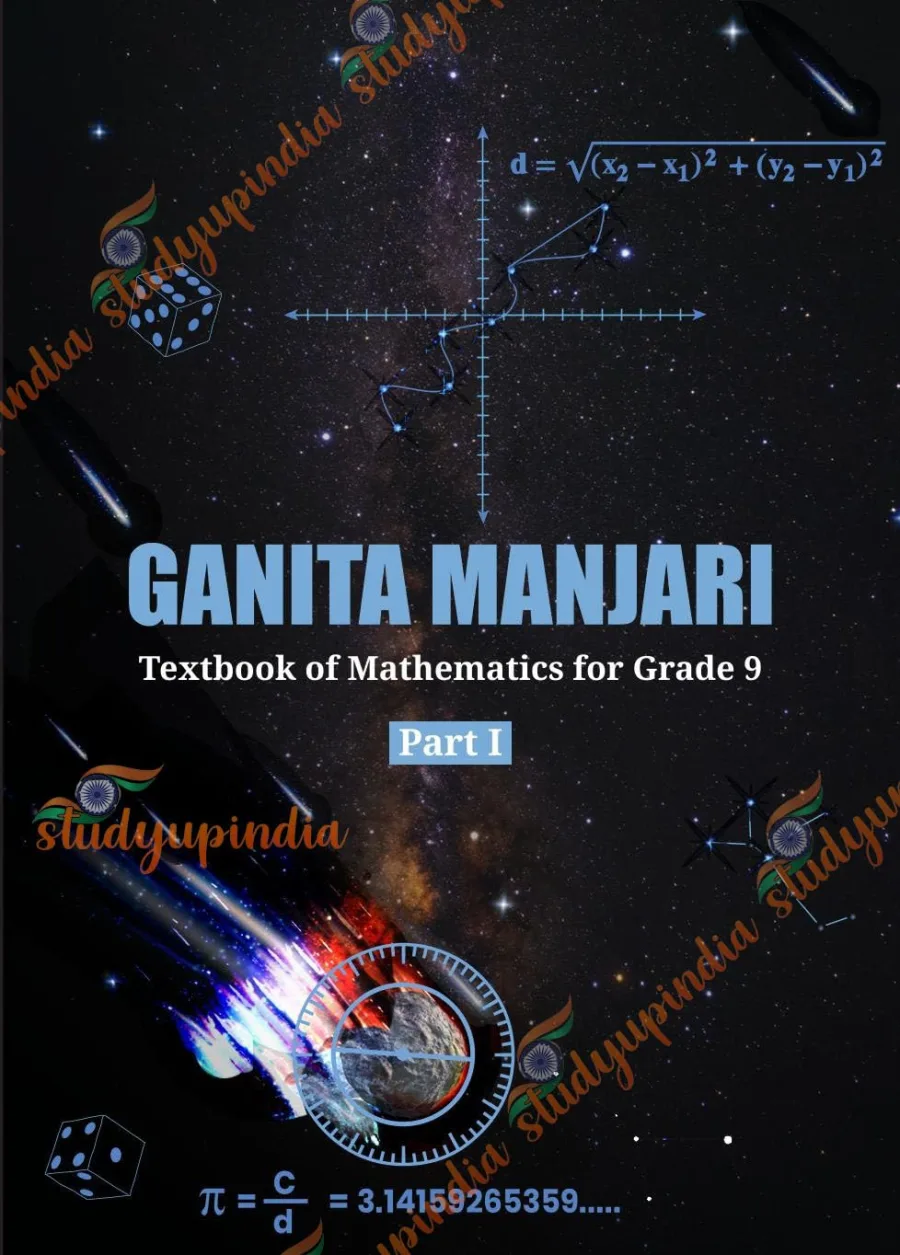
NCERT CLASS 9 Ganita Manjari, Part 1 | Textbook of Mathematics for Grade 9 Eng Med (2026-2027)
Paperback
• 260 Pages
• ₹ 115.00
• English
• 9789357296038
No ratings yet
| Publisher | National Council of Educational Research and Training |
|---|---|
| Brand/Group | NCERT |
| ISBN13 | 9789357296038 |
| ASIN/SKU | 9357296034 |
| Book Format | Paperback |
| Language | English |
| Pages | 260 |
| List Price | ₹ 115.00 |
| Series Title | NCERT Class 9 Books |
| Publishing Date | 20/04/2026 |
| Dimensions | 22 x 28 x 2 cm |
| Weight | 500 g |
| Book Code | BD00054633 |
Buy this Book
Amazon Stores
Ebook Stores
Other Stores
Discover NCERT CLASS 9 Ganita Manjari, Part 1 | Textbook of Mathematics for Grade 9 Eng Med (2026-2027) by NCERT. This book is published by National Council of Educational Research and Training in Paperback format, ISBN 9789357296038, ASIN 9357296034, under School Books, Mathematics.
Book Description
Book Description will be added soon…
Author Biography
National Council of Educational Research and Training (NCERT)
Established in 1961 by the Government of India, the National Council of Educational Research and Training (NCERT) is the apex autonomous organization shaping the landscape of Indian school education. Its core mandate is to assist and advise the Central and State Governments on policies and academic programs designed to drive qualitative improvement in schooling across the nation.
The Institute
NCERT is the architectural cornerstone of India’s educational framework. It is globally recognized for developing the National Curriculum Framework (NCF) and publishing standardized, highly acclaimed textbooks used by millions of students in CBSE-affiliated and state-board schools. Beyond publishing, the institute is a hub of innovation. It conducts extensive educational research, develops supplementary learning materials, designs multimedia and digital resources, and pioneers new pedagogical methods. NCERT operates through a robust network of constituent units, including the National Institute of Education (NIE), the Central Institute of Educational Technology (CIET), and several Regional Institutes of Education (RIEs) located across the country.
The Team
The true strength of NCERT lies in its multidisciplinary team of eminent academicians, seasoned pedagogues, researchers, and subject-matter experts. This diverse faculty works collaboratively to bridge the gap between educational theory and everyday classroom practice. The team includes curriculum designers who align syllabi with modern national goals—such as the National Education Policy (NEP)—and master trainers who lead capacity-building and specialized training programs for teachers nationwide. Their rigorous, research-backed approach ensures that all educational materials remain inclusive, scientifically accurate, and developmentally appropriate.
Vision and Impact
Driven by a commitment to holistic, learner-centric, and equitable education, the NCERT team continuously adapts to meet contemporary global challenges. Through decades of relentless dedication, the institute has shaped the intellectual foundation of generations of Indians, remaining the gold standard for educational excellence and progressive learning ecosystems in the country.
Established in 1961 by the Government of India, the National Council of Educational Research and Training (NCERT) is the apex autonomous organization shaping the landscape of Indian school education. Its core mandate is to assist and advise the Central and State Governments on policies and academic programs designed to drive qualitative improvement in schooling across the nation.
The Institute
NCERT is the architectural cornerstone of India’s educational framework. It is globally recognized for developing the National Curriculum Framework (NCF) and publishing standardized, highly acclaimed textbooks used by millions of students in CBSE-affiliated and state-board schools. Beyond publishing, the institute is a hub of innovation. It conducts extensive educational research, develops supplementary learning materials, designs multimedia and digital resources, and pioneers new pedagogical methods. NCERT operates through a robust network of constituent units, including the National Institute of Education (NIE), the Central Institute of Educational Technology (CIET), and several Regional Institutes of Education (RIEs) located across the country.
The Team
The true strength of NCERT lies in its multidisciplinary team of eminent academicians, seasoned pedagogues, researchers, and subject-matter experts. This diverse faculty works collaboratively to bridge the gap between educational theory and everyday classroom practice. The team includes curriculum designers who align syllabi with modern national goals—such as the National Education Policy (NEP)—and master trainers who lead capacity-building and specialized training programs for teachers nationwide. Their rigorous, research-backed approach ensures that all educational materials remain inclusive, scientifically accurate, and developmentally appropriate.
Vision and Impact
Driven by a commitment to holistic, learner-centric, and equitable education, the NCERT team continuously adapts to meet contemporary global challenges. Through decades of relentless dedication, the institute has shaped the intellectual foundation of generations of Indians, remaining the gold standard for educational excellence and progressive learning ecosystems in the country.
Editorial Reviews
Editorial Reviews will be added soon…
Book Summary
NCERT Class 9 Ganita Manjari, Part 1 | Textbook of Mathematics for Grade 9, English Medium (2026–2027) by NCERT is the new Mathematics textbook designed for students studying Grade 9 under the revised school curriculum for the 2026–27 academic session. The book is intended to build a strong mathematical foundation while moving students beyond routine calculations toward reasoning, problem-solving, mathematical communication, and the ability to apply concepts to unfamiliar situations.
The title Ganita Manjari reflects the broader effort to present mathematics as a connected and meaningful discipline rather than simply a collection of formulas. The textbook encourages students to understand why mathematical ideas work, how different concepts are related, and where mathematics appears in everyday situations. For Class 9 students, this is particularly important because the subject becomes more abstract and demanding compared with the mathematics studied in earlier grades.
The book is designed as a textbook rather than a question bank or guidebook, so its primary purpose is to teach concepts. Students should therefore approach it slowly and thoughtfully instead of treating it as a book to be completed as quickly as possible. Each chapter introduces ideas, develops them through examples and explanations, and provides opportunities for students to practise and investigate.
One of the most important changes in the new curriculum is the greater emphasis on conceptual understanding and mathematical reasoning. Students are encouraged to explain how they reached an answer rather than simply writing the final result. This develops mathematical thinking and prepares students for more advanced topics in Classes 10, 11, and 12.
Mathematics at Grade 9 level requires students to move comfortably between numbers, algebraic expressions, geometric figures, graphs, measurements, and logical statements. A strong textbook therefore needs to help students see connections between these areas.
The book's first sections establish this foundation by developing students' understanding of mathematical language and reasoning. Mathematics is not only about calculating numbers. It also involves making statements, recognizing patterns, identifying relationships, and proving whether something is true.
This is where logical thinking becomes important. Students learn to distinguish between an observation and a mathematical conclusion. They may be asked to investigate a pattern, form a conjecture, and then determine whether it is always true.
Such activities teach students that mathematics is a subject of reasoning rather than mere memorization.
Another important area is number systems. By Class 9, students need to understand different types of numbers and how they relate to one another. Concepts such as rational and irrational numbers become increasingly important and provide the foundation for later algebra.
Students often find irrational numbers difficult at first because they cannot be represented as ordinary fractions. The textbook approach helps learners understand these ideas conceptually instead of treating them as definitions to memorize.
The book also develops algebraic thinking, which is one of the most important transitions at this level. Algebra allows students to represent relationships using symbols and expressions rather than relying only on specific numerical examples.
Students need to understand variables, expressions, identities, equations, and relationships between quantities. The key is to understand what the symbols represent.
For example, an algebraic expression should not be viewed simply as a combination of letters and numbers. It represents a mathematical relationship that can describe many different situations. Learning to interpret expressions in this way makes later algebra much easier.
The textbook also encourages students to use patterns as a route to mathematical understanding. Patterns can reveal relationships that may not be obvious from individual calculations. Students can examine numerical sequences, geometric arrangements, and algebraic relationships and then try to describe the underlying rule.
This type of activity develops observation and reasoning skills.
Another important component of Class 9 Mathematics is geometry. Students move beyond identifying basic shapes and begin to reason about their properties and relationships. Geometry requires students to visualize figures, understand definitions, recognize conditions, and construct logical arguments.
Rather than memorizing every theorem separately, students benefit from understanding why the relationships are true. A textbook that encourages investigation and reasoning can make geometry more meaningful.
Geometric diagrams are particularly important. Students need to learn how to interpret diagrams carefully and understand that a diagram is a representation of a mathematical situation, not necessarily a perfect scale drawing.
This distinction becomes important when solving problems involving angles, lines, triangles, circles, or other geometric figures.
The book also develops measurement and spatial reasoning. These concepts connect mathematical formulas with physical objects and real-world situations. Students can see how area, volume, length, and other measurements are used to describe and compare objects.
Measurement is also closely connected with algebra because formulas represent relationships between different quantities. Understanding what each quantity means makes formula-based problems easier to solve.
Another important area is data and statistics. Students increasingly encounter numerical information in newspapers, websites, surveys, advertisements, and everyday life. Learning how to organize, represent, and interpret data is therefore an important practical skill.
The textbook encourages students to look beyond simply calculating an average. They need to understand what data represents and what conclusions can reasonably be drawn from it.
Graphs and tables can make large amounts of information easier to understand. Students should learn how to read these representations carefully and identify patterns or comparisons.
The book also contributes to mathematical communication. Students need to explain their reasoning in a way that another person can follow. This is especially important when solving multi-step problems.
A correct answer without adequate reasoning may not demonstrate complete understanding. Writing down the steps and explaining the mathematical idea behind them can help students identify their own mistakes as well.
One of the strengths of a modern NCERT textbook is its emphasis on activities and exploration. Instead of presenting every mathematical fact as something to memorize, students may be encouraged to investigate relationships themselves.
For example, they might construct figures, examine patterns, compare examples, estimate results, or use reasoning to discover a relationship before it is formally stated.
This approach can make learning more engaging because students become participants in the discovery process.
The book also encourages students to connect mathematics with real-life contexts. Mathematics appears in shopping, measurement, construction, design, finance, technology, science, sports, and everyday decision-making.
When students see how mathematical concepts are used outside the classroom, abstract ideas can become easier to understand.
For instance, percentages can be connected with discounts and comparisons, graphs with real-world data, geometry with design and architecture, and algebra with relationships between quantities.
Another important feature is the development of problem-solving ability. Students should not expect every problem to have an immediately obvious method. Sometimes they need to try different approaches, simplify the problem, draw a diagram, identify a pattern, or work backward.
Learning to remain patient when a solution is not immediately visible is an important mathematical habit.
The textbook can also help students understand that there may sometimes be more than one way to solve a problem. Comparing different methods can reveal the underlying structure of the mathematics and help students discover approaches that are more efficient.
This is particularly valuable for students who are preparing for higher-level mathematics in the future.
At the same time, students should avoid rushing into advanced problem-solving techniques without first mastering the fundamentals. Strong mathematical preparation is built on clear understanding of basic concepts.
The book is also useful for self-study, although some concepts may benefit from teacher guidance. Students can read an explanation, work through the examples, attempt the exercises, and then review any mistakes.
The title Ganita Manjari reflects the broader effort to present mathematics as a connected and meaningful discipline rather than simply a collection of formulas. The textbook encourages students to understand why mathematical ideas work, how different concepts are related, and where mathematics appears in everyday situations. For Class 9 students, this is particularly important because the subject becomes more abstract and demanding compared with the mathematics studied in earlier grades.
The book is designed as a textbook rather than a question bank or guidebook, so its primary purpose is to teach concepts. Students should therefore approach it slowly and thoughtfully instead of treating it as a book to be completed as quickly as possible. Each chapter introduces ideas, develops them through examples and explanations, and provides opportunities for students to practise and investigate.
One of the most important changes in the new curriculum is the greater emphasis on conceptual understanding and mathematical reasoning. Students are encouraged to explain how they reached an answer rather than simply writing the final result. This develops mathematical thinking and prepares students for more advanced topics in Classes 10, 11, and 12.
Mathematics at Grade 9 level requires students to move comfortably between numbers, algebraic expressions, geometric figures, graphs, measurements, and logical statements. A strong textbook therefore needs to help students see connections between these areas.
The book's first sections establish this foundation by developing students' understanding of mathematical language and reasoning. Mathematics is not only about calculating numbers. It also involves making statements, recognizing patterns, identifying relationships, and proving whether something is true.
This is where logical thinking becomes important. Students learn to distinguish between an observation and a mathematical conclusion. They may be asked to investigate a pattern, form a conjecture, and then determine whether it is always true.
Such activities teach students that mathematics is a subject of reasoning rather than mere memorization.
Another important area is number systems. By Class 9, students need to understand different types of numbers and how they relate to one another. Concepts such as rational and irrational numbers become increasingly important and provide the foundation for later algebra.
Students often find irrational numbers difficult at first because they cannot be represented as ordinary fractions. The textbook approach helps learners understand these ideas conceptually instead of treating them as definitions to memorize.
The book also develops algebraic thinking, which is one of the most important transitions at this level. Algebra allows students to represent relationships using symbols and expressions rather than relying only on specific numerical examples.
Students need to understand variables, expressions, identities, equations, and relationships between quantities. The key is to understand what the symbols represent.
For example, an algebraic expression should not be viewed simply as a combination of letters and numbers. It represents a mathematical relationship that can describe many different situations. Learning to interpret expressions in this way makes later algebra much easier.
The textbook also encourages students to use patterns as a route to mathematical understanding. Patterns can reveal relationships that may not be obvious from individual calculations. Students can examine numerical sequences, geometric arrangements, and algebraic relationships and then try to describe the underlying rule.
This type of activity develops observation and reasoning skills.
Another important component of Class 9 Mathematics is geometry. Students move beyond identifying basic shapes and begin to reason about their properties and relationships. Geometry requires students to visualize figures, understand definitions, recognize conditions, and construct logical arguments.
Rather than memorizing every theorem separately, students benefit from understanding why the relationships are true. A textbook that encourages investigation and reasoning can make geometry more meaningful.
Geometric diagrams are particularly important. Students need to learn how to interpret diagrams carefully and understand that a diagram is a representation of a mathematical situation, not necessarily a perfect scale drawing.
This distinction becomes important when solving problems involving angles, lines, triangles, circles, or other geometric figures.
The book also develops measurement and spatial reasoning. These concepts connect mathematical formulas with physical objects and real-world situations. Students can see how area, volume, length, and other measurements are used to describe and compare objects.
Measurement is also closely connected with algebra because formulas represent relationships between different quantities. Understanding what each quantity means makes formula-based problems easier to solve.
Another important area is data and statistics. Students increasingly encounter numerical information in newspapers, websites, surveys, advertisements, and everyday life. Learning how to organize, represent, and interpret data is therefore an important practical skill.
The textbook encourages students to look beyond simply calculating an average. They need to understand what data represents and what conclusions can reasonably be drawn from it.
Graphs and tables can make large amounts of information easier to understand. Students should learn how to read these representations carefully and identify patterns or comparisons.
The book also contributes to mathematical communication. Students need to explain their reasoning in a way that another person can follow. This is especially important when solving multi-step problems.
A correct answer without adequate reasoning may not demonstrate complete understanding. Writing down the steps and explaining the mathematical idea behind them can help students identify their own mistakes as well.
One of the strengths of a modern NCERT textbook is its emphasis on activities and exploration. Instead of presenting every mathematical fact as something to memorize, students may be encouraged to investigate relationships themselves.
For example, they might construct figures, examine patterns, compare examples, estimate results, or use reasoning to discover a relationship before it is formally stated.
This approach can make learning more engaging because students become participants in the discovery process.
The book also encourages students to connect mathematics with real-life contexts. Mathematics appears in shopping, measurement, construction, design, finance, technology, science, sports, and everyday decision-making.
When students see how mathematical concepts are used outside the classroom, abstract ideas can become easier to understand.
For instance, percentages can be connected with discounts and comparisons, graphs with real-world data, geometry with design and architecture, and algebra with relationships between quantities.
Another important feature is the development of problem-solving ability. Students should not expect every problem to have an immediately obvious method. Sometimes they need to try different approaches, simplify the problem, draw a diagram, identify a pattern, or work backward.
Learning to remain patient when a solution is not immediately visible is an important mathematical habit.
The textbook can also help students understand that there may sometimes be more than one way to solve a problem. Comparing different methods can reveal the underlying structure of the mathematics and help students discover approaches that are more efficient.
This is particularly valuable for students who are preparing for higher-level mathematics in the future.
At the same time, students should avoid rushing into advanced problem-solving techniques without first mastering the fundamentals. Strong mathematical preparation is built on clear understanding of basic concepts.
The book is also useful for self-study, although some concepts may benefit from teacher guidance. Students can read an explanation, work through the examples, attempt the exercises, and then review any mistakes.
Sample Chapters
Sample Chapters will be added soon…
Reader Reviews
No reviews yet.
NCERT CLASS 9 Ganita Manjari, Part 1 | Textbook of Mathematics for Grade 9 Eng Med (2026-2027)
Download Cover Image
Do you want to download the full cover image for NCERT CLASS 9 Ganita Manjari, Part 1 | Textbook of Mathematics for Grade 9 Eng Med (2026-2027)?